Fox Poop: Identification, Health Risks, and What It Reveals
Fox poop is a twisted, rope-like dropping about 2 to 3 inches long and half an inch thick, tapered to a point at one or both ends, and almost always left somewhere conspicuous: the middle of a path, a rock, a stump, a molehill, or squarely on your lawn. That placement is the biggest tell, because foxes use droppings as scent-marked billboards at the edges of their territory. Fresh fox scat is dark brown to gray, often visibly packed with fur, feathers, seeds, or berry skins, and carries a sharp musky odor stronger than dog waste.
Telling fox poop apart from coyote, raccoon, cat, and dog droppings matters for a practical reason: each animal calls for a different response, from shrugging (fox passing through) to securing the coop (fox resident) to real caution during cleanup. This guide covers identification, what the contents reveal, the health risks, safe cleanup, and what regular fox droppings say about who is working your yard at night.
| Feature | Fox Poop |
|---|---|
| Size | 2 to 3 in long, about 1/2 in thick |
| Shape | Twisted rope, tapered point at end(s) |
| Color | Dark brown to gray; lightens with age |
| Contents | Fur, feathers, bones, seeds, berry skins, insect parts |
| Placement | Prominent spots: paths, rocks, stumps, lawn centers |
| Smell | Sharp, musky, stronger than dog |
What Fox Poop Looks Like
A classic red fox dropping is a segment of twisted cord: 2 to 3 inches long, around half an inch in diameter, with a spiral texture and a distinct taper that pulls to a point, sometimes with a thin twisted tail of fur at one end. Gray fox scat runs slightly smaller with the same architecture. The pointed, twisted profile comes from the fur and feathers in a fox’s diet binding the dropping together as it forms.
Color tracks diet and age. A meat-heavy winter scat is nearly black and glossy when fresh, drying toward gray-white as fur content bleaches in the sun; a late-summer scat can be purple-tinged and studded with berry seeds, because foxes eat remarkable amounts of fruit in season. A dropping that looks like a knot of gray felt is an old, weathered fox scat reduced to its indigestible fur.
Freshness reads at a glance: moist, dark, and strong-smelling means the fox passed within the last day; dull and dry means days old; pale, fibrous, and crumbling means weeks. A marking fox refreshes its billboards regularly, so a spot that keeps producing fresh scat every few days is a maintained territorial post, not random traffic.
Why Foxes Poop in the Middle of Everything
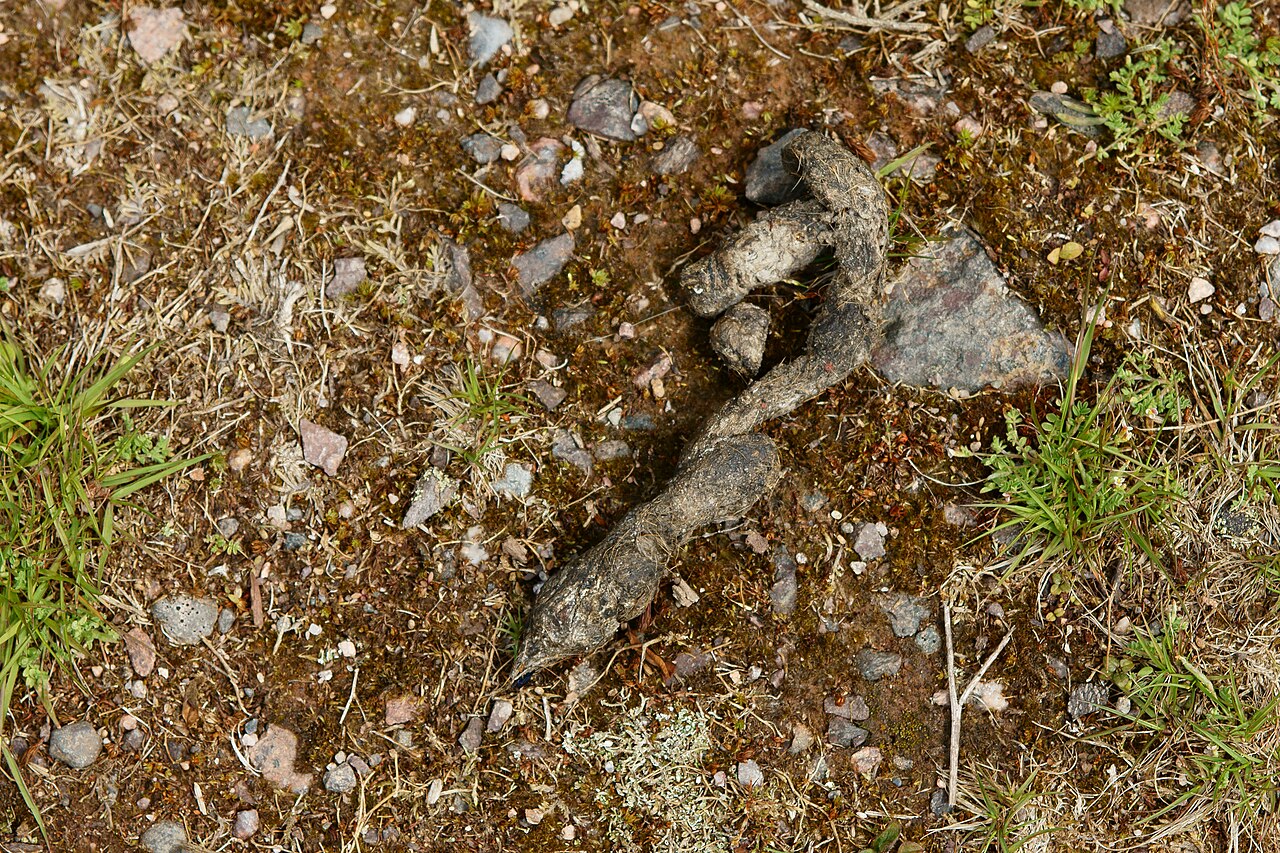
The single most diagnostic thing about fox poop is not the poop but the placement. Foxes deposit scat deliberately on elevated or prominent features, path junctions, flat rocks, tree stumps, molehills, garden walls, even children’s toys and doormats, because droppings double as scent marks announcing territory ownership to other foxes. A dropping placed dead-center on a walkway was put there on purpose.
This is the cleanest separation from most lookalikes. Cats bury their waste, raccoons pile theirs in hidden communal latrines, and dogs go wherever they happen to be; only foxes (and coyotes, their larger cousins) consistently curate display placement. If the same garden feature, the same stump or the same lawn spot, receives fresh deposits week after week, you are on a fox’s property line.
Marking intensity follows the calendar. Scent-marking surges during the winter breeding season, roughly December through February, when territory boundaries matter most, which is why homeowners suddenly notice fox droppings (and smell fox urine’s skunky tang) in midwinter. A springtime jump in scat volume near your yard often means the opposite of invasion: a den with hungry kits nearby, and parents hunting your rodents nightly.
Fox Poop vs Coyote Poop
Coyote scat is fox scat scaled up: the same twisted, tapered, fur-filled rope, but 3 to 5 inches long and closer to an inch thick, usually in larger total volume per deposit. Size separates most cases cleanly; a twisted cord thicker than your thumb leans coyote, slimmer than your index finger leans fox. Both species use prominent placement, so location will not split them.
Contents overlap heavily, since both eat rodents, rabbits, fruit, and carrion, but coyote scat more often contains large bone fragments and deer hair, reflecting bigger prey and heavier scavenging. Our full coyote poop guide covers the larger animal’s sign in detail, and the side-by-side habits of the two canids are mapped in fox vs coyote.
Where ranges overlap, one ecological note helps interpret what you find: coyotes dominate and sometimes kill foxes, so an area that flips from fox scat to coyote scat has usually changed management, not just menu. Suburban yards with tight fencing and small gaps often remain fox territory precisely because they are awkward for the bigger canid.
Fox Poop vs Dog, Cat, and Raccoon Droppings
Dog waste is the most common false alarm, and content is the referee: dog droppings are uniform, smooth, and homogeneous, the signature of kibble, with blunt ends and no fur, while fox scat is lumpy with visible fur, feather bits, seeds, and bone flecks, twisted and pointed. A dropping that looks like it was extruded from paste is a dog; one that looks woven is a fox.
Cat droppings run smaller (under 2 inches), segmented rather than twisted, and above all buried or deposited in loose soil; a cat’s instinct to cover its waste means a proudly displayed dropping on your front step is essentially never feline. Raccoon droppings are blunt-ended cylinders, not tapered, often containing corn or crayfish parts, and concentrated in repeat-use latrines at tree bases, decks, and attics rather than scattered display points.
For the rest of the backyard lineup, shape logic carries you: skunk scat is crumbly and insect-packed, possum poop is smooth and curved, and deer poop is pellets, never ropes. Master the twisted-tapered-displayed triad and fox identifications become one-glance calls.
What the Contents Reveal About the Fox’s Work

Fox scat is a nightly work report, and reading it tells you what the fox is doing for (and occasionally to) your property. Gray fur and tiny bones mean voles, mice, and rats, the fox’s staple and your rodent control; a single fox family can remove thousands of rodents in a season. Feathers mean birds, sometimes wild, sometimes, if you keep hens, a direct warning to audit the coop.
Seasonal contents rotate with honest opportunism. Summer and fall scats fill with berry seeds, cherry pits, apple fragments, and grasshopper parts, and it is normal for a late-summer fox dropping to look almost entirely vegetarian; foxes are true omnivores, not obligate hunters. Shiny insect wing cases in scat mean beetle-heavy foraging, common on lawns with grubs.
Scat contents also flag the one real conflict zone: poultry and small outdoor pets. Feathers plus fresh scat lines near a coop mean a fox has added your birds to its route, and the response is engineering, not panic: hardware cloth (not chicken wire), buried aprons against digging, and secured nighttime housing end fox losses far more reliably than any deterrent spray. Whether a bold visitor is anything to worry about personally is covered in are foxes dangerous.
Health Risks: Real but Manageable
Fox droppings deserve gloved respect for one main reason: Echinococcus tapeworms and roundworms. Fox scat can carry Echinococcus multilocularis (present in parts of North America and expanding) and Toxocara roundworm eggs, both of which infect humans through accidental ingestion of egg-contaminated soil or produce, with children and gardeners at highest practical exposure. The CDC (cdc.gov) lists wild canids as the primary hosts for these parasites, and eggs can remain viable in soil for months.
The exposure math stays small with basic hygiene, and none of it requires fearing the fox itself: transmission is via the droppings, not the animal’s presence. Leptospirosis and salmonella round out the bacterial risks, shared with most wildlife waste, and the same cleanup discipline covers all of it.
Pets are the likelier victims. Dogs that eat fox scat (a beloved dog hobby) can pick up intestinal parasites, and fox droppings in yards are a core reason veterinarians recommend routine deworming for dogs with outdoor access. Sandboxes deserve covers in fox country for exactly the same soil-contamination reason.
How to Clean Up Fox Poop Safely
Treat cleanup like the small biohazard job it is: gloves on, then lift the scat with a bag or scoop without crumbling it, seal it in a plastic bag, and dispose of it in the trash rather than compost, since parasite eggs survive composting temperatures. Avoid dry-sweeping or hosing at pressure, both of which spread material; a gentle direct pour of boiling water sterilizes the spot on hard surfaces.
On lawns and beds, remove the dropping plus the top inch of soil directly beneath it if children use the area, and wash hands and tools afterward. For decks, patios, and toys, a disinfectant wipe-down after removal finishes the job; parasite eggs resist many chemicals but are destroyed by heat, which is why the boiling-water trick outperforms most sprays on stone and concrete.
If a fox has designated your patio furniture or doormat as its billboard, break the advertising loop: clean thoroughly to strip the scent, then make the spot unrewarding, motion-activated sprinklers work well, and remove the attractants that anchor the territory, unsecured trash, fallen fruit, pet food left out, and rodent-rich brush piles. Foxes relocate their billboards easily once a spot stops being worth marking.
What Regular Fox Droppings Say About Your Yard
Consistent fox scat means your property sits inside an active fox territory, and on balance that is good news: a working fox suppresses the rodents, rabbits, and grubs that cause most actual yard damage, free of charge and mostly between dusk and dawn, on a schedule that runs almost entirely between dusk and dawn. Many gardeners only learn they have a resident fox from the scat, never the animal.
Scat mapping even locates the den in spring. Droppings thicken toward an active den, and a den site itself, a widened burrow under a shed, deck, or brush pile with flattened ground, scattered prey remains, and abundant scat, announces a family raising kits from roughly March through June. The standard playbook is patience: kits like the ones in our baby fox guide disperse by summer, after which humane exclusion (hardware cloth skirting under sheds and decks) prevents reuse.
Escalate only on genuine signals: scat plus daytime boldness around pets, a fox showing no wariness at close range, or visible mange or disorientation warrants a call to your local wildlife agency. Absent those, the twisted little ropes on the stump are just rent receipts from the quietest pest control contractor you will ever hire.
Frequently Asked Questions
What does fox poop look like?
A twisted, rope-like dropping 2 to 3 inches long and about half an inch thick, tapered to a point, dark brown to gray, and packed with fur, feathers, seeds, or bone fragments, usually left in a prominent spot.
How can I tell fox poop from dog poop?
Contents and shape: dog waste is smooth, uniform, and blunt-ended from kibble, while fox scat is lumpy, visibly fibrous with fur and seeds, twisted, and pointed. Display placement on paths and rocks also points to fox.
Why does a fox keep pooping in the same spot in my yard?
It is scent-marking territory. Foxes use prominent spots as boundary billboards and refresh them regularly, especially during the winter breeding season. Clean the spot, remove attractants, and add a motion sprinkler to retire the billboard.
Is fox poop dangerous to humans?
It can carry Echinococcus tapeworm and Toxocara roundworm eggs, which infect people through accidental ingestion from contaminated soil. Wear gloves, bag droppings for the trash, and wash up; the risk is in the scat, not the fox’s presence.
Is fox poop dangerous to dogs?
Dogs that eat or roll in fox scat can pick up intestinal parasites, so remove droppings promptly and keep routine deworming current for dogs with yard access.
What does it mean if fox poop is full of berries and seeds?
Normal seasonal diet: foxes eat large amounts of fruit in summer and fall, so purple-tinged, seed-studded scat is standard late-season fox sign, not evidence of a different animal.
Does fox poop mean a fox is living on my property?
Regular fresh scat means your yard is inside an active territory; a concentration of droppings near a burrow under a shed or deck in spring points to a den with kits, which typically empties by summer and can then be sealed against reuse.