Raven Sounds: The Croak, the Knock, and Every Other Call
Raven sounds are built around a deep, resonant croak that carries far further and sits noticeably lower in pitch than a crow’s caw. Common ravens produce more than 20 distinct vocalizations, including that signature croak, a rolling gurgle, a hollow knocking, a bell-like note, harsh alarm rasps, and a remarkable capacity for mimicry that extends to wolves, car alarms, and human speech. The single most useful thing to know is that if the sound is low, gravelly, and delivered in two or three drawn-out notes, it is a raven, not a crow.
That distinction is the reason most people search for raven sounds at all. Ravens and crows overlap across much of North America, look broadly similar at distance, and are far easier to separate by ear than by eye. Once you have the croak fixed in your head, the identification takes about a second and works even when the bird is invisible behind a ridge.
| Sound | Description and Meaning |
|---|---|
| Croak (quork) | Deep, gravelly, carries over 1 km, general contact |
| Gurgle | Rolling liquid note, close-range and social |
| Knocking | Hollow woodblock series, mostly females |
| Bell note | Clear metallic tone, mostly males |
| Harsh rasp | Alarm, predator or intruder present |
| Yell (food call) | Juveniles advertising a carcass |
| Mimicry | Wolves, other birds, machinery, human words |
Every Sound a Common Raven Makes
The common raven has one of the largest vocal repertoires of any North American bird. Researchers have catalogued more than 20 distinct call types, and individual birds appear to hold personal variations that other ravens recognise. That range is unusual for a non-songbird and reflects the species’ complex social structure, in which pairs hold long-term territories while non-breeding birds move in loose flocks.
The core categories are the croak, the gurgle, the knock, the bell, the alarm rasp, the yell, and a set of quiet close-contact murmurs that are only audible within a few metres. On top of these sits mimicry, which is learned rather than innate and varies enormously between individuals and populations.
Ravens also produce distinctly non-vocal sound. The wings of a flying raven generate an audible swish or whoosh that crows do not produce, a consequence of larger wing area and slower wingbeats. In quiet terrain that sound alone identifies the bird overhead before any call is given. Our comparison of the raven and the crow covers the full visual and structural differences.
The Deep Croak: The Raven’s Signature Call
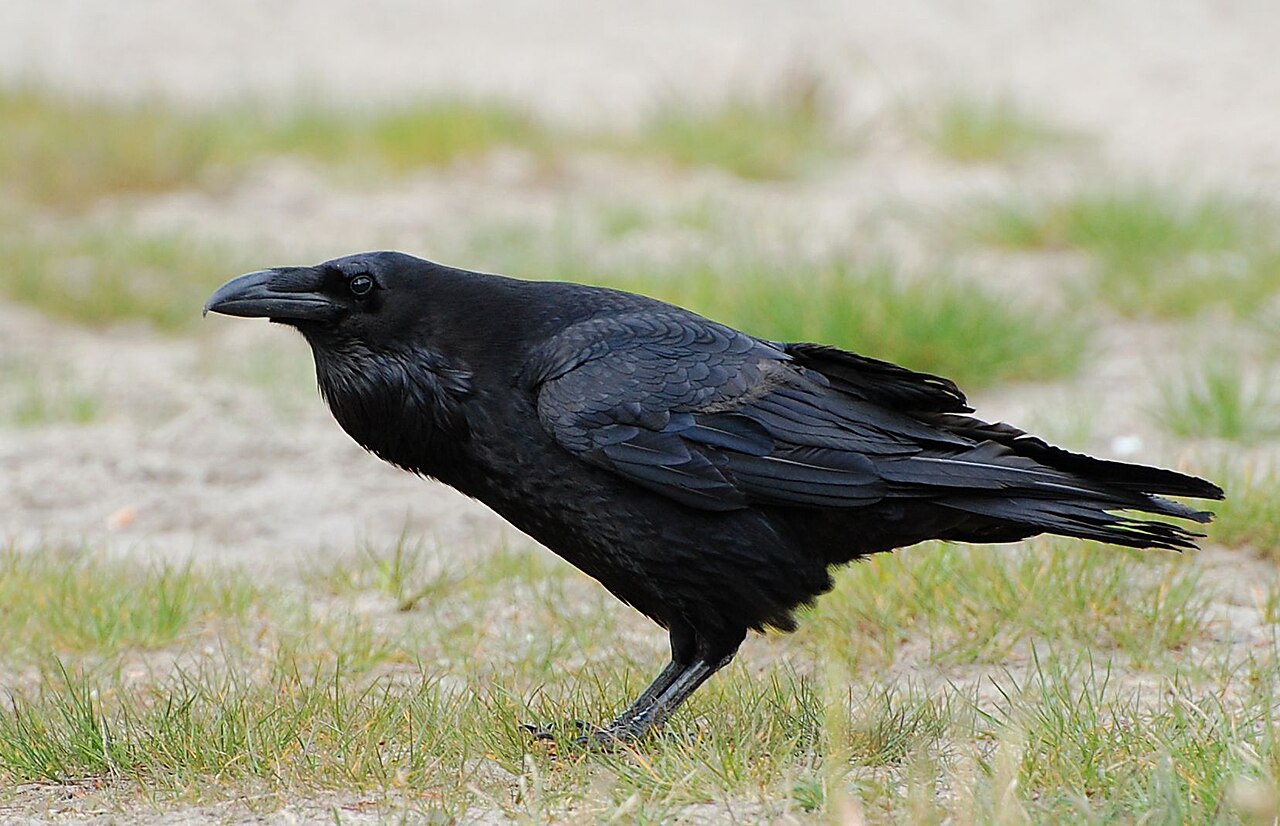
The croak is what people mean when they talk about raven sounds. It is a low, rough, resonant note usually written as quork, gronk, or prruk, delivered singly or in series of two to four, with a noticeable pause between notes. Pitch sits well below any crow call and the tone has a hollow, chest-resonant quality that crows never achieve.
Range is the practical difference. A raven croak carries reliably over a kilometre in open country and further along canyon walls and ridgelines, which is exactly the terrain ravens favour. Cornell Lab of Ornithology describes the call as the most frequently heard raven vocalization, and it functions as a general long-distance contact signal between paired birds and across territory boundaries.
Ravens vary the croak deliberately. A territorial croak given from a high perch is longer, lower, and more spaced than a casual in-flight contact croak, and a bird responding to another raven will often match the pattern of what it just heard. Paired birds develop recognisable duet patterns that persist across seasons.
Raven Sounds vs Crow Sounds
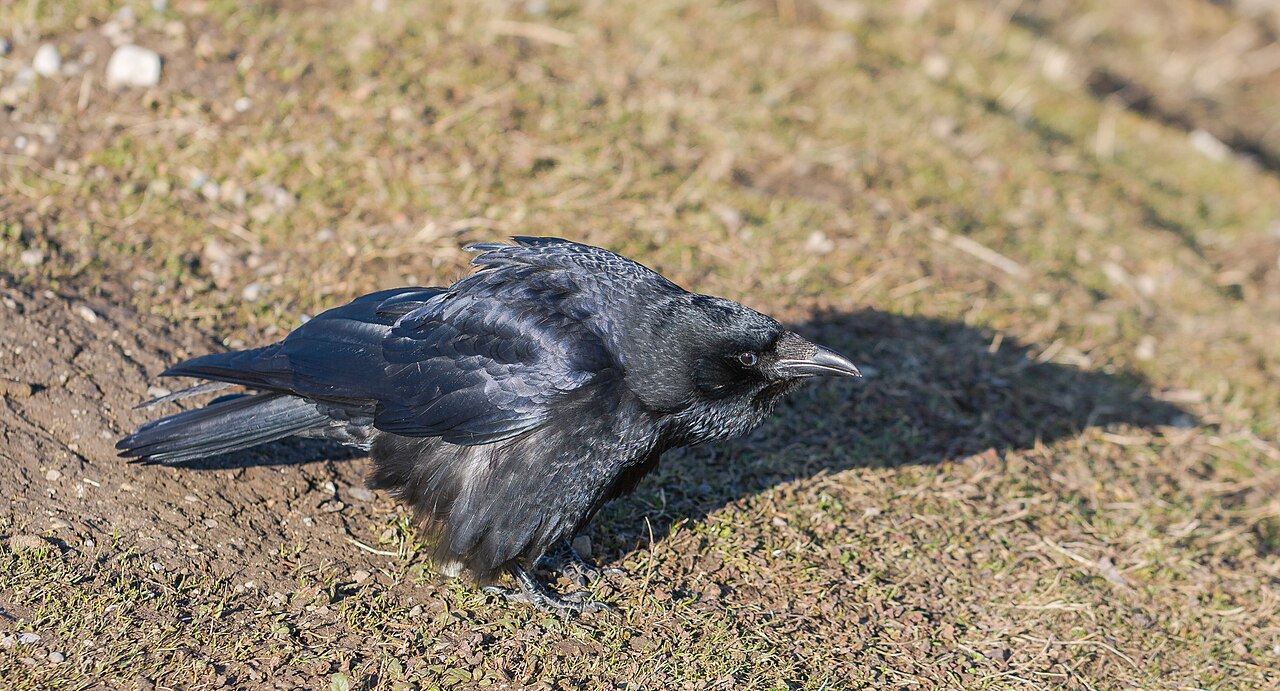
Four features separate them by ear, and any one of them is usually enough. Pitch is the most obvious: a crow’s caw is high, sharp, and nasal, while a raven’s croak is low and gravelly. Most people hear the difference immediately once told what to listen for, and it holds across all common variants of both calls.
Rhythm is the second. Crows deliver caws in rapid, evenly spaced series, often three to five in quick succession with little gap. Ravens space their notes further apart with clear pauses, giving the sequence a slower, more deliberate feel. Tone is the third: crow calls are clean and nasal, raven calls are rough and rattling with audible texture in the note.
Variety is the fourth and most reliable over time. A crow flock produces caws, rattles, and a few clicks, and that is close to the full range. A raven pair working a territory will produce croaks, gurgles, knocks, bells, and mimicry within a few minutes. If the bird is producing sounds you cannot easily describe, it is a raven. Our guide to crow sounds covers the crow side in full.
The Knocking and Bell Sounds
The knocking call is one of the strangest sounds any North American bird produces: a series of hollow, wooden taps, usually 5 to 12 in a row, with a resonance closer to a woodblock than to a bird. It is given mostly by females, often from a perch, and appears to function in pair contact and territorial advertisement.
The bell note is the male counterpart, a clear, almost metallic tone that sounds genuinely musical and out of character for a large corvid. It is quieter than the croak and carries a few hundred metres at most, so hearing it usually means the bird is fairly close and relaxed rather than alarmed.
Both calls are unmistakable once heard and neither has any crow equivalent, which makes them extremely useful for identification. Hikers frequently report these sounds as something unidentifiable or mechanical, and in remote terrain they are commonly the first raven sound people notice as unusual rather than as background bird noise.
What a Raven’s Cry Is Called
The standard term is a croak, and the verb is to croak. Older and regional usage includes gronk and quork, and ornithological literature frequently uses quork specifically for the two-note territorial version. Ravens do not caw in the strict sense, since caw describes the higher, nasal call of crows and rooks.
Collective and behavioural terminology adds some confusion. A group of ravens is an unkindness or a conspiracy, terms that come from medieval venery lists rather than from ornithology, and they say nothing about the sounds involved. The phrase raven’s cry as used in literature usually refers to the croak given in alarm or in flight.
Onomatopoeia varies by language and none of it captures the sound well. English writers reach for croak, gronk, and prruk, German uses krah and rab, and none convey the rough resonance that makes the real call distinctive. The symbolic weight the call carries in folklore is covered in our guide to raven symbolism.
Ravens Mimicking Other Sounds
Ravens are accomplished mimics, and captive birds regularly learn human words with clarity comparable to a parrot. Wild mimicry is less commonly witnessed but well documented, and includes the calls of other birds, the howls of wolves, running water, car alarms, and mechanical sounds from nearby human activity.
Wolf mimicry has an apparent function. Ravens follow wolf packs to feed on carcasses, and calls that draw wolves toward a dead animal the raven cannot open serve the bird directly, since a raven bill cannot penetrate the hide of a large ungulate. The relationship between the two species is one of the better-studied cases of interspecies cooperation in North American wildlife.
Individual variation is large. Some birds mimic extensively and others barely at all, and the repertoire reflects what a particular bird has been exposed to, so ravens near roads pick up vehicle sounds while ravens in wilderness pick up other wildlife. This flexibility is one of the traits that places corvids among the most cognitively capable birds, alongside the species covered in our guide to jays.
Raven Sounds in Flight
Ravens vocalise readily on the wing, and flight croaks differ from perched croaks in being shorter, more clipped, and delivered in longer series. A pair travelling together will often exchange croaks continuously, and a single bird crossing open country frequently croaks once every few seconds without any apparent trigger.
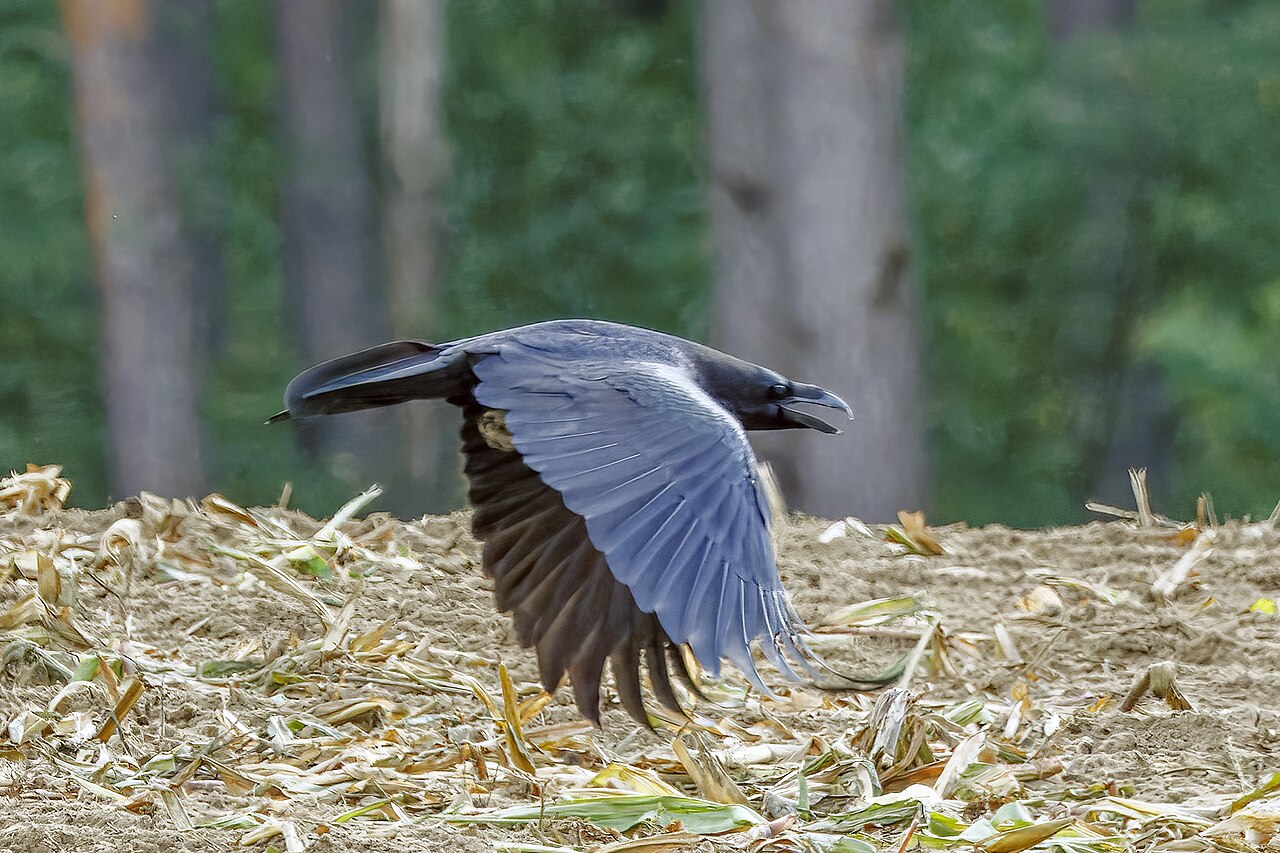
The wing swish is the other flight sound and it is genuinely diagnostic. Raven wings produce a soft rhythmic whoosh audible from perhaps 50 m in still conditions, generated by the larger wing area and the slower, deeper wingbeat compared with a crow. Crows flying overhead are effectively silent unless calling.
Ravens also perform aerial rolls and tumbles, particularly in territorial display and in wind, and these are frequently accompanied by a distinctive short croak burst. A bird that half-rolls onto its back mid-flight while croaking is displaying, not in difficulty, and the behaviour peaks around the late winter breeding period.
When and Why Ravens Are Most Vocal
Vocal activity peaks in late winter and early spring, from roughly January through April across most of the North American range. Ravens nest earlier than most birds, and territorial croaking, knocking, bell calls, and display flights all concentrate in the weeks around pair formation and nest site selection.
A second pattern runs through the winter and involves food rather than territory. Juvenile and non-breeding ravens that find a carcass in a territory held by an adult pair give loud yell calls that recruit other non-breeders to the site. Arriving in numbers lets them overwhelm the resident pair and feed, which is why a large carcass in raven country often produces a sudden noisy gathering.
Time of day matters less than for songbirds. Ravens call throughout daylight hours with a modest peak in the early morning, and unlike most birds they are equally vocal in midwinter and midsummer. Their diet, which drives much of that carcass-related calling, is covered in our guide to what ravens eat.
Frequently Asked Questions
What noises do ravens make?
Ravens produce more than 20 distinct sounds, including the deep croak, a rolling gurgle, a hollow knocking series, a clear bell note, harsh alarm rasps, and food-advertisement yells. They also mimic other birds, wolves, machinery, and human speech, and their wings generate an audible swish in flight.
Do ravens caw or croak?
Ravens croak. The caw is the higher, nasal, rapidly repeated call of crows and rooks. A raven’s equivalent is lower, rougher, more resonant, and spaced with clear pauses between notes, and it carries considerably further across open ground.
What is a raven’s cry called?
A croak, sometimes written as quork or gronk in ornithological and older regional usage. The two-note territorial version is frequently referred to specifically as a quork. Ravens do not caw in the technical sense of the word.
How do you tell raven sounds from crow sounds?
Pitch, rhythm, tone, and variety. Raven calls are lower, more widely spaced, rougher in texture, and drawn from a much larger repertoire. Crow calls are higher, nasal, delivered in rapid even series, and limited to a handful of variants.
Can ravens talk?
Captive ravens learn human words and reproduce them with surprising clarity, often as well as a parrot. Wild ravens mimic environmental sounds rather than speech, since they are copying what they hear repeatedly, and the extent of mimicry varies enormously between individual birds.
Why do ravens make a knocking sound?
The knocking call is given mainly by females and appears to serve pair contact and territorial advertisement. It is a series of hollow wooden taps with no crow equivalent, and it is one of the most reliable identifying sounds in the raven repertoire.
What sound does a raven make when flying?
Flight croaks are shorter and more clipped than perched croaks and are often given in longer series, particularly between paired birds travelling together. Raven wings also produce a soft rhythmic swish audible from around 50 m in still air, which crows do not produce.