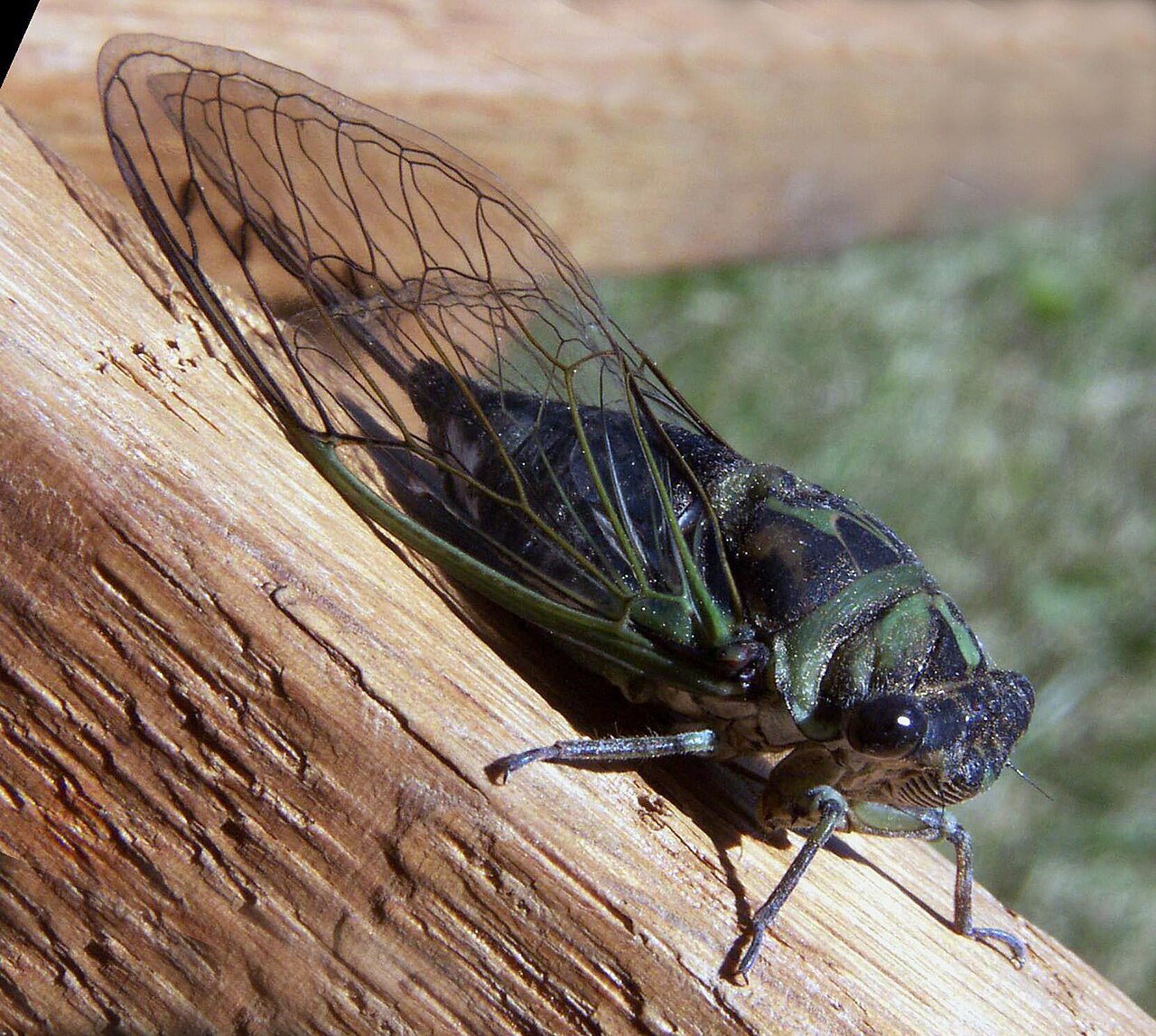
Cicada Sounds: What You Are Hearing and Why
Cicadas make a loud buzzing, whining, or rattling drone produced by a pair of ribbed membranes called tymbals on the sides of the abdomen, not by rubbing legs or wings together. Only males sing, each species has its own distinct song, and a large chorus can exceed 90 decibels, which is roughly the level of a lawnmower heard from a few feet away.
The sounds people describe as an electrical hum, a rising and falling whine, a rattling drone, or a sound like a distant power tool are all cicadas, and which one you hear depends on the species and the time of day. This guide covers what the calls mean, how to tell cicadas from katydids and crickets, why they suddenly get loud, whether they bite, and what to expect from the periodical broods.
Cicada sounds are made by male cicadas vibrating ribbed membranes called tymbals on the abdomen, at rates up to several hundred times per second. The song attracts females and each species has its own pattern. A chorus can exceed 90 decibels. Cicadas do not bite or sting and the noise stops when the adults die off, usually by late summer.
| Sound | What It Means |
|---|---|
| Steady buzzing drone | Male calling song, attracting females |
| Rising and falling whine | Annual cicada, often late afternoon |
| Rattling chorus | Periodical cicadas synchronising |
| Sharp squawk when handled | Distress call, both sexes may produce |
| Soft ticking near a female | Courtship song at close range |
| Wing flicks | Female’s reply signal to a calling male |
| Peak volume | Warm afternoons; over 90 decibels in chorus |
What Noises Do Cicadas Make?
The main cicada sound is the male calling song, a continuous buzz, drone, whine, or rattle held for several seconds to a minute at a time. Descriptions vary because the species vary: some produce a flat electrical hum, some a whine that rises and then falls away, some a pulsing rattle like a shaken box of gravel, and some a sound close to a distant chainsaw or an alarm.
Males also produce two quieter songs that most people never notice. A courtship song is given softly at close range once a female has responded, changing in structure as the male approaches. A distress squawk, a harsh irregular screech, is produced when a cicada is grabbed by a bird or a hand, and it is startling enough at close quarters that people frequently drop the insect, which is presumably the function.
Females make sound too, though not by singing. They answer a calling male with a sharp flick of the wings that produces a click, and males respond to the timing of that click to locate her. The exchange is precise, and researchers use finger snaps timed to the song to draw male periodical cicadas in, which works reliably enough to be a standard field technique.
How Do Cicadas Make Sound?
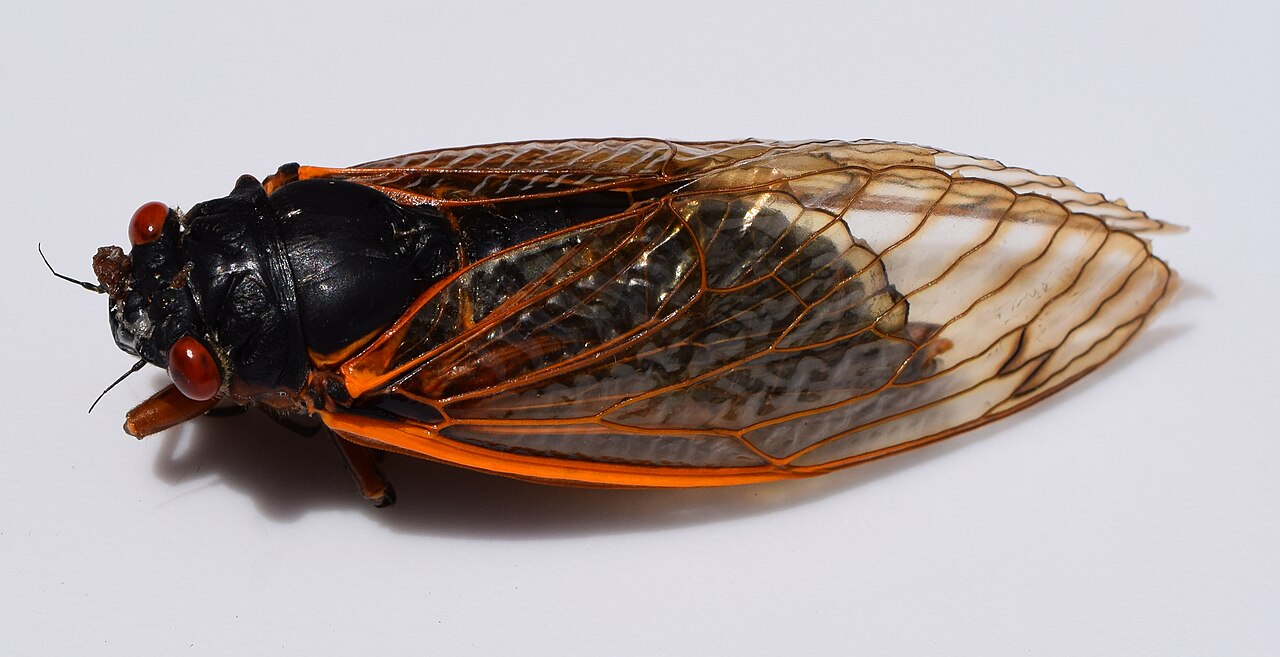
Cicadas sing with tymbals, a pair of ridged membranes on the sides of the first abdominal segment. Powerful muscles buckle each tymbal inward and release it, and each buckling produces a click; the ribs pop in sequence like the lid of a tin, so one muscle contraction generates a rapid train of clicks. Repeated hundreds of times per second, the result is a continuous tone.
The abdomen is largely hollow and acts as a resonating chamber, amplifying the tymbal clicks in the same way a guitar body amplifies a string. Males have air sacs occupying much of the abdomen for this reason, which is why male cicadas are noticeably lighter than they look. Some species further control the sound by opening and closing flaps called opercula, changing volume and direction.
This is a completely different mechanism from the one crickets and katydids use. Those insects stridulate, scraping a toothed file on one wing against a scraper on the other, which is why their songs are chirps and trills rather than continuous drones. Cicadas do not rub anything together, and the frequent claim that they make noise with their legs is simply wrong. The cricket sounds guide covers the stridulating insects for comparison.
Am I Hearing Cicadas or Katydids?
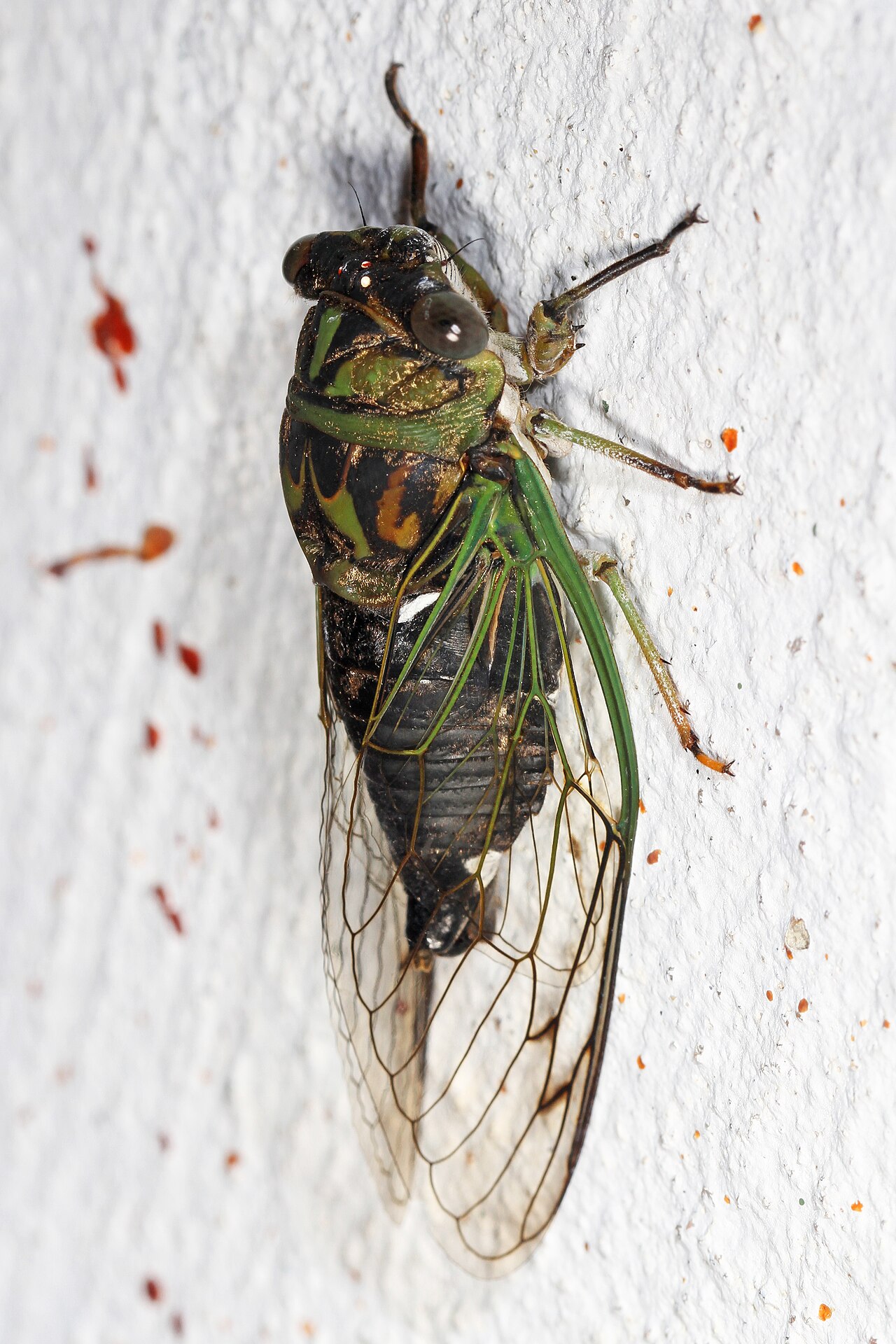
Time of day is the fastest test. Cicadas sing during daylight, peaking in the heat of the afternoon and often tailing off at dusk. Katydids sing at night, starting around sunset and continuing into the small hours, and the rasping katy-did katy-didn’t of the true katydid is a nocturnal sound almost everywhere it occurs.
Sound quality separates them further. Cicada song is continuous, mechanical, and tonal, a droning buzz or whine with no obvious individual pulses to the ear. Katydid song is scratchy and rhythmic, delivered in distinct raspy phrases with clear gaps. Crickets are different again: pure musical chirps or steady trills, mostly at night, and much higher pitched.
Location helps as a final check. Cicadas call from tree trunks and high branches, so the sound comes from overhead and is hard to pinpoint. Katydids call from foliage and shrubs at all heights, and crickets from ground level, grass, and cracks in paving. The cricket vs grasshopper guide covers the identification of the other loud summer insects.
Why Do Cicadas Suddenly Get Loud?
Temperature is the main driver. Cicadas are ectotherms and their muscles work faster when warm, so song rate and volume climb through the morning, peak in the hottest part of the afternoon, and drop when a cloud crosses the sun. A chorus can go from background hum to overwhelming in a couple of minutes purely because the temperature rose a degree or two.
Chorusing behaviour amplifies this. Males synchronise loosely with nearby males because a group chorus carries much further than any individual and because it swamps the ability of predators to locate a single insect. Once a few males start, others join, which produces the characteristic wave of sound that rolls through a wood and then subsides.
Timing across the season matters too. Annual cicadas, the species most of the country hears every year, emerge from midsummer and peak in July and August, which is why the sound arrives abruptly in high summer. Periodical cicadas emerge in enormous synchronised numbers in May and June in the years their brood is due, and the volume in those years is on a different scale entirely.
What Does It Mean If You Hear Cicadas?
Practically, hearing cicadas means high summer and warm weather, and the old saying that the first cicada song means six weeks to frost has some regional basis in the timing of the annual species. In much of the eastern United States the sound of dog-day cicadas is the reliable marker of the hottest part of the year.
Symbolically, cicadas carry an unusually rich set of meanings built on their life cycle. Spending years underground and emerging transformed made them symbols of rebirth, resurrection, and immortality in ancient Greece and especially in China, where jade cicadas were placed on the tongues of the dead for millennia. Greek writers used the cicada as an emblem of poetry and of song for its own sake.
Modern readings emphasise patience, hidden work coming to fruition, and the value of a long unseen preparation before a brief visible flowering, which fits the biology closely. A seventeen-year cicada spends more than 99 percent of its life underground and a few weeks above it. The murder hornet guide covers another large insect whose reputation runs far ahead of the actual risk.
Do Cicadas Bite or Sting?
No. Cicadas have no sting and no biting mouthparts. They feed through a slender straw-like beak called a rostrum, which they insert into plant tissue to drink xylem sap, and it is not built for or capable of breaking human skin in any meaningful way. A cicada held for a long time may occasionally probe a finger, which feels like a light prick and does no damage.
They are also harmless to people in every other respect. Cicadas carry no disease relevant to humans, do not swarm defensively, and have no chemical defences. The only genuine hazards are the noise, which can reach levels worth ear protection during a heavy periodical emergence, and the mess of shed exoskeletons and dead adults.
Damage to plants is limited and specific. Females cut slits in pencil-thin twigs with a blade-like ovipositor to lay eggs, which can cause the twig tips to wilt and break, a symptom called flagging. Mature trees shrug this off, but newly planted young trees can be set back during a periodical emergence, and netting with quarter-inch mesh for a few weeks is the standard protection. Insecticides are ineffective against the sheer numbers and are not recommended by extension entomologists.
How Long Do Cicadas Last?
Adult cicadas live only about four to six weeks, and individual insects often less. In a given area the annual species sing from midsummer into September, with the sound thinning through August as the first emergers die off, while periodical broods run a compressed four to six weeks from emergence in May or June to the last stragglers in early July.
The long part of the life cycle happens underground. Nymphs hatch from twig slits, drop to the soil, burrow in, and feed on root xylem for years, moulting through five instars. Annual species take two to five years underground but emerge in overlapping cohorts, so some appear every year. Periodical species in the genus Magicicada take exactly 13 or 17 years and emerge together.
Emergence itself is precisely cued. Nymphs come up when soil temperature at about eight inches deep reaches roughly 64 degrees Fahrenheit, usually after a warm rain, climb the nearest vertical surface, and moult into adults overnight, leaving the split brown exoskeletons that turn up on tree trunks and fence posts by the thousand. The wings take hours to harden, which is when they are most vulnerable to predators.
Which Cicadas Are Emerging This Year?
Annual cicadas emerge everywhere in the eastern and central United States every summer, so some cicada song is guaranteed. Periodical broods are the ones that make news, and each numbered brood covers a specific geographic area on a fixed 13 or 17 year schedule, so which one is due depends entirely on the year and the region.
Because brood schedules are fixed and well mapped, the answer is worth looking up rather than guessing. Cicada Mania and the U.S. Forest Service (fs.usda.gov) both publish current brood maps and emergence forecasts by county, and university extension services in the affected states issue local guidance each spring. Predictions of a bad year in the popular press usually refer to a periodical brood rather than to unusual annual numbers.
Numbers during a periodical emergence are genuinely extraordinary, reaching over a million insects per acre in prime habitat. This is a survival strategy called predator satiation: so many appear at once that every bird, mammal, reptile, and fish in the area eats its fill and the surplus still breeds successfully. The guide to birds that eat wasps covers the same predators that feast during these events.
How Do You Stop Cicada Noise?
You cannot, and the honest answer is to wait it out. There is no spray, trap, or deterrent that meaningfully reduces a cicada chorus, the insects are calling from high in trees across a wide area, and the season is short. Insecticide application is ineffective at these densities, kills pollinators and the birds’ food supply, and is advised against by every extension programme that addresses the question.
What does help is reducing the noise indoors. Closing windows during the hot afternoon hours when chorusing peaks, running a fan or white noise at night, and using earplugs during a heavy periodical emergence all work. Since cicadas sing in daylight and go quiet after dark, sleep is usually unaffected outside the loudest brood years, unlike the katydid and cricket chorus that runs all night.
For young trees, netting is the one intervention worth doing. Quarter-inch mesh wrapped over saplings and secured at the trunk for the four to six weeks of a periodical emergence prevents egg-laying damage entirely, and delaying new tree planting until after a known brood year avoids the problem altogether. Everything else is patience. The guide to birds chirping at night covers a different summer noise complaint with a different answer.
Frequently Asked Questions
What noises do cicadas make?
A loud continuous buzz, whine, drone, or rattle from calling males, plus a quiet courtship song at close range and a harsh distress squawk when handled. Females answer with a wing flick that produces a click.
How do cicadas make their sound?
With tymbals, ribbed membranes on the abdomen that buckle and pop hundreds of times per second while the hollow abdomen amplifies the result. They do not rub legs or wings together as crickets and katydids do.
Am I hearing cicadas or katydids?
Cicadas sing in daylight and peak in the afternoon heat with a continuous mechanical drone. Katydids sing at night with a scratchy rhythmic rasp. Crickets are nocturnal too, with clear musical chirps or trills.
Why do cicadas suddenly get loud?
Warmth. Their muscles work faster as temperature rises, so volume climbs through the afternoon and falls when a cloud passes. Males also synchronise into choruses, so once a few start, the rest join within seconds.
Do cicadas bite or hurt you?
No. They have no sting and no biting mouthparts, only a straw-like beak for drinking plant sap. They carry no disease and pose no threat, though a heavy chorus is loud enough to justify earplugs.
What month do cicadas go away?
Adults live four to six weeks. Annual cicadas thin out through August and are largely gone by mid September; periodical broods finish by early July, roughly six weeks after emerging in May or June.
What does it mean if you hear cicadas?
Practically, high summer and warm weather. Symbolically, cicadas represent rebirth, patience, and long unseen work coming to fruition, drawn from the years they spend underground before a few weeks above ground.