Purple Emperor Butterfly: Why the Purple Comes and Goes
The purple emperor is a large woodland butterfly of Europe and temperate Asia whose males flash an intense iridescent purple-blue when the light hits their wings at the right angle. Females are larger and entirely brown with white markings, with no purple at all. The species does not occur in North America, and the American butterflies people call purple emperors are usually red-spotted purples or other admirals.
The purple is not pigment. It is structural colour, produced by microscopic layers in the wing scales that interfere with light, which is why the same male looks dull brown from one angle and blazing violet from another. The butterfly is also famous for behaviour that sits badly with the usual image of butterflies: it ignores flowers entirely and feeds on carrion, dung, and tree sap. This guide covers identification, that behaviour, where to find one, and the North American look-alikes.
The purple emperor is a large Eurasian woodland butterfly with a wingspan of 70 to 92 millimetres. Only males show the iridescent purple, which is structural colour visible from certain angles, and females are plain brown and white. Adults do not visit flowers, feeding instead on tree sap, dung, and carrion. It does not occur in North America.
| Feature | Purple Emperor |
|---|---|
| Scientific name | Apatura iris |
| Wingspan | 70 to 92 mm |
| Purple sheen | Males only, angle-dependent |
| Female | Larger, brown and white, no purple |
| Food | Sap, dung, carrion, mud; not nectar |
| Host plant | Goat willow and other sallows |
| Range | Europe and temperate Asia; not North America |
What Does a Purple Emperor Look Like?
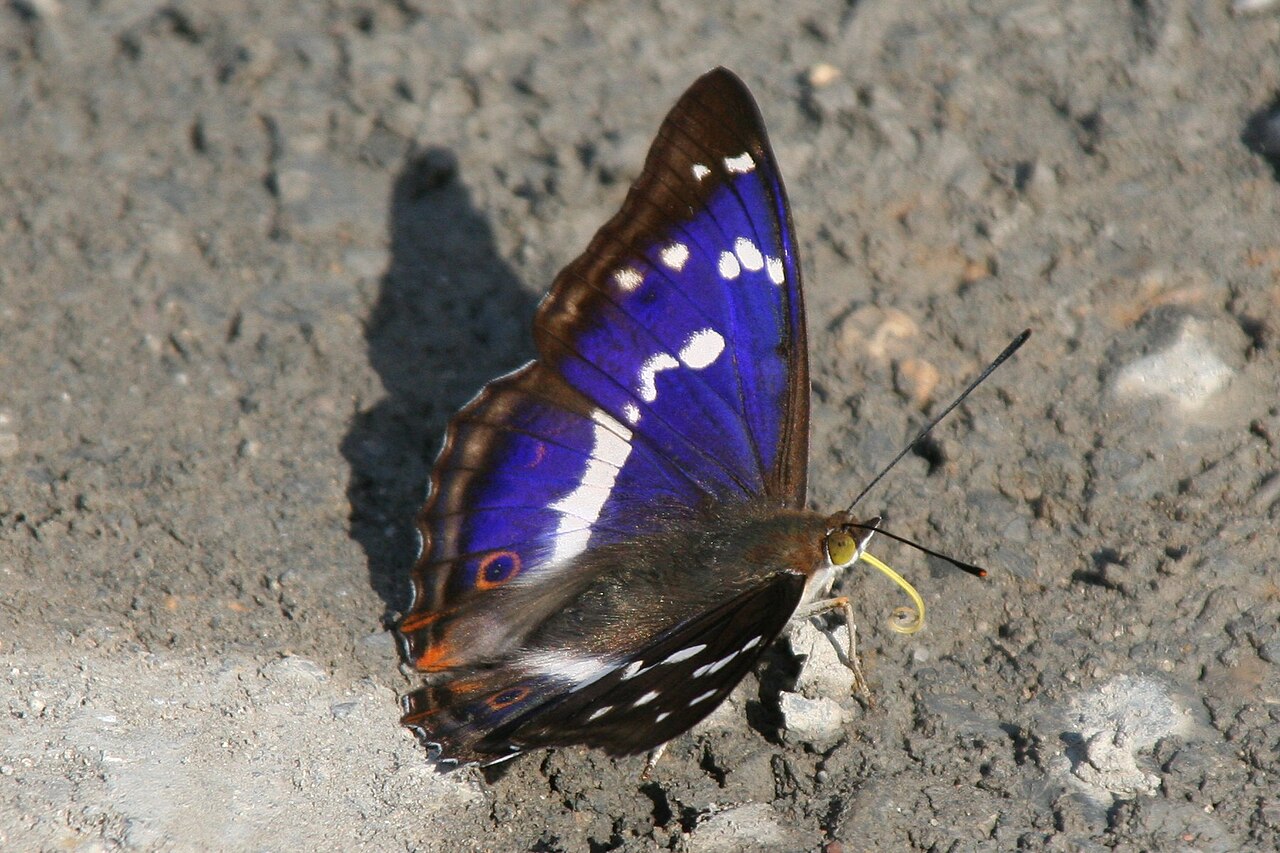
A purple emperor is a large, powerful butterfly with a wingspan of roughly 70 to 92 millimetres, dark brown above with a broad white band across each wing, white spots near the forewing tips, and a small orange-ringed eyespot on each hindwing. From most angles that is all you see: a big dark brown and white butterfly.
The purple appears only on males and only when light strikes the wings at a narrow range of angles, flooding the brown with an intense violet-blue that can look almost electric. Turn a few degrees and it vanishes. Because the effect depends on angle, a male in flight flashes on and off as he banks, which is one of the most striking sights in European butterfly watching.
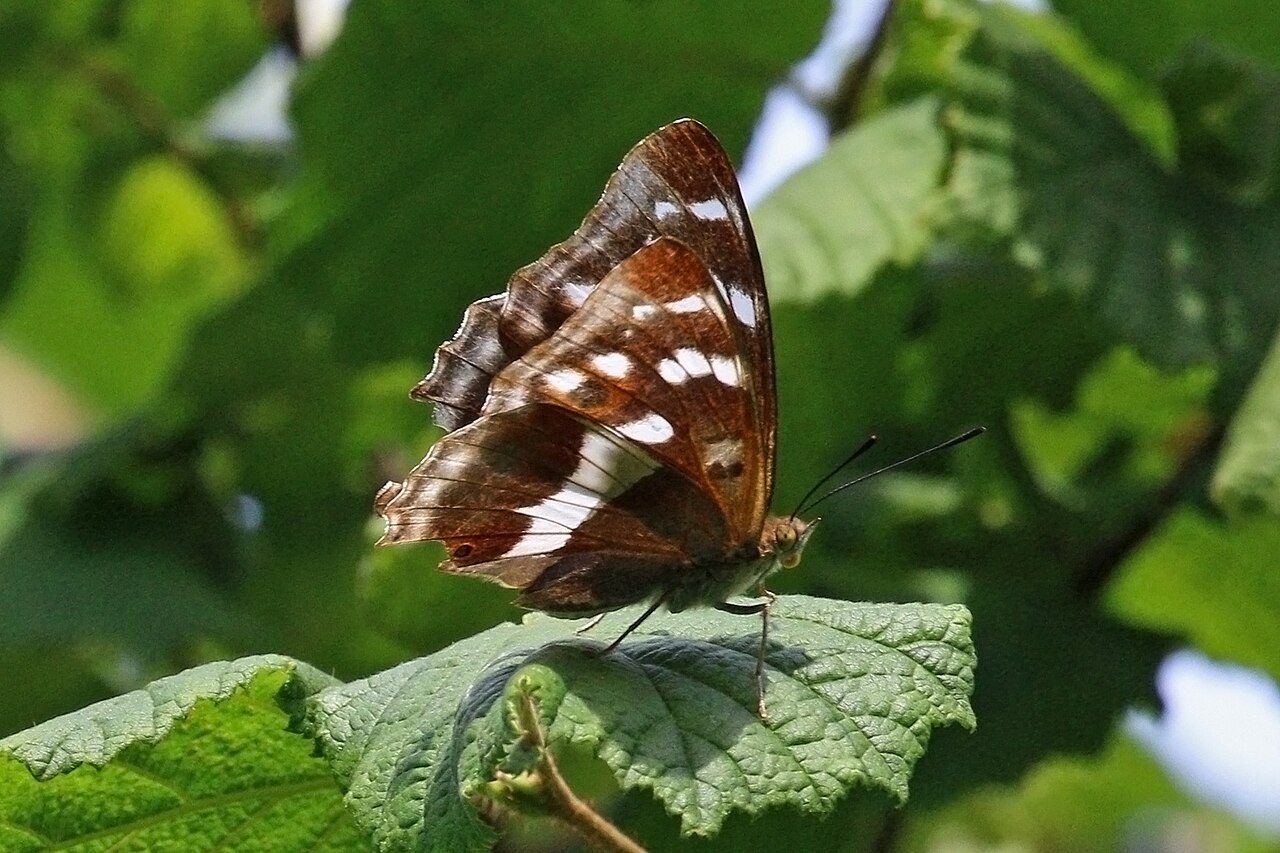
Females are larger, slightly heavier in build, and completely lack the iridescence, showing brown with white bands throughout. Underneath, both sexes are beautifully marbled in grey, orange, brown, and white, which provides good camouflage on bark and among leaves. A rare dark form, iole, lacks the white bands entirely.
Why Does the Purple Only Show at Certain Angles?
Because it is structural colour rather than pigment. The wing scales carry layers of microscopic ridges and air spaces spaced at roughly the wavelength of visible light, and light reflecting off successive layers interferes constructively at some wavelengths and destructively at others. The result is a colour produced by physics rather than by chemistry.
Since the path length through those layers changes with viewing angle, the wavelength that reinforces changes too, so the colour shifts and disappears as the angle moves. Pigment colours do not behave this way, which is why a brown butterfly stays brown from every direction while an iridescent one flickers.
The same mechanism produces the blue of morpho butterflies, the green of some beetles, and the iridescence in peacock and hummingbird feathers, and it is generally more resistant to fading than pigment because it depends on structure rather than on a molecule that can break down. The blue morpho butterfly guide covers the most famous example, and the black and blue butterfly guide covers the North American species that use the same trick.
Do Purple Emperor Butterflies Eat Meat?
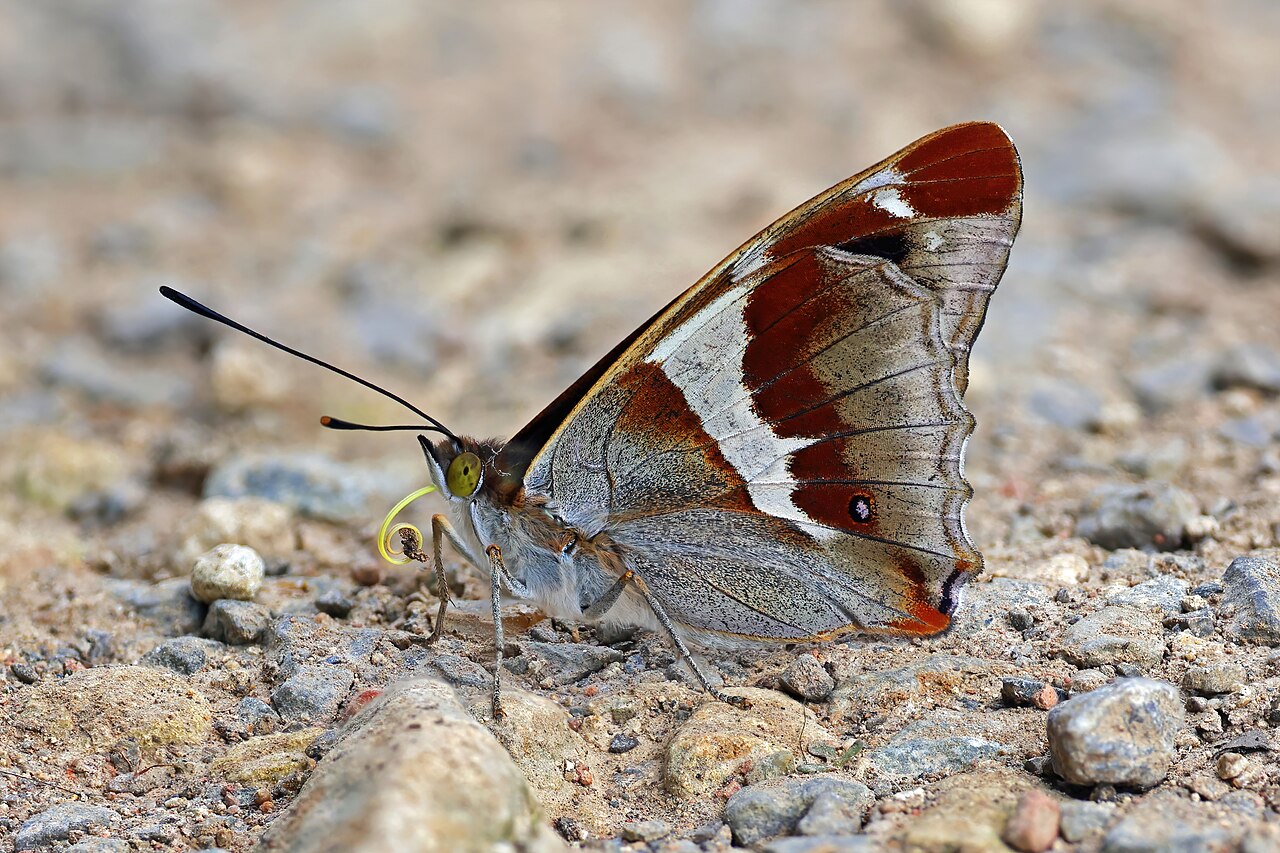
Effectively, yes. Adult purple emperors do not visit flowers and take almost no nectar. Instead they feed on oozing tree sap, honeydew from aphids in the canopy, animal dung, rotting fruit, damp mud, urine-soaked ground, and the fluids of animal carcasses, and males in particular seek these out.
The reason is minerals and salts, especially sodium, which nectar does not supply and which males transfer to females during mating as a nuptial gift that supports egg production. Butterfly watchers exploit this shamelessly: the traditional method for drawing a male down from the canopy involves banana skins, shrimp paste, ripe cheese, or fox scat placed on a woodland ride.
The behaviour is not unique to this species. Many butterflies puddle at damp ground and dung, and several tropical species feed at carrion routinely. What makes the purple emperor notable is the complete absence of flower visiting combined with a reputation built on the contrast between its beauty and its diet.
Are Purple Emperor Butterflies Aggressive?
Males are territorial and will investigate almost anything that enters their airspace, including other butterflies, birds, dragonflies, and people. They hold perches on prominent trees, called master trees, and launch at intruders in fast spiralling chases before returning to the same branch.
Whether that counts as aggression is a matter of definition, since the butterfly cannot harm anything. It has no bite, no sting, and no defence beyond flight, and the chases are territorial display rather than combat. Males will land on people, cars, and hats, usually seeking salt rather than confronting anything.
The birds-versus-butterflies encounters are the memorable ones. Purple emperors have been recorded chasing birds far larger than themselves away from a master tree, which is a display of confidence rather than capability. The guide to a butterfly landing on you covers what that behaviour actually reflects.
Where Can You Find a Purple Emperor?
In mature broadleaf woodland across much of Europe and temperate Asia, from England and France east through central Europe and Russia to Japan and Korea. In Britain it is concentrated in southern England, with strongholds in Sussex, Hampshire, Wiltshire, Northamptonshire, and Surrey.
The flight season is short, running from late June into August with a peak in July, and adults live only two to three weeks. That narrow window plus the canopy habit is why the species has a reputation for being hard to see despite not being especially rare.
The critical habitat requirement is a mix of tall oaks or other mature trees for males to hold territory and plenty of goat willow or grey willow in the understorey for egg laying. Woodland with one but not the other does not hold the species, and the loss of sallow scrub from managed woodland is the main historic cause of decline.
Are Purple Emperors Rare?
Less rare than their reputation suggests, but genuinely elusive. Populations declined through the twentieth century with the loss of coppiced woodland and sallow, and the species disappeared from much of its former British range. Recent decades have seen a partial recovery, helped by deliberate conservation of sallow in woodland management and by warmer summers.
Most of the difficulty in seeing one is behavioural rather than numerical. Adults spend the majority of their time high in the canopy, they fly for only a few weeks, they visit no flowers where a watcher might wait, and both sexes are camouflaged when settled. A woodland can hold a good population that goes unnoticed all season.
The Natural History Museum in London (nhm.ac.uk) holds historic series of the species that document how much the British range has contracted, and conservation organisations including Butterfly Conservation run monitoring and habitat projects for the species, and rewilding projects in southern England have produced some of the densest populations recorded in decades, largely because sallow regenerates freely on abandoned farmland.
What Is the North American Equivalent?
There is no purple emperor in North America, and reports of one almost always refer to something else. The closest match in appearance and behaviour is the red-spotted purple, a dark butterfly with an iridescent blue-purple sheen that also feeds on sap, dung, rotting fruit, and mud rather than flowers.
Red-spotted purples belong to the admiral group and are mimics of the toxic pipevine swallowtail, which is why they are dark and blue rather than banded like their close relative the white admiral. The two interbreed where their ranges meet, producing intermediates that confuse identification further.
The genus Apatura reaches into Asia with several further species, including the lesser purple emperor, which is smaller, more orange-marked, and often commoner where the two overlap in central and eastern Europe. Separating the two takes a look at the hindwing eyespot and the shape of the white band, and the lesser purple emperor uses poplars and aspens rather than sallow as its host plant, so the two can occupy the same wood without competing.
Other North American butterflies that get called purple emperors include hackberry emperors and tawny emperors, which are genuinely in the same subfamily as Apatura and share the sap and dung feeding habit, though neither shows purple. The red-spotted purple butterfly guide and the purple butterfly guide cover the American species most often involved.
What Is the Life Cycle?
Females lay eggs singly on the upper surface of sallow leaves, preferring shaded trees on the woodland edge, and the eggs hatch in about two weeks. The caterpillar is green with a pair of horns on the head, resembling a slug more than a typical larva, and it rests along a leaf midrib on a silk pad it returns to between feeds.
Overwintering is the distinctive part. The caterpillar turns brown in autumn, moves to a fork in a twig or a bud, and sits motionless through the winter camouflaged as part of the branch, then greens up again in spring as the leaves return. That colour change is under seasonal control and is one of the more precise camouflage adaptations in European butterflies.
Pupation happens in early summer, with the chrysalis hanging beneath a sallow leaf and shaped and coloured to match one. Adults emerge in late June, and the whole visible season is over within weeks. Total life cycle is one year, with the caterpillar stage taking up roughly ten months of it.
Frequently Asked Questions
What does a purple emperor butterfly look like?
A large dark brown butterfly with white bands and a small orange-ringed eyespot on each hindwing. Males flash intense iridescent purple at certain angles; females are larger, browner, and show no purple.
Why does the purple only appear sometimes?
It is structural colour from microscopic layers in the wing scales rather than pigment. The reinforcing wavelength changes with viewing angle, so the purple appears and disappears as the butterfly turns.
Do purple emperor butterflies eat meat?
Effectively yes. Adults ignore flowers and feed on tree sap, aphid honeydew, dung, carrion fluids, rotting fruit, and damp mud, seeking sodium and minerals that nectar does not supply.
Are purple emperor butterflies aggressive?
Males are territorial and chase other butterflies, dragonflies, birds, and people from their perch trees, but they cannot harm anything. Landings on people are usually about salt rather than confrontation.
Are purple emperor butterflies rare?
Less rare than their reputation. They are hard to see because they spend most of their time in the canopy, fly for only a few weeks in July, and never visit flowers where a watcher could wait.
Where can you find a purple emperor?
Mature broadleaf woodland across Europe and temperate Asia, in Britain mainly southern England. The habitat needs both tall trees for males to hold territory and sallow in the understorey for egg laying.
Is there a purple emperor in North America?
No. The closest equivalents are the red-spotted purple, which is iridescent blue-purple and also feeds on sap and dung, and the hackberry and tawny emperors, which are related but not purple.