Karner Blue Butterfly: Endangered and Tied to One Plant
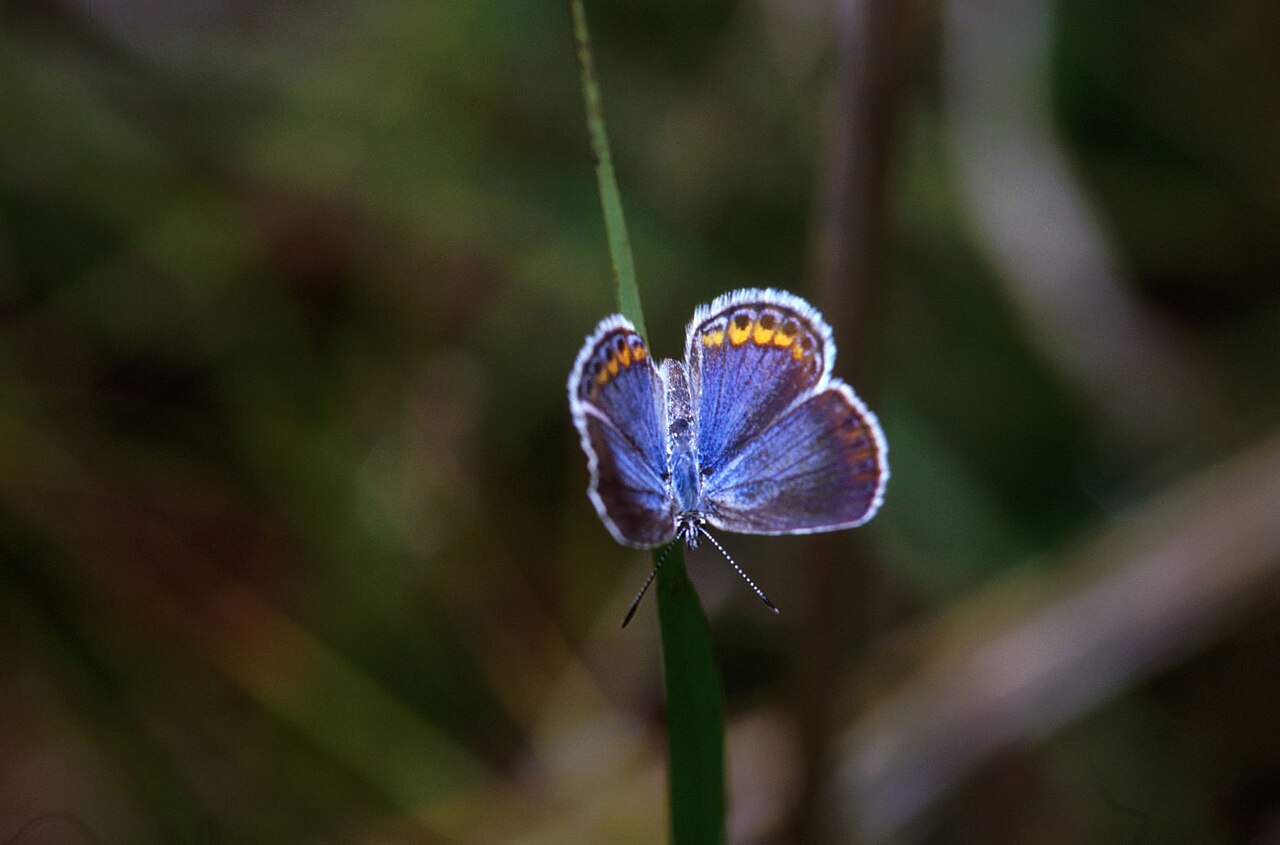
The Karner blue is a small federally endangered butterfly of the Great Lakes region and the Northeast, with a wingspan of about an inch, silvery blue males, grey-brown females with orange crescents, and a total dependence on one plant: wild blue lupine. Where lupine grows in open sandy barrens, the butterfly can occur; where it does not, the species is absent.
That dependency, combined with the loss of the fire-maintained pine barrens and oak savannas lupine needs, is why the butterfly was listed as endangered in 1992. It also has an unusual relationship with ants, which tend and protect its caterpillars in exchange for a sugary secretion. This guide covers identification, the lupine and ant relationships, the current range, and the recovery efforts.
The Karner blue is a federally endangered butterfly about an inch across, with silvery blue males and grey-brown females with orange crescents. Caterpillars feed only on wild blue lupine in sandy pine barrens and oak savannas maintained by fire. It was listed as endangered in 1992 and survives in Wisconsin, Michigan, New York, and reintroduction sites.
| Feature | Karner Blue |
|---|---|
| Scientific name | Plebejus samuelis |
| Wingspan | About 1 in |
| Male | Silvery blue above, narrow dark border |
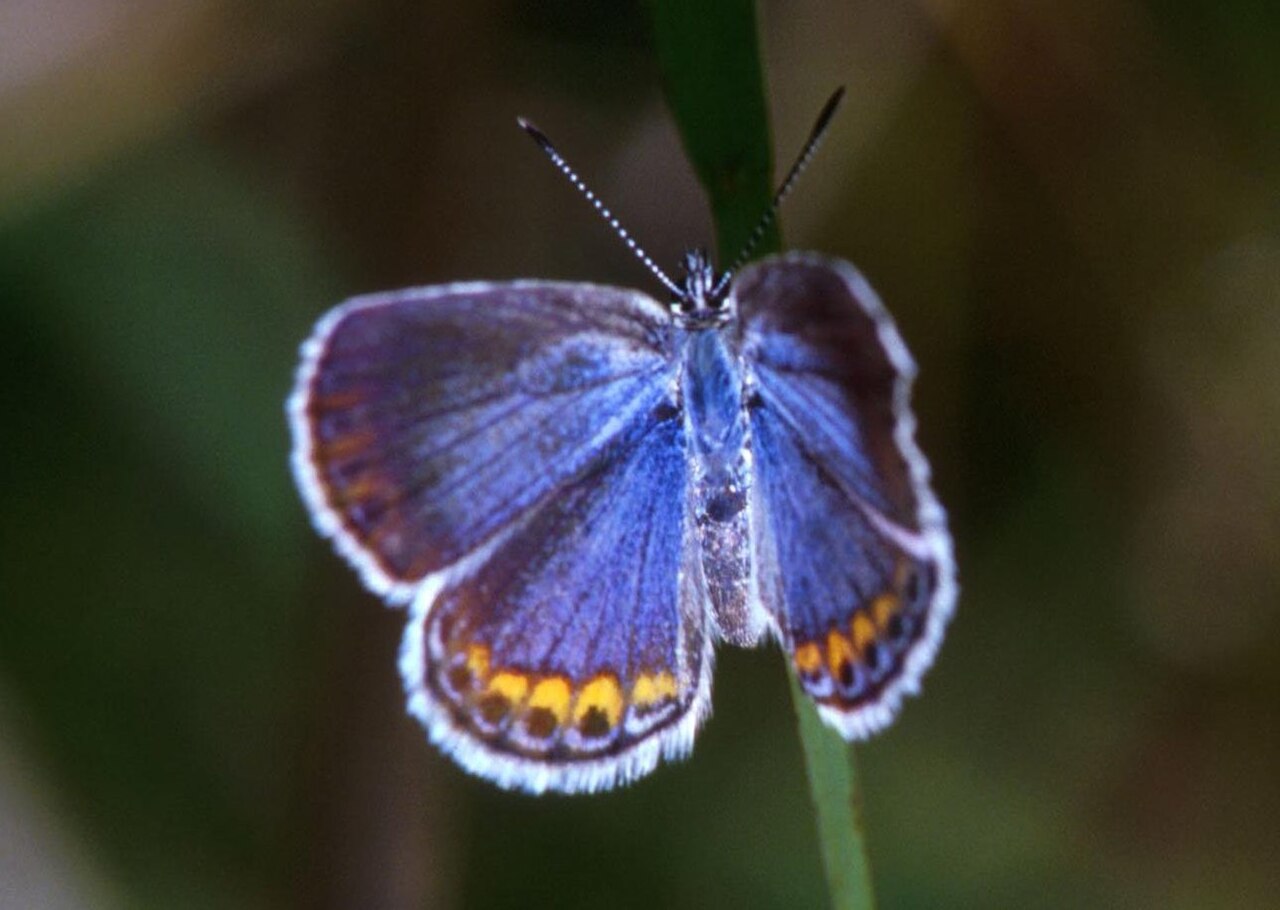
| Female | Grey-brown with orange crescents |
| Host plant | Wild blue lupine only |
| Ant relationship | Caterpillars tended by ants for secretions |
| Status | Federally endangered since 1992 |
What Does a Karner Blue Look Like?
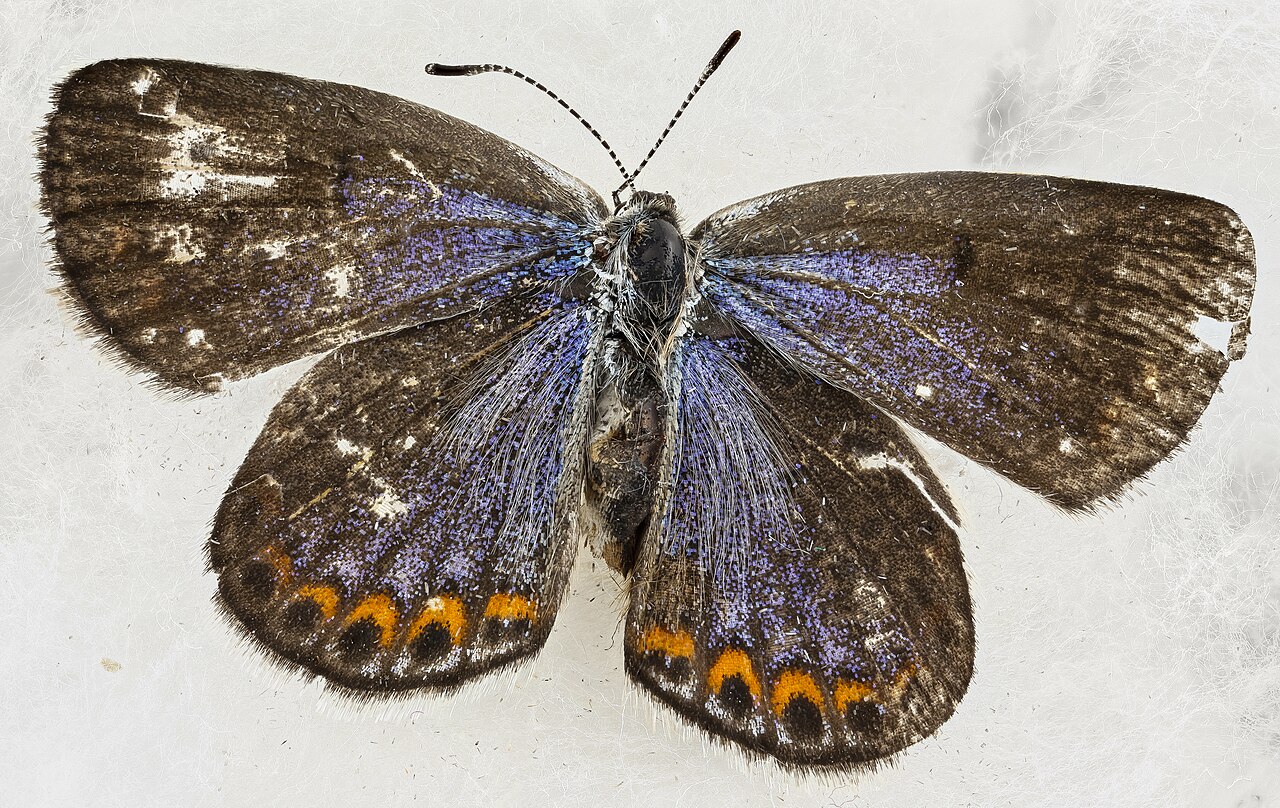
Small and delicate, spanning about an inch, with males a bright silvery blue above bordered by a narrow black line and a white fringe. Females are grey-brown above with blue scaling near the body and a row of orange crescents along the hindwing margin, sometimes on the forewing too.
The underside is the same on both sexes and is where identification happens: pale grey with a scatter of small black spots ringed in white, plus a band of orange crescents along the hindwing edge, each crescent capped with a small metallic blue-green scale. That orange band on a grey underside is the field mark.
Several other small blues occur in the same region and look similar. Eastern tailed blues have small tails; spring azures lack the orange band; silvery blues have a single row of black spots and no orange at all. The eastern tailed blue guide covers the commonest look-alike.
Why Does It Need Wild Lupine?
Because it is the only plant Karner blue caterpillars can eat. Females lay eggs on or near wild blue lupine, and the larvae feed on the leaves, and no substitute has ever been found, including the garden lupines and the western lupine species that look similar.
Wild blue lupine grows in dry sandy soil in open sunny conditions, in pine barrens, oak savannas, and sand prairies, and it disappears when those habitats close over into dense forest. It cannot tolerate shade, and once the canopy fills in, the lupine goes and the butterfly follows within a few years.
Those habitats were historically maintained by fire. Periodic low-intensity burns, both natural and set by Indigenous peoples, kept the canopy open and the understorey diverse, and a century of fire suppression allowed most of them to close. That is the underlying cause of the decline, more than direct habitat destruction. The Xerces blue guide covers a related species that ran out of time entirely.
What Is the Relationship With Ants?
Mutualism. Karner blue caterpillars have a gland that produces a sugary secretion, and ants of several species tend them to feed on it, in return driving off parasitoid wasps and predatory insects. Tended caterpillars survive at substantially higher rates than untended ones.
The relationship is facultative rather than obligate, meaning the caterpillar can survive without ants but does considerably better with them, and this is common across the blues family. Some related species take it much further, with caterpillars living inside ant nests and in a few cases eating the ants’ own brood.
The ant connection adds a hidden layer of vulnerability. A site can have lupine and sun and still support fewer butterflies if the ant community has been disrupted, by pesticides, by soil disturbance, or by invasive ants, and that is one reason restored sites sometimes underperform expectations even when the plants establish well.
How Rare Is the Karner Blue?
Genuinely rare and federally endangered, listed in 1992 after populations declined by an estimated 99 percent from historic levels. It has been extirpated from several states where it formerly occurred, including Ohio, Illinois, Indiana, Iowa, Massachusetts, Pennsylvania, and Ontario.
The stronghold is Wisconsin, which holds by far the largest remaining population, followed by Michigan, with smaller populations in Minnesota, New York’s Albany Pine Bush, and New Hampshire’s Concord pine barrens, the last two both dependent on active management. Reintroduction efforts have been undertaken in New Hampshire, Ohio, and Indiana with mixed results.
Numbers fluctuate sharply year to year with weather, and the species is vulnerable to single bad seasons because populations are small and isolated. Drought reduces lupine quality, late frosts kill early-brood larvae, and there is little scope for recolonisation between fragmented sites. The U.S. Fish and Wildlife Service (fws.gov) maintains the recovery plan and current status.
Where Can Karner Blues Be Found?
In a narrow band across the northern part of the historic range, from Minnesota and Wisconsin east through Michigan to New York and New Hampshire, always in dry sandy open habitat with lupine. Most surviving populations are on managed conservation land rather than on private property.
The Albany Pine Bush Preserve in New York and the Concord pine barrens in New Hampshire are the best-known eastern sites, both maintained by prescribed burning and mowing. In Wisconsin the species occurs across a wider landscape including state forest, utility rights-of-way, and managed pine plantations.
Utility corridors and roadsides turn out to matter more than expected. Powerline rights-of-way are kept permanently open by mowing, which happens to reproduce the conditions lupine needs, and several of the larger Wisconsin populations occupy them. That has made cooperation with utility companies a significant part of the conservation work, an approach also used for the pollinator habitat discussed in the monarch guide.
What Do Karner Blues Eat?
The caterpillars eat only wild lupine leaves. The adults are far less fussy and take nectar from a wide range of flowers, including butterfly weed, New Jersey tea, blazing star, goldenrod, horsemint, spreading dogbane, and the lupine itself, and males also puddle at damp sand for minerals.
Two broods run each year, which is unusual for an endangered butterfly with such a narrow diet. The first brood emerges in late April or May, feeds on lupine as caterpillars in spring, and produces adults; the second brood’s caterpillars feed in June and July and produce adults in July and August.
That second brood is the vulnerable one. By midsummer lupine is often senescing, and a hot dry season that kills the lupine back early can eliminate the second brood almost entirely at a site. Managing for lupine that stays green longer, including keeping some plants in partial shade, is part of the site management approach.
What Is Being Done to Save It?
Habitat management first, which mostly means fire. Prescribed burning on a rotation restores and maintains the open barrens structure lupine needs, and mowing and selective tree removal do the same where burning is not possible. The rotation has to be partial, since burning a whole site at once kills the butterflies along with the encroaching trees.
Captive rearing and reintroduction supplement it. The Toledo Zoo, the Detroit Zoo, and several partners have reared Karner blues and released them at restored sites in Ohio, Indiana, and New Hampshire, and the New Hampshire programme in particular has re-established a population that had been reduced to a handful of individuals.
Lupine planting is the third strand and is slower than it looks. Wild lupine is difficult to establish from seed, needs the right soil bacteria to fix nitrogen, and takes several years to form a stand large enough to support butterflies, so restoration timelines run in decades rather than seasons. The monarch butterfly guide covers a species where the conservation question is very different in scale.
Why Is the Name Karner?
From a hamlet in New York. The butterfly was described in 1944 by Vladimir Nabokov, the novelist, who was also a serious lepidopterist and worked as a curator at Harvard’s Museum of Comparative Zoology, and he named it for Karner in Albany County, a stop on the rail line where the type specimens were collected.
Nabokov’s taxonomic work on the blues was substantial and was largely dismissed during his lifetime as an amateur’s hobby. Genetic studies published decades later supported his hypotheses about the group’s evolution and dispersal from Asia into the Americas, which has since become a well-known case of a specialist being vindicated long after the fact.
The type locality itself is largely gone. The pine barrens around Karner were developed through the twentieth century, and what survives nearby is the Albany Pine Bush Preserve, one of the few remaining inland pine barrens and one of the last eastern strongholds for the butterfly that carries the place name.
Can You Help From a Garden?
Only indirectly, and it is worth being honest about that. Unless you live within the current range on sandy soil, planting wild lupine will not bring Karner blues to a garden, because the butterflies do not disperse far and the remaining populations are isolated on managed land.
What does help is supporting the habitat work. Pine barrens and oak savanna restoration is carried out by state agencies, land trusts, and organisations such as the Xerces Society and The Nature Conservancy, and the constraint is usually funding and public acceptance of prescribed burning rather than technical knowledge.
Locally, planting native lupine where it is genuinely native supports a wide range of other insects, including several other blues, bees, and moths, and avoiding the invasive big-leaf lupine matters in the Northeast. Reporting sightings to state natural heritage programmes also has value, since small overlooked populations do occasionally turn up. The black and blue butterfly guide covers the wider group. The blue butterfly guide covers the commoner relatives worth planting for.
Frequently Asked Questions
How rare is the Karner blue butterfly?
Federally endangered since 1992, after an estimated 99 percent decline. It has been lost from Ohio, Illinois, Indiana, Iowa, Massachusetts, Pennsylvania, and Ontario, with Wisconsin holding the largest remaining population.
What do Karner blue butterflies eat?
Caterpillars eat only wild blue lupine. Adults take nectar from many flowers including butterfly weed, New Jersey tea, blazing star, and goldenrod, and males puddle at damp sand for minerals.
Where can Karner blue butterflies be found?
Minnesota, Wisconsin, Michigan, New York’s Albany Pine Bush, and New Hampshire’s Concord pine barrens, always in dry sandy open habitat, mostly on managed conservation land and utility corridors.
Why does it need wild lupine specifically?
It is the only plant the caterpillars can eat, and garden and western lupines are not substitutes. Wild lupine needs open sunny sandy ground maintained by periodic fire, which is what has been lost.
What is the relationship with ants?
Caterpillars produce a sugary secretion that ants feed on, and in return the ants drive off parasitoid wasps and predators. Tended caterpillars survive at much higher rates than untended ones.
What does a Karner blue look like?
About an inch across, males silvery blue above, females grey-brown with orange crescents. Both have a pale grey underside with black spots and an orange band edged with metallic blue-green scales.
What is being done to save it?
Prescribed burning and mowing to restore open barrens, captive rearing and reintroduction by zoos and partners, and lupine planting, which takes years to produce stands large enough to support butterflies.

Similar Posts
What Do Mice Eat? Wild, House & Pet Diet Guide
What mice eat in the wild, indoors as a household pest, and as pets, plus the cheese myth and foods to avoid.
Hognose Snake Playing Dead: The Whole Performance
Belly-up, tongue out, musk and sometimes blood, and it flips straight back over if you right it. Why they do it, how long it lasts, and what comes before the collapse.
Frog Sounds: What Each Call Means and Who Makes It
Frogs peep, trill, croak, snore, quack and scream, and only one species actually says ribbit. Every major call explained, plus how to identify a species by ear.
Bull Snake: How to Tell It Apart From a Rattlesnake
Bull snakes hiss and shake their tails to mimic rattlesnakes, but they’re harmless. Here’s how to identify one and where it lives.
House Centipede
House centipedes look alarming but are harmless, fast-moving hunters that eat roaches, silverfish, and even bed bugs. Here’s what to know.
Are Deer Nocturnal? What the Activity Pattern Really Is
Deer are crepuscular, not nocturnal, but shift into darkness under hunting pressure within days. Where they bed by day, how well they see at night, and why they freeze.