Albatross Symbolism: Good Luck or Around Your Neck?
Albatross symbolism runs in two directions at once. To sailors the albatross was a companion that rode the wind beside the ship for days, barely moving its wings. In everyday English, though, an albatross is the thing you cannot put down: the debt, the failed project, the old mistake that follows you into every meeting. Whether you spotted one offshore, met it in an English class or heard the word in a budget discussion, the albatross means something different in each place.
An albatross symbolizes good luck, freedom and protection for sailors, a bird that glides for days and signals fair wind. In everyday English, an albatross around your neck is a burden you brought on yourself, from Coleridge’s Rime of the Ancient Mariner, where the crew hangs the shot bird on the Mariner.
What Does an Albatross Symbolize?
An albatross symbolizes endurance first. Grey-headed albatrosses tracked from South Georgia have circled the globe in as little as 46 days, and they do it without the frantic flapping of smaller seabirds. A gull works for every mile. An albatross holds its wings out and lets the wind do the labor. That image, of a traveler who keeps going long after everyone else has turned back, is the root of its reputation for perseverance.
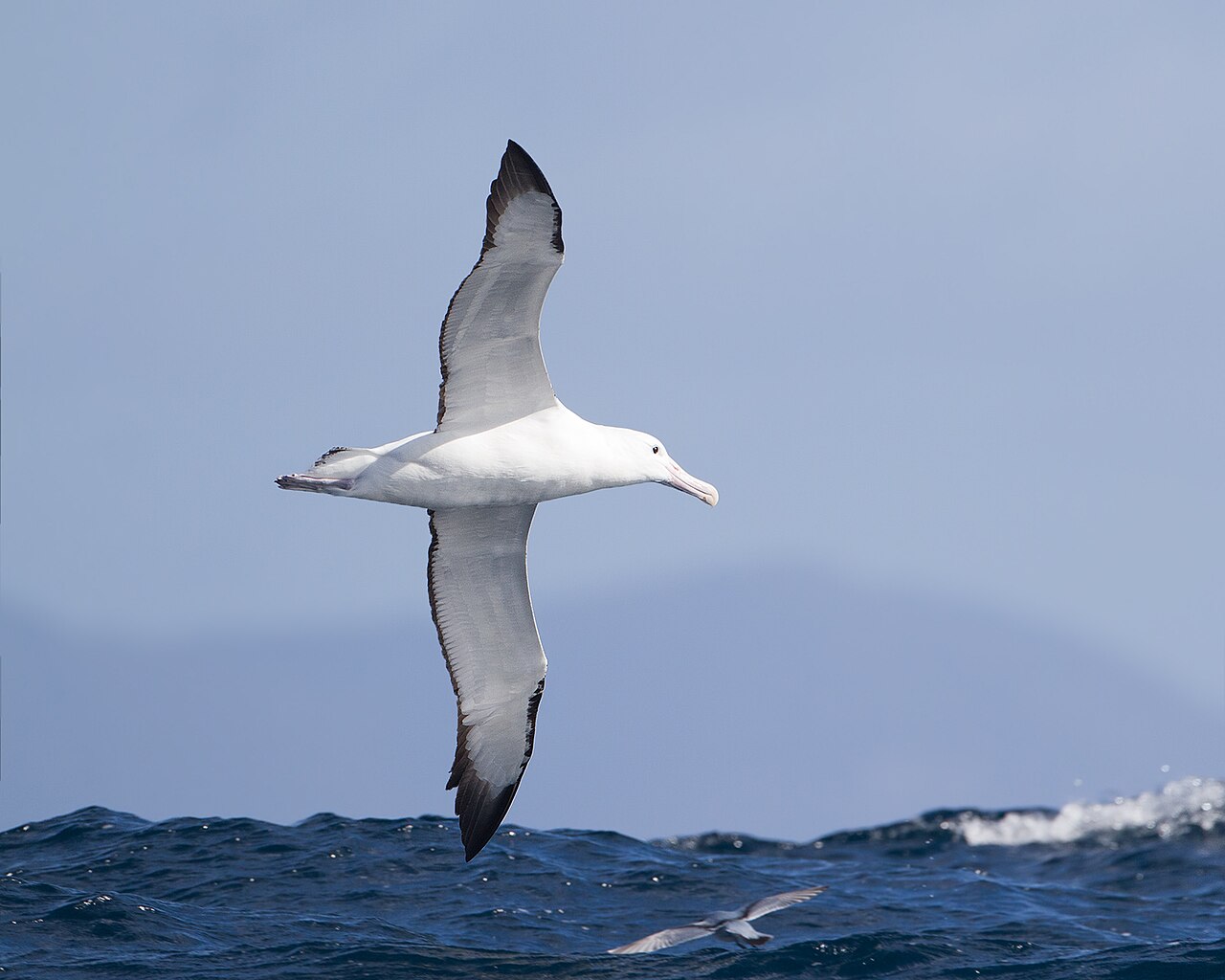
Freedom is the second meaning, and it is tied to open water. Albatrosses live far from coasts for most of their lives, outside any country’s borders and beyond the reach of anyone’s rules. Most creatures in animal symbolism are tied to a home ground. The albatross stands for the absence of territory.
The third reading is the wisdom of age. Albatrosses are long-lived birds, and a grey-headed bird that has crossed the same ocean for decades reads naturally as an elder. Finally there is the ocean itself. Sailors treated open water as the unknown, a place with no landmarks and no promises. The albatross, which seemed completely at home there, became the guide through it.
Albatross Around Your Neck: Meaning and Origin
An albatross around your neck is a burden you carry because of something you did, and the phrase comes straight from Coleridge’s poem. After the Mariner shoots the albatross and the wind dies, his shipmates take the dead bird and hang it on him in place of the cross he wears. It is public blame, visible to everyone on deck. The image stuck, and by the twentieth century an albatross had become a standard English word for an inescapable encumbrance.
The nuance matters. An albatross is not just a heavy load. It is a heavy load that hangs where everyone can see it, and it comes with blame. The word fits best when you brought the burden on yourself, though dictionaries do not require guilt: Merriam-Webster defines the word as something that causes persistent deep concern or anxiety, or something that greatly hinders accomplishment. A loan you signed against advice or a merger you championed is a textbook albatross.
How to Use the Word Albatross Correctly
In current use the word attaches to debt, failed projects, scandals and people. A city calls an unfinished stadium an albatross, and a party calls an unpopular policy its albatross. Here are two sentences that use it correctly. “The downtown mall has been an albatross around the council’s neck since the day it opened.” “His early tweets became an albatross he carried through the whole campaign.” In both cases the burden is lasting, visible and self-inflicted.
The common misuse is treating the word as a synonym for any small annoyance. A slow printer is not an albatross. If the thing can be fixed in an afternoon, choose another word. The albatross earns its name through duration, weight and guilt.
The Story of the Albatross in The Rime of the Ancient Mariner
The albatross in Coleridge’s Rime of the Ancient Mariner arrives as a rescuer. A storm has driven the ship south into a world of ice and fog with no living thing in it. Then the bird comes through the mist, and the crew hails it “as if it had been a Christian soul.” It eats the food the sailors offer, and the ice splits. A good south wind springs up behind them. For nine evenings the bird follows the ship, and the men treat it as the reason their luck turned.
Then the Mariner shoots it with his crossbow. The poem never gives a motive. The lack of a reason is part of the horror. The crew’s verdict flips with the weather. At first they curse him for killing the bird that made the breeze blow. When the fog lifts and the sun comes out, they decide the bird brought the fog and praise him for shooting it. Then the wind dies, the ship stalls under a copper sky, and the water runs out. Now they blame him again and hang the dead albatross around his neck.
The crew dies, and the Mariner survives alone under the dead men’s eyes. The turn comes when he watches water snakes moving beside the ship at night. Without planning to, he finds them beautiful and blesses them “unaware.” At that instant he can pray again, and the albatross falls from his neck and sinks like lead into the sea. His penance is not over, though. For the rest of his life he must travel and retell the tale to whoever needs to hear it. The moral he leaves with the Wedding Guest is short: “He prayeth best, who loveth best / All things both great and small.”
The Albatross in Baudelaire and Melville
Writers after Coleridge kept the albatross as a figure for the misfit genius. Charles Baudelaire’s poem “L’Albatros” describes sailors catching one of the birds for sport and laughing as it stumbles on deck, its great wings dragging like oars. Aloft it was a prince of the clouds, on the planks a clumsy joke. Baudelaire ends by saying the poet is like that bird, exiled on the ground among the jeering, his giant wings keeping him from walking.
Herman Melville takes a different angle in Moby-Dick. In the chapter on the whiteness of the whale, he recalls his first albatross and describes a regal, feathery creature of spotless white with a vast archangel’s wings. He writes that it cried out like some king’s ghost in supernatural distress. Melville’s albatross is not a burden at all. It is a glimpse of something holy and strange that the sea occasionally allows.
The Albatross in Comedy, Music and Golf
Popular culture lightened the load. Monty Python’s “Albatross!” sketch has John Cleese as a cinema usherette selling a dead seabird from a tray like ice cream, and the joke lands because the word already carried so much literary weight. Fleetwood Mac’s 1968 instrumental “Albatross” borrows the bird’s calm glide, a slow guitar line that rises and falls like wings over swell. In golf, an albatross is a score of three under par on a single hole. It is far rarer than an eagle, so the name of the rare bird was chosen for it.
Albatross Spiritual Meaning
Among animal spiritual meanings, the albatross stands for homecoming after a long absence. An albatross spends years at sea, then returns to the colony where it hatched to breed. Readers draw a plain lesson from that. You can wander for a long time and still belong somewhere.
Sea lore gave the bird a darker spiritual job. Later sailors’ lore held that albatrosses carried the souls of drowned seamen, so a bird following the ship deserved respect and killing one was a crime against the dead. There is little record of that belief before Coleridge, and his poem did more than any older custom to fix it in print.
The albatross is also read as a messenger between sea and sky. It lives in both and belongs fully to neither, so a sighting is taken as a sign that change is on its way, a message crossing from one realm to the other.
Is It Good Luck to See an Albatross?
Yes, in seafaring tradition an albatross near the ship is good luck and a fair-wind omen. Sailors on the long southern passages watched the birds join the ship and stay with it for days, and the arrival of one meant steady wind and company on an empty sea.
The taboo against harming one is mostly literary. Later sea lore held that killing an albatross brought bad luck to the whole ship, a belief the poem made famous, even though real sailors often caught albatrosses on baited lines, ate them and made tobacco pouches from their feet. In the poem the crew first curses the Mariner, then praises him when the fog lifts, and only turns on him for good when the wind dies. Omen logic of this kind, where a creature is lucky until you cross it, shows up in other animals too, and the black cat is the best known land example.
Is It Rare to See an Albatross?
For most people, yes. Albatrosses nest on remote islands, and away from a colony every sighting happens far offshore from a boat. In the North Atlantic an albatross is an exceptional vagrant, not a regular visitor. If one appears off a US East Coast beach, it is news. The table lists the places where a sighting is realistic.
| Albatross species | Ocean region | Public viewing spot |
|---|---|---|
| Laysan albatross (Phoebastria immutabilis) | North Pacific | Kīlauea Point National Wildlife Refuge, Kauaʻi, Hawaiʻi |
| Black-footed albatross (Phoebastria nigripes) | North Pacific | Pelagic birding trips out of Monterey Bay, California |
| Northern royal albatross (Diomedea sanfordi) | Southern Ocean off New Zealand | Taiaroa Head, Otago Peninsula, New Zealand |
| Wandering albatross (Diomedea exulans) | Southern Ocean | Prion Island, South Georgia, by expedition cruise |
| Black-browed albatross (Thalassarche melanophris) | South Atlantic and Southern Ocean | Saunders Island, Falkland Islands |
| Waved albatross (Phoebastria irrorata) | Eastern tropical Pacific | Punta Suárez, Española Island, Galápagos |
Albatross Symbolism in Love and Loyalty
The albatross is a symbol of loyal love because pairs stay together for life. Once two birds commit, they return to the same colony and the same partner season after season, and divorce is rare, a few percent of pairs in most studied colonies, usually after a failed breeding season.
The courtship is part of the appeal. Laysan albatross (Phoebastria immutabilis) pairs build an elaborate synchronized dance from bill clacks, sky points, head shakes and wing stretches, and they refine it over several seasons before breeding. The dance is specific to the pair. Two birds learn each other’s rhythm until they move as one, and that learning period is what people with long engagements recognize in them.
Then comes the absence. Albatross partners forage apart for long stretches, each flying its own route across the ocean, and they meet again at the nest to swap incubation duties. The pair survives on trust and timing. That makes the albatross a natural emblem for long-distance couples and for military families, and it fits anniversaries and vows about staying through separation. The crane carries the same promise of fidelity, but it does not keep it across an ocean.
Albatross Spirit Animal and Totem
The albatross spirit animal stands for self-sufficiency and ease with long solitude. People who claim it work alone for long periods without feeling lonely, and they distrust shortcuts. The albatross does not nest early. Young birds spend years at sea and breed only after reaching full maturity, a slow start that mirrors anyone whose goals run on a decade-long clock rather than a quarterly one.
The central lesson of the albatross totem is to use the forces around you instead of fighting them. The bird gets its distance from the wind, not from muscle. In practice that means reading the conditions around you and positioning yourself where the lift already is. The albatross totem teaches leverage and patience, not force.
Every totem has a shadow, and the albatross shadow is never landing. A person who always has another horizon can avoid committing to one place, one partner or one piece of work. Freedom becomes a way of never being pinned down. Call on the albatross before a long journey, at the start of a slow and demanding project, or when you need to stop struggling and let a situation carry you. Leave it alone when what you actually need is to come ashore and stay.
Albatross Dreams and Other Encounters
An albatross in a dream is about scale and distance. The bird sees the ocean from high above and covers more ground in a week than most animals see in a lifetime, so dreaming of one means the dream is working on the big picture of your life, not this week’s errands.
Flying albatross in a dream. A flying albatross represents ambition and a wide view. You are above the detail and can see where the currents are going. The dream arrives when a decision has been nagging at you and you have been too close to it to judge. Pull back and look at the whole route.
Shot or dead albatross in a dream. A dead or shot albatross marks a long chapter coming to an end, and the Mariner’s story colors it. Ask what you have been carrying out of guilt. The dream does not announce punishment. It points at a weight you could set down if you were willing to name it.
Finding an albatross feather. An albatross feather is read as lightness after strain. In the US, albatrosses are protected under the Migratory Bird Treaty Act, and keeping even a molted feather without a permit is illegal, so photograph it and leave it where you found it.
Albatross Meaning in Māori Culture
In Māori tradition in Aotearoa New Zealand the albatross, called toroa, is a bird of rank. The prized white toroa feathers were made into plumes called raukura and worn by leading men on important occasions, and the soft belly feathers were shaped into feather-ball earrings called pōhoi toroa. The bird’s whiteness and its command of the open ocean made it a fitting emblem for leaders. In the Ngāti Porou story of the ancestor Pourangahua, two albatrosses go with him across the ocean, and the roimata toroa (albatross tears) pattern in meeting-house panels comes from that story.
The bird was also material culture. Māori carvers made kōauau, a short end-blown flute, from albatross wing bone among other materials, and the hollow, light bone gave the instrument its tone. The northern royal albatross colony at Pukekura, Taiaroa Head, is co-managed today by the Department of Conservation together with Te Rūnanga o Ōtākou, the Korako Karetai Trust and Dunedin City Council, so local Māori remain the bird’s guardians.
Albatross Meaning in Hawaiian Culture
In Hawaiʻi the Laysan albatross is mōlī. The bird is named in the Kumulipo, the Hawaiian creation chant, and mōlī feathers went into kāhili, the feather standards of Hawaiian royalty. The birds nest today at protected sites on Kauaʻi and Oʻahu as well as on Midway and the other islands of Papahānaumokuākea, and Hawaiian cultural practitioners are involved in their management.
The Albatross as a Symbol of Ocean Conservation
The albatross today symbolizes the health of the ocean itself, and the shift from sailors’ omen to environmental indicator happened within living memory. Longline fishing bycatch is the main threat to albatrosses worldwide. The birds follow fishing vessels for the bait, grab a baited hook as the line sinks and are dragged under. A bird that once brought luck to ships now dies behind them.

Plastic made the albatross an icon of pollution. Photographs of Laysan albatross chicks on Midway Atoll, dead with stomachs full of bottle caps, lighters and fragments their parents mistook for food, spread around the world and became some of the best-known images of ocean plastic. The albatross feeds by picking from the surface across huge distances, so what it brings home is a sample of what floats in the Pacific.
15 of the 22 albatross species recognized by the IUCN are listed as threatened, and the long lifespan and slow breeding that make the bird a symbol of wisdom also make it slow to recover from losses. There are concrete fixes. Bird-scaring lines, also called tori lines, are streamers towed behind fishing boats that keep birds away from the hooks as the line sets, and weighted lines that sink faster cut bycatch further.
Albatross Facts That Explain the Symbolism
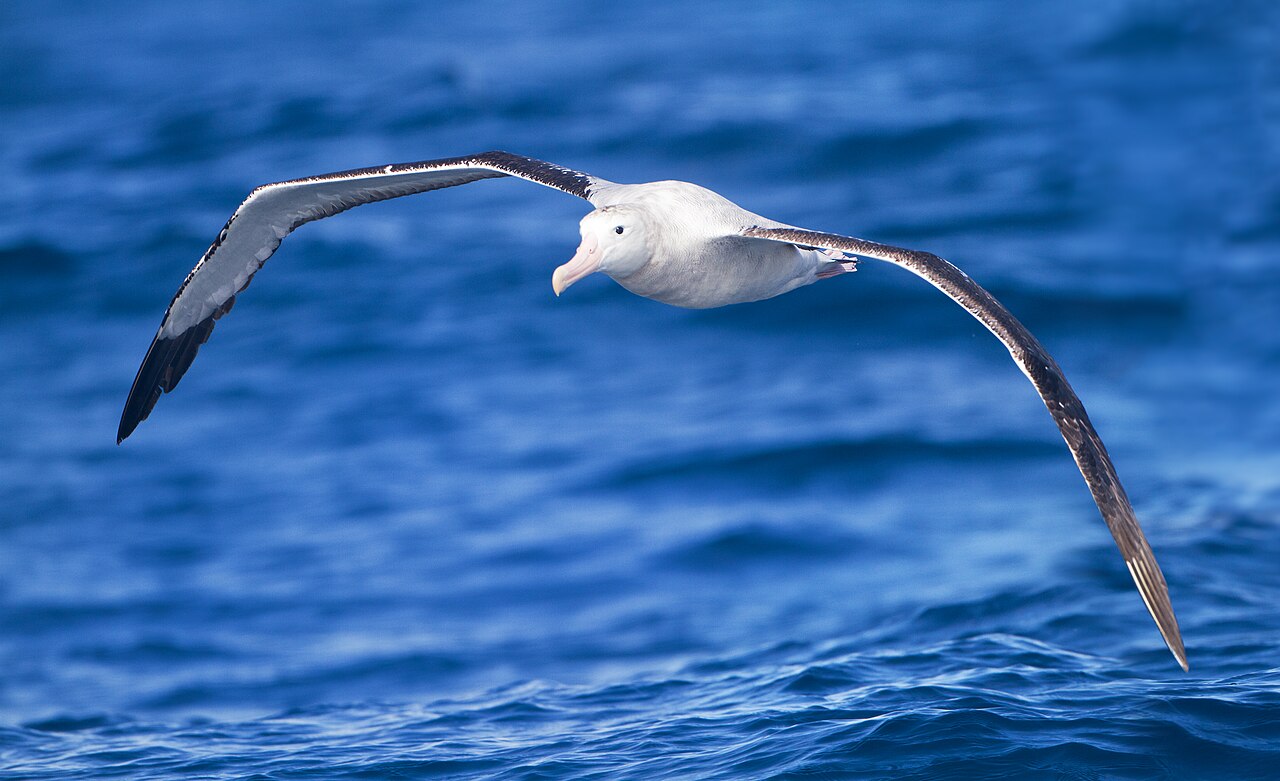
Albatrosses belong to the family Diomedeidae, split into four genera: the great albatrosses Diomedea, the mollymawks Thalassarche, the North Pacific albatrosses Phoebastria and the sooty albatrosses Phoebetria. The wandering albatross (Diomedea exulans) has the largest wingspan of any living bird, up to about 11 ft, and that span is the first thing anyone notices. The wings are long and narrow, built for gliding rather than flapping, and they lock at the shoulder so the bird can hold them out for hours without muscular effort.
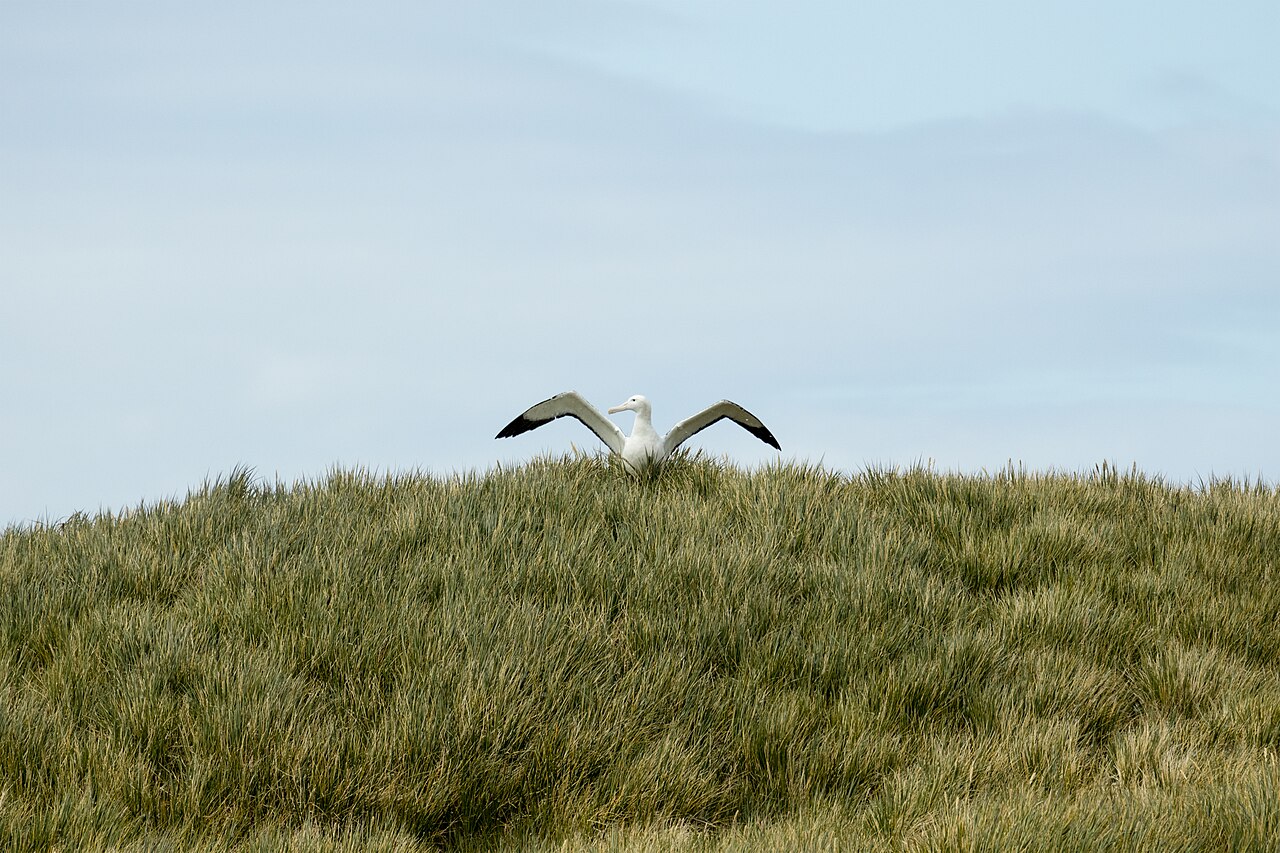
The flight technique is called dynamic soaring. Wind moves faster a few yards above the waves than right at the surface, and the albatross climbs into the faster layer, turns, and dives back down with the energy it gained, gaining ground with each cycle. It barely flaps. This is the biological fact behind every symbol of endurance and effortless freedom. The bird is not strong in the way an eagle is strong. It is efficient.
Two more adaptations explain the rest. Albatrosses are tubenoses, with nostrils in tubes along the bill and a keen sense of smell that finds squid and fish across empty ocean. And they have salt glands above the eyes that pull excess salt from the blood and drip it out through the nostrils, so the bird can drink seawater and never needs fresh water. A bird that needs no land, no fresh water and almost no effort to travel is exactly what sailors saw: a creature that belongs to the open sea.
Frequently Asked Questions
Where did Coleridge get the idea of the albatross?
Wordsworth suggested it. While the two poets were planning the poem on a walk, Wordsworth had been reading George Shelvocke’s 1726 account of a voyage around Cape Horn, in which second captain Simon Hatley shot a black albatross because he blamed its constant presence for the storms, and Wordsworth proposed that the Mariner kill such a bird and be pursued by the consequences.
Why are albatrosses called gooney birds?
Gooney bird is the nickname sailors and servicemen on Midway Atoll gave to Laysan and black-footed albatrosses because of their clumsy landings and ungainly walk. A bird built to glide for days looks ridiculous coming down on a runway, and the name stuck through the decades the island served as a military base.
What is the albatross called in Japanese?
Ahōdori is the Japanese name, and it translates roughly as fool bird. Ground-nesting albatrosses had no fear of people and were easy for feather hunters to walk up to and club, which came close to wiping out the short-tailed albatross on its Japanese breeding islands in the nineteenth and early twentieth centuries.
Is the albatross mentioned in the Bible?
No, no biblical verse names the albatross, unlike the dove, which scripture names again and again. The bird’s Christian overtones, the sailor hailing it as a Christian soul and the dead bird hung in place of a cross, come entirely from later sea literature, above all Coleridge’s poem. Readers who sense a religious meaning in the albatross are responding to the poem, not to scripture.
What is the oldest bird on Earth?
At least 74 years old: Wisdom, a Laysan albatross on Midway Atoll, was banded as a breeding adult in 1956 and laid another egg in late 2024. She is the oldest known wild bird, and her age is the living proof behind the albatross as a symbol of wisdom.
Does an albatross bring bad luck?
No, not on its own. In sea lore the living bird is a good omen, and the bad luck in Coleridge’s poem comes from killing it. The only albatross that is bad luck is the one hanging around your neck, the burden you brought on yourself.
Sources
- Poetry Foundation, The Rime of the Ancient Mariner (text of 1834)
- Merriam-Webster, Albatross definition
- CDC, How Bird Flu Spreads
- Te Ara, Ngā manu, birds: Toroa
- Department of Conservation, Taiaroa Head Nature Reserve
- US Fish and Wildlife Service, Migratory Bird Treaty Act