Deer Symbolism: Spiritual Meaning, Omens and Sightings Explained
Seeing a deer is most often read as a sign of gentleness, alertness and a call to move through a difficult stretch of life without force. That is the short version of the deer spiritual meaning carried in Native American, Christian, Celtic and East Asian tradition, where the animal appears as a messenger rather than a warning.
What a sighting is believed to mean depends heavily on the setting. A doe with a fawn at the treeline, a buck frozen in your headlights at midnight and two deer crossing the road ahead of you are read differently in folk belief, and the sections below keep them separate. None of this is biology. It is what people have long believed, and it helps to know which tradition each idea comes from.
In most traditions, seeing a deer is taken as a gentle, favorable omen: a sign to stay alert, trust your instincts and approach a problem softly instead of forcing it. Native American belief ties the deer to provision and kinship, Christian readings to longing for God, and Celtic lore to passage between worlds.
| Situation | Common symbolic reading |
|---|---|
| Deer crosses your path | A decision is close; move forward carefully rather than quickly |
| Two deer together | Partnership, balance, a relationship that needs tending |
| Deer stares at you | A message is being held out; pay attention to what you were just thinking |
| Deer in your garden or at the window | Comfort and reassurance arriving in your own space |
| Deer at night | Guidance through uncertainty; something hidden is about to clear |
| Dead deer found | The end of a phase of innocence, often read as release rather than loss |
| White deer | A rare, strongly auspicious sign in Celtic and East Asian lore |
What Does Seeing a Deer Signify?
Across most of the traditions covered below, a deer sighting signifies vigilance paired with softness. The animal survives by noticing, not by fighting, and folk belief has turned that behavior into a lesson: notice more, react less, and stop trying to overpower the thing in front of you.
Deer are also a sign of timing. People who keep records of their own sightings usually say the deer appeared during a transition, a move, a new job, a loss. Because white-tailed deer (Odocoileus virginianus) live at the edges of fields and suburbs across most of the United States, the encounter is common enough to feel personal and rare enough to feel marked.
A third thread is provision. Where deer were a staple food, their arrival meant the family would eat. That practical meaning survives in the modern reading of the deer as a sign that what you need is on its way, even if it is not here yet.
Deer as a Spirit Animal, Totem and Omen

The three words are used loosely online, and they are not interchangeable. A spirit animal, in the way the term is used in contemporary spiritual practice, is a guide whose qualities you are meant to borrow. People who name the deer as their spirit animal usually mean they want its sensitivity without its fearfulness.
A totem, in the anthropological sense, belongs to a clan or family rather than an individual. Several Native nations have deer clans, and in those systems the deer is inherited, not chosen. Using the word for a personal preference flattens something that had legal and social weight.
An omen is a single event read as a message about what is coming. That is what most people actually mean when they ask what a deer sighting means. The reading depends on the situation, which is why the folk material is organized by setting rather than by animal. If you track symbols across species, the gentler readings line up with bird symbolism rather than with predator signs.
Deer Symbolism in Native American Traditions

There is no single Native American meaning, and treating hundreds of nations as one tradition is the most common mistake in this topic. In Lakota tradition, the deer is associated with gentleness and with a warning against being led astray by charm. In Cherokee stories, the deer figures in accounts of why hunters must ask permission and take only what is needed.
Among Huichol communities in Mexico, the deer is central to ceremony and is linked with maize and peyote in a triad that structures the ritual year. Hopi and Pueblo deer dances honor the animal as a provider whose cooperation has to be earned rather than assumed.
What runs through these traditions is reciprocity. The deer gives, and something is owed in return. That is a different idea from the modern self-help reading, in which the deer exists to deliver a message to the person who sees it.
Deer in Christian and Biblical Symbolism
The anchor text is Psalm 42: “As the deer pants for streams of water, so my soul pants for you, my God.” In Christian reading, the deer became an image of spiritual thirst, of the soul in search of God rather than of a soul at rest.
Early Christian art used the stag drinking at a spring on baptismal fonts and mosaics for the same reason. Medieval bestiaries added the claim that the stag tramples serpents, which let writers cast the deer as Christ opposing evil, a reading with no basis in animal behavior but considerable staying power in church imagery.
The legend of Saint Hubert and Saint Eustace, who each see a crucifix between the antlers of a white stag and convert on the spot, fixed the deer as the animal of sudden conversion. Where a Christian reader sees a deer as a sign, this is usually the frame: a call, not a comfort.
Celtic and Norse Deer Symbolism
In Irish and Scottish lore, deer move between this world and the other one. In the Fenian tales, Sadhbh appears as a doe and gives birth to Oisin, whose name means “little deer.” Deer repeatedly lead hunters into the hills and out of ordinary time, which is why the animal is read as a guide across thresholds rather than as a resident of either side.
The white stag is the strongest of these signs. In Arthurian and Welsh material, the appearance of a white stag starts a quest, and the hunt that follows is never really about the animal. That motif is the reason “white deer spiritual meaning” is searched so often today.
Norse tradition gives the stag a structural role instead of a prophetic one. Four stags browse the branches of Yggdrasil, and the hart Eikthyrnir stands over Valhalla. Here the deer is part of how the world holds together, closer in function to bear symbolism as a figure of cosmic order than to a personal omen.
Deer Symbolism in East Asian Traditions
In Chinese tradition the deer is a symbol of longevity and official success, helped by the fact that the word for deer, lu, sounds like the word for salary. Deer appear beside the god of longevity in painting and carry the lingzhi mushroom of immortality in their mouths.
Japanese practice is more concrete. The sika deer (Cervus nippon) of Nara are treated as messengers of the kami of Kasuga Shrine, and for centuries killing one was a serious offense. Visitors who feed them are participating in a living tradition, not a tourist invention.
Buddhist iconography gives the deer a fixed place as well. The Buddha’s first sermon was preached in a deer park at Sarnath, and paired deer at the base of a dharma wheel mark that moment in art across Asia. The reading there is attentive listening rather than good fortune.
What Is the Spiritual Meaning of Seeing Two Deer Cross Your Path?
Two deer crossing your path is usually read as a sign about relationship rather than about you alone. In popular interpretation, a pair points to partnership, mutual protection and a decision that should be made with someone else rather than for them.
When the pair is a doe and a fawn, the reading shifts to care and responsibility, which is also why people search for the meaning after seeing a baby deer in early summer. A doe with young is the most common deer sighting of the year in much of the country, and the symbolic reading tends to follow the season.
Two bucks together is read differently again, as competition that has not yet turned into conflict. Bachelor groups are ordinary deer behavior outside the rut, so the symbolic weight here comes from the viewer, not from anything unusual in the animals.
What If a Deer Stares at You?
A deer that holds your gaze is read, in nearly every popular tradition, as a message being offered rather than a threat. The usual advice is to note what you were thinking in that moment and treat it as the content of the message.
The behavior itself is not mysterious. A deer that has detected you but not identified you freezes and stares to gather information, often while flicking its tail or stamping a front hoof. It is deciding, and the stillness ends the moment it decides.
Some traditions add a caution. In Lakota teaching, the deer woman is beautiful and dangerous, and a deer that behaves too boldly is a reason for care rather than delight. A wild animal that shows no fear of people is also a practical concern, and the National Park Service asks visitors to keep well back from deer and elk for exactly that reason.
Deer in Your Garden, at Your Window, at Night or Again and Again
A deer in your garden is read as reassurance arriving in your own space, a sign that safety and ordinary life are closer than they feel. A deer at the window carries the same meaning with more urgency, since the animal has crossed into territory it normally avoids.
A deer at night is read as guidance through uncertainty. Deer are most active at dawn and dusk and move freely after dark, so the sighting is common; the symbolic reading leans on the darkness rather than on the animal. People describe it as a sign that something unclear is about to resolve.
Repeated sightings are the one case where most traditions agree. A deer that keeps appearing is read as a message that has not been acted on. If you have been putting off a decision about a relationship, a move or a job, that is the standard interpretation, and it is the same logic applied in blackbird symbolism for repeat visits.
What Does Finding a Dead Deer Signify?
Finding a dead deer is widely read as the close of a phase rather than as bad luck. The common interpretation is that a period of innocence, naivety or dependence has ended, and that the ending was necessary even if it was not chosen.
Roadside deaths are read more plainly as a warning about speed, both literal and otherwise. Deer and vehicle collisions peak in October and November during the rut, so the sighting is seasonal, and the folk reading of “slow down” has an obvious practical core.
Some traditions treat a dead deer as a debt. Where the deer is a provider, its death asks for respect: acknowledge it, do not photograph it for amusement, and report it if it is blocking a road. That is the version most consistent with the Native traditions discussed above.
Deer in Dreams
A deer in a dream is generally read as the dreamer’s own vulnerability, the part of the self that startles easily and would rather leave than argue. Dream interpreters in this tradition ask whether the deer was calm or fleeing, because the answer is taken as a statement about the dreamer’s current state.
A deer being hunted in a dream is read as pressure from outside, often work or family expectation. A deer that approaches and allows contact is read as self-acceptance, a sign that the gentler part of the dreamer is no longer being chased off.
Antlers change the reading. A buck with a full rack is read as earned authority, since antlers grow and are shed every year, and a buck that has dropped them is read as a loss of status that will return. Whether you take any of this as meaningful, the questions it forces are useful ones.
White, Black and Red Deer Spiritual Meaning
A white deer is the strongest positive sign in this material. Celtic lore treats the white stag as the start of a quest, and Chinese and Japanese tradition link white animals with divine messengers. Biologically these are usually piebald or leucistic white-tailed deer, or true albinos, and both are rare enough that the sighting stays memorable.
Black deer are read as mystery, grief work and the part of a transition that happens out of sight. Melanistic white-tailed deer are rarer than albinos and concentrated in central Texas, so most reported black deer are simply animals seen in poor light.
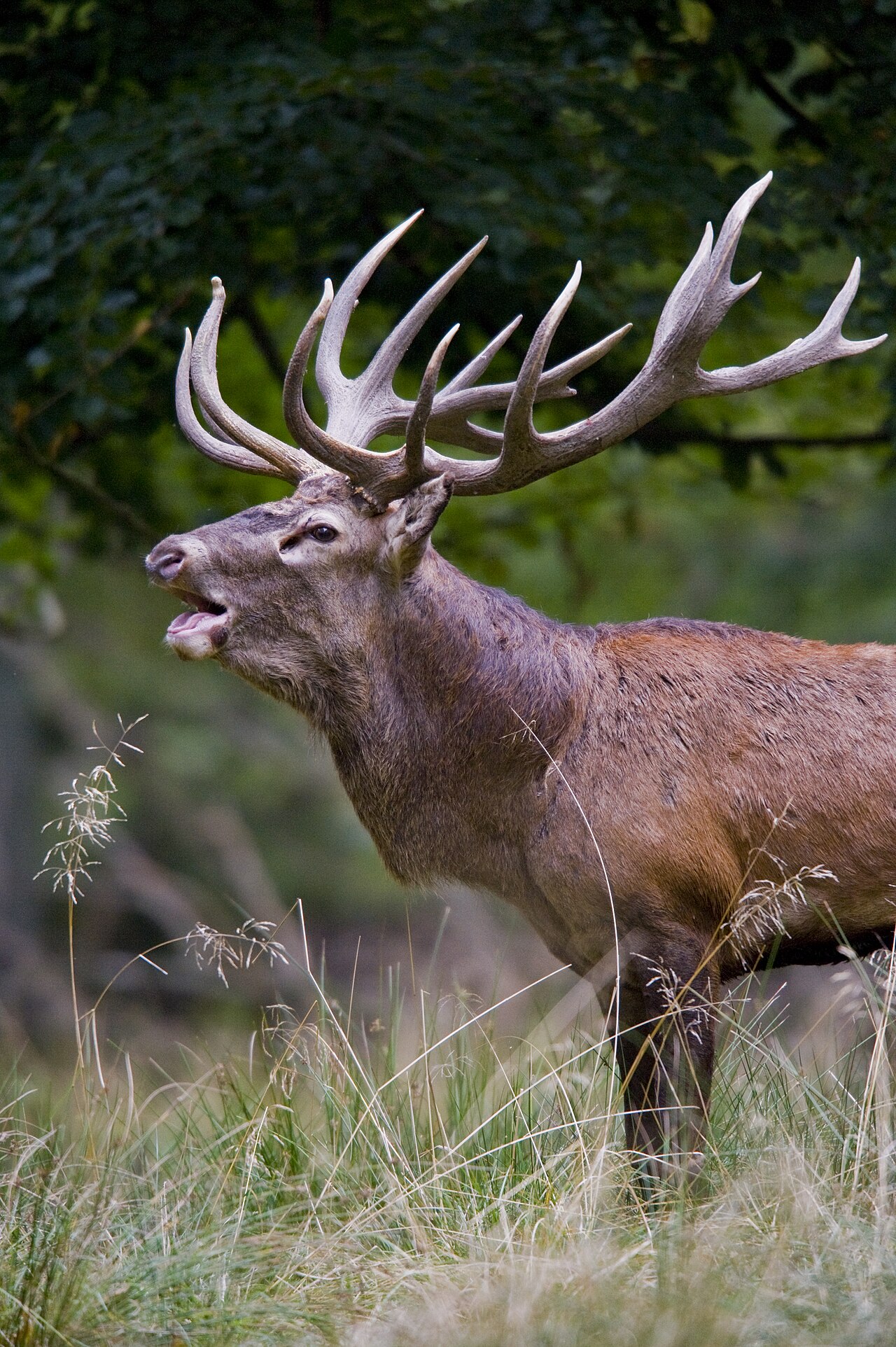
Red deer (Cervus elaphus) carry a separate European tradition of vitality, royal authority and the hunt, and in Britain the red stag is the emblem of wild high ground. A red-coated white-tailed deer in summer is not the same animal, and the symbolic literature often conflates the two.
Frequently Asked Questions
What are some mythological deer names?
Oisin, the son of the doe Sadhbh in Irish legend, whose name means little deer. Eikthyrnir and the four stags Dainn, Dvalinn, Duneyrr and Durathror from Norse myth. Cernunnos, the antlered Celtic figure. Actaeon, turned into a stag in Greek myth. Ceryneian Hind, the golden deer of Heracles.
What does the word “deer” mean?
It comes from Old English deor, which simply meant animal or wild beast. The narrowing to one family of hoofed mammals happened in Middle English. The older sense survives in the German Tier, and in Shakespeare’s line about “small deer,” meaning small creatures of any kind.
What are deer known for?
Deer are known for their speed, their alertness and the annual antler cycle of the males. White-tailed deer run up to 30 mph, leap fences of 7 to 8 ft (2.1 to 2.4 m), and swim well. Their habit of freezing before fleeing is what made them a symbol of watchfulness.
What is a deer’s biggest enemy?
In the United States, vehicles and human hunting kill far more deer than predators do. Where wolves, mountain lions and bears are present, those are the main natural predators, and coyotes and bobcats take most fawns. Winter starvation and disease also outweigh predation in many northern populations.
What smells are deer afraid of?
Deer avoid strong predator and irritant odors: human scent, dog and coyote urine, putrescent egg solids, garlic, mint, rosemary and capsaicin sprays. Commercial repellents work for a few weeks at best, and deer adapt quickly, so gardeners rotate products rather than relying on one.
What is the lifespan of a deer?
Wild white-tailed deer average 2 to 3 years in heavily hunted areas and can reach 10 to 12 years where pressure is low. Does outlive bucks in most populations. In captivity, 15 to 20 years is possible. For the terms used for each age and sex, see what a female deer is called and compare with the bald eagle’s symbolism in American tradition.