Rough-Legged Hawk: Arctic Visitor
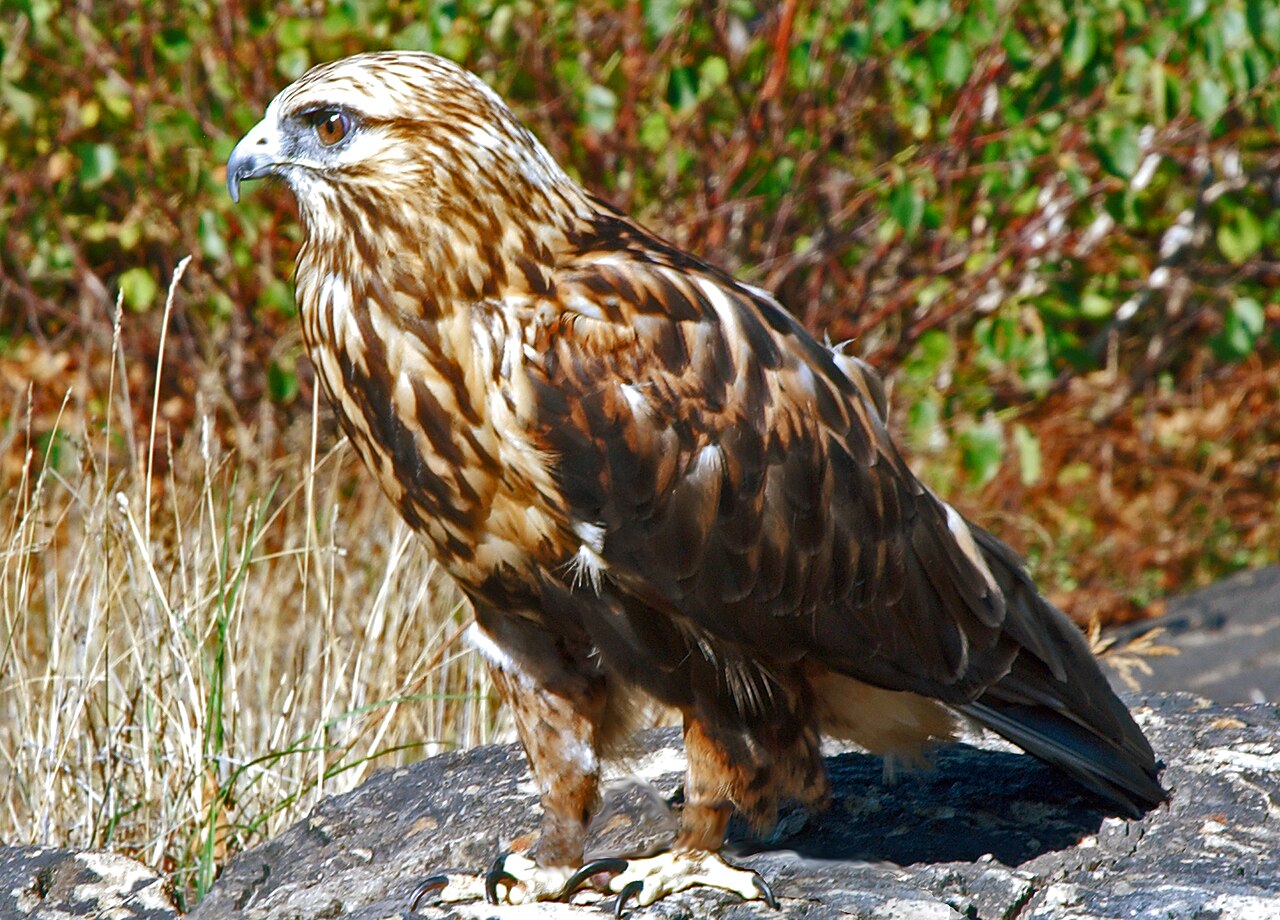
A Rough-Legged Hawk is a large buteo identified by its feathered legs extending all the way to the feet, a dark belly band or blotchy dark markings on a pale body in most morphs, a dark carpal patch at the wrist visible in flight, and a habit of hovering in place over open ground while hunting, a behavior unusual among large North American hawks. It breeds on the Arctic tundra and is seen in the Lower 48 states only as a winter visitor to open grassland, farmland, and marshes.
| Fact | Detail |
| Length | 18.5 to 20.5 inches |
| Wingspan | 52.5 to 54.3 inches |
| Weight | 1.5 to 3.2 pounds |
| Key field mark | Feathered legs to the feet, dark wrist patch |
| Habitat | Arctic tundra (breeding), open farmland (winter) |
| Hunting style | Frequently hovers in place |
| Range in US | Winter visitor only |
How to Identify a Rough-Legged Hawk
A Rough-Legged Hawk shows legs feathered all the way down to the toes, an adaptation to its Arctic breeding habitat that few other North American hawks share. Most individuals show a dark carpal patch at the bend of the wing visible from below in flight, along with a dark belly band or blotchy dark markings against a paler body, though the species shows both light and dark color morphs that can look quite different from one another, somewhat similar to the color variation seen in the Red-Tailed Hawk. The tail typically shows a dark terminal band with a paler base, most visible when the bird is soaring or hovering.
A Hawk That Hovers
Unlike most large buteos, which hunt from a high perch or by soaring in wide circles the way a Red-Shouldered Hawk often does, a Rough-Legged Hawk frequently hunts by hovering in place directly over open ground, holding its position on rapidly beating wings while scanning below for movement, a technique more commonly associated with kestrels than with a hawk this size. This hovering behavior, combined with a preference for wide-open, treeless country more like the habitat favored by a Northern Harrier, is often the fastest way to identify the species even at a distance where plumage details are hard to make out.
Breeding on the Arctic Tundra
Rough-Legged Hawks breed on open Arctic and subarctic tundra across northern Canada and Alaska, nesting on cliff ledges and rocky outcrops in a landscape with essentially no trees, a stark contrast to the wooded or semi-wooded habitat favored by most other North American hawks and even by many owls such as the Snowy Owl that share the same tundra habitat in summer. Breeding success is closely tied to the boom-and-bust population cycles of lemmings and voles on the tundra, with pairs raising larger broods in years when rodent numbers are high and skipping breeding altogether in poor rodent years.
Winter Range in the Lower 48
According to the Cornell Lab of Ornithology, Rough-Legged Hawks winter across open farmland, grassland, and marshes throughout much of the northern and central United States, arriving in late fall and departing again by early spring to return to their tundra breeding grounds. Because the species is absent from the Lower 48 for the rest of the year, any Rough-Legged Hawk sighting outside the winter months in the continental United States is notable and worth double-checking against similar species like the Red-Tailed Hawk or Ferruginous Hawk, both of which can show pale morphs that superficially resemble a Rough-Legged Hawk at a distance.
Diet
Small mammals, particularly voles and lemmings, make up the overwhelming majority of a Rough-Legged Hawk’s diet both on its Arctic breeding grounds and during its winter stay farther south, where it shifts its focus to voles and mice in open farmland and grassland. This narrow dietary focus on small rodents is part of why the hovering hunting technique works so well for the species, allowing it to scan a wide area of open, low vegetation for the slightest movement below.
Light and Dark Color Morphs
Rough-Legged Hawks occur in both a light morph, with the pale body and dark belly patch described above, and a much less common dark morph, in which the body is almost entirely blackish-brown with only the flight feathers showing a paler, silvery cast from below. Both morphs share the same feathered legs and hovering hunting style, so overall shape and behavior remain more reliable identification tools than color alone, especially when a dark-morph bird is seen at a distance or in poor light.
Rough-Legged Hawk vs Ferruginous Hawk
Both species winter across open western grassland and can show pale, light-colored plumage, but a Ferruginous Hawk is considerably larger with rust-colored, not dark, leggings, and a plain, unbanded pale tail rather than the dark-banded tail typical of a Rough-Legged Hawk. Habitat overlap is heaviest in winter, when both species can be found hunting the same open agricultural fields, making tail pattern and leg color the two most useful features for separating them at a distance.
Why This Hawk Is Rarely Seen in Summer
Because its entire breeding range lies within the Arctic and subarctic, well north of where the vast majority of birders live and travel, the Rough-Legged Hawk is essentially a ghost species for most of the year across the Lower 48, appearing only in the cooler months and vanishing again each spring. This strict seasonal pattern makes it one of the more reliable ways to judge how far south winter conditions and prey scarcity have pushed Arctic wildlife in a given year, with unusually large numbers sometimes signaling a poor lemming year on the tundra rather than any change in the overall population.
Backyard and Farmland Sightings
Anyone living near open farmland or grassland in the northern half of the country has a reasonable chance of spotting a wintering Rough-Legged Hawk perched on a fence post, utility pole, or isolated tree at the edge of a field, often sitting more upright and appearing slightly smaller-headed than a nearby Red-Tailed Hawk. Because the species tolerates cold, open conditions that few other large hawks favor, a lone hawk hunting over a snow-covered field in January is a reasonably strong candidate for a Rough-Legged Hawk before ruling out other, less cold-tolerant species.
Why Feathered Legs Matter
The dense feathering that covers a Rough-Legged Hawk’s legs all the way to the toes is a direct adaptation to breeding on the Arctic tundra, where temperatures and wind chill routinely reach levels no other North American buteo regularly tolerates during the nesting season. This feature places the species in a small group of raptors, alongside birds like the Golden Eagle and Snowy Owl, that carry the same kind of insulating leg covering for survival in genuinely cold, exposed breeding habitat rather than for any hunting advantage, and it remains visible and diagnostic on wintering birds seen thousands of miles south of the tundra itself, a small physical reminder of just how far each bird has traveled to reach a farm field in the American Midwest each winter, often thousands of miles from the nearest tree. Birders who learn to check for this single feature early gain a quick, reliable shortcut for confirming the species even on a distant or partially obscured bird.
Frequently Asked Questions
How do you identify a Rough-Legged Hawk?
Look for a large hawk with legs feathered all the way to the feet, a dark patch at the bend of the wing, and a habit of hovering in place over open ground while hunting, seen only in winter across most of the United States.
Where does the Rough-Legged Hawk live?
It breeds on Arctic and subarctic tundra across northern Canada and Alaska and winters across open farmland, grassland, and marshes in the northern and central United States.
Why does a Rough-Legged Hawk hover?
Hovering lets the hawk scan open, treeless ground for small rodents without needing a high perch, a hunting style suited to both its treeless Arctic breeding habitat and open wintering grounds.
What does a Rough-Legged Hawk eat?
Its diet is dominated by small rodents, especially voles and lemmings, both on the Arctic tundra where it breeds and in open farmland during its winter stay farther south.
Is the Rough-Legged Hawk found in the US year round?
No. It is present in the continental United States only during the winter months, breeding entirely on Arctic and subarctic tundra in Canada and Alaska during the rest of the year.
How big is a Rough-Legged Hawk?
Rough-Legged Hawks measure about 18.5 to 20.5 inches long with a wingspan of roughly 52.5 to 54.3 inches, making them one of the larger buteos seen in North America.
Why do Rough-Legged Hawks skip breeding some years?
Breeding success is closely tied to lemming and vole population cycles on the tundra, so in years when rodent numbers crash, pairs may raise smaller broods or not breed at all.