Blue Centipede: 6 Species, How Dangerous They Are and Where They Live
A blue centipede is venomous, every one of them, but almost none of the blue bodied species in the United States can do more to a person than a wasp sting. The ones that look alarming in a flashlight beam at 2 a.m. are usually the eastern bark centipede or a desert centipede, both of which deliver a sharp local pain and nothing else.
Blue is also the color that gets reported wrong more than any other. Centipedes range from genuinely blue green pigment to a metallic sheen that only shows at certain angles, and a long list of imported pet species with brilliant blue legs circulate in photos that get posted as backyard finds. The species accounts below cover what actually turns up where, with size, range, markings and the real risk for each.
All centipedes are venomous, so a blue centipede can bite and it will hurt, but no blue species in the United States is considered dangerous to a healthy adult. The two most commonly found are the eastern bark centipede (Hemiscolopendra marginata), blue green with an orange head, and the common desert centipede (Scolopendra polymorpha), which often has blue legs.
| Species | Blue where | Size | Range | Risk |
|---|---|---|---|---|
| Hemiscolopendra marginata | Whole body, blue green | 1.5 to 2.5 in (4 to 6 cm) | Southeast to Texas | Mild, bee sting level |
| Scolopendra viridis | Body, blue to olive | 2 to 3 in (5 to 8 cm) | Florida, Gulf Coast | Mild to moderate |
| Scolopendra polymorpha | Legs and leg bases | 4 to 7 in (10 to 18 cm) | Southwest, California | Moderate, painful |
| Scutigera coleoptrata | Body, blue gray | 1 to 1.5 in (2.5 to 4 cm) | Nationwide, indoors | Very low |
| Scolopendra subspinipes | Body and legs | 6 to 8 in (15 to 20 cm) | Hawaii, pet trade | Severe pain |
| Ethmostigmus trigonopodus | Legs, bright blue | 5 to 7 in (13 to 18 cm) | Pet trade only | Moderate to severe |
Is a Blue Centipede Poisonous?
No centipede is poisonous, and the distinction matters for what you do next. Poison has to be eaten or absorbed; venom is injected. Centipedes inject, so there is nothing hazardous about touching one, and nothing hazardous about a pet that mouths one, beyond the bite itself. Cats and dogs that catch small centipedes are generally fine.
What a blue centipede can do is bite, and the small blue bodied species native to the United States produce pain comparable to a bee sting that fades within a few hours. Redness and local swelling are normal. The larger Scolopendra species hurt considerably more and can leave the area sore for a day or two, but confirmed serious outcomes are extremely rare worldwide and essentially unknown in the continental United States.
Are the Legs of a Centipede Poisonous?

The walking legs are completely harmless, and this is one of the most persistent myths about the group. What people are thinking of is the first pair of legs, which in centipedes is modified into a pair of venom claws called forcipules. These sit under the head, look like jaws, and are the only part of the animal that can inject anything.
A few of the big tropical species have sharp spines on the last pair of legs that can scratch, and running a centipede across bare skin can leave a faint track of pinprick marks from the claws on each foot. Those marks are mechanical, not chemical. The practical point is that a centipede pinned at the head cannot hurt you with the rest of its body.
Why Some Centipedes Look Blue

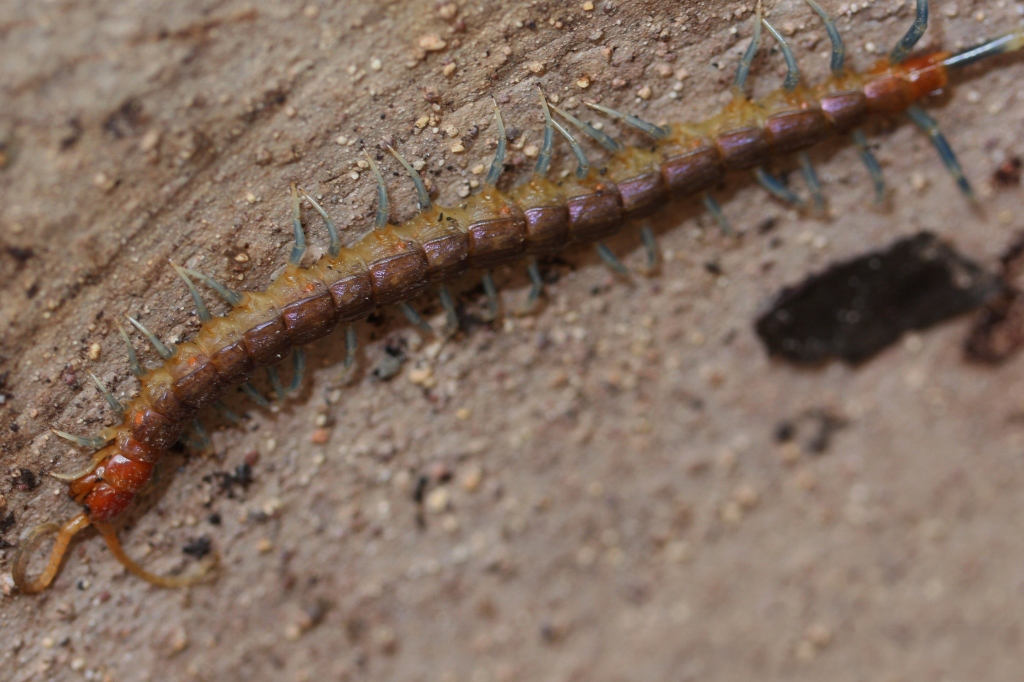
Two completely different things produce a blue centipede. The first is real pigment: Hemiscolopendra marginata and Scolopendra viridis carry blue green coloring in the cuticle itself, and they stay that color in any light, in a jar, and after death. The second is structural iridescence, where microscopic layering in the exoskeleton throws back blue wavelengths at some angles and looks plain brown at others.
Lighting explains the rest of the mismatched reports. Phone flashes push the blue channel hard, and a brown desert centipede photographed with a flash on wet concrete regularly comes out slate blue. If the animal looked blue in a photo but brown in your hand, trust the hand. Structural color also fades quickly in dead specimens, which is why museum drawers hold far fewer blue centipedes than the field does.
Florida Blue Centipede (Hemiscolopendra marginata)

The eastern bark centipede is the blue centipede most people in the United States actually meet. It runs 1.5 to 2.5 inches (4 to 6 cm), with a flat blue green body, twenty one pairs of legs, and a head and antennae that are noticeably orange or amber, producing a two tone look that is diagnostic on sight. Males often have a faint pale band on the final leg segment.
It lives under loose bark, logs and landscape timbers from Virginia south through Florida and west into Texas, and it comes indoors in damp weather. Venom is mild. Published accounts and the general pattern of reports put it at bee sting level, with pain that drops off inside an hour and no systemic effects. This is the species behind most “is this blue centipede dangerous” posts from the Southeast, and the answer is no.
Florida Blue Centipede (Scolopendra viridis): Same Name, Different Animal

Confusingly, the name Florida blue centipede is also applied to Scolopendra viridis, a different and somewhat larger animal at 2 to 3 inches (5 to 8 cm). It is blue to olive green, often with a darker stripe running down the back, and the legs tend toward yellow rather than orange. The head is not the bright contrasting shade seen in the bark centipede.
Range overlaps in Florida and along the Gulf, extending into Texas and the Caribbean. The venom is a step up from Hemiscolopendra but still in the unpleasant rather than medical category. When an identification thread turns into an argument, the orange head is the fastest tiebreaker: strongly contrasting orange head means bark centipede, uniform coloring with a dorsal stripe means S. viridis.
Common Desert Centipede (Scolopendra polymorpha)
The common desert centipede is the one sold under the name blue leg centipede, and the species name earns its keep: individuals range from tan to brown to nearly black, with the blue appearing on the legs and leg bases rather than the body. It reaches 4 to 7 inches (10 to 18 cm), making it the largest blue centipede most Americans encounter outside a pet shop.
It occupies dry country from Texas and Oklahoma west through New Mexico, Arizona, Nevada, Utah and southern California, hiding under rocks and in rodent burrows by day and hunting at night. Bites are genuinely painful, with burning that can last several hours and swelling that can persist into the next day, though there are no credible reports of lasting harm. For bite care and when a reaction warrants a call, the Mayo Clinic guidance on insect and arthropod bites applies directly.
House Centipede (Scutigera coleoptrata): The Blue Gray One Indoors
If the blue centipede you saw was in a bathroom, had alarmingly long legs and moved in a blur, it was a house centipede. The body is 1 to 1.5 inches (2.5 to 4 cm) long with three dark stripes on a gray to blue gray ground, and the fifteen pairs of extremely long banded legs make the animal look several times its actual size. It is the only centipede in the country that breeds happily indoors.
This species is effectively harmless. Its forcipules are small enough that bites on humans are rare and often cannot break skin, and it earns its keep eating silverfish, cockroach nymphs, small spiders and the young of other centipede species. A persistent indoor population points at moisture, so a damp crawlspace or a leaking trap is usually the real finding.
Blue Centipedes in the Pet Trade
Most of the spectacular blue centipedes online are not wild American animals. Ethmostigmus trigonopodus, the blue ring leg centipede, is African, reaching 5 to 7 inches (13 to 18 cm) with a dark body and vivid blue legs, and it is the species behind a large share of the rehousing and feeding videos that dominate search results. Rhysida nuda is another import regularly sold as a blue centipede.
Scolopendra dehaani, the Malaysian or Vietnamese centipede, carries the deepest blue coloring of any commonly kept species and reaches 8 inches (20 cm) or more. These are not animals to handle. Venom volume scales with body size, and bites from large Scolopendra cause severe pain, pronounced swelling and occasionally nausea or a racing heart. None of them establish outdoors in the continental United States, so a blue centipede in a Michigan basement is a house centipede or an escapee, not an invasion.
Hawaiian Centipedes and What They Eat
Hawaii has the one genuinely worrying blue centipede in American territory. Scolopendra subspinipes is established across the islands, reaches 6 to 8 inches (15 to 20 cm), and shows blue to blue green coloring on the body with orange or red legs. Bites account for a steady stream of emergency room visits in the state, with pain often described as among the worst from any arthropod, though recovery is the normal outcome.
What do Hawaiian centipedes eat? Live prey, taken at night: cockroaches, crickets, spiders, earthworms, geckos, and occasionally small mice or nestling birds in the case of the biggest individuals. They do not feed on plants, stored food or wood, so a centipede in the house is hunting something else that is already there. Clearing the prey base does more than spraying the centipede.
Blue Centipede vs Blue Millipede
Blue millipedes exist, including several iridescent species, and they are confused with centipedes constantly despite being harmless detritus eaters that cannot bite. The leg count is the reliable test, and it is visible in any decent photo.
| Trait | Centipede | Millipede |
|---|---|---|
| Legs per body segment | One pair | Two pairs |
| Body shape | Flattened | Rounded, tube like |
| Movement | Fast, darting | Slow, steady |
| When handled | Tries to bite or flee | Coils up, may ooze fluid |
| Antennae | Long, obvious | Short, stubby |
| Diet | Live prey | Decaying plant matter |
Where Blue Centipedes Live in the US
Florida produces the most blue centipede reports in the country, because both blue bodied native species reach the state and the climate keeps them active year round. Expect Hemiscolopendra marginata under bark and mulch statewide and Scolopendra viridis in sandier, more open habitat, with peak sightings during the summer rains when both species move at night.
California and the Southwest produce a different pattern. There the blue is on the legs of Scolopendra polymorpha, and animals turn up under rocks, in woodpiles and inside garages after irrigation or monsoon rain. Everywhere else in the country, a blue looking centipede indoors is almost certainly a house centipede. The same regional logic applies across the blue colored groups, from blue spiders and blue snakes to blue lizards, where a handful of species account for the great majority of sightings.
Bites, First Aid and Keeping Them Out
Wash a centipede bite with soap and water, apply a cold pack for the swelling, and take an over the counter pain reliever if you need one. Watch for spreading redness over the following days, which suggests infection rather than venom. Seek care immediately for difficulty breathing, widespread hives or swelling of the face and throat, all of which point to an allergic reaction rather than a normal bite.
Exclusion works better than killing. Centipedes need humidity and die quickly in dry air, so running a dehumidifier in the basement, fixing leaks, pulling mulch back from the foundation and sealing gaps under doors removes the conditions they depend on. Sticky traps along baseboards catch the ones already inside and tell you where they are entering. Insecticides kill individuals and do nothing about the damp that keeps producing them, which is the same mistake people make with blue dragonflies and other moisture linked insects around a house, and in the garden the larvae that get mistaken for blue caterpillars follow the same rule.
Frequently Asked Questions
Is a blue centipede poisonous?
No centipede is poisonous, but all of them are venomous. Blue species native to the United States deliver bites comparable to a bee sting, with pain and local swelling that resolve within hours. The larger imported and Hawaiian species cause severe pain but very rarely anything worse.
What color blood do centipedes have?
Centipedes have hemolymph rather than blood, and it is close to colorless, sometimes with a faint blue or greenish tint. The tint comes from copper based hemocyanin carrying oxygen instead of the iron based hemoglobin that makes vertebrate blood red. A crushed centipede leaves a pale smear, not a red one.
What kills centipedes immediately?
Direct contact sprays containing pyrethrins kill on contact within seconds, and so does a spray of soapy water on a smaller species. Neither does anything about the population, since centipedes come indoors from damp soil and mulch. Drying out the space is the only measure that reduces numbers.
What smell do centipedes hate?
Peppermint, tea tree and cedar oils repel centipedes in the short term, and strong scents will keep them off a treated baseboard for a few days. The effect fades as the oil evaporates, and no scent reaches the damp void where the animals actually live. Treat it as a stopgap.
Why should you never squish a centipede?
Mostly because it is wasteful. House centipedes eat cockroach nymphs, silverfish, carpet beetle larvae and spiders, so killing one removes a predator of the pests you care about more. Squashing a large species can also push venom out of the forcipules onto your skin, and a crushed body stains light grout.
How big does a tiger centipede get?
The tiger or common desert centipede, Scolopendra polymorpha, reaches 4 to 7 inches (10 to 18 cm), with most adults around 5 inches (13 cm). Reports of 8 inch animals usually turn out to be the giant desert centipede, Scolopendra heros, which is a different and much more colorful species.