Blue Lizard Identification: 8 US Species With Blue Tails and Bellies
A blue lizard in the United States is almost always one of two things: a young skink with a brilliant cobalt tail, or an adult male fence lizard flashing blue patches on his belly and throat. No native US lizard is blue over its whole body. The color shows up on one body part, at one life stage, or in one sex, which is exactly why the same species confuses people twice.
Nine species account for nearly every blue lizard sighting from Maine to California. This guide covers what each one looks like, how large it gets, where it lives, and whether it can hurt you. None of them can, but the reasons people worry are worth answering first.
Blue lizards in the US are harmless. The blue is either a juvenile skink tail, used as a decoy against predators, or breeding color on a male fence lizard. No North American lizard is venomous except the Gila monster, which is pink and black, not blue.
What Counts as a Blue Lizard?
Blue in reptiles is structural, not pigment based. Skin cells called iridophores stack guanine crystals in regular layers that scatter short wavelengths back at the viewer, so the color shifts with the angle of the light and disappears the moment the animal dies and the cells collapse. That is why a blue tailed skink in a photograph can look electric in one frame and dull gray in the next. The same optical trick explains the sheen on a purple looking snake after a fresh shed.
Because the mechanism is structural, it is cheap for a lizard to switch on in one patch of skin. Juvenile skinks put it on the tail, where it draws a predator’s strike to the one body part they can shed and regrow. Male fence lizards put it on the belly, where only a rival or a female looking up from below will see it. Neither investment requires coloring the entire animal, and no US species does.
Blue Lizards of the United States at a Glance
| Species | Where the blue is | Adult length | Range |
|---|---|---|---|
| Five-lined skink | Juvenile tail, vivid cobalt | 5 to 8.5 in (13 to 21 cm) | Eastern US to Texas |
| Broad-headed skink | Juvenile tail | 6.5 to 12.5 in (16 to 32 cm) | Southeast |
| Western skink | Tail, often kept into adulthood | 4 to 8.25 in (10 to 21 cm) | West Coast, Great Basin |
| Blue-tailed mole skink | Juvenile tail, blue to pink | 3.5 to 6.5 in (9 to 16 cm) | Central Florida only |
| Western fence lizard | Male belly and throat | 6 to 9 in (15 to 23 cm) | California to Idaho |
| Eastern fence lizard | Male belly patches | 4 to 7.25 in (10 to 18 cm) | East and central US |
| Granite spiny lizard | Male back, purple to blue sheen | 7 to 11 in (18 to 28 cm) | Southern California |
| Eastern collared lizard | Male head and body, turquoise | 8 to 14 in (20 to 35 cm) | Ozarks to Southwest |
Are Blue Lizards Venomous or Dangerous?
No blue lizard in the United States is venomous, and none is aggressive toward people. The only venomous lizard native to the country is the Gila monster (Heloderma suspectum), a heavy bodied desert animal patterned in pink, orange, and black that nobody mistakes for a skink. Every blue tailed lizard you find under a porch board is harmless. The caution belongs elsewhere: a blue or blue gray snake in the same yard is worth identifying properly, since a few North American snakes do carry venom.
A cornered skink or collared lizard will bite, and a large broad-headed skink can break skin. Wash the spot with soap and water as you would any small scratch. The persistent folk belief that blue tailed skinks are poisonous to eat has one grain of truth behind it: cats that catch and swallow them sometimes vomit, though no toxin has ever been isolated. Treat them as you would any wild animal in a pet’s mouth and call a vet if symptoms last.
Five-Lined Skink (Plestiodon fasciatus)
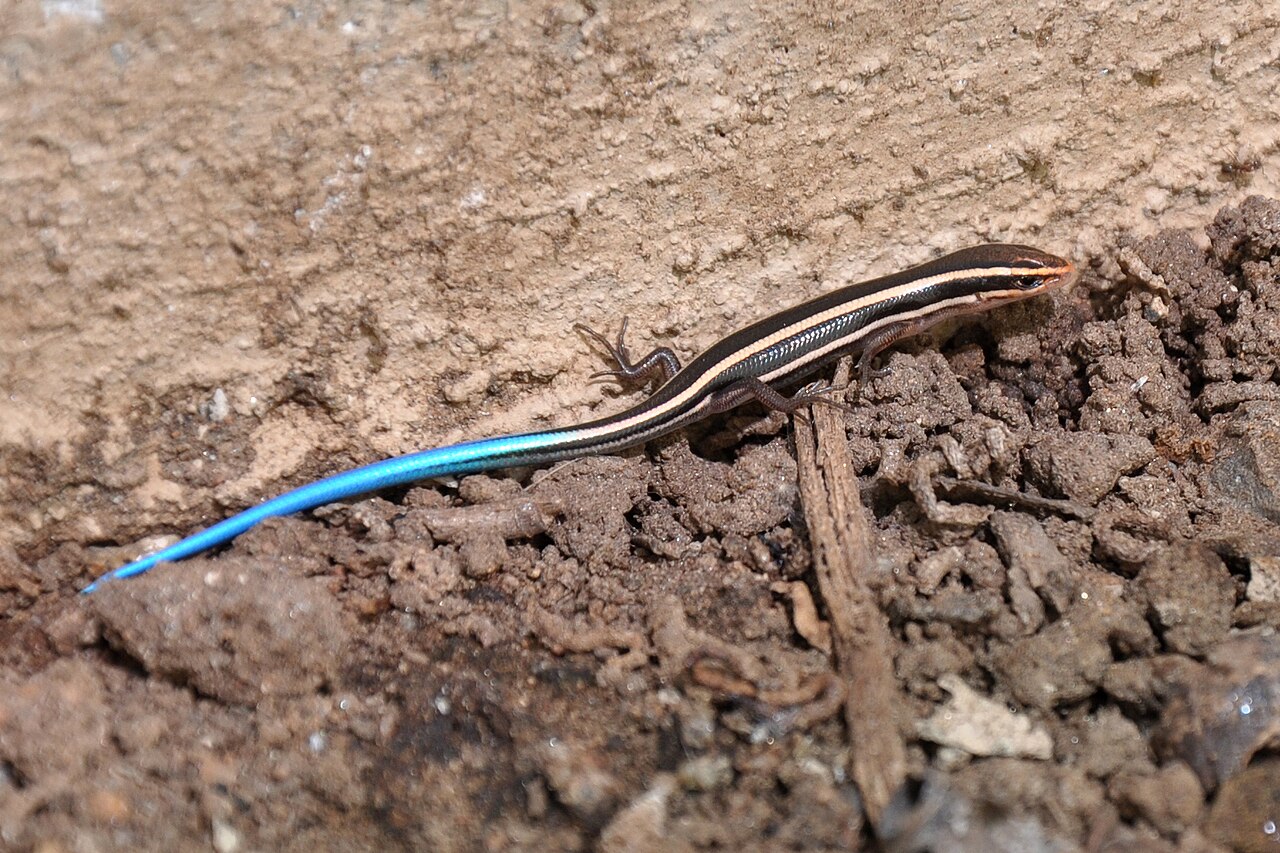
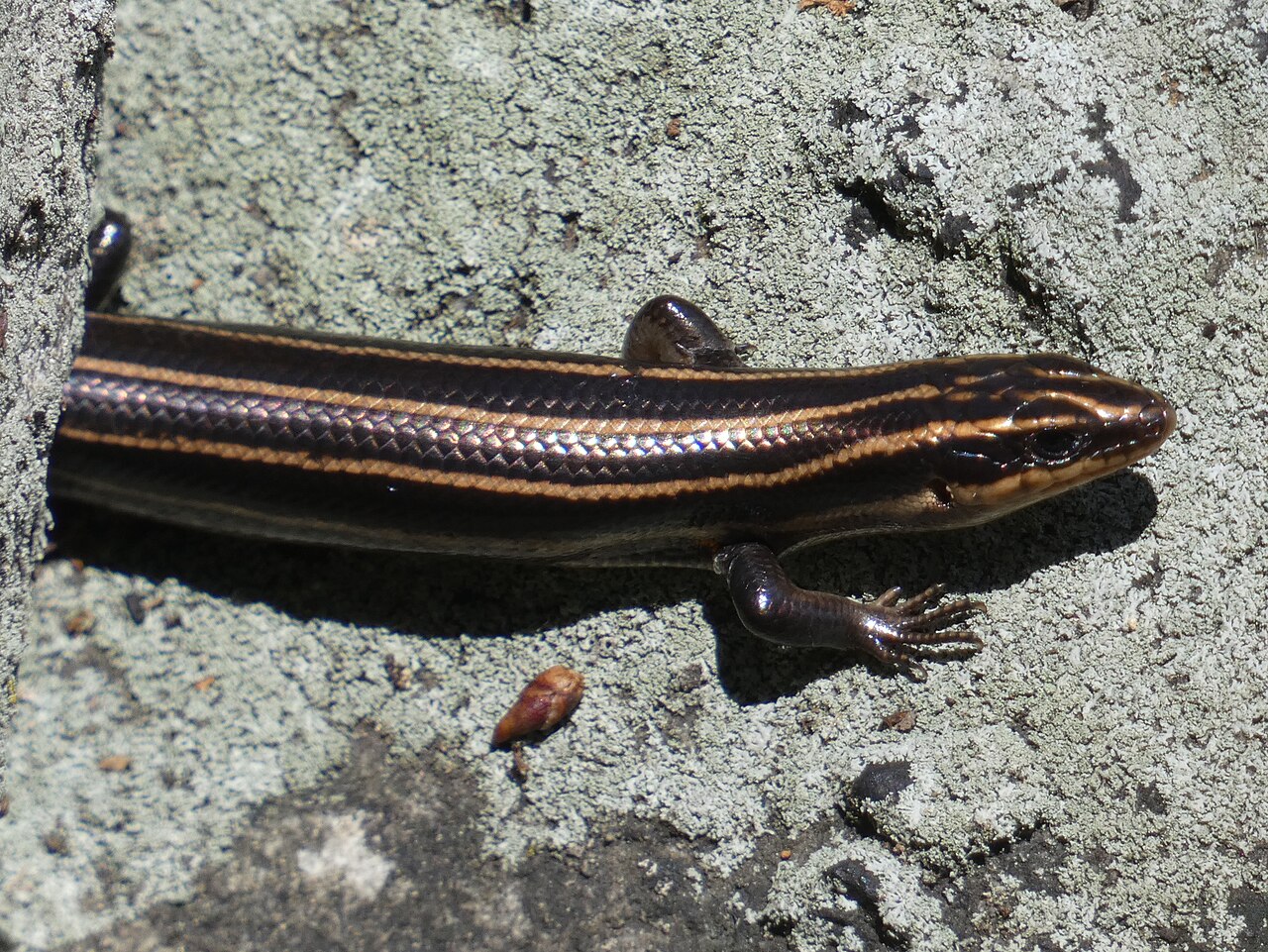
This is the blue lizard most Americans actually see. Hatchlings are glossy black with five cream to yellow stripes running head to tail and a tail so intensely blue it looks painted. They turn up on woodpiles, stone walls, deck steps, and mulch beds across the eastern half of the country, from southern New England south to Florida and west into Texas and Kansas.
Adults reach 5 to 8.5 inches (13 to 21 cm) including the tail and lose most of the color. Females keep faint stripes on a brown body; breeding males fade to uniform olive brown and develop a swollen, bright orange red head in spring. People routinely report these as three different species in one yard. They are one.
Broad-Headed Skink (Plestiodon laticeps)
The largest skink in the eastern US, reaching 12.5 inches (32 cm), and the one most likely to be seen up a tree. Juveniles are nearly identical to young five-lined skinks, with the same black body, pale stripes, and blue tail, which makes small individuals genuinely hard to call without counting the scales on the upper lip.
Adult males are the easy ones: olive brown, heavy jawed, with a head that swells wide and turns bright orange in breeding season. They favor mature oak and other hardwoods in the Southeast, often hunting in rotten limbs well above the ground. If a large blue tailed juvenile is climbing bark rather than running across the patio, this species is the likelier answer.
Western Skink (Plestiodon skiltonianus)
The West Coast counterpart, running 4 to 8.25 inches (10 to 21 cm), with a brown back, two pale stripes down each side, and a blue tail that many individuals keep well into adulthood rather than losing at maturity. Range covers California, Oregon, Washington, Idaho, Nevada, and Utah, mostly in open woodland, grassland edges, and rocky slopes with cover.
Western skinks are secretive and spend much of the day under rocks and logs, so the usual sighting is a flash of blue vanishing into leaf litter. Breeding adults add orange on the chin and the sides of the head. They share habitat with the blue tinged salamanders of the Pacific Northwest, and the two get confused in photographs because both are smooth and glossy, though salamanders lack scales and claws.
Blue-Tailed Mole Skink (Plestiodon egregius lividus)
A small, federally threatened lizard restricted to the sandy scrub of the Lake Wales Ridge in central Florida and a few neighboring counties. Adults run 3.5 to 6.5 inches (9 to 16 cm), with a slender pinkish brown body, tiny legs, and a tail that is blue in juveniles and often shifts toward pink or lavender with age.
Mole skinks swim through loose sand rather than walking on it, which is why they are rarely seen even where they are common. Their habitat has been cut to a fraction of its original extent by citrus groves and development, and the subspecies is listed as threatened by the US Fish and Wildlife Service. Finding one in central Florida is worth reporting to a state biologist rather than collecting.
Western Fence Lizard (Sceloporus occidentalis)
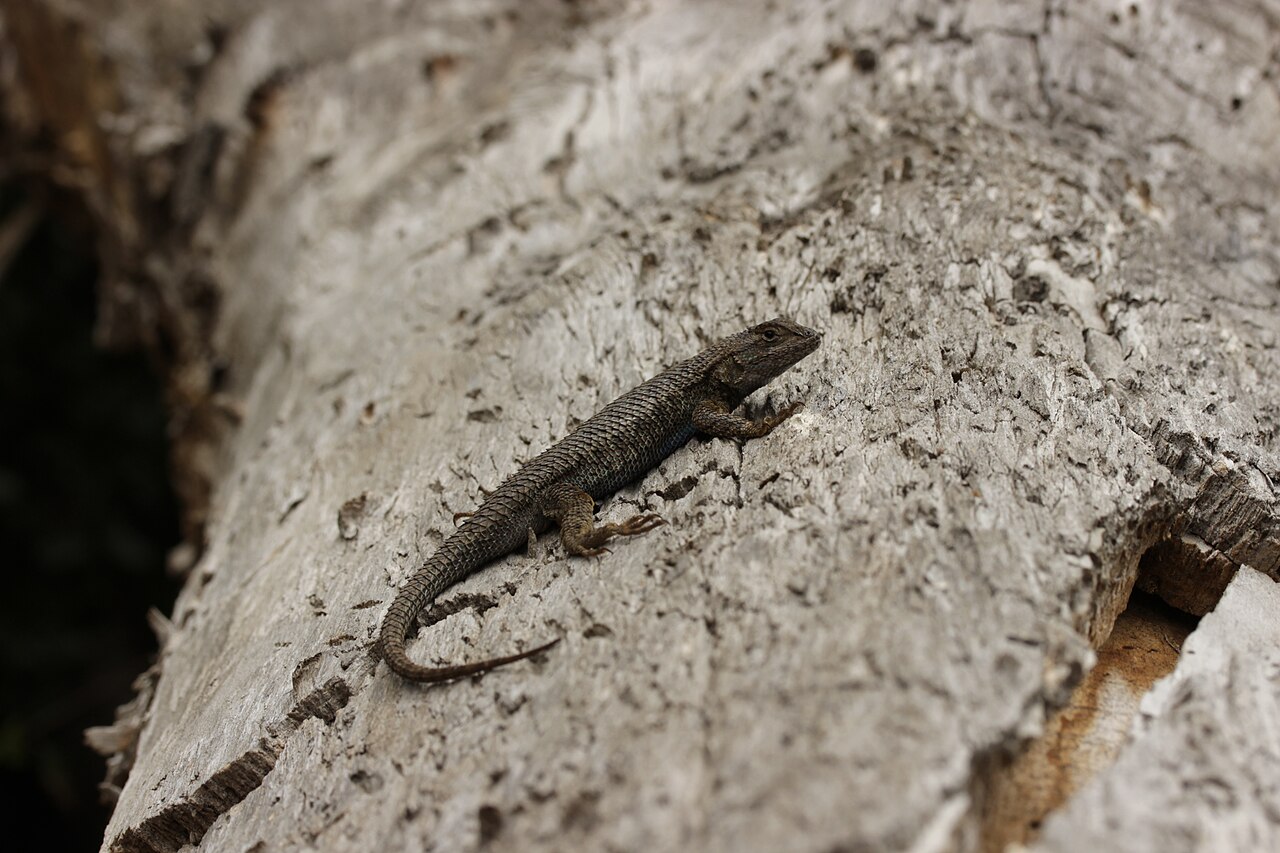
Known across California simply as the blue belly. Males are 6 to 9 inches (15 to 23 cm) long, gray to near black above with rough keeled scales, and carry two brilliant blue patches on the belly plus blue on the throat. They display by doing push-ups on a rock or fence rail, flashing the color at rivals and females below.
This species has a genuine public health side. A protein in western fence lizard blood kills the bacterium that causes Lyme disease inside ticks that feed on them, which measurably lowers infection rates in local tick populations. It is one of the few backyard reptiles with a documented benefit to people, and a good reason to leave the woodpile where it is.
Eastern Fence Lizard (Sceloporus undulatus)
The eastern equivalent, 4 to 7.25 inches (10 to 18 cm), gray to brown with the same spiny keeled scales and a strong preference for sunny fence posts, stumps, and open pine woods from New Jersey to Florida and west to Kansas. Males show two deep blue to blue black belly patches edged in black, plus blue on the throat; females are paler below with wavy dark crossbars on the back.
They are fast, they run up the far side of a tree trunk when approached, and they are harmless. In the Southeast, populations living with invasive fire ants have evolved longer hind legs and a stronger body shaking response, one of the better documented cases of rapid evolution in a North American vertebrate.
Granite Spiny Lizard (Sceloporus orcutti)
A heavy, flat bodied lizard of boulder piles in southern California and Baja California, reaching 11 inches (28 cm). Breeding males are the closest thing the US has to a genuinely blue bodied lizard: the dark back scales take on an iridescent purple to turquoise wash that shifts with the angle of the sun, with a purple stripe down the spine and blue green on the sides.
They live on granite outcrops and rarely stray far from a crevice. Approach slowly and the male will hold his ground and do push-ups rather than flee, which is when the color is most visible. Females and juveniles are plain brown with faint crossbars and look like a different animal entirely.
Eastern Collared Lizard (Crotaphytus collaris)
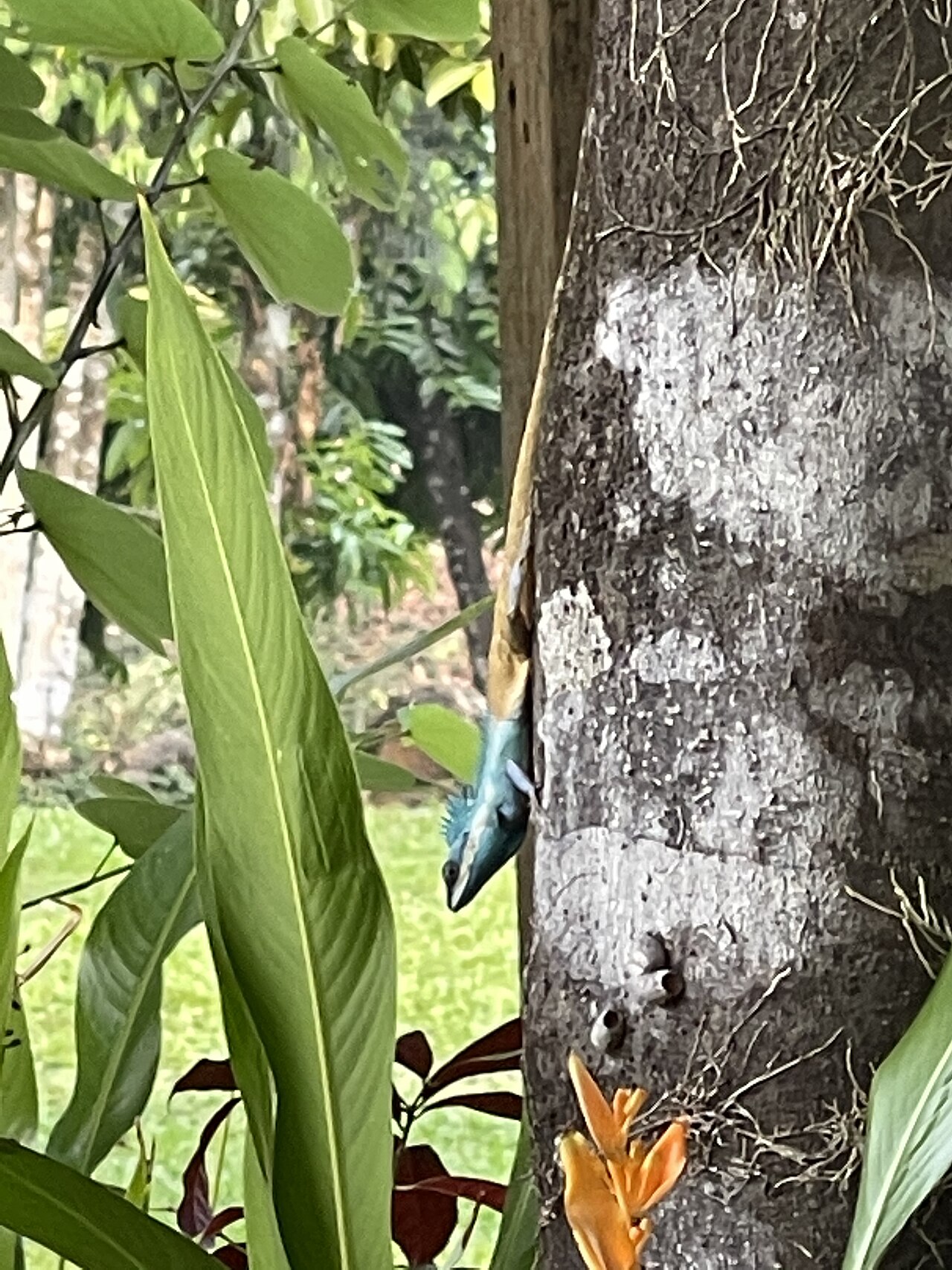
The showiest of the group and the one that sends people searching for a blue lizard the hardest. Males in breeding condition are turquoise to blue green over the body with a yellow head, pale spots, and two black bands across the neck that give the species its name. Adults reach 14 inches (35 cm) with the long tail included.
They occupy rocky glades and desert hillsides from the Missouri and Arkansas Ozarks across Oklahoma and Texas into Arizona. Collared lizards sprint on their hind legs like a tiny dinosaur, hit speeds around 16 mph (26 km/h), and hunt other lizards as well as insects. A big male will bite hard if handled, which is unpleasant but harmless.
Why Some Lizards Are Blue
Two separate jobs explain almost all of it. Juvenile tail blue is a decoy: experiments with clay models show predators aim at the bright tail, and a skink that sheds it walks away from a strike that would otherwise have hit the body. The color fades with maturity because an adult skink relies on crypsis and cannot afford to advertise.
Belly and body blue in adult males is a social signal driven by testosterone, used in territorial push-up displays and visible mainly to other lizards at close range. The same structural blue shows up across unrelated animals for the same optical reason, from blue dragonflies and blue spiders to blue feathered birds, none of which contain a single molecule of blue pigment.
Frequently Asked Questions
What are blue lizards called?
There is no single species called the blue lizard in North America. Juveniles with blue tails are skinks, usually the five-lined skink, broad-headed skink, or western skink. Adults with blue undersides are fence lizards, called blue bellies in the West. Collared lizards are the blue bodied exception.
Why is my lizard’s tail blue?
Because it is young. Blue tails are a juvenile trait in North American skinks and work as a decoy that pulls a predator’s bite toward a detachable body part. The color fades over the first year or two as the animal matures and shifts to camouflage instead of distraction.
Is Blue Lizard the same as the sunscreen brand?
No. Blue Lizard is also the name of an Australian mineral sunscreen line, which dominates search results for the phrase. The brand has no connection to any reptile species. If you are identifying an animal rather than shopping for SPF, the species above cover nearly every US sighting.
Are blue tailed skinks poisonous to cats or dogs?
No toxin has been identified in any North American skink. Cats that eat one occasionally vomit, likely from parasites or simple stomach upset rather than poison. Watch for drooling, repeated vomiting, or lethargy lasting more than a few hours and call a veterinarian if they appear.
Can you keep a blue lizard as a pet?
Five-lined and western skinks can be kept, but they are nervous, drop their tails under stress, and hide most of the day, so they make poor display animals. Many states regulate collecting native reptiles, and the blue-tailed mole skink is federally protected. Check state wildlife rules first.
Do blue lizards lose their blue color?
Skinks do. The tail dulls to gray or brown during the first year or two, and a regrown tail usually comes back a duller shade than the original. Fence lizards and collared lizards work the other way: males brighten in spring and fade outside breeding season.