Wolverine Tracks: Identify Them, Then Keep Your Distance
Large clawed prints crossing a high snowfield may belong to a wolverine (Gulo gulo), a carnivore that is rare in the lower 48 and listed there as threatened under the Endangered Species Act. For most people a trail is the only sign of one they will ever see.
Fresh wolverine sign can lead to a carcass or a den, so read it from where you stand.
Wolverine tracks are broad prints with five toes and claw marks, though the small inner toe sometimes fails to register. In firm snow they usually fall in groups of three or four; in deep powder, in pairs. Read them from where you stand, do not follow them, and report the location to state biologists.
What Wolverine Tracks Look Like
A wolverine print shows five toes in an uneven arc, a broad main pad and claw marks ahead of the toes. The small inner toe is light and misses the ground in some prints, so a track with four toes is still a candidate. The uneven arc gives the print a lopsided look that no dog or cat track has.
Size is the second clue. Front prints measure about 4 to 5 in wide, the size of a large dog’s print and oversized for a member of the weasel family. Front and hind prints are similar in size, with the front slightly wider, so check several prints before you decide.
Animal track identification rests on toe count, claw marks and pad shape, and a wolverine print passes all three tests above.
Wolverine Track Patterns in Snow, Mud and Sand
A common wolverine pattern in snow is a lope that leaves repeating groups of three or four prints. The animal often rolls along at an easy gait, and the feet land close together in each group with a long gap before the next. Read that rhythm over a long stretch of trail, not in a single print.
Deep powder changes the pattern. In soft snow the wolverine switches to a 2×2 bound, with paired prints side by side. Its broad feet spread and keep it near the surface, so the trail stays shallow where a deer would sink.
Mud keeps claw dots and pad lobes sharp and is the best place to count toes. Sand blurs detail, so judge by group pattern and stride instead of print shape. In any ground, the trail holds a straight line over ridges and through passes. Weasel tracks show the same bounding rhythm on a far smaller scale.
Wolverine Tracks vs. Look-Alikes
The main look-alikes are bear, wolf or dog, fisher and badger, and toes and claws settle most of them. Bear prints show five toes in a straighter row behind a much broader pad. Wolf and dog prints show four symmetric toes with claws, set in a neat oval.
Fisher tracks share the weasel-family toe arc on a smaller print and turn up in lower conifer forest far below the alpine zone.
Badger tracks are also smaller and show long front claws built for digging.
| Animal | Toes that register | Claw marks | Gait in snow | Habitat clue |
|---|---|---|---|---|
| Wolverine (Gulo gulo) | 5, sometimes 4 | Yes | Lope in groups of 3 or 4, 2×2 bound in powder | Alpine ridges, passes, high snow |
| Fisher (Pekania pennanti) | 5, smaller print | Yes | Bounding groups | Lower conifer forest |
| Badger (Taxidea taxus) | 5 | Long front claws | Pigeon-toed walk | Open grassland, burrows |
| Black bear (Ursus americanus) | 5 in a straight row | Yes | Walk | Forest, snow-free months |
| Wolf (Canis lupus) or dog | 4, symmetric | Yes | Trot in a straight line | Valleys, trails, roads |
| Coyote (Canis latrans) | 4, narrow oval | Yes, small | Trot | Edges, open country |
| Canada lynx (Lynx canadensis) | 4 | No | Walk | Dense boreal forest |
Gulo gulo: The Animal Behind the Tracks
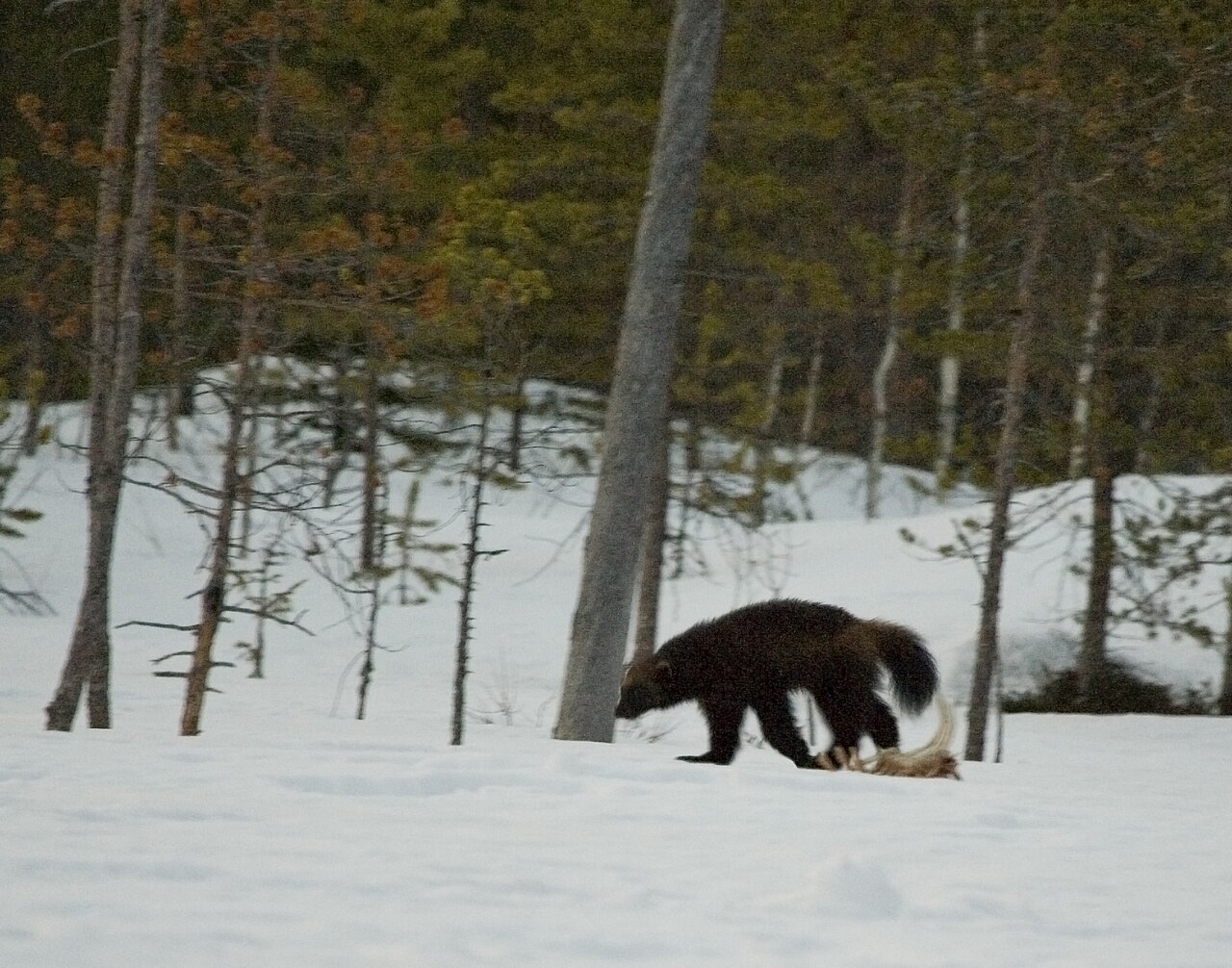
The wolverine is Gulo gulo, a stocky weasel-family carnivore that looks more like a small bear than a weasel. It has a low, heavy build, a bushy tail and a pale band along each flank. No other land-dwelling weasel-family animal in North America leaves prints this large.
Its body is built for deep cold. Dense, frost-resistant fur sheds snow and ice, and large furry feet work like snowshoes.
Wolverines scavenge winter carcasses and cache food in snow, so their trails lead to carrion again and again.
Where Wolverines Live in the US
Alaska holds most US wolverines, and the lower 48 has small, scattered populations in the North Cascades and the Northern Rockies, mainly in Washington, Idaho, Montana and Wyoming, with a few animals in northeast Oregon. The U.S. Fish and Wildlife Service listed the lower 48 population as threatened in November 2023, and only about 300 animals remain there. In those ranges they stay in high country that keeps deep snow into spring. Females dig their dens in that snow.
Wolverines are rare in the lower 48, so every confirmed track helps biologists map where the animals still live.
Found Wolverine Tracks? Keep Your Distance and Report Them
If you find fresh wolverine tracks, stay where you are, photograph them and do not follow them toward a carcass or a possible den. In late winter and spring, leave snow dens in avalanche debris and boulder fields undisturbed. Then report the trail to your state wildlife agency.
Leave any carcass untouched; CDC links handling dead animals to tularemia and plague.
Bear tracks at the same carcass in spring or fall mean a second animal may return to feed, so back off the way you came.
Frequently Asked Questions
Are wolverines endangered in the US?
No, they are listed as threatened. The U.S. Fish and Wildlife Service added the lower 48 population to the Endangered Species Act list in November 2023, which makes every confirmed track a useful record for state biologists.
How can I tell if a wolverine track is fresh?
Crisp edges and no fallen snow inside the print point to a recent pass. Sun softens edges within hours, and wind fills prints with loose grains. Press your own boot print next to the track and compare the two as they age under the same sun and wind.
Can lynx tracks be confused with wolverine tracks?
Yes, in soft snow both leave large rounded prints. A Canada lynx leaves four toes and no claw marks because its claws retract. It walks in a steady line of single prints instead of loping in groups of three or four, and that gait settles most cases.
How big are wolverine tracks?
About 4 to 5 in wide for a front print, close to a large dog’s. Hind prints are similar in size and slightly narrower, and the inner toe may not show.
Can wolverine tracks show up outside the mountains?
Yes. Young wolverines leave their birth range and travel long distances to find their own territory, so rare trails appear well outside known populations. Dispersing males have crossed into Colorado, California and North Dakota far from any resident population.
Sources
- National Park Service, Carnivore Tracks of Mount Rainier
- Washington State Standard, U.S. Fish and Wildlife Service lists wolverines as threatened
- Axios, Wolverines listed as threatened species
- CDC, About Tularemia
- CDC, Causes of Plague