Female Cardinal: Identification & Behavior Guide
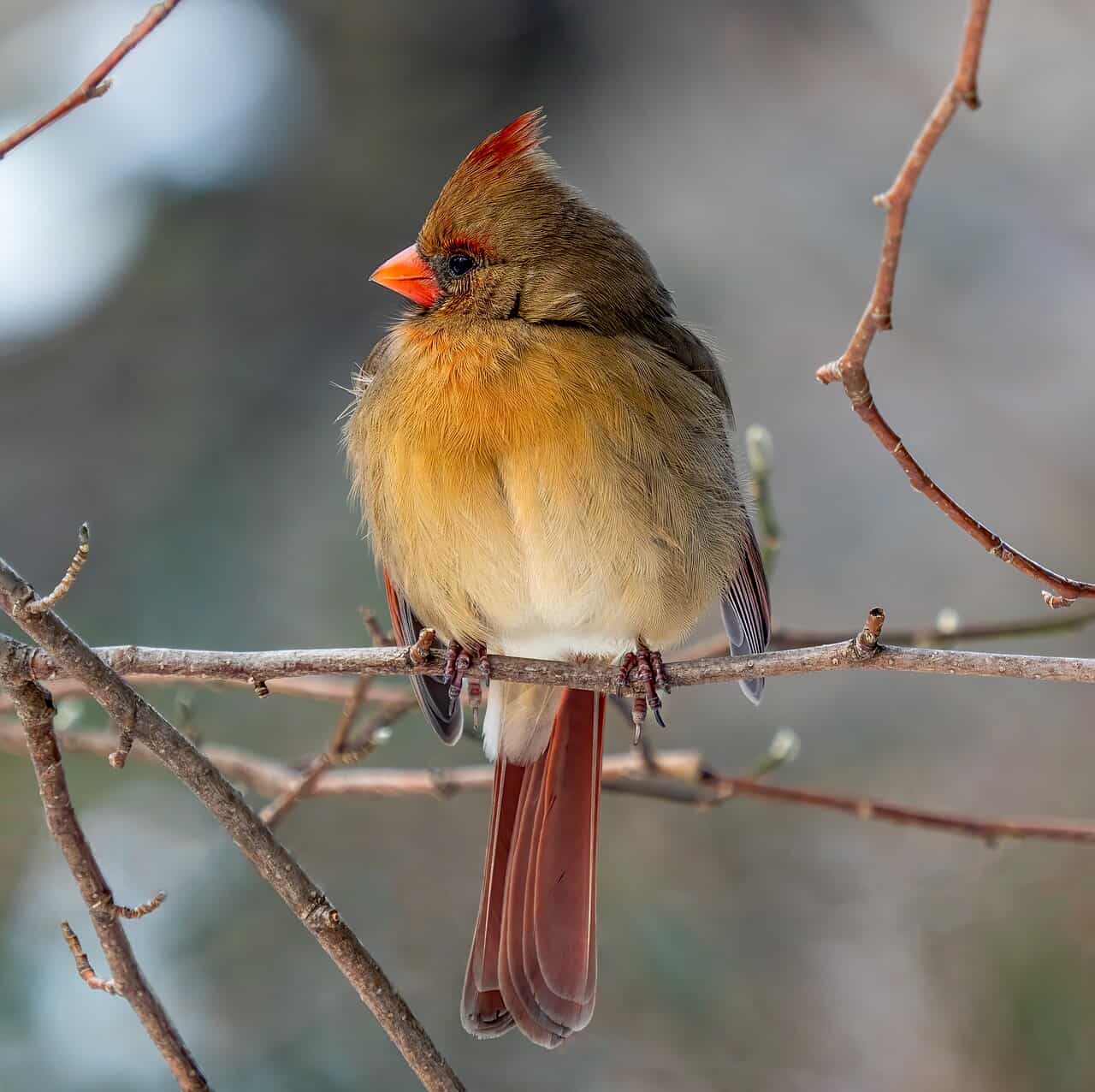
A female northern cardinal is a warm tan to olive-brown bird with reddish tinges on her wings, tail, and crest, a bright orange bill, and a faint gray mask around the face. She shares the male’s unmistakable pointed crest and heavy shape but trades his brilliant scarlet for soft, earthy camouflage. Female cardinals are also one of the few female songbirds in North America that sing, often trading phrases with their mate from the nest. If cardinals visit your feeders, close to half of them are females, and once you learn her muted color palette and glowing orange bill, she becomes just as easy to recognize as her flashy partner.
| Feature | Female Cardinal |
|---|---|
| Overall color | Warm tan to olive-brown, red tinges on wings, tail, crest |
| Bill | Bright orange-red, thick and conical |
| Crest | Present, pointed, tan with reddish edges |
| Face mask | Faint grayish-black around the bill |
| Length | 8.3 to 9.1 in (21 to 23 cm) |
| Sings? | Yes, unusual among female songbirds |
| Range | Eastern and central US, year-round resident |
What Does a Female Cardinal Look Like?
The female northern cardinal wears the same silhouette as the male, a plump body, a long tail, and a distinctive pointed crest, but her coloring is a completely different story. Instead of blazing red, she shows a warm buffy tan or pale olive-brown across her back and belly. Look closely and you will notice reddish tones washing through her wings, tail, and crest, as if the male’s color has been diluted and brushed on lightly. Her single most eye-catching feature is the same as his: a stout, cone-shaped bill in vivid orange-red, perfectly built for cracking hard seeds.
Her face carries a subtle grayish mask around the bill, far softer than the male’s crisp black one. This understated look is no accident. Because she does almost all of the incubating, her camouflage lets her disappear against branches and leaf litter while she sits on the nest. According to the Cornell Lab of Ornithology, this kind of muted female plumage is common in songbirds precisely because it protects the incubating parent from predators. For a full overview of the species, including the male’s appearance and range, see our complete guide to the Northern Cardinal.
Female vs. Male Cardinal: Key Differences
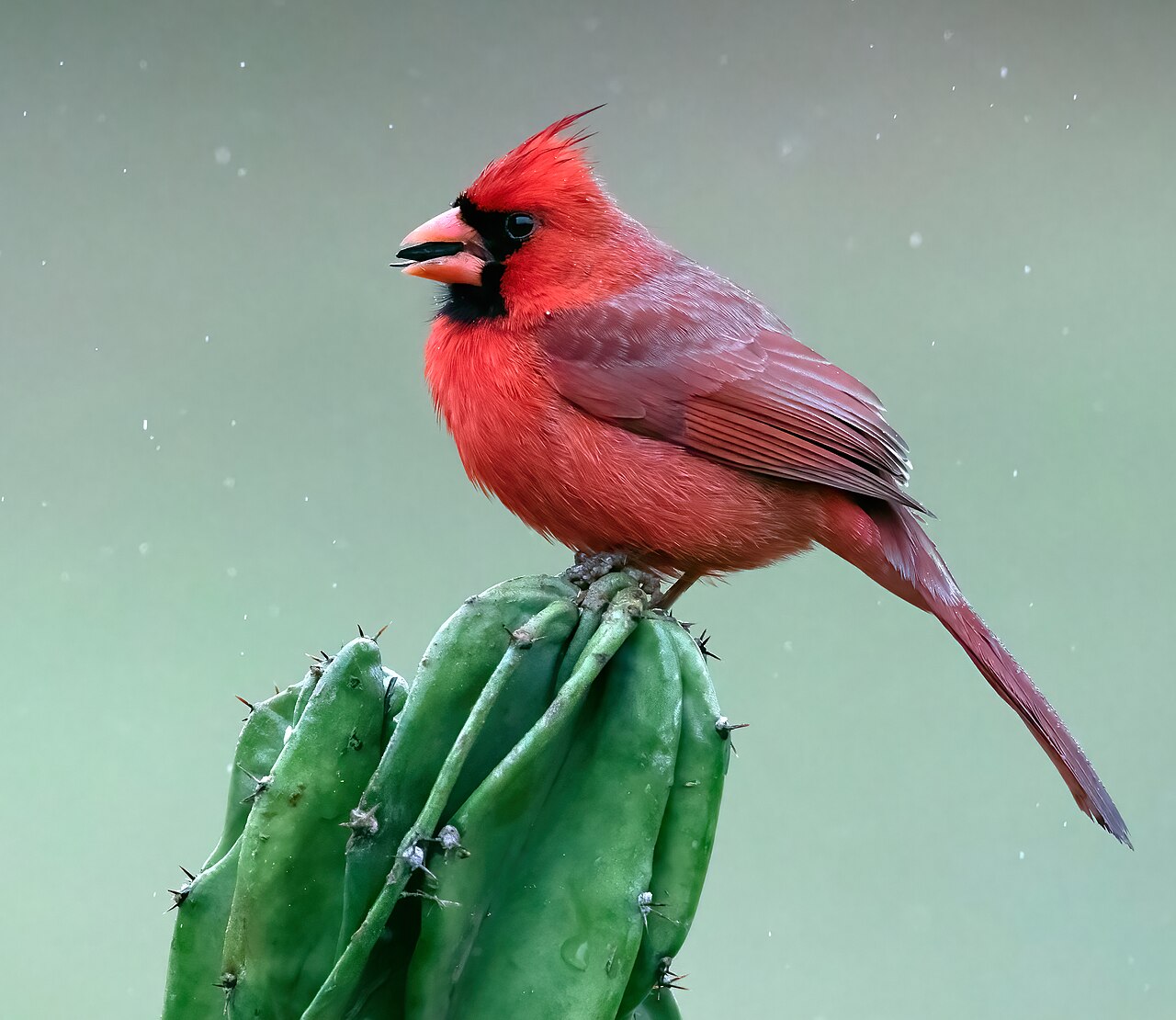
The contrast between the sexes is one of the clearest examples of sexual dimorphism among North American backyard birds, meaning the two sexes look strikingly different. The male is impossible to mistake, an all-over brilliant red with a jet-black face and throat. The female keeps the shape, the crest, and the orange bill, but swaps the fireworks for warm earth tones. Side by side at a feeder, the pair looks almost like two different species, which trips up many beginners.
Beyond color, the two behave a little differently during breeding season. The male spends more time perched high and singing to defend territory, while the female spends more time low in cover, building and tending the nest. Both, however, are drawn to exactly the same foods. Cardinals are ground and platform feeders at heart and love black oil sunflower seed above all else. Our bird seed guide breaks down which seeds pull in the most cardinals, and if you are setting up a new station, the bird feeders guide covers the sturdy hopper and platform styles a pair will use side by side.
How to Tell a Female Cardinal From a Juvenile
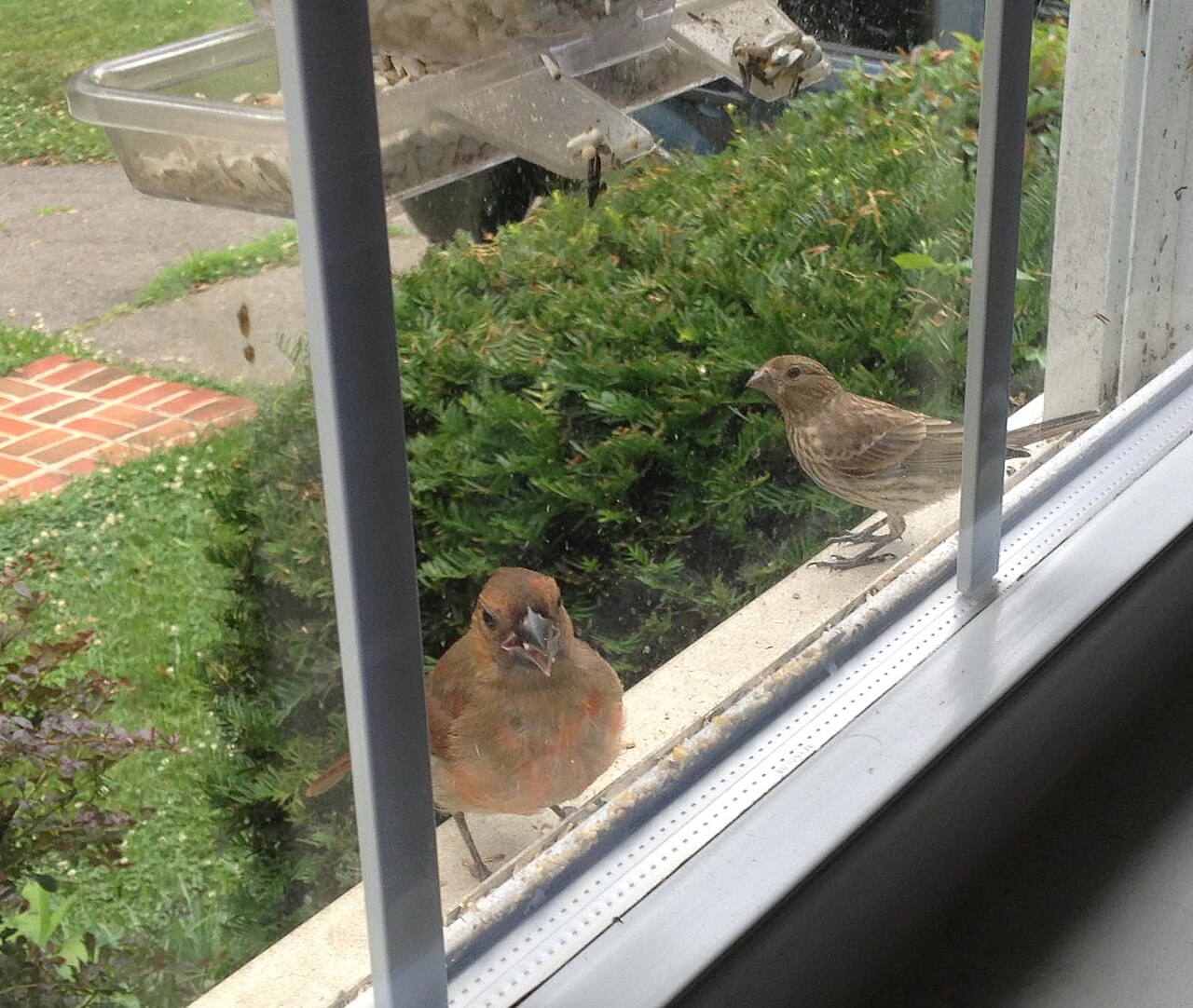
This is one of the most common points of confusion, because young cardinals of both sexes look a lot like the adult female. Both are brownish, both have the crest, and both can appear at feeders together in late summer. The reliable difference is the bill. An adult female has a bright orange bill, while a juvenile cardinal, male or female, has a dark grayish-black bill that has not yet brightened. That dark bill is the single fastest way to age a young cardinal in the field.
Telling a juvenile male from a juvenile female is trickier and often not possible with certainty until they begin to molt. As young males mature through their first fall, patches of red gradually appear until they reach full adult red by their first winter. Young females stay in warm brown tones. If you want to trace the whole progression from hatchling to adult, our baby cardinal guide walks through each stage and what to look for.
Do Female Cardinals Sing?
Yes, and this sets the cardinal apart from most of our backyard birds. In the large majority of North American songbird species only the male sings, but female northern cardinals sing frequently, often right from the nest. The Cornell Lab of Ornithology has documented females singing longer and more complex phrases than males, sometimes apparently to signal the male to bring food to the nest. A mated pair will often countersing, taking turns with matching phrases, which is a beautiful thing to hear in early spring as the breeding season ramps up.
Her vocabulary includes the same clear whistled phrases the male uses, rendered as “birdy-birdy-birdy,” “cheer-cheer-cheer,” or “purty-purty-purty,” as well as a sharp metallic “chip” call used for alarm and to keep contact with her mate. So if you hear that ringing song coming from a plain brown crested bird, you are listening to a female defending her patch, not a different species.
What Is a Half-Male, Half-Female Cardinal?
Every so often a truly extraordinary cardinal appears, one that is brilliant red down one side of its body and soft brown down the other, split almost perfectly along the midline. These birds are called bilateral gynandromorphs, and they are genuinely half male and half female. The condition arises very early in development when the sex chromosomes fail to sort normally, leaving one side of the body genetically male and the other genetically female. Cardinals show the effect dramatically because males and females are so differently colored, which is why the rare wild sightings that make the news are almost always cardinals.
Gynandromorph cardinals are extremely rare, and most birders will never see one, but they are a vivid reminder of how the male and female plumages are wired separately into the bird’s biology. If you ever photograph a cardinal that looks split down the middle, you have documented something scientists still find fascinating.
Female Cardinal Behavior and Nesting
The female does the lion’s share of nest building, weaving a cup of twigs, bark strips, and grasses into dense shrubs or vine tangles, usually three to ten feet off the ground. She then incubates the eggs almost entirely on her own for about twelve days while the male brings her food and stands guard nearby, a courtship-feeding behavior that continues from before laying through incubation. This division of labor is exactly why her plumage evolved to be so understated in the first place. You can see how the whole nesting cycle unfolds in our guide to the cardinal nest, and learn what the young look like after hatching in our baby cardinal guide.
Cardinals are famously devoted to their territory and usually stay in the same area year-round rather than migrate, which is one reason they feel like such reliable backyard companions. To keep a pair coming back season after season, offer steady food and plenty of dense cover. Our guide on how to attract birds to your yard covers the shrubs, feeder placement, and water sources that make cardinals feel at home.
Why Is a Female Cardinal Attacking My Window?
During breeding season, both male and female cardinals sometimes attack windows, car mirrors, and other reflective surfaces, sometimes for hours at a time. The bird sees its own reflection, mistakes it for a rival cardinal intruding on its territory, and repeatedly charges the “invader.” It looks alarming and can go on for days, but it is usually harmless and fades once the hormonal peak of nesting passes. The fix is to break up the reflection on the outside of the glass with soap, screens, decals, or window film, since anything applied inside the glass still leaves a mirror on the outside.
This is a completely different problem from birds flying into windows by accident, which is a collision risk rather than territorial behavior. If you are noticing a lot of bird activity around your glass and want to sort out which is which, our broader guide to identifying and helping backyard birds, how to identify backyard birds, is a good place to start.
Related reading: How to Identify Backyard Birds.
Related reading: Cardinal Symbolism.
Related reading: what do cardinals eat.
Related reading: what is a female horse called.
Frequently Asked Questions
What does a female cardinal look like?
A female northern cardinal is a warm tan to olive-brown bird with reddish tinges on the wings, tail, and crest, a bright orange bill, and a faint gray face mask. She shares the male’s crest and heavy shape but not his brilliant red color.
What is the difference between a male and female cardinal?
The male is an all-over brilliant red with a black face, while the female is mostly warm tan-brown with only red tinges. Both share the crest and bright orange bill, so the bill and crest confirm both are cardinals despite the color difference.
Do female cardinals have a crest?
Yes. Female cardinals have the same pointed crest as males. It is tan with reddish edges and can be raised or lowered depending on the bird’s mood.
Do female cardinals sing?
Yes. Unlike most female songbirds, female cardinals sing regularly, often from the nest, and will trade song phrases with their mate. Their song sounds like the male’s clear whistled “birdy-birdy” or “cheer-cheer.”
How can I tell a female cardinal from a juvenile?
The bill is the giveaway. Adult females have a bright orange bill, while juveniles of both sexes have a dark grayish-black bill. Young males slowly turn red during their first fall.
What is a half-red, half-brown cardinal?
That is a bilateral gynandromorph, a rare bird that is genetically male on one side and female on the other, split down the midline. Cardinals show it dramatically because the sexes are so differently colored.
Why do female cardinals attack windows?
During breeding season they mistake their reflection for a rival cardinal and attack it. The behavior is usually harmless and stops once nesting hormones subside. Breaking up the reflection on the outside of the glass ends it.
Related reading: the female northern flicker, the female yellow warbler.
Related reading: the female rose-breasted grosbeak.