Corn Snake: Identification, Copperhead Lookalikes, and Bite Risk
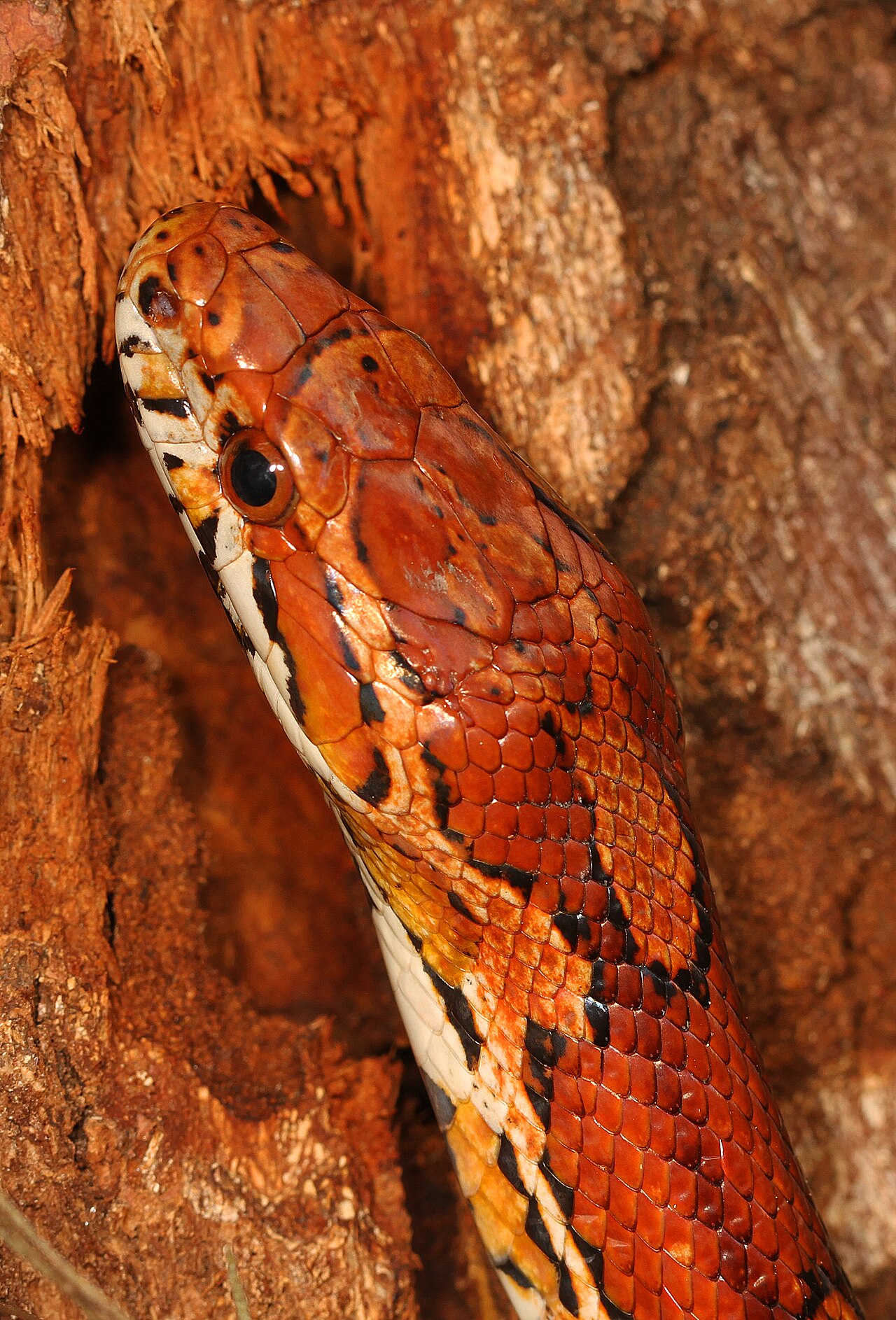
The corn snake (Pantherophis guttatus) is a nonvenomous North American rat snake with orange to rust colored blotches outlined in black, a checkerboard belly, and a spear shaped mark on the head. It is harmless to people, cannot deliver a medically significant bite, and is one of the most useful rodent predators in the southeastern United States.
Most encounters start with a worry about copperheads, because the two species overlap in range and both show reddish patterning. The differences are clear once you know what to look at: blotch shape, pupil shape, head width, and the pattern on the underside.
Corn snakes are nonvenomous rat snakes measuring 24 to 72 in (61 to 183 cm), with orange bodies, red blotches ringed in black, and a black and white checkerboard belly. They are harmless to humans, eat rodents and birds, and live across the southeastern United States from New Jersey to Florida and west to Louisiana.
| Feature | Corn Snake | Copperhead |
|---|---|---|
| Venom | None | Venomous |
| Blotch shape | Square or rectangular, black edged | Hourglass, narrow across the back |
| Belly | Black and white checkerboard | Plain cream to pinkish |
| Pupil | Round | Vertical slit |
| Head | Barely wider than neck | Distinctly triangular, wide |
| Facial pit | Absent | Present between eye and nostril |
| Adult length | 24 to 72 in (61 to 183 cm) | 20 to 37 in (51 to 94 cm) |
What Is a Corn Snake?
The corn snake is a medium sized colubrid in the rat snake group, placed in the genus Pantherophis along with the black, yellow, and gray rat snakes. It is a constrictor: it kills prey by coiling and restricting blood flow rather than with venom, and it has no fangs, no venom glands, and no heat sensing facial pits.
Two explanations compete for the common name. The older one points to the black and white belly pattern, which resembles the kernel arrangement on Indian corn. The other notes that these snakes concentrate around grain stores and corn cribs, where rodents gather. Both descriptions are accurate, and the species is also widely called the red rat snake.
Taxonomy shifted in the 2000s. Populations west of the Mississippi River were separated as Slowinski’s corn snake (Pantherophis slowinskii), and the Great Plains rat snake (Pantherophis emoryi) is a close relative with grayer coloring. Older field guides and many museum records still use the genus name Elaphe for all of them.
How to Identify a Corn Snake
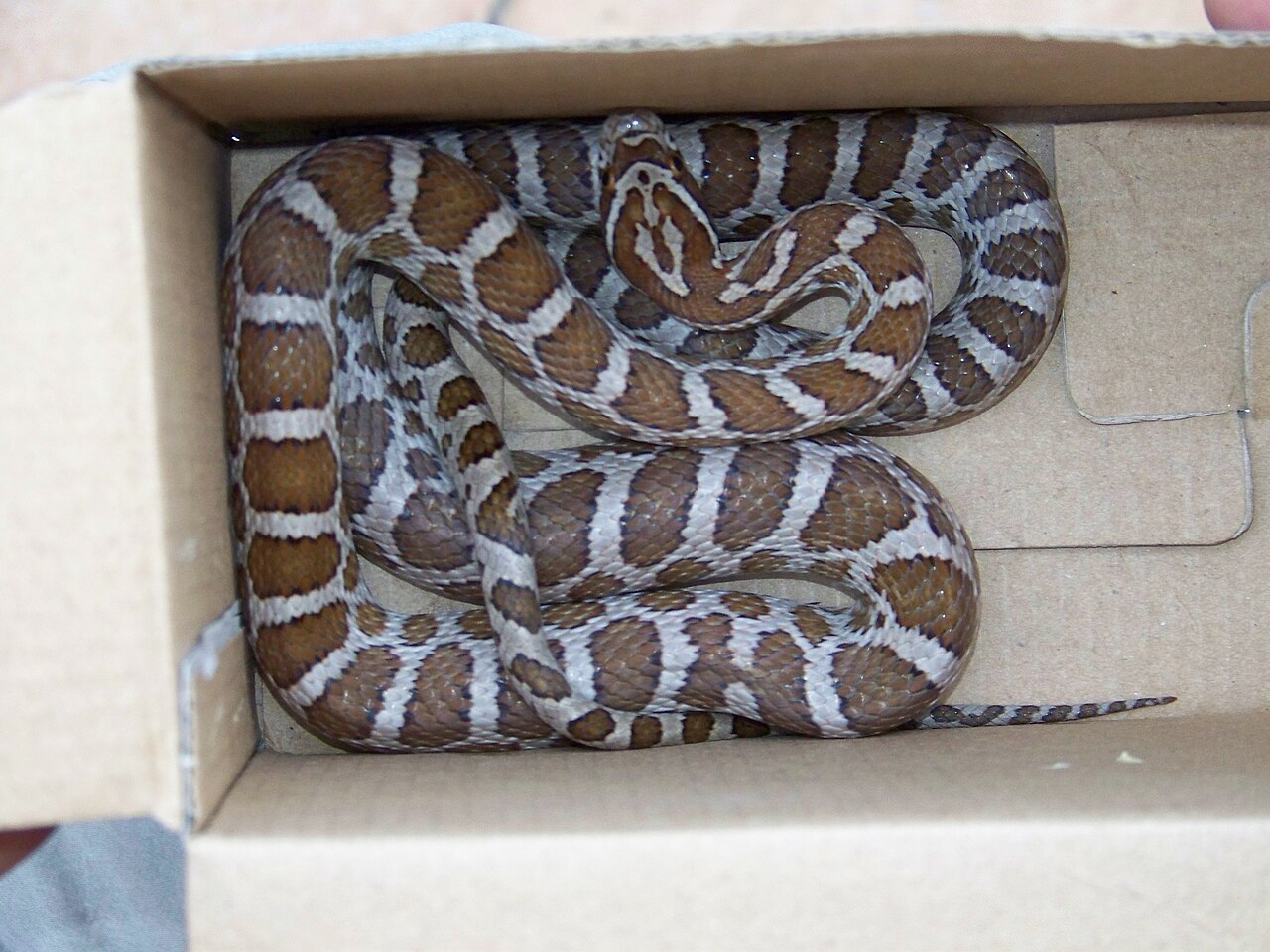
Start with the belly. A corn snake has a bold black and white checkerboard running the length of the underside, and no other snake in its range shows that pattern combined with reddish dorsal blotches. If you can see the underside, either on a road killed animal or through glass, the identification is finished in one look.
On the back, look for large squared blotches, deep red to orange brown, each outlined in a distinct black border against an orange, tan, or gray ground color. Smaller blotches alternate along each side. The scales are weakly keeled, meaning they carry a faint ridge that makes the skin look slightly less glossy than a fully smooth scaled species.
The head carries a spear or arrowhead shaped mark that points forward, with the two rear points running back toward the neck and a dark band crossing between the eyes and continuing onto the jaw. The head itself is only slightly wider than the neck, the pupils are round, and there is no pit between eye and nostril.
Corn Snake vs Copperhead: The Difference That Matters
This is the mistake that gets corn snakes killed in yards across the Southeast, and it is avoidable. The copperhead (Agkistrodon contortrix) has hourglass shaped crossbands that are wide on the sides and pinch narrow across the spine. A corn snake has blotches that are widest across the back and do not reach down to the belly scales as complete bands.
The head tells the same story. A copperhead has a broad triangular head clearly wider than its neck, a vertical slit pupil, and a heat sensing pit between each eye and nostril. A corn snake has a narrow head, round pupils, and no pits. Copperhead ground color is a copper or tan without the strong orange of a corn snake.
Behavior differs too. A cornered corn snake will vibrate its tail against leaf litter, flatten slightly, and strike defensively before fleeing. A copperhead frequently freezes and relies on camouflage, which is precisely why people step close to one. When you cannot make the call from a safe distance, leave the animal alone and photograph it from 10 ft (3 m) away.
Next question: Corn Snake Lifespan: 15 to 20 Years, and What Decides It
Are Corn Snakes Venomous or Dangerous?
Corn snakes are not venomous, and they are not poisonous either. The two words get used for the same thing, but a venomous animal injects a toxin through fangs, while a poisonous one is harmful to eat or touch. Corn snakes are neither, and they pose no medical threat. They have small recurved teeth for gripping prey, not fangs, and a bite from an adult produces a set of pinprick scratches comparable to a blackberry thorn. Wash it with soap and water and treat it like any other minor skin break.
Defensive bites are uncommon even when the snake is handled. Wild corn snakes usually try to escape first, then vibrate the tail, then strike with a closed or barely open mouth as a bluff. Captive bred animals are calm enough that they are among the most widely recommended first snakes for children old enough to handle an animal carefully.
The species is beneficial around buildings. A single adult corn snake removes dozens of rodents a year from a barn, crawlspace, or feed shed, which reduces both structural damage and the tick load that rodents carry. Killing one on suspicion of being a copperhead trades a harmless predator for a rodent problem.
Where Do Corn Snakes Live?
The native range runs from southern New Jersey down the Atlantic coastal plain through Florida and west into Louisiana, with populations reaching parts of Kentucky, Tennessee, and the eastern edge of Texas. Density is highest in the Carolinas, Georgia, and Florida, where the species uses almost every terrestrial habitat available.
Preferred habitat is edge country: pine flatwoods, hardwood hammocks, overgrown fields, meadows bordering woodlots, and rocky hillsides with cover. Corn snakes also live comfortably alongside people, using barns, abandoned buildings, woodpiles, and crawlspaces. In Florida they climb readily and hunt in trees and palm thatch far above ground.
Introduced populations exist in the Bahamas, the Cayman Islands, and parts of Australia, where escaped or released pets established themselves. State wildlife agencies and university herpetology programs such as the Savannah River Ecology Laboratory maintain current distribution maps for the southeastern species.
What Do Corn Snakes Eat?
Adults eat mostly small mammals: white footed mice, deer mice, voles, cotton rats, and young rats. They locate prey by scent, following trails with the tongue and Jacobson’s organ, then strike, coil, and constrict. A large adult takes a full grown rat, and one meal every five to ten days is a normal wild feeding rate.
Diet shifts with age. Hatchlings and juveniles are too small for mammals and start on lizards, small frogs, and occasionally insects, moving to mice as they grow through their first year. That transition is the main reason baby corn snakes turn up in different habitats than adults do.
Birds and eggs are a regular part of the adult diet. Corn snakes climb well, raid nests in shrubs and cavities, and swallow eggs whole rather than crushing them at the mouth. They occasionally take bats from roosts in barns and caves, which is unusual among North American colubrids.
How Big Do Corn Snakes Get?
Adults measure 24 to 72 in (61 to 183 cm), with most wild animals between 30 and 48 in (76 and 122 cm). The record approaches 72 in (183 cm), and Florida populations run larger on average than those at the northern edge of the range. Adults weigh 1 to 2 lb (450 to 900 g).
Hatchlings emerge at 8 to 12 in (20 to 30 cm) and roughly the thickness of a pencil. Growth is fast in the first two years given adequate prey, and animals reach sexual maturity between 18 and 36 months at about 36 in (91 cm). Growth continues slowly after maturity throughout life.
Build stays slender regardless of length. A corn snake is noticeably lighter bodied than a rat snake of the same length and far lighter than a pit viper, which is one more field cue: a heavy bodied reddish snake in the Southeast is far more likely to be a copperhead than a corn snake.
Corn Snake Behavior and Activity
Corn snakes are mostly nocturnal in warm weather and shift to daytime activity in spring and fall, when night temperatures fall too low for hunting. Summer activity concentrates in the hours after dusk, which is when they cross roads and when most encounters with people happen.
Much of their life is spent out of sight. They shelter under logs, in rodent burrows, beneath loose bark, and inside rotting stumps, and in the northern part of the range they brumate through winter in rock crevices and underground cavities. Warm winter spells bring them briefly to the surface even in January.
Defensive behavior follows a fixed sequence: freeze, flee, tail vibrate, S coil and strike, and finally musk. The tail vibration against dry leaves produces a buzzing sound that people mistake for a rattlesnake, and that mistake, rather than any actual aggression, drives most of the panic reactions the species provokes. Several harmless species including the king snake use the same bluff.
Corn Snake Reproduction and Eggs
Breeding runs from March through May after brumation ends. Males locate females by pheromone trail and may engage in ritual combat, raising the forebody and pushing without biting. Mating lasts from several minutes to more than an hour, and females can store sperm for a limited period after the encounter.
Females lay 10 to 30 eggs about a month after mating, usually in late May through July, choosing rotting stumps, compost, leaf litter piles, or decomposing vegetation where decay produces steady warmth. There is no parental care of any kind: the female leaves immediately after laying and does not return.
Incubation takes 60 to 65 days at roughly 82 F (28 C), and hatchlings emerge in late summer using an egg tooth to slit the leathery shell. They are fully independent at hatching and disperse within a day or two, though most are taken by predators well before reaching maturity.
Corn Snake Morphs and Color Variation
Wild corn snakes already vary considerably. Animals from the Carolinas tend toward bright orange with red blotches, Florida Keys populations show a lighter and less contrasted pattern, and the Okeetee locality in South Carolina produces the deep red on orange look that drove the species into the pet trade in the first place.
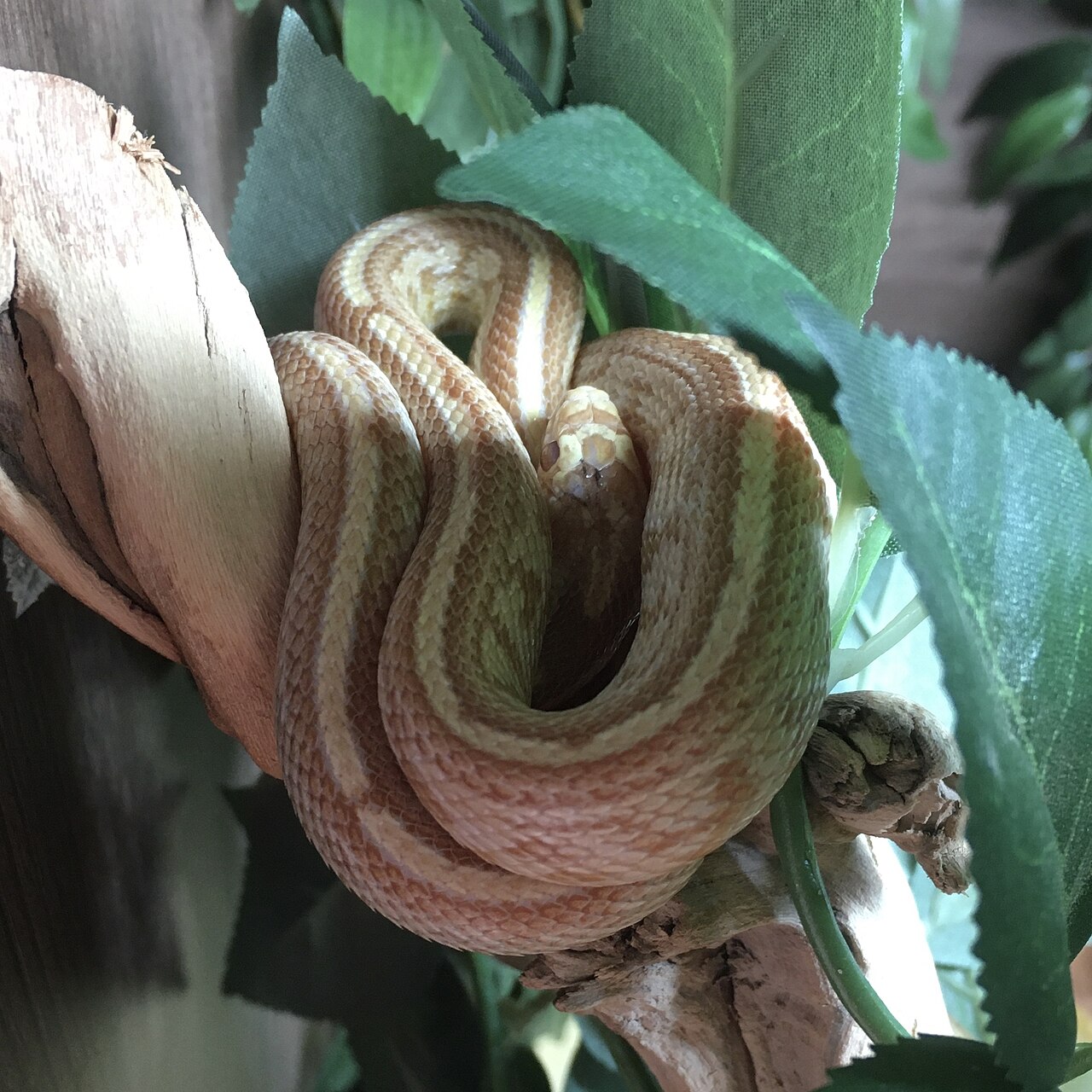
Captive breeding has produced hundreds of named morphs over five decades. Amelanistic animals lack black pigment entirely, leaving red and orange on white, and are sold as albino corn snakes. Anerythristic animals lack red and appear gray and black, and snow corn snakes combine both mutations to produce a nearly white animal.
Pattern mutations exist alongside color ones. Motley and striped morphs replace blotches with connected bands or continuous lines, scaleless morphs lack most body scales, and combination morphs stack several genes at once. None of these occur at any meaningful frequency in the wild, where the standard blotched pattern is effective camouflage.
Keeping a Corn Snake: Basic Requirements
An adult needs a secure enclosure of at least 40 gallons, roughly 36 by 18 by 18 in (91 by 46 by 46 cm), with a locking lid. Corn snakes are determined escape artists and will push through any gap wider than their head, which is the most common failure in a first setup.
Provide a thermal gradient with a warm side at 85 F (29 C) and a cool side at 75 F (24 C), controlled by a thermostat rather than left to a bare heat mat. Aspen shavings or cypress mulch hold burrows well, and the animal needs at least two hides, one on each side, plus a water bowl large enough to soak in.
Feed appropriately sized frozen and thawed rodents every 7 to 10 days for adults and every 5 to 7 days for juveniles, choosing prey no wider than the thickest part of the snake. Captive corn snakes commonly live 15 to 20 years, which is a longer commitment than most first time keepers expect.
What to Do If You Find a Corn Snake in Your Yard
Leave it alone and it will move on. Corn snakes are transient in open yards and usually pass through within a day while hunting. If the animal is in a garage or shed, open the door, leave the area quiet, and check again after dark when the snake becomes active.
If it has to be moved, use a broom and a tall bin or a trash can laid on its side rather than your hands. Guide the snake in gently, cover the container, and release it within a few hundred feet in cover such as a brush pile or woodland edge. Relocating a snake miles away usually kills it, since it loses access to its known shelters.
Prevention works better than removal. Rodent control removes the food source, sealing gaps larger than 0.25 in (6 mm) at foundations and vents removes access, and clearing woodpiles and tall grass near the house removes cover. The same measures reduce visits from other harmless species such as the garter snake.
Related reading: Corn Snake Morphs.
Related reading: Corn Snake Size.
Frequently Asked Questions
Are corn snakes venomous?
No. Corn snakes are nonvenomous constrictors with no fangs, venom glands, or heat sensing facial pits. A defensive bite leaves a few pinprick scratches that need nothing more than soap and water. They are among the safest wild snakes to encounter anywhere in the southeastern United States.
Is a corn snake bite poisonous?
No. A corn snake bite is neither poisonous nor venomous, and the two words mean different things: a poisonous animal is harmful when eaten or touched, a venomous one injects a toxin through fangs. Corn snakes do neither. A bite leaves shallow scratches that need soap and water.
Will a corn snake bite a human?
Rarely. A corn snake bites only when cornered, grabbed, or when a hand smells of rodents and gets mistaken for food. It tries to flee first and vibrates its tail as a bluff. If bitten, wash the scratches with soap and water and watch the spot for redness.
How can you tell a corn snake from a copperhead?
Check blotch shape and belly. Corn snakes have squared blotches that are widest across the back and a black and white checkerboard underside. Copperheads have hourglass bands that pinch narrow across the spine, a plain belly, a triangular head, vertical pupils, and a facial pit between eye and nostril.
How big do corn snakes get?
Adults reach 24 to 72 in (61 to 183 cm), with most wild animals between 30 and 48 in (76 and 122 cm) and weights of 1 to 2 lb (450 to 900 g). Florida populations average larger. Hatchlings emerge at 8 to 12 in (20 to 30 cm) and about the thickness of a pencil.
What do corn snakes eat in the wild?
Adults eat mice, voles, cotton rats, young rats, birds, and bird eggs, and they occasionally take bats from barn and cave roosts. Hatchlings and juveniles start on lizards and small frogs, switching to mammals during their first year as they grow large enough to handle them.
How long do corn snakes live?
Wild corn snakes typically live 6 to 8 years, with predation taking most individuals long before that. In captivity, with stable temperatures and regular feeding, they commonly reach 15 to 20 years, and the documented record exceeds 30 years.
Are corn snakes good pets?
Yes, for a keeper prepared for a 15 to 20 year commitment. They are calm, nonvenomous, feed reliably on frozen and thawed rodents, and stay a manageable size. The main requirements are a fully escape proof enclosure, a thermostat controlled temperature gradient, and two hides on opposite sides.