How to Get Rid of Skunks: Evict the Den, Then Seal It
To get rid of skunks, remove the food and shelter that keep them on your property, then let the animal leave on its own before you seal the entry. Skunks are not territorial squatters. They stay where grubs, pet food, and a dry space under a deck make life easy, and they move on within days once those three things disappear.
The mistake most homeowners make is starting with the trap. Trapping is slow, smelly, tightly regulated in many states, and it does nothing about the den the next skunk finds next spring. The order below runs the other way: cut the attraction, confirm the den is empty, close it, and only then consider repellents.
Get rid of skunks by removing food sources, treating grubs in the lawn, and blocking den sites under decks and sheds. Confirm the den is empty at night, install a one way door for 3 to 5 days, then seal the opening with hardware cloth buried 12 in (30 cm) deep.
| Method | How Fast | Works Best For | Reliability |
|---|---|---|---|
| Remove food and secure trash | 3 to 7 nights | Yard visits, digging | High |
| Grub treatment | 2 to 4 weeks | Cone shaped lawn holes | High |
| One way door on the den | 3 to 5 nights | Skunk under deck or shed | High |
| Exclusion fencing | Permanent | Preventing return | Very high |
| Bright light and radio at the den | 1 to 3 nights | Nudging a skunk out | Moderate |
| Ammonia rags or predator urine | Varies | Short term harassment | Low to moderate |
| Mothballs, coffee grounds, chocolate | Never | Nothing | None |
What Will Make Skunks Stay Away?
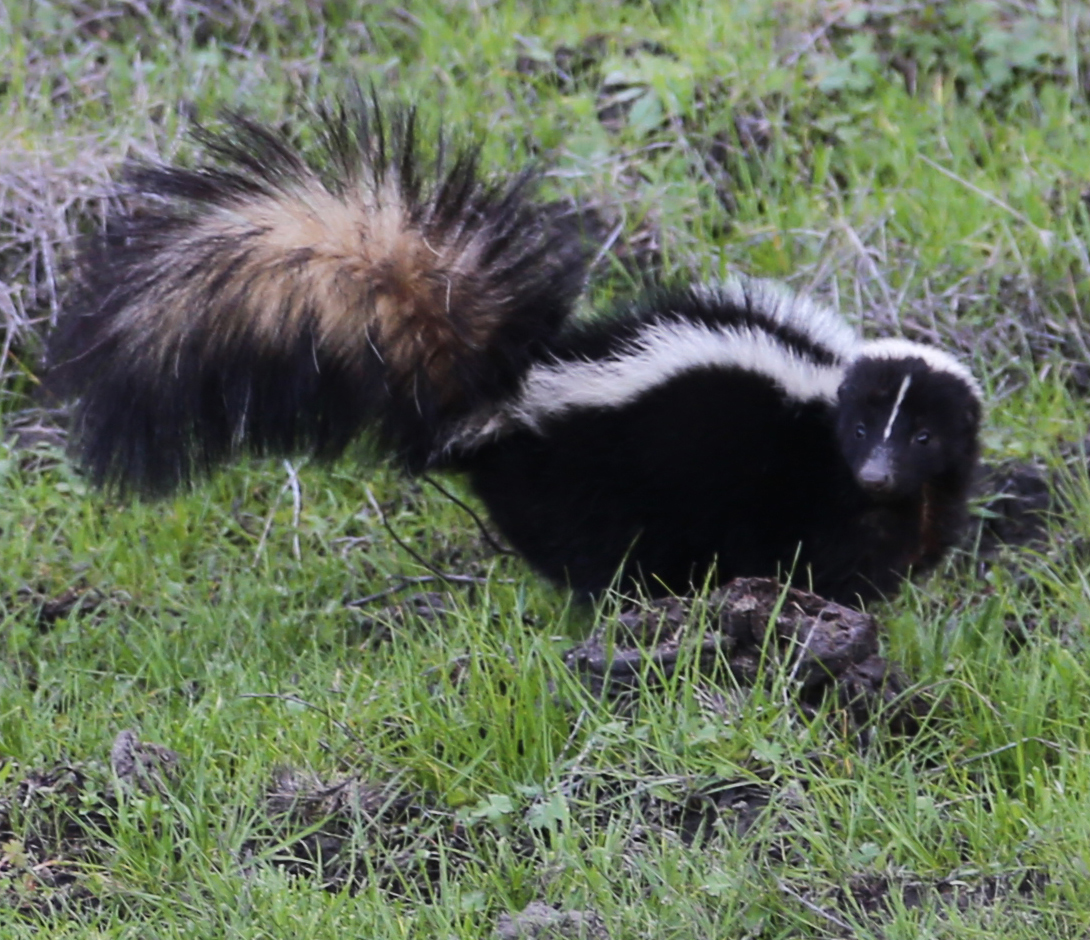
Three changes make skunks stay away, and none of them come in a spray bottle: no reachable food, no reachable shelter, and no dark undisturbed corner to raise a litter. The striped skunk (Mephitis mephitis) is a generalist that eats insects, grubs, fallen fruit, pet kibble, and whatever a loose trash lid exposes. A yard that offers all four is worth defending; a yard that offers none is not worth the walk.
Start with the obvious sources. Feed pets indoors, use trash cans with locking lids or a bungee cord across the top, and rake up fallen fruit and spilled birdseed, since the seed draws skunks less than the mice and insects it attracts. Open compost piles with food scraps are a reliable skunk magnet.
Then close the shelter. Skunks dig their own burrows but prefer a ready made space: under a deck, a shed with a gap at one corner, a crawl space vent that has lost its screen, a woodpile, or an abandoned groundhog burrow. Walk the perimeter of every structure and note every opening wider than 4 in (10 cm).
Find the Den Before You Do Anything Else
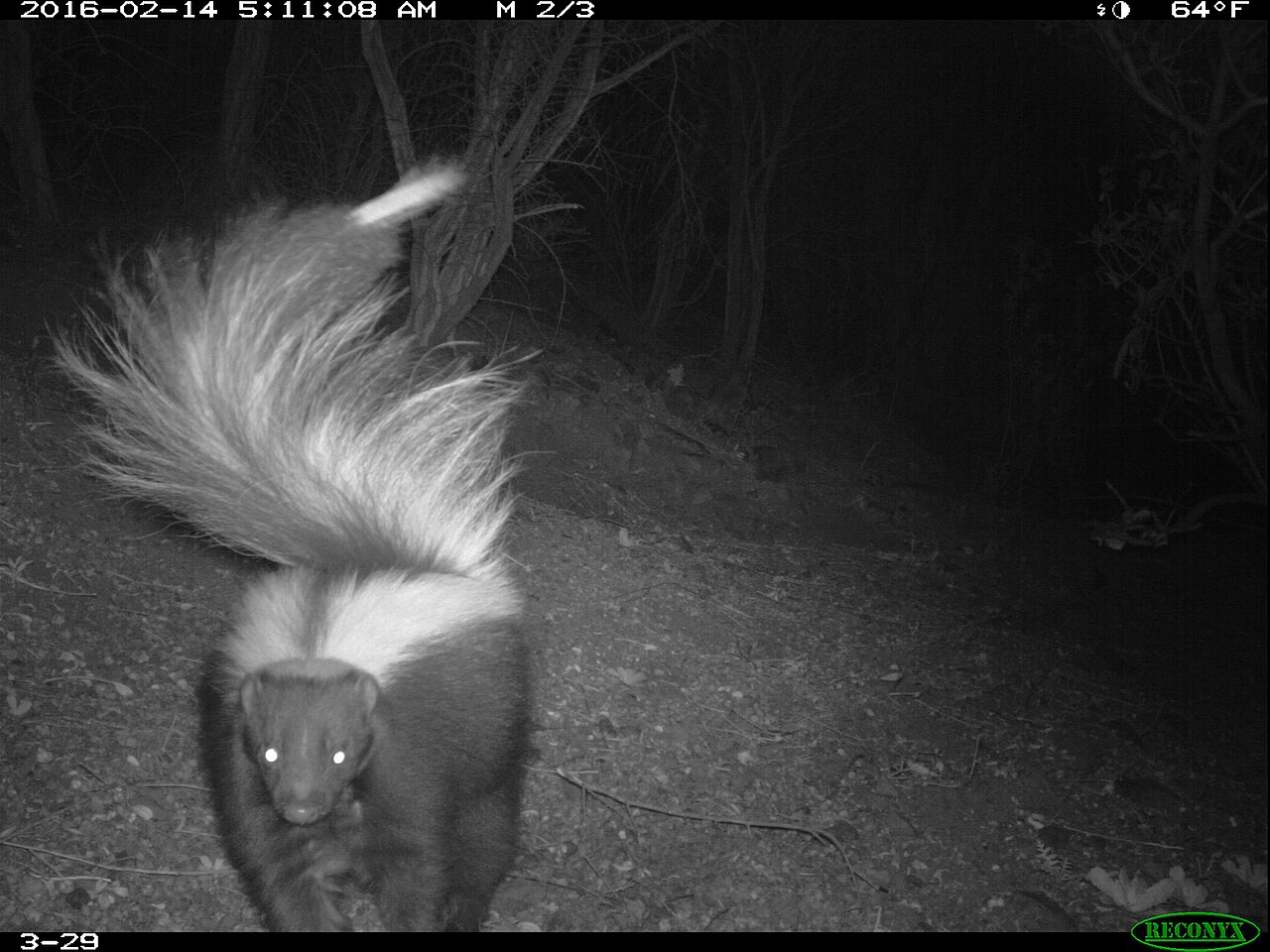
You cannot evict an animal you have not located, and sealing a hole with a skunk behind it creates a far worse problem. Look for an opening 4 to 8 in (10 to 20 cm) across with packed soil at the entrance, coarse black and white hairs on the edge, and a faint musk smell. Skunk tracks show five toes and long front claw marks.
Droppings near the entrance confirm the tenant. Skunk scat is about 2 in (5 cm) long, blunt at the ends, and full of insect shells or seeds, which separates it from cat or raccoon waste. Our guide to identifying skunk droppings shows the comparison.
Confirm occupancy with the flour test. Spread a thin layer of flour in a 12 in (30 cm) band across the opening at dusk, then check it after dark and again at dawn. Tracks leading out and none leading back in mean the den is empty right now, which is your window. Tracks in both directions mean the animal is home, so wait another night.
How Do I Get a Skunk to Leave My Property?

The reliable eviction tool is a one way door, a wire flap mounted over the entrance that swings outward and not back in. Fit it over the only active opening after screening every other gap, and leave it for 3 to 5 nights so a skunk that sits out a rainy evening still gets its chance. Check the flour band each morning.
Timing matters more than technique. Never evict between mid March and early July in most of the United States, because a female skunk carries a litter of 4 to 7 kits that cannot follow her out. Sealing the den in those weeks leaves the young to die under your deck, which is both cruel and, in practical terms, a smell problem that lasts for months. Our piece on skunk kits and when they leave the den covers the timeline in detail.
Harassment speeds things up when you cannot wait. A bright work light at the entrance, a radio on a talk station, and rags soaked in household ammonia placed near but not inside the den usually move an adult within 1 to 3 nights. Never use ammonia where a litter might be trapped.
Do Coffee Grounds, Vinegar, or Mothballs Get Rid of Skunks?
No. Coffee grounds do not get rid of skunks, and the popular claim that the smell repels them has no field support; skunks routinely forage through compost piles that contain grounds. Vinegar does nothing to skunks beyond a strong odor they walk past, and a bowl of vinegar left under a deck will evaporate within a day or two without changing anything about the den.
Mothballs are worse than useless because they are also illegal in this use. Naphthalene products are registered pesticides, and applying them outdoors or under a structure violates the label and federal law, while the vapor is a genuine hazard for children, pets, and groundwater. The same applies to the widely shared tip about chocolate, which is simply a slow poisoning method dressed up as a home remedy.
Will a Porch Light Keep Skunks Away?
A porch light alone will not keep skunks away, because a steady light becomes background within a night or two and skunks forage comfortably at the edge of a lit yard. What does work is light that changes: a motion activated floodlight aimed at the den entrance or the feeding area startles the animal each time it approaches and never fully loses its effect.
Motion activated sprinklers are the stronger version of the same idea and the one gadget worth buying. A sudden burst of water reroutes a skunk’s nightly circuit, works in rain, and needs no reapplying. Position it across the approach path, not the middle of the lawn.
Sound follows the same rule: constant ultrasonic devices are ignored within days, while an irregular human voice from a radio near a den is disruptive during the daylight hours when the skunk is asleep. Our notes on the calls and stomping skunks make help you tell a skunk from a raccoon first.
What Is a Skunk’s Worst Enemy?
The great horned owl (Bubo virginianus) is the skunk’s most significant natural predator, because it hunts silently from above and has a poor sense of smell, which makes the spray defense nearly worthless. Coyotes, bobcats, foxes, and domestic dogs kill skunks occasionally, but usually young or sick ones, and most learn after a single face full of musk to leave adults alone.
That explains why predator urine repellents underperform. A skunk whose spray works at 10 to 15 ft (3 to 4.5 m) against almost every ground predator does not abandon a good den over a bottle of coyote urine.
Suburbs concentrate skunks because cover is good and traffic is slow, which is also where they overlap most with other yard visitors. If you are unsure which animal you have, compare with opossum behavior in yards; the two share habits and are confused constantly.
Remove What They Are Actually Eating
Most suburban skunk problems are grub problems. Cone shaped holes 2 to 4 in (5 to 10 cm) across appearing overnight across a lawn mean the skunk is digging for the larvae of Japanese beetles and June bugs, and no amount of repellent competes with a food source that dense. Treat the lawn with beneficial nematodes in late summer or a labeled grub control product, and the digging usually stops within 2 to 4 weeks.
Other sources are easier. Put bird feeders on poles with seed catchers, pick up fallen fruit daily in season, and store chicken feed in metal bins. Outdoor cat colonies are the hardest case, since they provide a nightly meal the skunk can count on.
Seal the Yard so They Do Not Come Back
Exclusion is the only permanent answer, and it fails almost entirely on one detail: skunks dig. Screen the open sides of decks, sheds, and porches with 1/4 in (6 mm) hardware cloth, then extend the bottom of that screen 12 in (30 cm) into the ground and bend the buried edge outward into an L shape. A flush screen that stops at soil level buys you about one night.
Cover crawl space vents and foundation gaps with the same material rather than plastic mesh, which skunks and raccoons tear through, and clear the brush piles and stacked lumber that serve as backup shelter. The same work stops the rodents and other mammals using those spaces, which is why our exclusion guide for bats recommends doing the whole perimeter in one pass.
Where local rules allow trapping, understand what you are taking on. Many states prohibit relocating skunks because of rabies risk, so a trapped animal must be released on site or euthanized, and a licensed wildlife control operator is usually the only legal route. The rabies precautions themselves are worth reading directly from the CDC rabies pages before anyone in the household handles a trap.
Frequently Asked Questions
Do skunks come out during the day?
Yes, occasionally, and daytime activity alone is not a rabies sign. Nursing mothers forage in daylight when food is short, and young skunks in late summer often wander at dusk or dawn. Staggering, circling, aggression, or no reaction to people are the symptoms that justify a call to animal control.
What food is poisonous to skunks?
Chocolate, caffeine, and antifreeze are all toxic to skunks, which is why they circulate as home remedies. Using any of them is animal cruelty under most state laws, and a skunk that dies under your deck creates an odor problem that lasts for weeks. There is no legal poison registered for skunks in the United States.
Will skunks eventually go away on their own?
A skunk passing through will move on in a few nights, but one that has established a den under a structure will stay through the season and return to the same site the next year. Females often reuse a successful den. If food and shelter stay available, the vacancy is filled quickly by another animal.
How do I get rid of a skunk den fast?
Confirm the den is empty with a flour test at the entrance, mount a one way door, and leave it for 3 to 5 nights before sealing with buried hardware cloth. Adding a bright light and a radio at the entrance usually cuts that to 1 or 2 nights outside the spring denning season.
How do I get rid of skunk smell in the yard?
Mix 1 quart (about 1 liter) of 3 percent hydrogen peroxide, 1/4 cup of baking soda, and a teaspoon of dish soap, then apply to hard surfaces and rinse. Tomato juice does not work. For soil and lawn, dilute the same mixture heavily or simply water the area, since the musk breaks down within about 2 weeks.