Green Anole: Why It Turns Brown, What It Eats, and How to Keep One
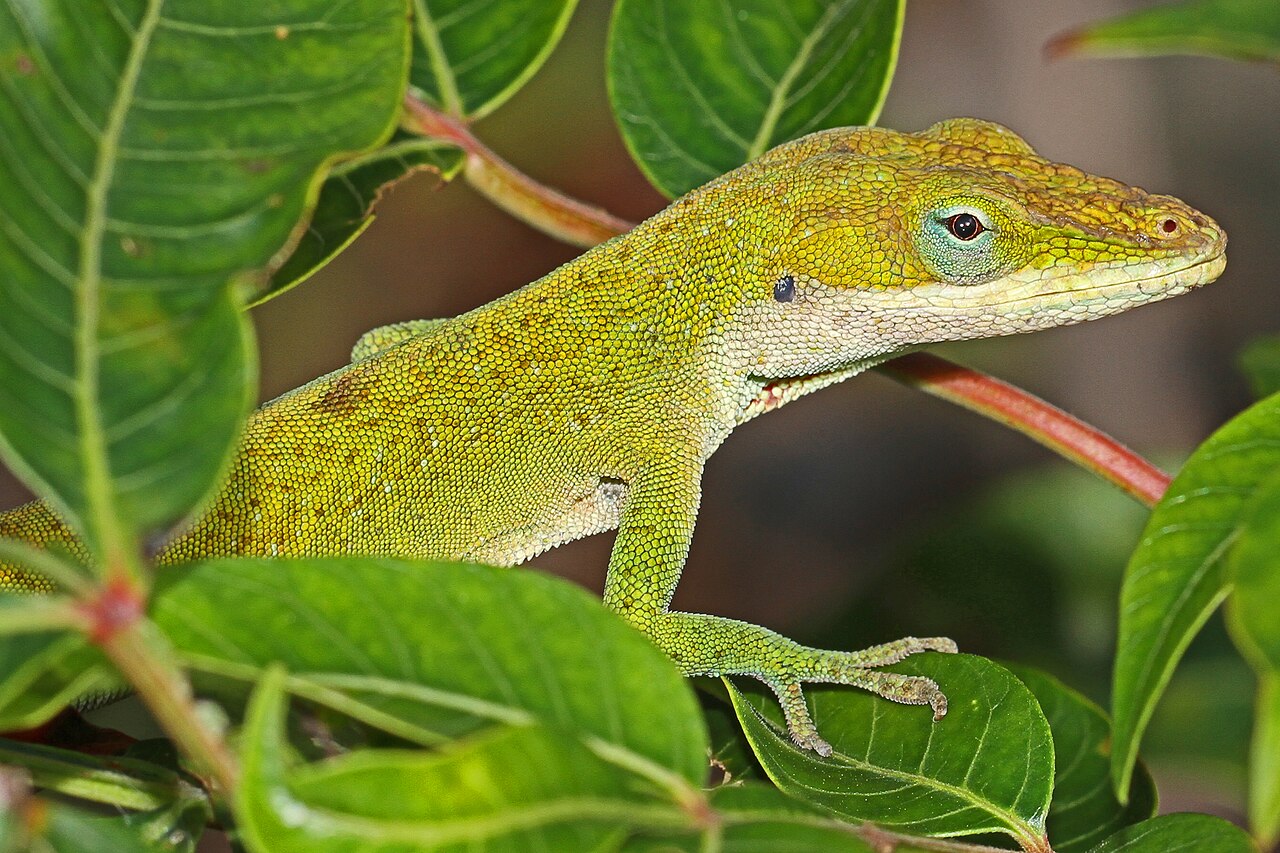
The green anole (Anolis carolinensis) is the only anole lizard native to the United States, a slender five to eight inch (13 to 20 cm) climber that shifts between bright green and dull brown depending on temperature, stress, and social context. If you live anywhere from North Carolina to Texas, this is the small lizard doing push ups on your porch railing.
Most people meet a green anole long before they learn its name. It is common in yards, hedges, and citrus trees across the Southeast, tame enough to watch from three feet away, and easy to confuse with the invasive brown anole that has pushed it higher into the shrubs. This guide covers identification, the real reason for the color change, diet, the pink throat fan, and what it takes to keep one alive in a tank.
A green anole is a small arboreal lizard native to the southeastern United States. It grows 5 to 8 in (13 to 20 cm) including the tail, eats insects, and changes between green and brown for reasons tied to temperature and stress rather than background color. It is harmless to humans and lives 4 to 8 years.
| Quick Fact | Detail |
|---|---|
| Scientific name | Anolis carolinensis |
| Adult length | 5 to 8 in (13 to 20 cm), tail included |
| Native range | Southeastern US, North Carolina to Texas |
| Diet | Crickets, flies, spiders, moths, small beetles |
| Lifespan | 2 to 4 years wild, 4 to 8 in captivity |
| Dangerous? | No. Not venomous, not poisonous, bite cannot break skin |
What Is a Green Anole?
The green anole is a small lizard in the family Dactyloidae, a group of roughly 400 anole species centered on the Caribbean and Central America. Only one of them reached the US mainland on its own, and that is Anolis carolinensis. Everything else you might see in Florida arrived by ship, cargo, or pet trade.
It is built for vertical life. The toes carry adhesive lamellae that let it walk up glass and tree bark, the tail is roughly twice the body length for balance, and the eyes move independently so it can watch a wasp and a rival at the same time. People often call it an American chameleon, which is wrong on both counts: it is not a chameleon and its color change works nothing like one.
How to Identify a Green Anole
Look for a slim body, a long pointed snout, and a clean line of color with no pattern. An adult green anole in its green phase is a uniform bright leaf green above and pale white or cream underneath, with a thin white stripe sometimes visible along the flank. There are no spots, no bands, and no ridge of spines along the back.
Males are noticeably larger than females and carry a pink to reddish throat fan they can snap open. Females usually show a distinct cream or white stripe running down the spine, which males lack. If the lizard you are looking at has a dark diamond or wavy pattern on its back, you are almost certainly looking at a brown anole instead.
Why Do Green Anoles Turn Brown?
Green anoles do not match their background. The shift from green to brown is driven by temperature, light level, hormones, and stress, and it happens through pigment cells called melanophores that spread dark melanin toward the skin surface. A cold or frightened anole goes brown. A warm, settled anole sitting in filtered sun goes green.
That distinction matters for anyone keeping one. A captive anole that stays brown for days is usually telling you something is wrong: the enclosure is too cold, the lighting is poor, or another lizard is bullying it. A healthy animal cycles through both colors in the course of a normal day, often turning green within minutes of finding a warm perch.
Green Anole vs Brown Anole: How to Tell Them Apart
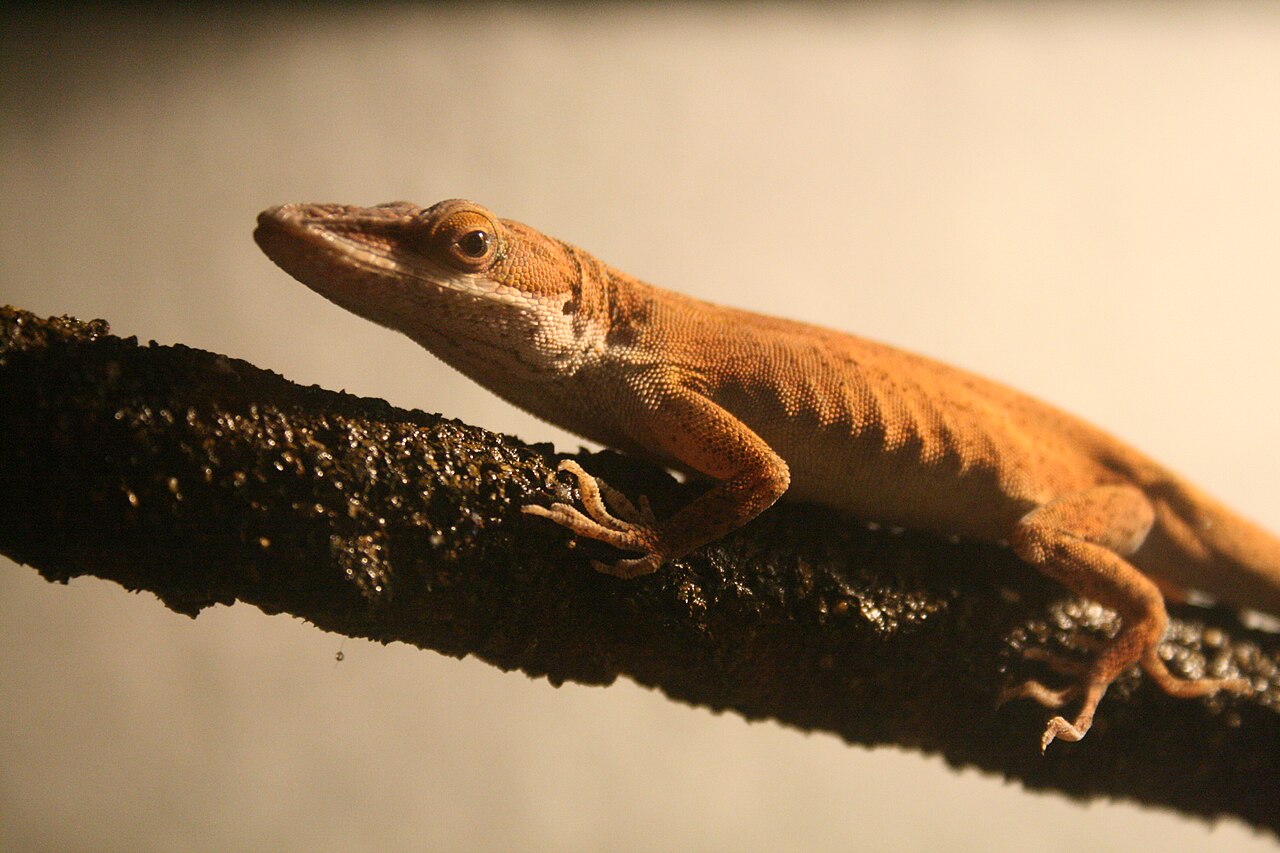
This is the single most common identification error in Florida yards, because a stressed green anole is brown. The reliable difference is pattern, not color. Brown anoles (Anolis sagrei) carry dark triangular or diamond markings on the back and never turn green at any point in their lives.
The throat fan settles it too. A green anole flashes a pink or rose dewlap with no border. A brown anole flashes a fan that is orange to red with a bright yellow or cream edge. Brown anoles also keep lower to the ground, which is part of why they displaced green anoles upward into the canopy after arriving from Cuba in the late 1800s.
Where Green Anoles Live
The native range runs from southeastern Virginia and North Carolina south through Florida and west across the Gulf states into central Texas and southern Oklahoma. Introduced populations exist in Hawaii, Guam, and parts of southern California. Within that range they are creatures of edges: fence lines, shrub borders, palm trunks, and the sunny outer branches of trees.
They tolerate suburbia well, which is why most sightings happen on porches and garden walls rather than in deep forest, often in the same hedges that attract green birds and other yard wildlife. Cold snaps are the limiting factor at the northern edge of the range. Below roughly 40 degrees Fahrenheit (4 C) they go sluggish and shelter in leaf litter, bark crevices, or under siding until it warms.
What Do Green Anoles Eat?
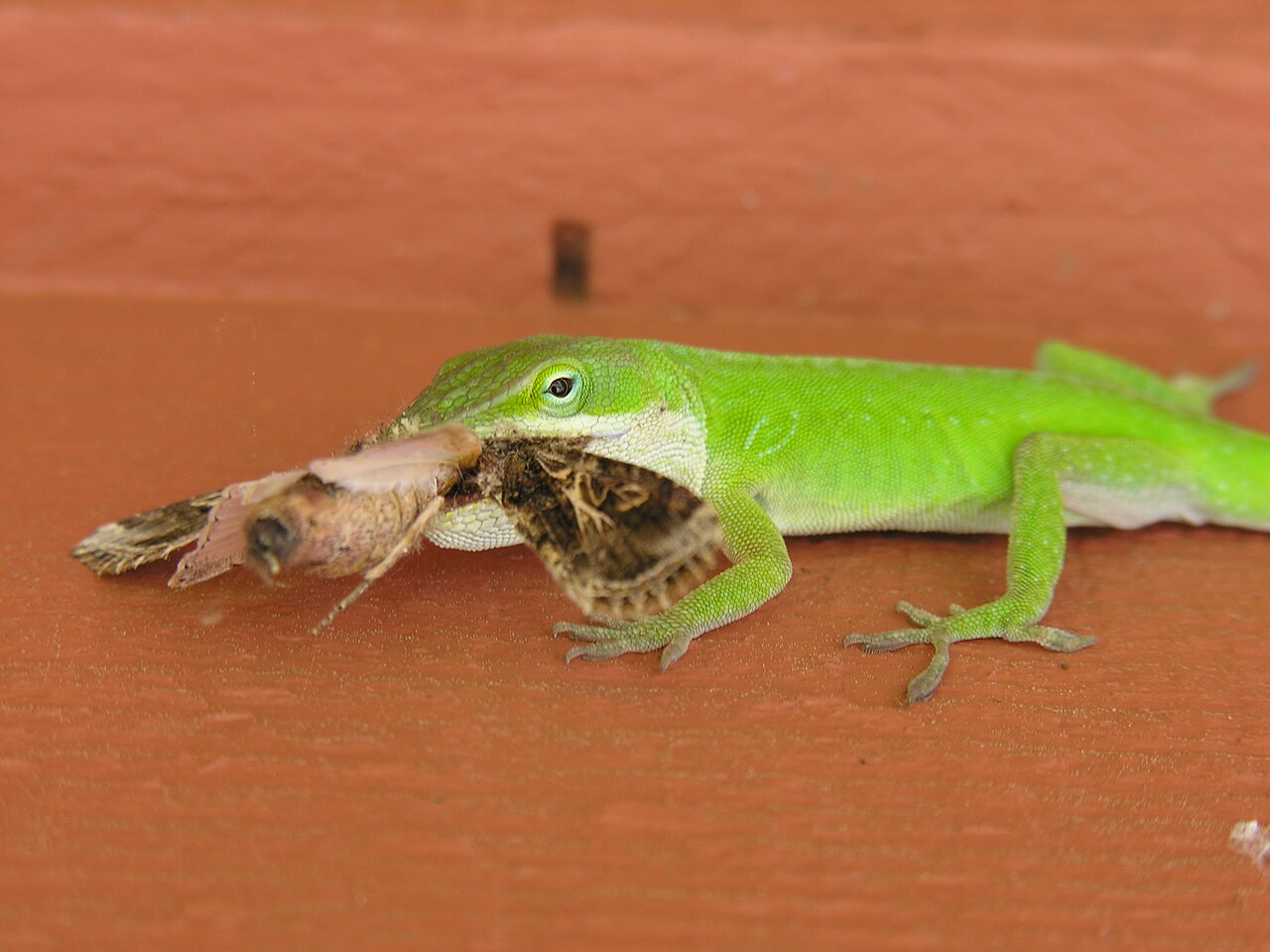
Green anoles are insectivores and hunt by sight, staying still until something moves and then closing the distance in a short rush. The wild diet is crickets, flies, moths, spiders, small beetles, grubs, and the occasional soft caterpillar. They rarely take anything wider than their own head, so a fat green caterpillar is usually safe unless it is a young one.
They drink from droplets rather than standing water, licking rain and dew off leaves, which is why misting matters so much in captivity. Anoles will also lap at overripe fruit or nectar now and then, but that is opportunistic rather than a real part of the diet. If your yard has anoles, it has an insect population worth keeping, and a green grasshopper in the grass is very much on the menu.
The Dewlap: Why Male Anoles Flash Pink
The dewlap is a fold of skin under the throat supported by a hinged cartilage rod. When a male extends it, the skin stretches thin and the pink pigment shows through, often paired with a series of head bobs and push ups. The whole display lasts a few seconds and is repeated as long as the audience stays.
It does two jobs. Against another male it means the perch is taken, and it usually settles the matter without contact. Toward a female it is courtship, delivered with a slower, more rhythmic bob. Females have a small dewlap too and occasionally flash it, but the display is far less frequent and much paler.
Green Anole Behavior Through the Day
Anoles are diurnal and follow the sun. Early morning is spent basking flat against a warm surface, often still brown from the cool night. By mid morning they have warmed, turned green, and moved to a patrol perch where they watch for insects and rivals.
Territories are small and vertical. A male defends a column of shrub or trunk, typically a few square yards, and the females whose ranges overlap his. At dusk they wedge into a leaf cluster or bark crack and sleep in the open, which is when snakes such as the rough green snake take the greatest toll on them.
Breeding and Baby Green Anoles
Breeding runs from April through September in most of the range. After mating, the female lays a single soft shelled egg roughly every two weeks through the season, burying each one shallowly in moist soil, leaf litter, or a pot of damp mulch. There is no parental care at all once the egg is covered.
Eggs hatch in five to seven weeks depending on temperature. Hatchlings are about 2 in (5 cm) long, fully independent, and immediately at risk from larger anoles, birds, and cats. They reach breeding size in roughly eight months, which means an anole hatched in June may be defending its own perch the following spring.
How Long Do Green Anoles Live?
Wild green anoles usually live two to four years, and a great many never finish their first. Predation is constant: jays, mockingbirds, snakes, larger lizards, and domestic cats all take them, and cats alone account for heavy losses in suburban populations.
In captivity the picture changes. With correct heat, UVB, humidity, and a varied insect diet, four to eight years is normal and a few individuals pass nine. The gap between wild and captive lifespan is almost entirely about predation rather than any fragility in the animal itself.
Keeping a Green Anole as a Pet
Green anoles are inexpensive and widely sold, which has given them a reputation as a beginner animal that they do not really deserve. They need a tall enclosure, at least 10 gallons for one adult and 20 for a small group, planted so they can climb and hide. One male per tank is the rule, since two males in a confined space means constant stress for the loser.
Provide a basking spot near 88 degrees Fahrenheit (31 C), a cool end in the mid 70s, a UVB tube, and humidity around 60 to 70 percent maintained by misting twice a day. The setup is closer to what an albino corn snake needs than to a desert enclosure, since humidity matters as much as heat. Feed appropriately sized crickets dusted with calcium every other day. They are a display animal rather than a handling animal: they stress quickly in the hand and can drop their tail, and unlike some reptiles the regrown tail never looks right again. Anyone comparing options should know that a Abyssinian guinea pig tolerates handling far better.
Are Green Anoles Dangerous or Poisonous?
No. Green anoles are not venomous, not poisonous, and not capable of doing meaningful harm. A cornered adult may gape and give a quick nip, and in most cases the jaws cannot break human skin. There is no toxin involved and no medical concern beyond washing the spot.
They are also safe to have around the house and yard, where they work as free pest control on flies and small roaches. The reasonable precaution is the same as with any reptile: wash your hands afterward, because reptiles can carry Salmonella on the skin. The US Fish and Wildlife Service keeps general guidance on native reptiles and their habitat at fws.gov.
Frequently Asked Questions
Are green anoles and American chameleons the same thing?
Yes, they are the same animal under two names. American chameleon is an old pet trade nickname earned by the color change, but green anoles are not chameleons and are not closely related to them. Their color shift responds to temperature and mood rather than to background, and they cannot move their eyes the way true chameleons do.
Is a green anole bite poisonous?
No. A green anole bite carries no venom and no poison of any kind. The lizard is too small to break skin in most cases, and the bite feels like a firm pinch that releases within a second or two. Wash the area with soap and water as a routine precaution against bacteria, and nothing further is needed.
Why is my green anole staying brown all the time?
Persistent brown almost always signals a problem. The usual causes are an enclosure that is too cold, a missing or burned out basking lamp, low humidity, or stress from a dominant tank mate. Check the basking surface temperature first, confirm the UVB tube is under a year old, and separate any two males housed together.
Do green anoles need UVB lighting?
Yes. Green anoles are diurnal baskers and use UVB to synthesize vitamin D3, without which they develop metabolic bone disease. Run a low output linear UVB tube across part of the enclosure for 10 to 12 hours a day and replace it every 6 to 12 months, since output drops long before the light stops working.
Can green anoles live with other lizards?
Mixing species is a bad idea, and mixing males is worse. One male with two or three females works in a large planted enclosure, but two males will display and chase until the subordinate stops eating. Brown anoles in particular outcompete green anoles for food and perches, so never house the two together.
Are green anoles disappearing from Florida?
They are not disappearing, but they have shifted. Since brown anoles spread through Florida, green anoles have moved higher into trees and shrubs and are seen less often at ground level. Population studies show they persist in that upper layer rather than vanishing, which is why sightings feel rarer than they used to on porches and low walls.