Diamondback Water Snake: Not Venomous, but It Bites Hard
The diamondback water snake (Nerodia rhombifer) is not venomous, and that is the single most useful fact about it. This heavy bodied, brown to olive snake spends its life along the edges of rivers, oxbows, and farm ponds across the central and southern United States, and it gets killed constantly because people mistake it for a cottonmouth. It has no fangs, no venom glands, and no interest in chasing anyone.
What it does have is a very bad temper when cornered, a mouthful of small backward curving teeth, and a habit of draping itself over branches directly above the water where swimmers notice it first. Knowing how to tell a diamondback water snake from the venomous species that shares its range takes about ten seconds once you know what to look at.
The diamondback water snake is a nonvenomous North American colubrid that grows 3 to 5 ft long and lives in slow water across the Mississippi River basin and Gulf states. It bites hard and bleeds freely when handled because of anticoagulant saliva, but it carries no venom. Round pupils, a narrow head, and a chain link back pattern separate it from the cottonmouth.
| Quick Facts | Diamondback Water Snake |
|---|---|
| Scientific name | Nerodia rhombifer |
| Adult length | 30 to 60 in (76 to 152 cm), rarely 5 ft |
| Venomous | No |
| Range | Texas and Louisiana north to Iowa and Indiana |
| Habitat | Slow rivers, sloughs, oxbows, ponds, ditches |
| Diet | Fish, frogs, toads, tadpoles, carrion |
| Lifespan | Up to 10 years in the wild |
Is the Diamondback Water Snake Venomous?
No. The diamondback water snake has no venom glands and no hollow fangs. It belongs to the family Colubridae, the same group that includes the common garter snake and the rat snakes, and it kills prey by grabbing and swallowing rather than by envenomating. Nothing about a bite from this species requires antivenom.
The confusion comes from the cottonmouth (Agkistrodon piscivorus), a genuinely venomous pit viper that swims the same waters across the southern half of the diamondback’s range. Both are dark, thick, and semiaquatic. Because the two overlap from east Texas to Alabama, every water snake in that region gets treated as a moccasin by default, which is how thousands of harmless snakes die each summer.
How to Identify a Diamondback Water Snake
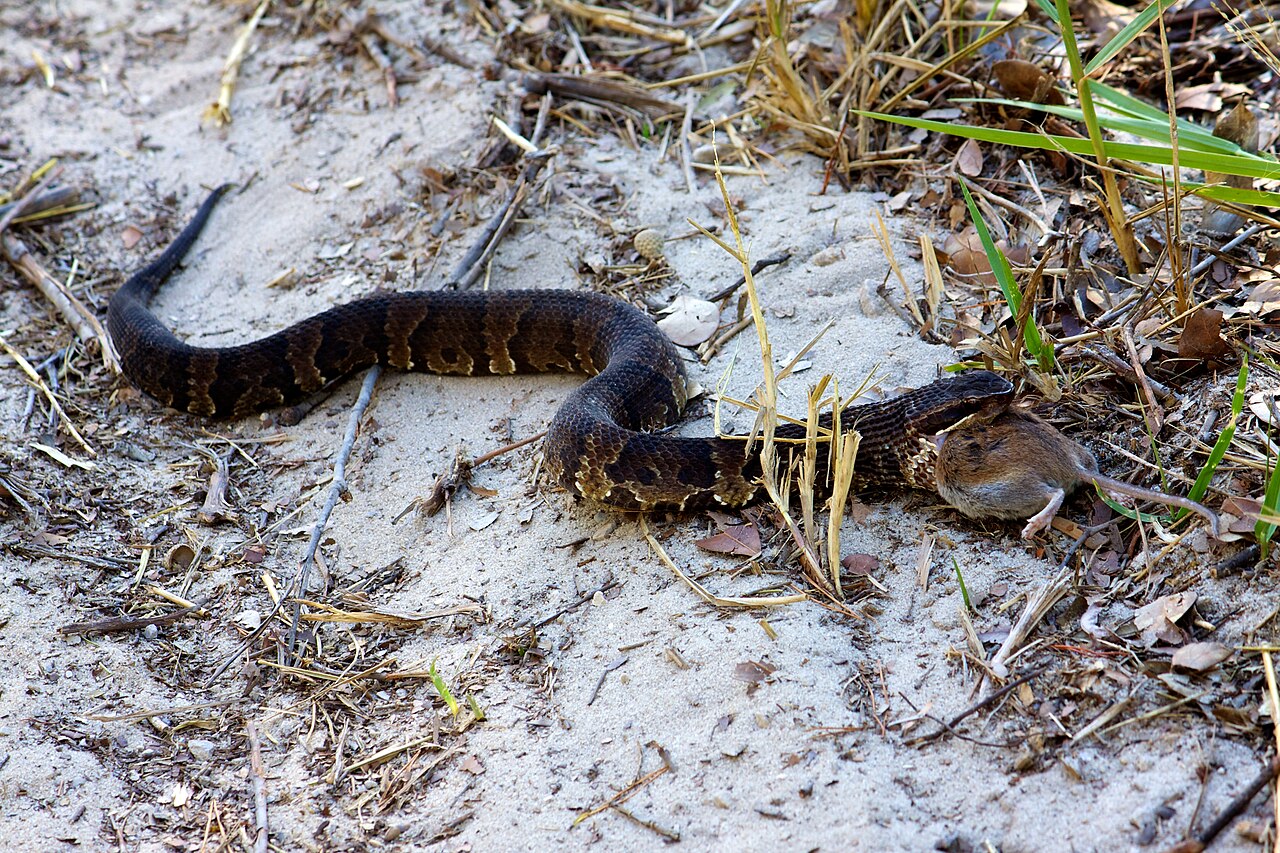
Look at the back first. The pattern is a dark chain of connected blotches over a brown, olive, or dull yellow ground color, and the links form rough diamond shapes with pale centers. Down each side runs a row of separate dark bars that interlock with the chain above. Older adults darken with age until an ancient male can look almost uniformly muddy brown in bad light.
The belly is the giveaway that costs nothing to check on a dead or photographed snake: cream to yellow, marked with scattered dark half moons and spots. Males carry small raised bumps called tubercles under the chin, a feature no other water snake in the region shows. The scales are strongly keeled, which is why a dry specimen looks rough rather than glossy.
Diamondback Water Snake vs Cottonmouth
The head shape shortcut that everyone repeats is the weakest one, because a frightened water snake flattens its head into a broad triangle on purpose. Use the eyes instead. A cottonmouth has a vertical slit pupil and a deep heat sensing pit between the eye and the nostril. The diamondback water snake has a round pupil and no pit, and a heavy dark stripe runs from the eye back to the jaw.
Behavior separates them too. A cottonmouth swims with its whole body riding high on the surface and tends to hold its ground, gaping to show the white mouth lining that gives it its name. A water snake swims with only the head above water, and it flees into the water or drops off a branch the moment it registers you. Neither species chases people. Learning the difference is worth more than any of the folk rules about red and yellow bands that circulate for other species.
How Big Do Diamondback Water Snakes Get?
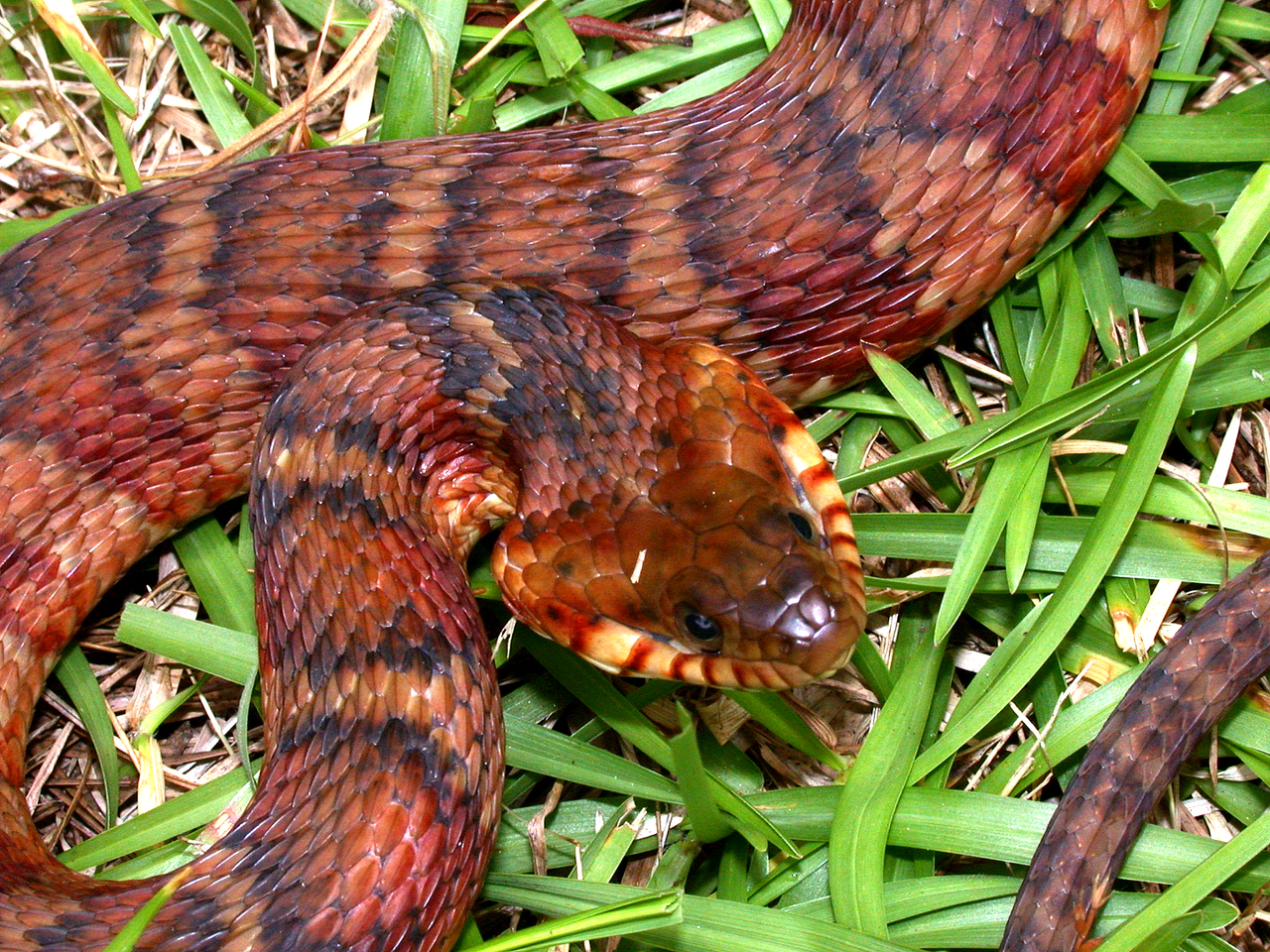
Adults typically run 30 to 48 in (76 to 122 cm), with large females reaching 60 in (152 cm). Females grow noticeably longer and much heavier than males, which is normal for the genus Nerodia. A big gravid female in late spring can be as thick through the middle as a soda can, and that bulk is a large part of why people read the animal as a viper.
Hatchlings arrive at 8 to 11 in (20 to 28 cm) and are far more sharply patterned than their parents. The contrast fades over the first two or three years. A yearling diamondback water snake has crisper markings than a bull snake of the same age, which sometimes leads to reports of exotic species in places they have never occurred.
Where Diamondback Water Snakes Live
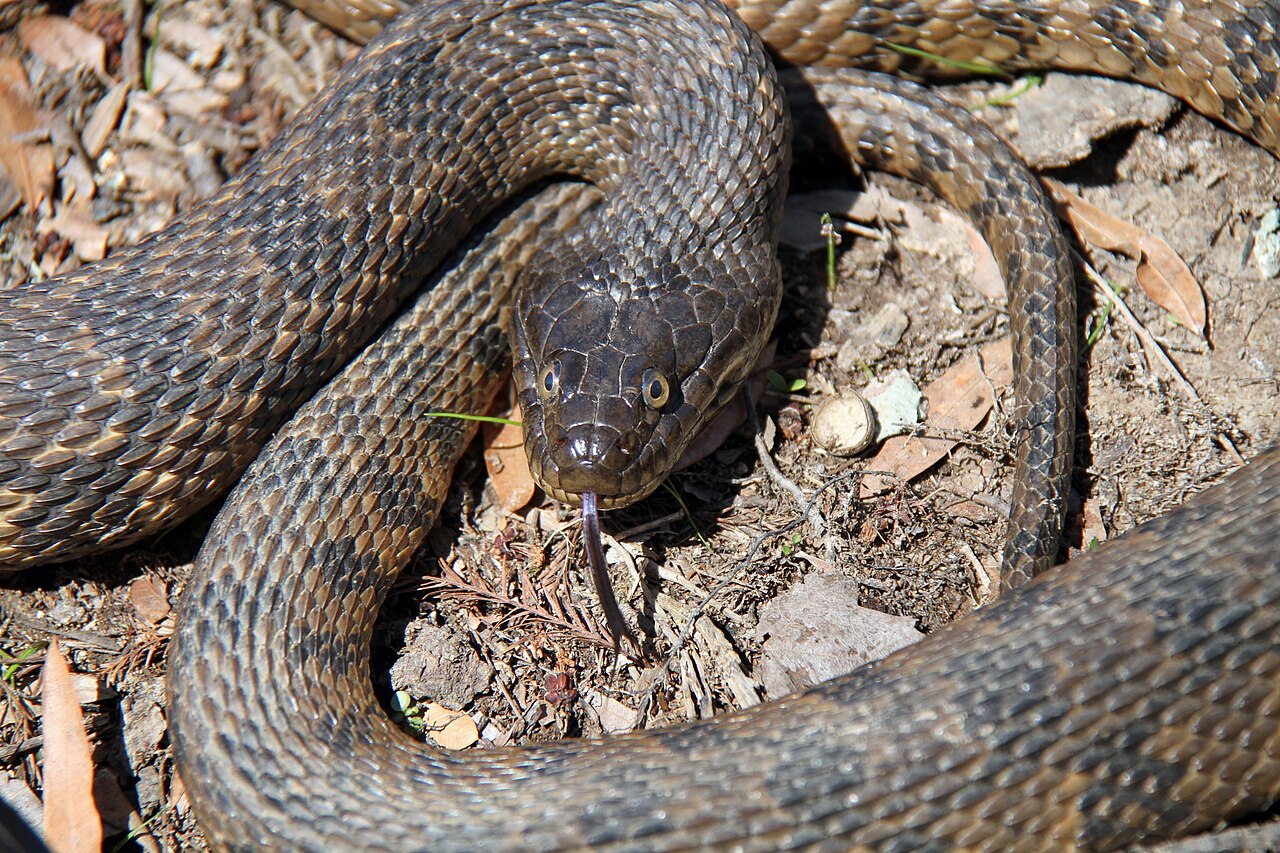
The core range covers the Mississippi River drainage from the Gulf Coast north through Arkansas and Missouri into southern Iowa, Illinois, and Indiana, and west across Texas to the edge of the Chihuahuan Desert. Isolated populations sit in Kansas and Nebraska along major river corridors. The species has also been introduced to a handful of California waterways, where it is treated as invasive.
Within that range it wants still or slow water with heavy cover: cypress sloughs, cattle tanks, drainage ditches, borrow pits, and the backwaters of large rivers. Fast clear streams hold fewer of them. Basking structure matters as much as the water itself, which is why so many sightings happen under bridges and along the willow branches that lean out over a bank.
What Diamondback Water Snakes Eat
Fish make up most of the diet, and the snake shows a clear preference for slow, sick, or dying ones. It hunts by hanging its head into the water from a low branch or by nosing through vegetation in the shallows with its mouth open, snapping shut on contact. Catfish, shad, sunfish, and minnows all turn up in stomach contents.
Amphibians fill the rest: frogs, toads, tadpoles, and the occasional salamander. Unlike a hognose snake, which specializes in toads and shrugs off their skin toxins, the diamondback water snake is an opportunist and will take carrion, including dead fish washed against a dam. It does not constrict. Prey goes down alive and head first.
Does a Diamondback Water Snake Bite Hurt?
Yes, more than people expect. The teeth are small but numerous and angled backward, so a bite that lands and holds leaves a ragged crescent of shallow punctures rather than two clean holes. The saliva contains mild anticoagulant compounds, and a hand bitten by a 4 ft female can bleed impressively for ten to fifteen minutes. That bleeding scares people into thinking they were envenomated.
Treatment is the same as for any minor animal bite: wash with soap and water, apply pressure until the bleeding stops, and watch for infection over the next few days. Tetanus status is worth checking. A garter snake bite follows the same pattern on a smaller scale. If there is swelling that spreads, severe pain, or discoloration, that points to a misidentified pit viper and needs emergency care.
Diamondback Water Snake Behavior Through the Year
Activity starts in March or April in the south and closer to May in the northern part of the range. Spring is the most visible season because snakes bask hard to warm up after brumation and males roam widely looking for females. Summer pushes activity toward dawn, dusk, and full night, especially during heat waves when daytime water temperatures climb.
By late October the snakes move to overwintering sites: crayfish burrows, root tangles, rock crevices, and old muskrat lodges above the flood line. They do not truly hibernate. A warm winter afternoon in Louisiana will bring a few out to bask on the bank, which is why reports of water snakes in January are usually accurate rather than mistaken.
Breeding and Baby Diamondback Water Snakes
Mating happens in April and May, often with several males trailing one female and jostling around her in a loose ball. Males use those chin tubercles during courtship, pressing them against the female’s body. The species is viviparous, meaning the female carries developing young internally and gives birth to live neonates rather than laying eggs the way a corn snake does.
Litters arrive in August and September and are large: 14 to 30 young is typical, and exceptional females have produced more than 60. The neonates disperse immediately with no parental care and begin eating small fish and tadpoles within days. Most will be taken by herons, egrets, bass, turtles, and larger snakes before their first birthday.
Are Diamondback Water Snakes Aggressive?
They are defensive, not aggressive, and the difference matters. A cornered diamondback water snake flattens its head and body, hisses, strikes repeatedly, and empties its cloacal glands, producing a musk that smells like spoiled fish and clings to skin for hours. That whole performance is an attempt to end the encounter, not to start one.
The stories about water snakes chasing boats and swimmers come from a real behavior with a boring explanation. A snake startled off a branch heads for the nearest deep water or the shadow of the boat, which can put it on a line straight toward the person who scared it. It is looking for cover, not for a target.
What to Do If You Find One in Your Yard or Pond
Leave it alone and it will leave. A diamondback water snake in a backyard pond is there because the pond holds fish or frogs, and it will move on when that food runs out or when the season turns. It poses no threat to people or to dogs that are not actively harassing it. Killing it is both unnecessary and, in several states, illegal without a permit.
If the snake needs to go, spray it with a garden hose from a safe distance or gently sweep it toward open ground with a long pool skimmer. Never grab a water snake by hand, and never use a shovel, because most bites happen during attempts to kill or move the animal. Reducing brush piles and trimming overhanging branches makes the spot less attractive next season.
Diamondback Water Snakes as Pets
They are legal to keep in most of their range but rarely a good choice. Wild caught adults stay defensive for months or years, musk constantly, and often carry heavy parasite loads. The fish based diet is smelly and expensive, and the enclosure needs a large water area plus a dry basking surface, which means constant cleaning.
Captive bred neonates handled daily from birth do calm down, and a few keepers work with them successfully. Even so, a beginner is far better served by a docile, dry substrate species such as a corn snake morph, which eats frozen rodents and tolerates handling. The Savannah River Ecology Laboratory at the University of Georgia publishes a detailed regional guide to native snakes at srelherp.uga.edu that is worth reading before acquiring any native species.
Related reading: Banded Water Snake.
Related reading: Brown Water Snake.
Related reading: Plain Bellied Water Snake.
Related reading: Northern Water Snake.
Frequently Asked Questions
Is a diamondback water snake poisonous?
No. The snake is neither poisonous nor venomous. Poisonous means harmful to eat or touch, and venomous means it injects toxins through a bite. The diamondback water snake is neither. Handling one is safe from a toxicology standpoint, though the bite itself is painful and the musk is genuinely awful.
What is the difference between a diamondback water snake and a water moccasin?
The water moccasin, or cottonmouth, is a venomous pit viper with vertical pupils, a facial heat pit, and a solid dark body with faint crossbands. The diamondback water snake has round pupils, no facial pit, a chain link back pattern, and a spotted cream belly. Cottonmouths gape to show a white mouth; water snakes flee.
Do diamondback water snakes have rattles?
No. Despite the shared word in the name, this species is unrelated to the diamondback rattlesnakes. It has no rattle and no venom. The name refers only to the diamond shaped links in its back pattern. A rattlesnake in the water is uncommon but possible, and it will always have a visible rattle at the tail tip.
How long do diamondback water snakes live?
Wild individuals that survive their first year commonly reach 6 to 10 years. Predation on newborns is heavy, so average lifespan across all births is far lower. Captive specimens with clean water and steady food have lived past 15 years, though the species is not widely kept long term.
Why does my diamondback water snake smell so bad?
Defensive musk. Glands at the base of the tail release a thick yellowish fluid mixed with feces when the snake feels threatened, and it is one of the most persistent smells in North American herpetology. Soap alone often will not remove it from skin. Time, repeated washing, and a baking soda paste work better.
Can a diamondback water snake kill a dog?
No. A bite from this species produces punctures and bleeding but no systemic effect, so a healthy dog needs only wound cleaning and monitoring for infection. Any dog with facial swelling, lethargy, or collapse after a snake encounter near water should be treated as a possible cottonmouth bite and taken to a veterinarian immediately.