Coral Snake Rhyme: The Exact Words and Where They Fail
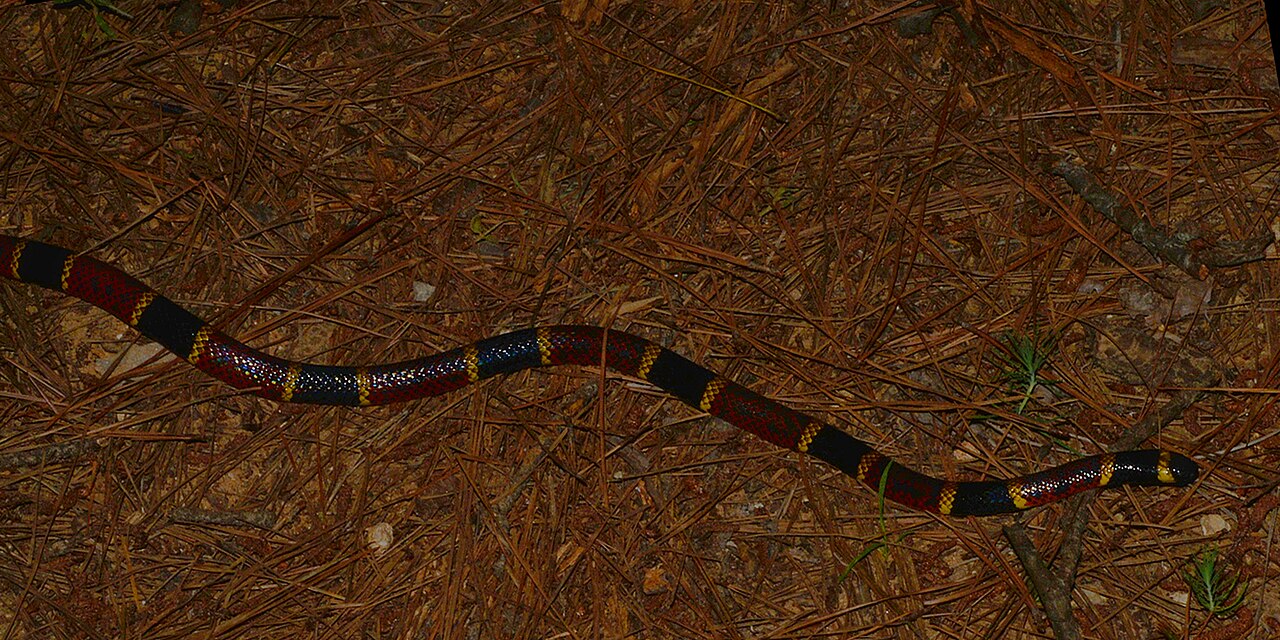
The coral snake rhyme is the old field saying “red touches yellow, kill a fellow; red touches black, venom lack,” and in the United States it is right far more often than it is wrong. Every venomous coral snake north of Mexico wears narrow yellow rings that sit directly against the red ones, while the harmless mimics separate their red from their yellow with black. The rhyme is a memory aid, not a law of nature, and it collapses the moment you leave North America.
Knowing the words is only half of it. The rhyme fails people who misremember the second line, who meet a faded or blotched individual, or who try to apply it to a snake in Costa Rica. Below is the exact wording, where it came from, which snakes it sorts correctly, and the one head marking that beats the rhyme in a glance.
The coral snake rhyme is “red touches yellow, kill a fellow; red touches black, venom lack.” It reliably separates the three venomous coral snakes of the United States from their harmless lookalikes, because only coral snakes place red bands against yellow ones. The rhyme does not apply outside North America, where coral snakes show black, white, and solid patterns.
| Snake | Band order | Snout color | US range | Danger |
|---|---|---|---|---|
| Eastern coral snake (Micrurus fulvius) | Red touches yellow | Black | NC to FL, west to LA | Venomous, neurotoxic |
| Texas coral snake (Micrurus tener) | Red touches yellow | Black | TX, AR, LA | Venomous, neurotoxic |
| Sonoran coral snake (Micruroides euryxanthus) | Red touches white or yellow | Black | AZ, NM | Venomous, bites very minor |
| Scarlet kingsnake (Lampropeltis elapsoides) | Red touches black | Red | NJ to FL, west to TX | Harmless |
| Scarlet snake (Cemophora coccinea) | Red touches black | Red | Southeast, NJ to TX | Harmless |
| Milk snake (Lampropeltis triangulum) | Red touches black | Varies | East and central US | Harmless |
What Is the True Rhyme for Coral Snakes?
The version worth memorizing is “red touches yellow, kill a fellow; red touches black, venom lack.” It describes the adjacency of colored rings on the snake’s body, nothing else. On a coral snake the wide red bands are bordered on both sides by narrow yellow bands, so red and yellow are always in contact somewhere along the animal.
The reason this couplet beats the alternatives is that “venom lack” is a factual statement rather than a friendly one. Rhymes that end in “friend of Jack” or “safe for Jack” invite people to handle a snake they have identified from six feet away in bad light. A harmless snake is still a wild animal with teeth and a bad temper.
What Is the Nursery Rhyme About Coral Snakes?

There is no true nursery rhyme about coral snakes, only a folk mnemonic passed between hunters, farmers, and scout troops in the American South. It has no single author and no fixed wording, which is exactly why so many corrupted versions circulate. Search interest in a “nursery rhyme” version usually traces back to people half remembering something a relative said.
The saying almost certainly spread in the nineteenth and twentieth centuries alongside settlement of the Gulf Coast pine woods, where eastern coral snakes and scarlet kingsnakes share the same leaf litter. It survives because it is short, because it rhymes, and because in that specific landscape it works.
What Does “Red Touches Yellow” Mean?

“Red touches yellow” means the red and yellow rings are physically adjacent, with no black ring between them. Look at any point along the snake’s body and ask which colors share a border. On Micrurus fulvius the sequence runs black, yellow, red, yellow, black, so red and yellow meet twice per cycle.
A second detail makes this easier to see than people expect: coral snake rings encircle the entire animal, belly included. Mimics usually have a plain white, pink, or checkered belly, so a snake crossing a road with an unbanded underside is not a coral snake.
Which Snakes Does the Rhyme Sort Correctly?

Within the United States, the rhyme sorts every relevant species correctly. The three venomous species, eastern coral snake, Texas coral snake, and Sonoran coral snake, all put red against yellow or white. The common mimics, scarlet kingsnake, scarlet snake, and several milk snake subspecies, all put red against black.
That accuracy has limits made of geography rather than biology. Coral snakes in Central and South America include species with solid red bodies, black and white banding, and tricolor patterns in the “wrong” order. If you are outside North America, the rhyme is worse than useless because it produces false confidence. The same lesson applies to other regional identification shortcuts, including the ones people use for garter snakes in the Midwest.
Where the Coral Snake Rhyme Fails
The rhyme also fails on individual snakes rather than whole regions. Aberrant eastern coral snakes turn up with broken rings, melanistic patches, or unusually wide black bands that crowd the yellow. Juveniles fresh from the egg can be pale enough that yellow reads as cream and red reads as orange in low light.
Wet, muddy, or shedding snakes are the worst case. A coral snake that has just come out of a wet ditch looks gray brown until it dries, and a snake in blue, the cloudy pre shed phase, loses contrast entirely. When the colors are not clean, stop using the rhyme and use the head.
What Snake Gets Mistaken for a Coral Snake?
The scarlet kingsnake is the mimic people meet most often. It is a slender snake of pine flatwoods and rotting stumps, usually under 20 in (51 cm), and its red snout is the fastest tell. The scarlet snake is similar but has a plain belly and a slightly upturned rostral scale it uses for digging.
Farther north and west, milk snakes take over the mimic role, though their pattern is often blotched rather than ringed. Young corn snakes also get called coral snakes by people who register only “red snake,” despite having blotches instead of rings. None of these species is dangerous, and all of them eat rodents that you want off your property.
How to Identify a Coral Snake Without the Rhyme
Look at the snout. Every coral snake in the United States has a solid black snout that ends in a broad yellow band behind the eyes, and none of the mimics do. The mimics lead with red. This single character survives bad light, dried mud, and half remembered couplets.
Body shape helps too. Coral snakes have blunt heads barely wider than the neck, small black eyes with round pupils, and a smooth, almost enameled look to the scales. They are elapids, related to cobras, not pit vipers, so they lack the heat sensing pits and triangular heads people watch for on a bull snake that is bluffing.
Which Is Deadlier, a Rattlesnake or a Coral Snake?
Drop for drop, coral snake venom is more potent, but rattlesnakes kill far more people in the United States. Coral snakes account for roughly one percent of venomous snakebites in the country, on the order of 15 to 25 bites a year, because the animals are secretive, non aggressive, and have short fangs at the front of a small mouth.
Rattlesnakes bite thousands of people annually and deliver large volumes of tissue destroying venom through long, hinged fangs. If you are ranking risk by the chance of something bad happening to you this summer, rattlesnakes win the argument, and copperheads are not far behind.
Can a Coral Snake Bite a Human?
Yes. The old claim that coral snakes cannot break human skin or must chew to envenomate is wrong. Their fangs are short and fixed rather than hinged, so a glancing strike often fails, but a snake that gets a grip can deliver venom in seconds.
The dangerous part is the delay. Coral snake venom is neurotoxic, and symptoms such as drooping eyelids, slurred speech, double vision, and difficulty swallowing can appear hours after a bite that looked like two pinpricks. Any suspected coral snake bite is an immediate emergency room trip, even with no pain and no swelling. The U.S. Fish and Wildlife Service and state wildlife agencies publish regional snake guides worth reading before field season; see fws.gov for the federal materials.
Where You Are Likely to Meet One
Eastern coral snakes live in sandy pine woods, hardwood hammocks, and suburban yards across Florida, south Georgia, and the Gulf states. They spend most of their lives under leaf litter, logs, and mulch, hunting other snakes and lizards, which is why most encounters happen during yard cleanup rather than on trails.
Spring and fall mornings after rain produce the most sightings, and unlike many species they do not truly hibernate in the warm parts of their range. Wearing gloves when moving woodpile and mulch is the whole prevention strategy.
Can a King Snake Eat a Coral Snake?
Yes, and this is part of why the mimicry exists. Kingsnakes are ophiophagous, meaning snake eating, and eastern kingsnakes routinely kill and consume venomous species, including coral snakes, rattlesnakes, and copperheads. They constrict rather than envenomate and tolerate pit viper venom well.
The scarlet kingsnake is a much smaller relative and eats mostly lizards, so its resemblance to a coral snake is protective rather than predatory. The full comparison of pattern, size, and behavior is laid out in our guide to coral snakes and king snakes.
What to Do When You Find a Banded Red Snake
Back up to a distance of at least the snake’s body length and let it leave. Coral snakes do not chase, do not rattle, and prefer to burrow away from trouble; almost every recorded bite involved someone picking up or trying to kill the animal. Handling is the risk factor, not proximity.
If the snake is in a garage or pool enclosure, call animal control or a local reptile rescue rather than using a shovel. Killing snakes at close range with tools is how people get bitten by species they had correctly identified, the same mistake that turns harmless encounters with a hognose snake into hospital visits.
Frequently Asked Questions
Are coral snakes poisonous?
Coral snakes are venomous, not poisonous. Poison harms when eaten or absorbed; venom is injected through fangs. A coral snake is safe to eat and dangerous to handle. The distinction matters for first aid, because venom requires antivenom and emergency care rather than anything you can do in the field.
What is the coral snake rhyme in full?
“Red touches yellow, kill a fellow; red touches black, venom lack.” Some versions end with “friend of Jack” or “safe for Jack.” The wording differs, the meaning does not: red bands against yellow bands indicate a venomous coral snake in the United States, red against black indicates a harmless mimic.
Does the coral snake rhyme work in Mexico or South America?
No. More than 65 coral snake species live in Latin America, and many have patterns the rhyme would call harmless, including bicolored black and red forms. Outside the United States, treat every slender, brightly banded snake as venomous until an expert says otherwise.
Has anyone died from a coral snake bite recently?
Deaths are extremely rare. Fatalities in the United States have been counted in single digits over decades, thanks to antivenom and prompt hospital care. Bites remain serious: untreated envenomation can cause respiratory paralysis, and supply of North American coral snake antivenom has been tight for years.
How big is a coral snake?
Eastern coral snakes usually measure 18 to 30 in (46 to 76 cm), with exceptional individuals near 47 in (119 cm). They are pencil thin compared with pit vipers, which is why they are so often mistaken for harmless red patterned colubrids at a distance.
Do coral snakes rattle or hiss before striking?
No. Coral snakes give almost no warning. Some individuals curl the tail and wave it as a decoy, and a cornered snake may make a popping sound by expelling air from the cloaca, but there is no rattle, no hood, and no loud hiss. Silence is not safety.