Black Racer Snake: Not Venomous, Just Fast (Full ID Guide)
The black racer snake is a fast, slender, non-venomous snake that is completely black above, has a white or pale gray chin, and would rather outrun you than fight you. It is one of the most commonly seen snakes in yards from Florida to New England, and it is almost always reported as something more dangerous than it is.
Two subspecies cover nearly every sighting: the southern black racer (Coluber constrictor priapus) across the Southeast and the northern black racer (Coluber constrictor constrictor) from Virginia into Maine. Both hunt by day along field edges, fence lines, and mulch beds.
Black racers are harmless to people. They are non-venomous, average 20 to 56 in (51 to 142 cm), and move about 4 mph (6.4 km/h), fast enough to vanish before you get a second look. A cornered racer will vibrate its tail, musk, and bite, but the bite causes nothing worse than shallow scratches that need soap and water.
| Feature | Black racer |
|---|---|
| Scientific name | Coluber constrictor |
| Adult length | 20 to 56 in (51 to 142 cm) |
| Venom | None |
| Top speed | About 4 mph (6.4 km/h) |
| Active hours | Daytime, warm months |
| Diet | Rodents, lizards, frogs, insects, other snakes |
| Range | Eastern and central US, Florida to Maine, west to Texas |
What a Black Racer Looks Like
An adult racer is uniform satin black on the back with smooth, unkeeled scales that give it a glossy finish rather than a ridged one. The chin and throat are white or light gray, the belly is dark gray, and the eyes are large with round pupils. The body is thin for its length, more whip than rope, and the tail tapers to a fine point.
Juveniles look like a different species. Hatchlings are gray with reddish brown saddle blotches and dark side speckling, a pattern that fades near 20 in (51 cm). Many identification requests for small dark snakes in the garden are patterned young racers. Despite the species name constrictor, racers do not constrict; they pin prey under a loop of body or swallow it alive.
How to Tell the Difference Between a Black Snake and a Black Racer

Most of the country uses the phrase black snake for two animals: the racer and the black rat snake (Pantherophis obsoletus). Scale texture separates them in one look. The racer is smooth and shiny; the rat snake has weakly keeled scales and a dull surface with faint blotches showing through in good light.
Shape and behavior finish the job. A rat snake is heavy bodied with a loaf-shaped cross section, climbs trees and siding, and freezes when discovered. A racer is thin, holds its head off the ground, and leaves at speed. The racer has a clean white chin, while a rat snake’s belly usually shows dark checkering. Where patterns are visible, compare banded black and white species and black and yellow snakes first.
How Venomous Is a Black Racer?
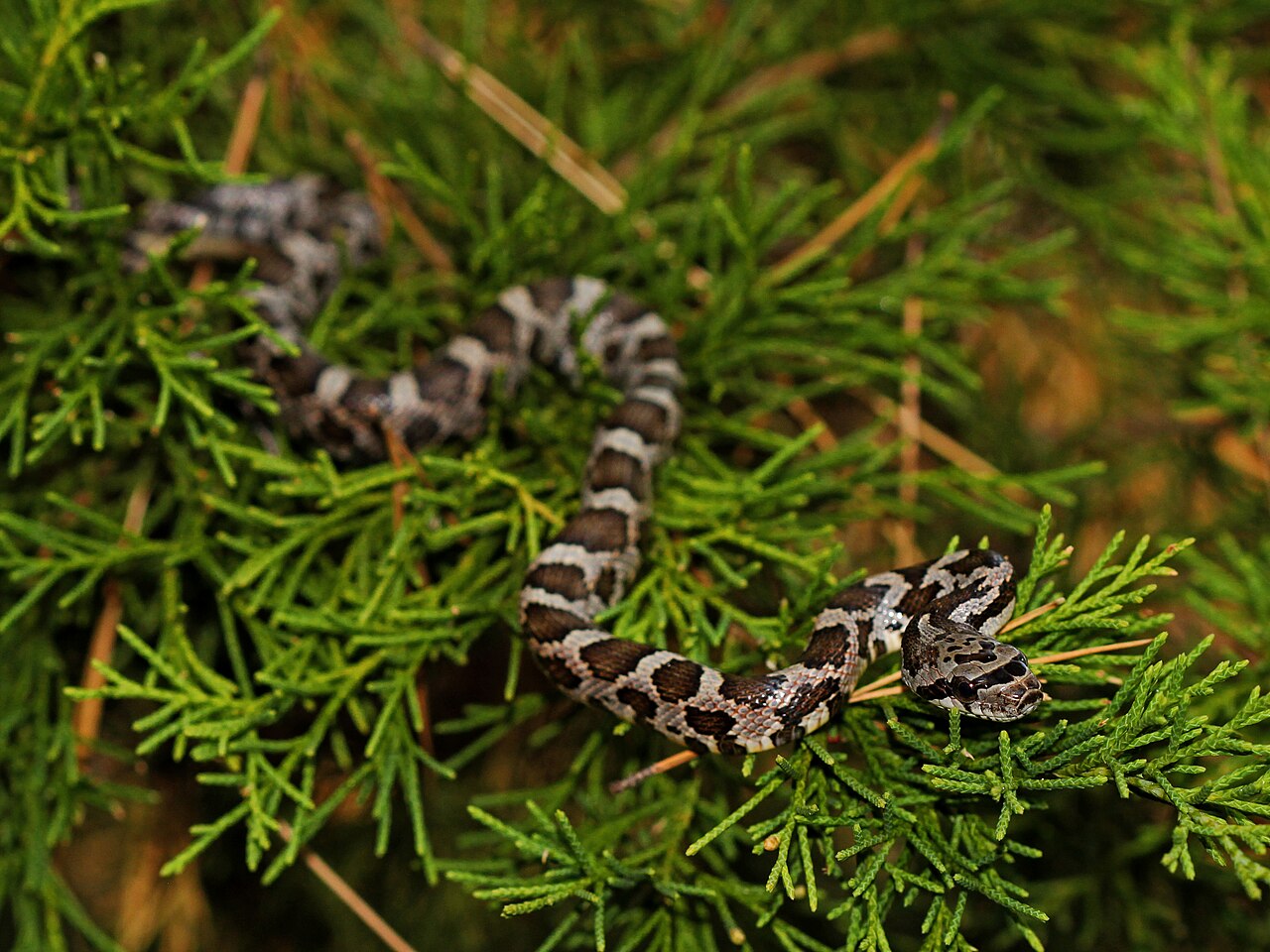
A black racer is not venomous at all. It has no fangs, no venom glands, and no medical significance. The University of Georgia’s Savannah River Ecology Laboratory lists it among the harmless colubrids of the Southeast, and no state wildlife agency treats a racer bite as a medical emergency. Species accounts are collected in the SREL herpetology guide.
What a racer does have is attitude. Grabbed or cornered, it will flatten out, vibrate the tail tip in dry leaves to fake a rattle, release a foul musk mixed with feces, and bite repeatedly with small teeth. The result is a set of pinprick scratches. Wash them, apply an antiseptic, and watch for ordinary infection.
The real risk runs the other way: people kill harmless snakes on suspicion. Knowing red and black patterned snakes and the checks in our coral snake and king snake comparison prevents most of those mistakes.
Will a Black Racer Snake Chase You?
No. Racers do not chase people, but they produce the most convincing illusion of it of any North American snake. A startled racer bolts for the nearest cover, and if that cover happens to be behind you, the snake runs toward you at full speed before veering off.
Racers also hunt by sight and habitually lift the front third of the body to scan, a posture called periscoping. A snake that raises its head, holds still, then moves in your direction looks deliberate. It is tracking movement, not targeting a person. Blocked from cover, a racer may advance with the mouth open and strike at a boot; step back and the bluff ends.
Where Do Black Racer Snakes Sleep at Night?
Racers are strictly diurnal, so they need a secure place to shut down every night. They use stump holes, rodent burrows, rock crevices, brush piles, dense grass tussocks, and the gaps under sheds and woodpiles. In warm weather some individuals rest a few feet up in shrubs or vine tangles, tucked where a raccoon cannot reach them.
Cold months push the same animals underground. Racers overwinter in rock fissures, old mammal burrows, and rotted root channels, sometimes sharing the space with rat snakes and copperheads. Those shared sites explain the run of spring sightings in a single yard.
Are Black Racers Good Snakes to Have Around?
Yes, and they earn their keep quickly. A single adult works through voles, mice, young rats, lizards, frogs, large insects, and other snakes across a home range of several acres. Racers eat venomous juveniles too, which makes a resident racer a small but real reduction in copperhead numbers.
They are also the least intrusive large snake you can host: no attic visits, no interest in dark enclosed spaces, and out of sight in a second. If one is crossing a patio, stand still and let it pass. If it is in a garage, open the door, leave the room, and give it an hour. The honest drawback is nest raiding, since racers take eggs and nestlings from ground nests and low shrubs.
Frequently Asked Questions
Is it safe to pick up a black racer?
It is safe in the sense that nothing venomous is involved, but it is a bad idea. Racers rarely tolerate handling. Expect thrashing, musk, feces, and several quick bites that leave shallow scratches. Handlers rank racers among the most reliably defensive harmless snakes in the country.
Will a black racer bite a dog?
Only if the dog pins or mouths it, and the bite is harmless. There is no venom, so the concern is a minor puncture that can get infected, plus musk on the dog’s face. Rinse the area, watch for swelling over 24 hours, and call the vet if the wound stays sore.
When you see one snake, are there more?
Often, but not the way people fear. Racers are solitary hunters and never travel in groups. Repeat sightings in one yard usually mean good habitat or a shared overwintering site nearby, so the same individual keeps passing through the same cover.
How fast is a black racer snake?
Measured speeds top out near 4 mph (6.4 km/h), a brisk walking pace for a person. The reputation comes from the short burst over open ground and the constant motion of the head, not from any ability to outrun a jogger. Over more than a few yards the snake slows sharply.