Moose Symbolism: Spiritual Meaning, Omens and Sightings Explained
Seeing a moose is read as a sign of self-worth, unmoved confidence and the right to take up space without apologizing for it. That is the core of the moose spiritual meaning in contemporary practice, and it fits an animal that is 6 to 7 ft (1.8 to 2.1 m) at the shoulder and has no reason to hurry out of anyone’s way.
The older material is thinner than for deer or bear, because the moose lives at the northern edge of the continent and appears mainly in Algonquian, Athabaskan and Nordic sources. Those traditions are kept separate below, followed by the situation readings people actually search for: a moose crossing the road, a moose in the yard, a dead moose, a white moose, a moose in a dream.
The moose symbolizes self-esteem, boundaries and quiet strength. Seeing one is commonly read as a sign to stop shrinking, state what you need plainly, and trust your own judgment. In Algonquian tradition the moose is a provider and a test of the hunter’s respect, and in Nordic lore the antlered animal marks a threshold.
| Situation | Common symbolic reading |
|---|---|
| Moose crosses your path | A boundary needs to be stated; stop asking permission |
| Moose in your yard or garden | Self-worth arriving in ordinary life; something you own is being tested |
| Moose at night or in headlights | A hidden risk made visible; slow down in the literal sense too |
| Cow with a calf | Fierce protection, often of a plan rather than a person |
| Bull in full antler | Earned authority at its peak, and the knowledge it is temporary |
| Dead moose | A heavy phase ending; weight you no longer have to carry |
| White moose | A rare, strongly auspicious sign in Cree and Mi’kmaq belief |
What Is a Moose a Symbol Of?
The moose is a symbol of self-esteem. That specific reading, repeated across nearly every modern source on the animal, comes from its posture: a bull moose does not retreat, does not hide and does not scale itself down for an audience. People who name the moose as a guiding symbol almost always say they are working on taking themselves seriously.
Second comes provision. The moose is the largest deer on earth, and a single animal supplied a northern family with months of meat, hide for moccasins, bone for tools and sinew for thread. Where that dependence existed, the symbolism grew out of it rather than being attached from outside.
Third is the paradox of the animal itself. A moose is enormous and almost silent, swims strongly, dives for water plants and disappears into willow thickets a few yards from a road. That combination of bulk and invisibility gives the moose its reputation as a teacher of presence without noise.
What Does Seeing a Moose Mean Spiritually?
In popular interpretation, seeing a moose means you have been underestimating your own standing. The reading is almost always directed at the viewer rather than at the future, which separates moose symbolism from classic bird omens that are read as news arriving.
The second common reading is about pace. Moose move slowly until they decide not to, and the lesson drawn is that deliberate movement is not weakness. People apply it to decisions they have been rushing because someone else set the deadline.
A third strand treats the sighting as a reminder of the boundary between wild and settled country. A moose on a suburban lawn in Anchorage or in a New Hampshire village is a visitor from a system that does not negotiate, and that reading leans on awe rather than on advice. Compared with the gentler deer symbolism, the moose message is read as blunter and harder to ignore.
Moose as Spirit Animal, Totem and Power Animal
Spirit animal, totem and power animal are used interchangeably online and should not be. In contemporary practice, a spirit animal is a guide whose qualities a person deliberately draws on, and people choose the moose for self-respect and for the ability to say no without a speech.
A totem in the anthropological sense belongs to a clan or family and is inherited. Several Algonquian-speaking nations have moose clans with specific responsibilities, and in those systems no one picks the animal for themselves. Borrowing the word for a personal preference removes everything that made it meaningful.
Power animal is a term from twentieth century neoshamanic practice, popularized in the West through books and workshops rather than through any single Indigenous tradition. Moose as a power animal is usually taught as grounded confidence and as protection of what you are responsible for.
Moose Symbolism in Native American Traditions

Among the Algonquian-speaking peoples of the northeast and subarctic, including the Cree, Innu, Mi’kmaq, Abenaki and Anishinaabe, the moose is a central provider. The English word itself comes from an Eastern Algonquian term, usually given as Narragansett moos, meaning roughly “he strips off,” for the animal’s habit of stripping bark.
Innu and Cree accounts describe a strict code around the hunt: the animal gives itself, bones are handled respectfully rather than discarded, and waste or boasting causes the moose to withhold itself in future. In these traditions the moose is a party to an agreement, not a resource.
Athabaskan peoples of Alaska and northwestern Canada place the moose in the same role, with stories in which the animal rewards a humble hunter and frustrates an arrogant one. That moral, rather than any claim about luck, is the consistent Native reading: respect first, and provision follows. It parallels what bison symbolism carries on the Plains.
Moose in Christian and Biblical Symbolism

There is no moose in the Bible. The animal does not live in the Near East, and the large wild bovid behind the Hebrew re’em, translated as “wild ox” or in older versions as “unicorn,” is the aurochs rather than a deer of any kind.
What Christian readers usually apply to the moose is the deer imagery of Psalm 42, where the deer panting for streams of water becomes the soul longing for God. Since the moose is a deer, and spends much of the summer standing in water, the association transfers easily even though it is a modern extension rather than a scriptural one.
The other borrowed frame is the legend of Saint Hubert and Saint Eustace, who see a cross between the antlers of a stag. Writers who speak of a biblical moose meaning are generally working from these two images, and it is more honest to say so than to imply a chapter and verse exists.
Celtic, Norse and Siberian Antler Traditions
Celtic lore has no moose either; the elk had vanished from Britain and Ireland long before the surviving stories were written. Its symbolic place is filled by the red deer stag and by the antlered figure Cernunnos, who is read as a guardian of wild country and of passage between worlds.
Norse and Finnic material is closer to the real animal. The Scandinavian elg is the same species as the North American moose (Alces alces), and Nordic rock carvings show it repeatedly from the Bronze Age on. In the Finnish Kalevala, the Elk of Hiisi is a supernatural quarry that Lemminkainen must capture, and the hunt turns into a test he nearly fails.
Across Siberia, the elk carries cosmological weight. Evenki and related traditions tell of a cosmic elk that carries or steals the sun, and the constellation Westerners call the Big Dipper is read in several of these systems as an elk being pursued. These are the oldest surviving stories about the animal, and they treat it as sky-sized rather than as a personal sign.
What Does It Mean If a Moose Crosses Your Path?
A moose crossing your path is read as a boundary issue coming due. The standard interpretation is that you have been asking for permission where none is required, and the sighting is treated as a prompt to state a position plainly and then stop explaining it.
When the crossing is in front of a vehicle, the symbolic reading is usually about speed. People take it as a warning that they are moving faster than their judgment can keep up with, and the literal version of that warning is deadly serious: a moose stands high enough that a car strikes its legs and the body comes through the windshield.
If the moose stops in the middle of the road and looks at you, the common reading is that a decision is being held open for you rather than being made for you. Behaviorally, the animal is just deciding which way to go, and the National Park Service advice is simply to wait rather than to edge forward.
Is It Lucky to See a Moose?
Most popular sources treat a moose sighting as fortunate, and in the practical sense it is: moose are solitary, mostly active at dawn and dusk, and good at being invisible, so the encounter is uncommon even in moose country.
Traditional sources are more conditional. In the Algonquian and Athabaskan material, the appearance of a moose is not luck but a relationship, and whether it goes well depends on how the person behaves. A moose that appears to someone who boasts about it has not, in that framework, brought good fortune.
Where sightings are read as pointedly lucky is the white moose, discussed below, and the first moose of a season in regions where the hunt still shapes the year. Beyond that, the honest answer is that the luck is in the rarity of seeing one at all, much as it is with the bald eagle in the lower 48 states.
Moose in Your Yard, at the Window or at Night
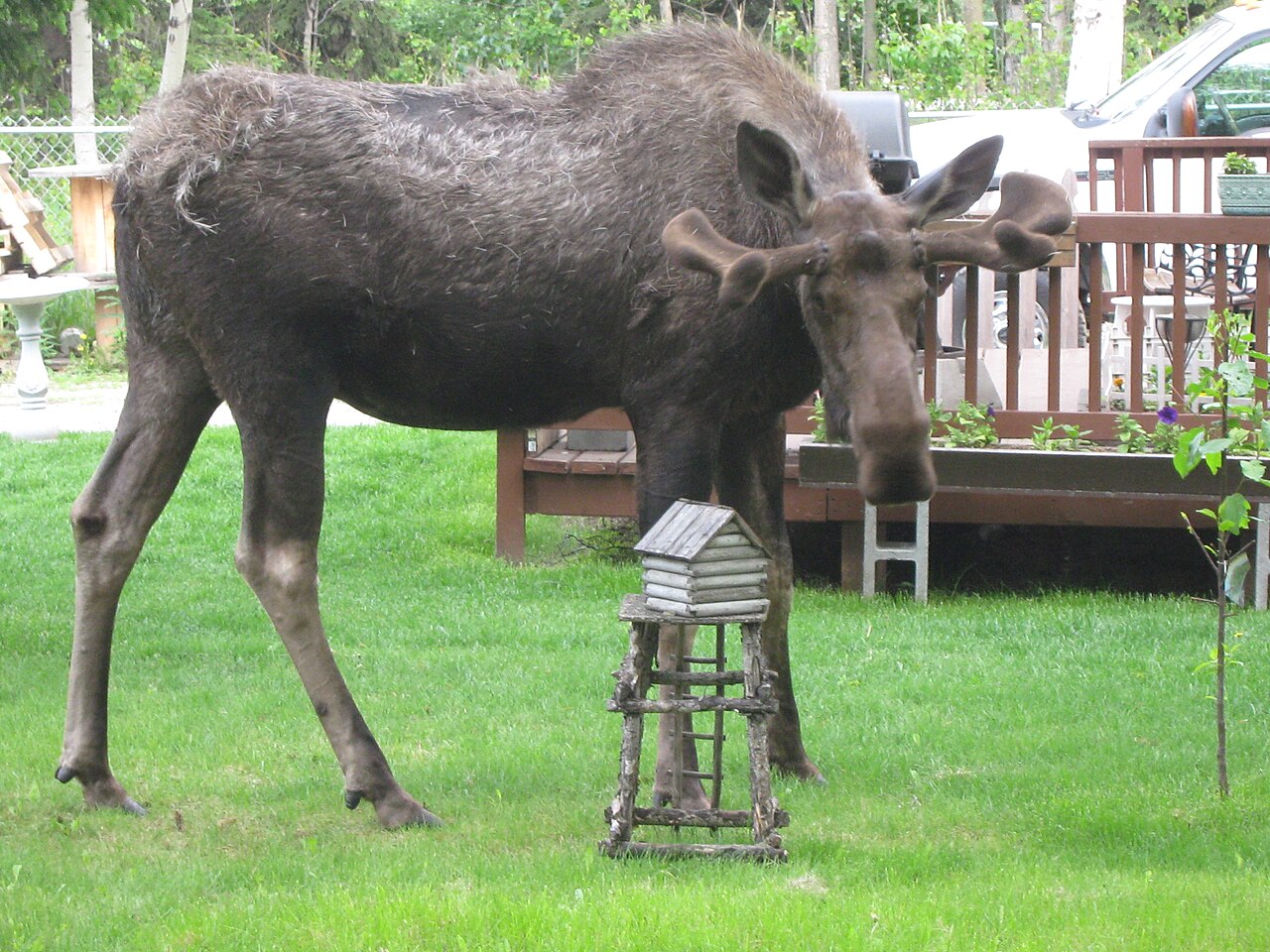
A moose in the yard is read as self-worth turning up in ordinary life, and often as a test of something you own or are responsible for. The practical meaning is simpler: in winter, moose come down into towns for browse and for plowed roads that are easier to walk than deep snow.
A moose at the window, which happens in Alaska and northern New England more often than people expect, is read as a message that cannot be deferred any longer. It also means an animal weighing up to 1,500 lb (680 kg) is standing next to your house, and the right response is to stay inside and let it leave.
A moose at night or in headlights is read as a hidden risk becoming visible. Moose eyes reflect poorly and their dark coats absorb light, which is why they are so often seen too late. The symbolic and the literal advice converge on the same word: slow down.
Dead Moose Spiritual Meaning
Finding a dead moose is generally read as the end of a heavy phase rather than as misfortune. The common interpretation is that a weight you have been carrying out of duty is being set down, and that the ending was overdue.
Where the animal died matters to the reading. A winter-killed moose is read as the natural close of a cycle, while a road-killed one is read as a warning about momentum and about the cost of moving through life at speed. In much of Alaska and Canada, roadkill moose are salvaged for food under organized charity lists, which gives the loss a continuation.
Among the traditions where the moose is a provider, a dead moose found by chance asks for acknowledgment rather than interpretation. Reporting it, not photographing it, is the version of respect that fits those sources.
Moose Symbolism in Dreams and in Love
A moose in a dream is usually read as unused strength, specifically the kind that comes from self-respect rather than from effort. Dream interpreters in this tradition ask whether the moose was calm, charging or submerged, and treat the answer as a statement about the dreamer’s standing in waking life.
A charging moose is read as a boundary that has already been crossed and is now being defended loudly. A moose feeding peacefully in water is read as restoration, and a moose watching from a treeline as a question the dreamer has been avoiding.
In love and relationships, moose symbolism is read as a call to stop making yourself smaller to keep the peace. Bulls compete openly in the autumn rut and cows choose, which is the behavioral hook for the usual advice: be direct about what you want and let the other person answer. For the lighter, message-carrying readings people often look for alongside this, see blue jay spiritual meaning.
White and Black Moose Spiritual Meaning
A white moose is the strongest positive sign attached to the animal. In Cree and Mi’kmaq belief, white moose are sacred and are not hunted, and the killing of white animals in Ontario and Nova Scotia has caused real public conflict. Most are piebald or leucistic rather than true albinos, and the gene is concentrated in a few northern populations.
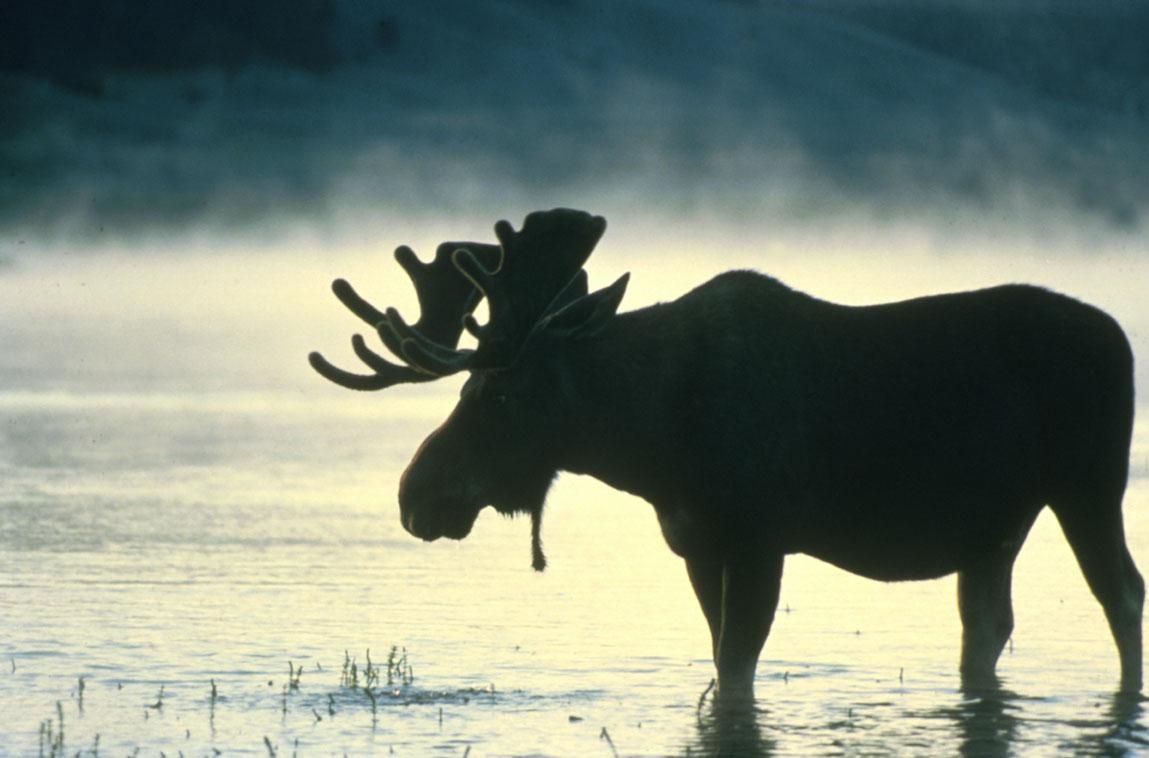
Black moose, in the symbolic literature, are read as grief work, the unseen part of a transition and strength that is still forming. Biologically there is no melanistic moose morph of note; a moose soaked from feeding in a pond, or seen against evening light, simply looks black, which is likely where most reports begin.
The ordinary moose color scale runs from pale grey-brown in old bulls to near chocolate in prime animals, and it shifts with season and age. Before reading color as a sign, it is worth knowing that the animal’s coat was probably doing something routine. The same caution applies to bird symbolism, where lighting changes apparent color constantly.
Frequently Asked Questions
What are moose warning signs?
Ears laid back, raised hackles along the neck and shoulders, a lowered head, licking of the lips, swaying, and a stiff-legged walk toward you. A cow with a calf and a bull in the September and October rut are the two most dangerous situations. Back away and break the line of sight.
What is a moose’s worst enemy?
Wolves and brown bears take adults and calves, and black bears take calves, but winter ticks, brainworm and vehicle collisions kill more moose in much of the range. In New England and Minnesota, warming winters and tick loads are the main drivers of decline, not predators. See also bear symbolism for the animal most often paired with the moose in northern lore.
What is a moose’s favorite food?
Willow, birch and aspen twigs in winter, and aquatic plants such as pondweed and water lilies in summer, which they reach by submerging completely. An adult eats 40 to 60 lb (18 to 27 kg) of browse a day. The full seasonal diet is covered in what moose eat.
What US state has the most moose?
Alaska, by a wide margin, with roughly 175,000 to 200,000 animals. Maine has the largest population in the lower 48 states at around 60,000 to 70,000, followed by Minnesota, Idaho, Wyoming, Montana, New Hampshire and Vermont. Colorado’s herd is introduced and growing.
What are moose afraid of?
Very little, which is the whole basis of the symbolism. Moose react to wolves, bears and dogs, and a loose dog is the most common trigger for a charge in populated areas. They are not deterred by noise, fences under 8 ft (2.4 m) or human presence the way deer are.
Is a moose the same as an elk?
In North America, no. Moose are Alces alces, with palmate antlers and a dangling bell of skin at the throat. Elk are Cervus canadensis, smaller, herd-living and branch-antlered. In Europe the word elk means the moose, which is why translated myth and symbolism sources contradict each other constantly.