Frog Poop vs Lizard Poop: 5 Ways to Tell Them Apart
Frog poop vs lizard poop comes down to one feature you can see from a few feet away: lizard droppings carry a chalky white cap at one end, and frog droppings do not. That white tip is uric acid, the way reptiles and birds excrete nitrogen without wasting water. Frogs pass urine separately as liquid, so their droppings are uniformly dark.
Size separates them next. A frog dropping is surprisingly large for the animal, often 1/2 to 1 in (1.3 to 2.5 cm) long and nearly as thick as the frog’s own body, dark and soft with visible insect parts. A house gecko or anole leaves a thin pellet 1/8 to 1/4 in (3 to 6 mm) long with that white dot. Both show up on porches, window sills and pool decks, which is why they get confused in the first place.
Lizard poop is a small dark pellet 1/8 to 1/4 in (3 to 6 mm) long with a distinct white chalky cap at one end. Frog poop is larger, 1/2 to 1 in (1.3 to 2.5 cm), thicker, shiny when fresh, dark brown to black with no white tip, and often breaks apart to reveal insect wings and legs.
What Does Frog Poop Look Like?
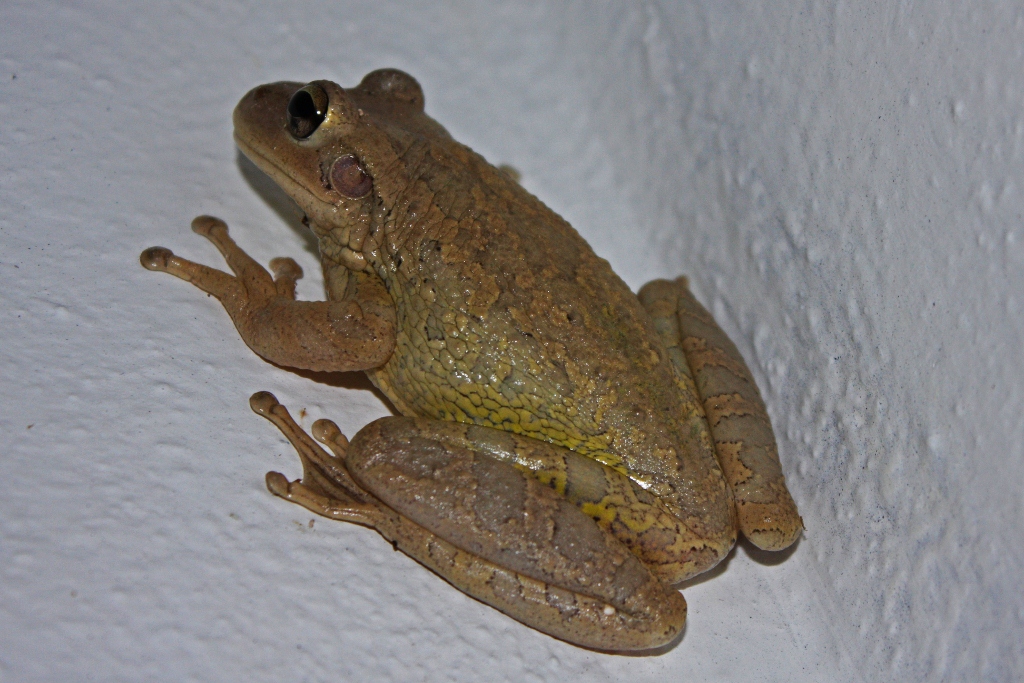
Fresh frog droppings look like a thick dark cylinder with rounded ends, glossy from the mucus coating, and they flatten rather than crumble when they dry. Length relative to the animal is the part that surprises people: a 2 in (5 cm) treefrog can produce a dropping a third of its body length, because frogs swallow prey whole and pass a large mass at once rather than continuously.
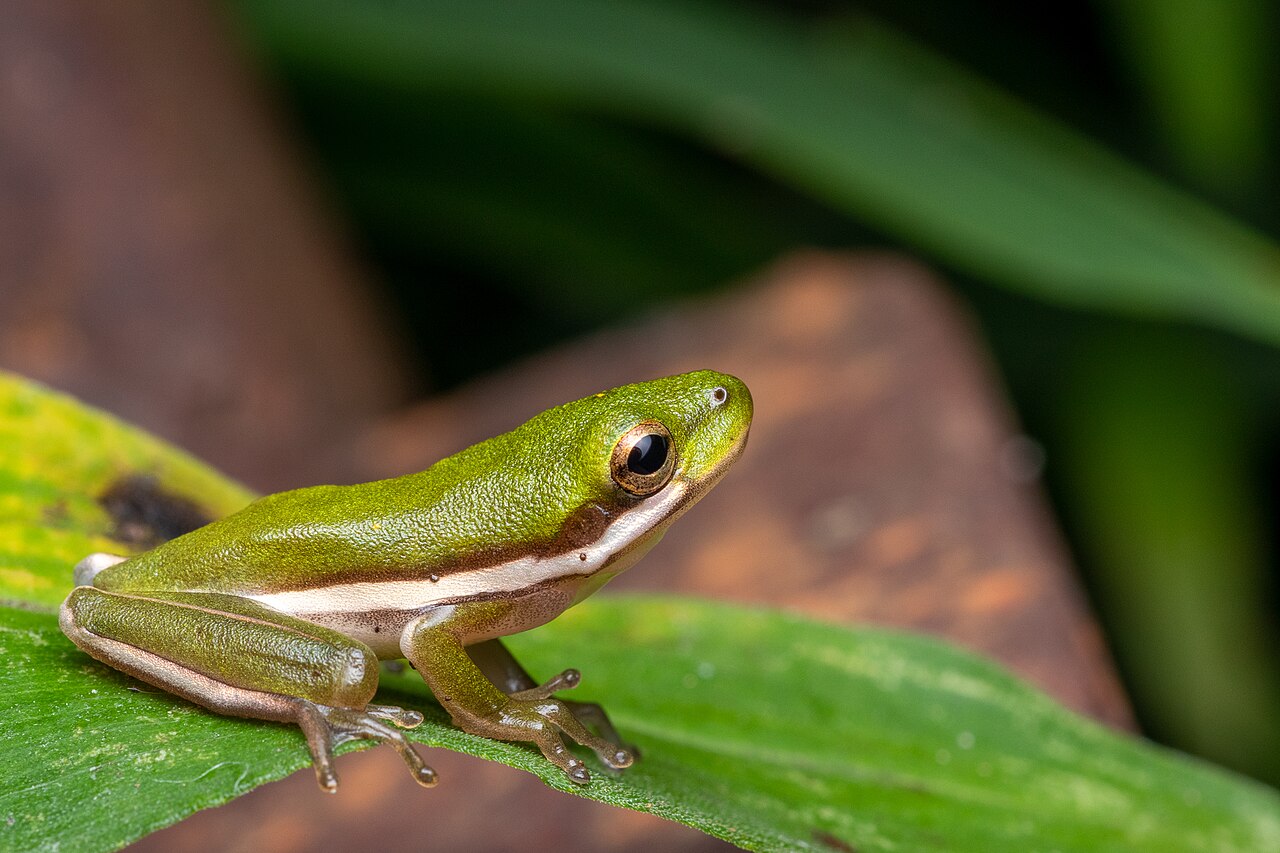
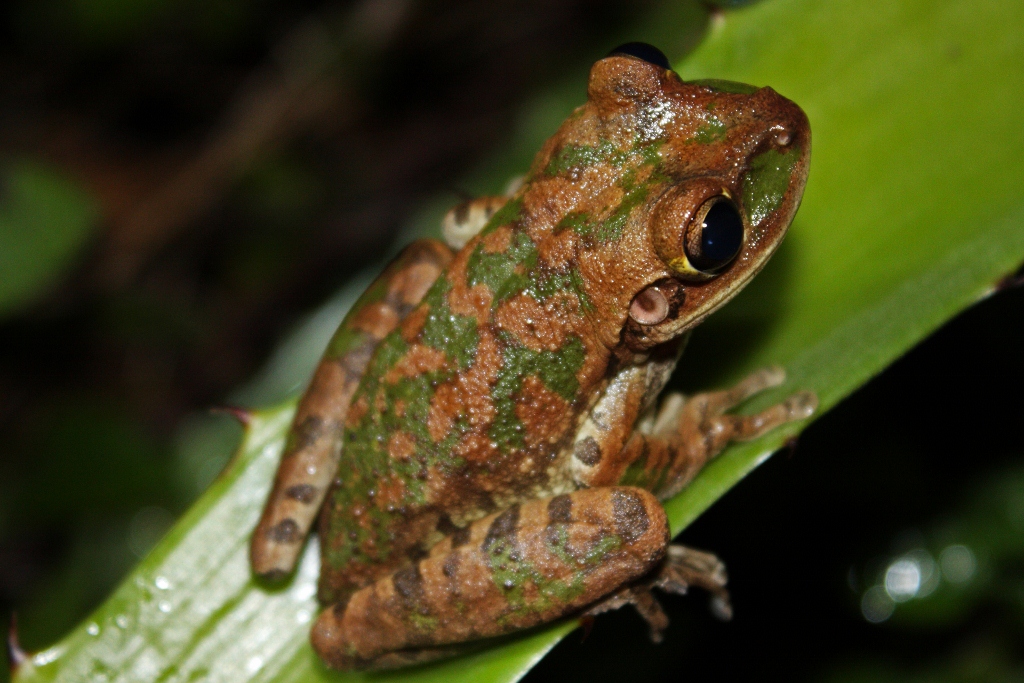
Color runs dark brown to black with a slight sheen, and there is no chalky portion anywhere in it. Break a dried one apart and you get beetle elytra, ant heads and moth wings. Treefrogs are the usual source on buildings, especially the Cuban treefrog (Osteopilus septentrionalis) in Florida and the green treefrog (Hyla cinerea) across the Southeast. Our full guide to frog poop covers the tadpole stage.
What Do Lizard Feces Look Like?
Lizard feces are small, firm, dark pellets with a white or cream cap fused to one end, and they hold their shape when dry instead of smearing. The dark portion is the fecal matter, the white portion is the urate, and both leave the body together through the cloaca as a single unit. That two tone structure is the single most reliable identification feature in this whole comparison.
A Mediterranean house gecko (Hemidactylus turcicus) leaves a blunt ended cylinder, a brown anole (Anolis sagrei) something shorter and tapered. Accumulation tells you more than any single pellet: geckos reuse one perch night after night, so droppings pile up in a single spot. See lizard poop for species sizing and indoor cleanup.
Five Differences You Can See Without Touching Anything
| Source | Size | Shape | Color | White cap | Where you find it |
|---|---|---|---|---|---|
| Frog or treefrog | 1/2 to 1 in (1.3 to 2.5 cm) | Thick cylinder, rounded ends, flattens when dry | Dark brown to black, shiny fresh | No | Walls, railings, pool decks, single large deposits |
| Gecko | 1/8 to 1/4 in (3 to 6 mm) | Firm pellet, blunt end | Dark brown with white tip | Yes | Piles under one perch, door frames, light fixtures |
| Anole | 1/8 in (3 mm) | Short, tapered | Nearly black with white tip | Yes | Leaves, fences, patio furniture, scattered |
| Rat | 1/2 to 3/4 in (1.3 to 1.9 cm) | Capsule with blunt ends | Dark brown to black, dull | No | Along walls and runways, 40 to 50 a night |
| Mouse | 1/8 to 1/4 in (3 to 6 mm) | Grain of rice, pointed ends | Black when fresh, gray when old | No | Drawers, pantries, scattered everywhere, 50 to 75 a night |
| Snake | Variable, 1 to 3 in (2.5 to 7.6 cm) | Soft, smeared, irregular | Dark with a large chalky white portion | Yes, large and streaked | Rare, single deposits, sheds and crawl spaces |
Read the table top down and the logic is simple. White cap present means reptile. White cap absent and large means frog. White cap absent and small means rodent, and rodent is the only group of the three that arrives in quantity, because a rat or mouse defecates while it travels.
Lizard Poop vs Rat Poop: What Is Commonly Mistaken for Mouse Poop?
Gecko droppings are the single thing most often mistaken for mouse poop, and the mix up is understandable because the sizes overlap almost exactly at 1/8 to 1/4 in (3 to 6 mm). Three things separate them. Gecko pellets carry the white urate cap, mouse droppings never do. Gecko pellets pile in one place under a perch, mouse droppings trail across a surface. Gecko pellets stay hard and hold shape for months, mouse droppings go gray and crumbly within a week or two.
Roach droppings are the other frequent confusion indoors, and they are smaller still at under 1/16 in (1.6 mm), blackish and ridged along the sides rather than smooth. Our side by side on roach poop vs mouse poop shows the ridging clearly, and rat poop vs mouse poop handles the two rodents against each other.
Frog Poop vs Rat Poop
At a glance these two are the closest pair of the six, because a large treefrog dropping and a rat dropping can both be around 3/4 in (1.9 cm) long and both are dark with no white cap. Count and texture settle it. Rats leave 40 to 50 droppings a night in lines along baseboards, pipes and runways; a frog leaves one or two in a spot that makes no sense for a mammal, like the middle of a glass door or the top of a porch light.
Texture confirms it. A fresh frog dropping is wet and glossy and smears if disturbed, and a dried one flattens into a dark disc. A rat dropping is dull and firm from the start, and it breaks into dry fibrous crumbs that show hair and seed fragments, never insect wings. The deposit site is also diagnostic: frogs leave droppings on vertical surfaces because they cling to them, and rats cannot. Bat guano sits in a third category, crumbling to a shiny insect dust when crushed.
What Are the Differences Between Snake Poop and Lizard Poop?
Both carry white urate, so the difference is size, consistency and frequency. Snake droppings are far larger relative to the animal and come out semi liquid, often as a smeared dark mass with a prominent white streak running through or beside it, sometimes with hair, scales or bone fragments embedded. Lizard droppings are firm, discrete and neatly capped.
Frequency does the rest of the work. A snake that ate a mouse may defecate once in one to two weeks, so you find a single large deposit and nothing else nearby. A gecko defecates most nights, so you find a growing pile in one location. If you are seeing many small white tipped pellets, you have a lizard, not a snake, regardless of how large the yard’s snake population is.
Where Each Animal Leaves Droppings Around a House
Location narrows the list before you ever look closely. Droppings on a vertical pane, a railing, or the top edge of a door mean a climber with sticky toes, so a treefrog or a gecko. Droppings in a horizontal line along a baseboard, pipe or fence rail mean a rodent travel route. Scattered single pellets on patio furniture and fence tops in daylight are anole, since anoles are active by day while geckos work at night. A pile under one porch light is the clearest sign of all: both geckos and treefrogs station themselves where the insects gather.
Health Risks and Safe Cleanup
Both frogs and lizards can carry Salmonella on their skin and in their droppings, and the CDC links reptile and amphibian contact to human salmonellosis cases every year, with young children and immunocompromised adults at highest risk. Cuban treefrogs are also toxic to pets that mouth them, and the irritant secretion is a veterinary issue rather than a cleanup issue.
Clean the same way for either animal. Wear disposable gloves, spray the dropping with a disinfectant or a 1 to 10 bleach solution and let it sit for 5 minutes, wipe it up with paper towels, bag the towels, then wash your hands with soap for 20 seconds. Do not sweep or vacuum dry droppings of any kind, because that aerosolizes the particles, and the risk is highest with rodents, where hantavirus is the concern. Indoor accumulations from other species, including bed bug stains, call for a different approach entirely.
Related reading: Frog Poop vs Rat Poop.
Frequently Asked Questions
How can I tell if this is rat poop?
Rat droppings are 1/2 to 3/4 in (1.3 to 1.9 cm) long, capsule shaped with blunt ends, dark and dull, with no white cap, and they appear in groups of dozens along a travel route. One or two droppings on a wall or window is not a rat. Thirty along a baseboard is.
What color is mouse poop?
Fresh mouse droppings are shiny black or very dark brown and slightly soft. Within a few days they dull and turn gray brown, and after a week or two they are chalky gray and crumble under pressure. That color change is the fastest way to judge whether an infestation is active or old.
Do all rat droppings carry hantavirus?
No. In North America hantavirus is carried mainly by deer mice and a few other native rodents, not by the Norway rats and roof rats found in cities. Rat droppings do carry other pathogens including Salmonella and Leptospira, so the same gloves and wet cleanup rules apply.
What smell do rats absolutely hate?
Rats avoid strong peppermint, ammonia and predator scent, but no odor reliably clears an established population. Repellents move rats a few feet, not out of a building. Sealing entry points larger than 1/2 in (1.3 cm) and removing food sources is the only approach that holds. Our squirrel poop vs rat poop guide covers attic cases.
What are three signs that you have a rat infestation?
Droppings in groups along walls, gnaw marks with parallel tooth grooves on wood or plastic, and greasy dark rub marks where fur repeatedly contacts a surface. Night scratching inside walls and a strong ammonia smell in enclosed spaces are supporting signs rather than proof on their own.