Bear Tracks: 5 Toes and How to Read Them in Snow or Mud
A bear track is one of the easiest large mammal prints to name once you know what to look for: five toes on both the front and the hind foot, a wide pad, and claw marks set well ahead of the toes. Dogs and coyotes show four toes, cats usually hide their claws, and nothing else in North America leaves a hind print that looks like a short, broad human foot.
The ground decides how much of that you actually see. Snow holds a clean outline but exaggerates size, mud records claws and toe pads best, and dry sand collapses the edges until only the general shape survives. This guide covers the anatomy, then the three substrates in the order you are most likely to meet them, then the look alikes that fool people every winter.
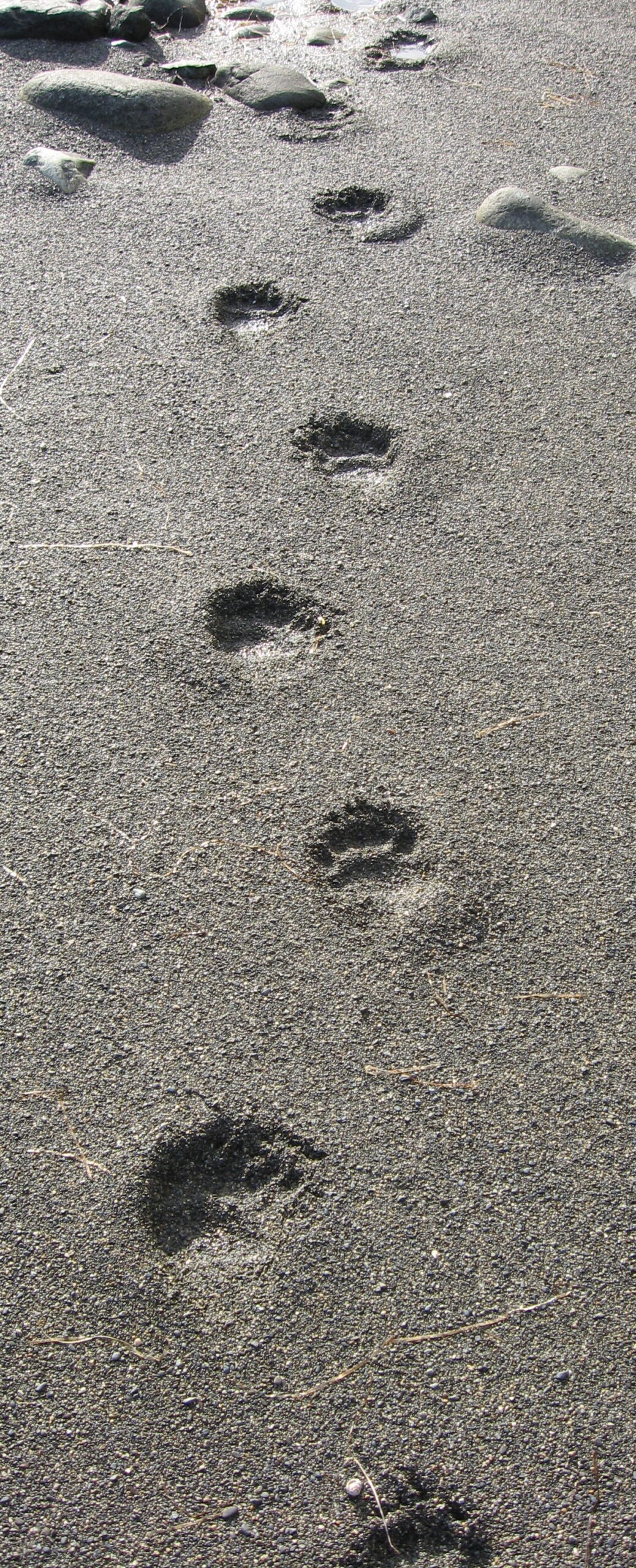
Bear tracks show five toes on both feet, with claw marks about 1 to 2 inches (2.5 to 5 cm) in front of the toe pads. The hind print resembles a broad human footprint 7 to 9 inches (18 to 23 cm) long in black bears, while the front print is shorter and wider. Dog and coyote tracks show only four toes.
| Species or gait | Front track | Hind track | Straddle and pattern |
|---|---|---|---|
| Black bear | 4 to 5 in long (10 to 13 cm) | 7 to 9 in long (18 to 23 cm) | Straddle 10 to 14 in, overstep walk |
| Grizzly or brown bear | 5 to 7 in long (13 to 18 cm) | 9 to 13 in long (23 to 33 cm) | Straddle 14 to 20 in, toes point inward |
| Polar bear | 7 to 9 in wide (18 to 23 cm) | 10 to 13 in long (25 to 33 cm) | Straddle to 24 in, furred pad, soft edges |
| Walking stride | 15 to 25 in (38 to 64 cm) | Lands ahead of the front print | Relaxed, feet nearly in line |
| Running stride | Over 40 in (100 cm) | Paired prints, bounding | Trail widens, dirt thrown back |
What a Bear Track Looks Like: Front and Hind Feet
Count the toes first. A bear has five on every foot, and they sit in a shallow arc rather than the tight cluster a dog leaves. The smallest toe is on the inside of the foot, the opposite of a human foot, and that detail tells you which side of the trail you are reading.
The hind track is the one people photograph, because it carries a heel pad and reads like a short, wide human print. The front track is shorter and broader, often a crescent pad with the toes above it, since the front heel usually does not touch down. Both in one trail is normal and does not mean two animals. Claws show more often than not: a black bear’s run 1 to 1.5 in (2.5 to 4 cm) and curve, a grizzly’s reach 2 to 4 in (5 to 10 cm) and are straighter.
Bear Tracks in Snow
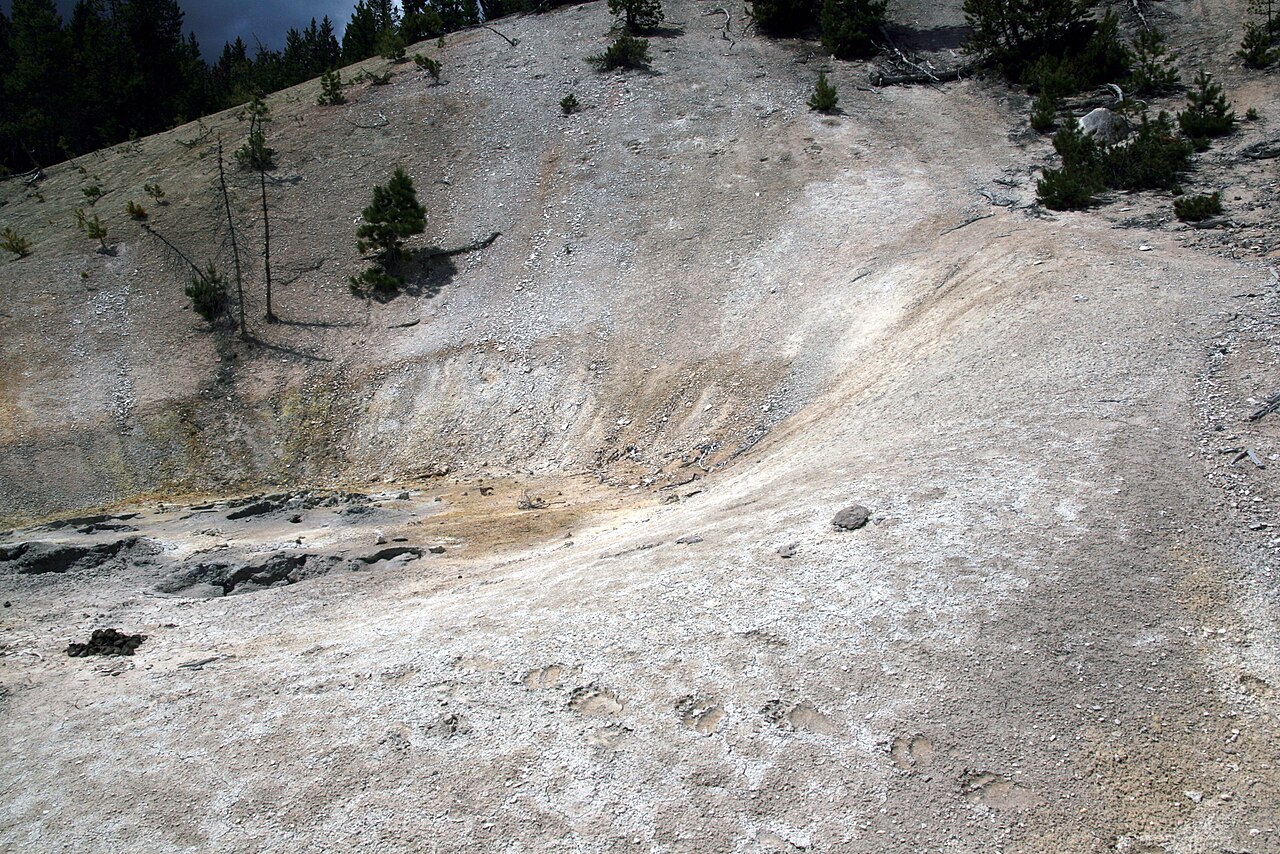
Winter is tracking season, and snow is where most people meet their first bear track. Fresh prints in 1 to 3 in (2.5 to 8 cm) of snow over a firm base hold the best detail: toes, pad outline and sometimes claw tips. Deeper snow turns the print into a sloppy hole, and drifting enlarges it further as the walls slump inward.
Snow also misleads on size. Melt widens a print by an inch or more over a warm afternoon and refreezing locks in the exaggerated shape, so a track measured at midday on a sunny slope can read a full species larger than the animal that made it. Measure the inner edge rather than the outer rim, and favor tracks in shade. A track in deep winter is unusual but not impossible, since bears do not hibernate in the strict sense and may leave the den during a thaw.
Bear Tracks in Mud
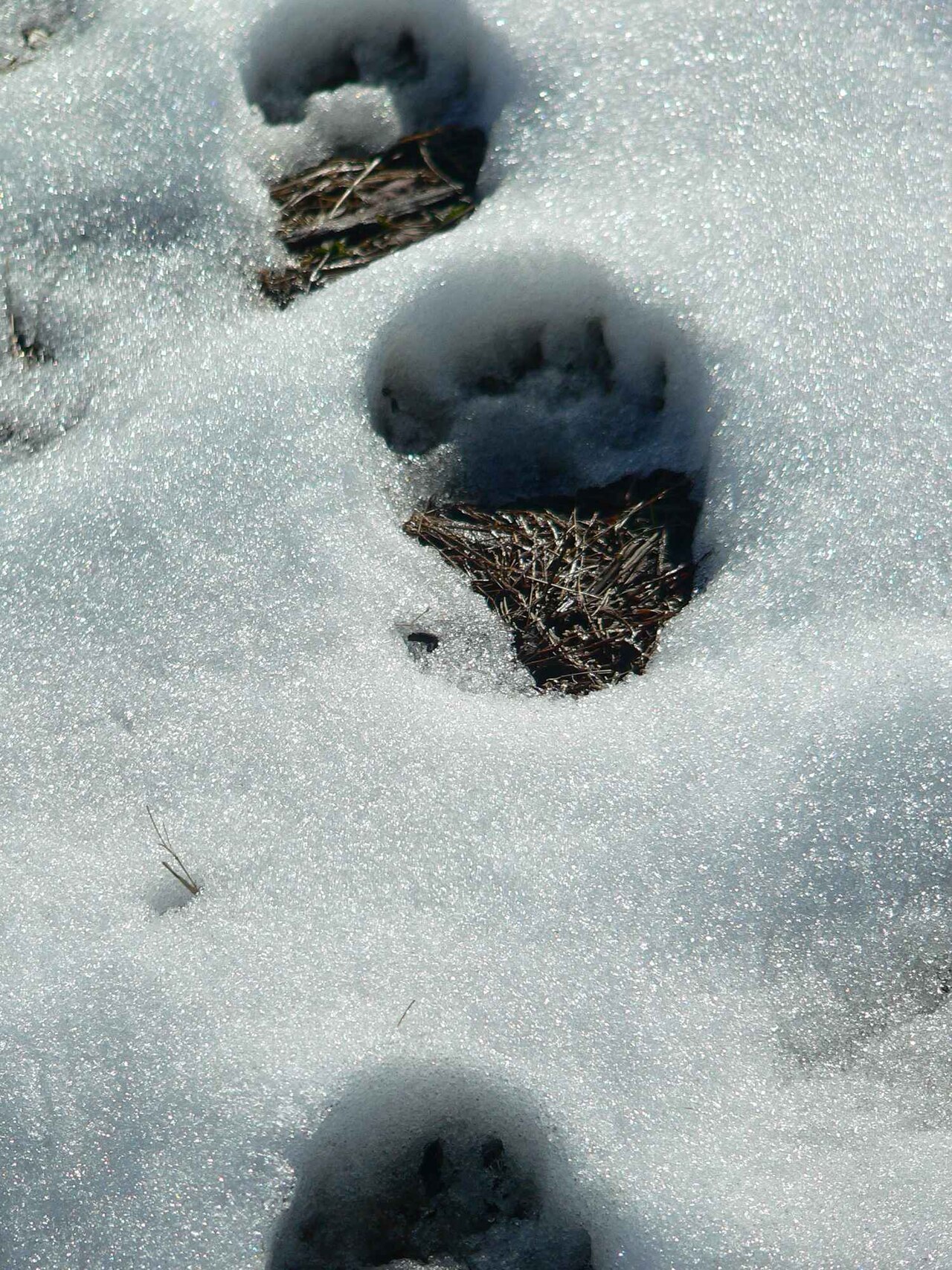
Mud gives the best record of all. Soft, fine mud at a pond edge, a stream crossing or a logging road puddle holds the toe pads, the pad texture and every claw, and a good mud print can be measured to the quarter inch.
Look for trackways rather than single prints. Bears walk with an overstep pattern that puts the hind foot ahead of the front on the same side, so a line of mud prints reads as paired tracks, large and small together. Mud also preserves the extras: hair on a stub, a flipped rock, scat on the trail. A print beside fresh bear scat answers both species and freshness, and the contents say what the animal was eating, which ties to a bear’s seasonal diet.
Bear Tracks in Sand and Dust
Dry sand is the hardest substrate. The walls collapse immediately, toes blur into the pad, and claws rarely register at all, leaving a shallow oval that could be almost anything large. In dune sand even a fresh track can look days old.
Damp sand at a lake margin or a tidal flat behaves like mud and holds detail for a few hours. On dry sand, shift to shape and trail pattern: the wide straddle, the pigeon toed front prints and the overstep pairing survive even when individual toes do not. Use low light, since early and late sun throws shadow into depressions invisible at noon, and a flashlight at ankle height does the same job at any hour.
Bear Tracks vs Dog, Coyote and Cat Tracks
The toe count settles most cases. Dogs, coyotes, wolves and foxes all leave four toes with claws; a bear leaves five. A large dog print can match a black bear front print in size, which is why misidentifications cluster on snowy trails near trailheads, where coyote tracks and loose dog tracks are far more common than bears.
Cats are the other confusion. Bobcat tracks and mountain lion tracks show four toes, a three lobed trailing pad edge and usually no claws, and they are round rather than oblong; a mountain lion print runs 3 to 4 in (8 to 10 cm) across, well short of a bear hind print. In the East, a raccoon leaves five long toes and a print like a tiny hand that gets mistaken for a bear cub, with length under 3 in (8 cm) as the giveaway. Deer tracks, two halves of a split hoof, are never confused with a bear once seen.
Reading the Trail: Stride, Straddle and Direction
A single print names the species; the trail says what the animal was doing. Measure stride from one print to the next print of the same foot, and straddle as the width of the whole trail. A black bear walking easily leaves a stride of 15 to 25 in (38 to 64 cm) and a straddle near 12 in (30 cm).
When the stride jumps past 40 in (100 cm) and prints come in close pairs, the bear was running. When the trail wanders and clusters around logs and stumps, it was foraging, and torn bark or flipped rocks nearby confirm it. Direction comes from the claws and the toe arc, both pointing forward, which tells you whether the animal walked toward or away from where you stand.
How to Tell if a Black Bear Is Around
Tracks are one sign out of five, and the others last longer. Look for claw marks on smooth barked trees such as aspen and beech, hair snagged at 2 to 4 ft (60 to 120 cm) on fence wire and rough bark, bitten sign posts, overturned rocks, shredded logs and scat on trails.
Food sites tell you the most: flattened berry patches, stripped corn at a field edge, raided bird feeders in spring, and trash cans opened without being chewed apart all point to a bear rather than a raccoon. If the sign is fresh and close to a home or campsite, the answer is management rather than tracking. Agencies including the National Park Service recommend removing attractants, securing garbage and food, and giving any bear you see a wide path.
Frequently Asked Questions
Do bear tracks always show claw marks?
No. Claws register well in mud and damp sand but often fail to appear in snow, dry dust or hard ground. Their absence does not rule out a bear, so count the toes first: five toes with a wide pad is a stronger identification than claw marks alone.
What smells do bears hate?
Bears avoid strong irritants, which is why capsaicin based bear spray works at close range. Ammonia and pine based cleaners discourage them around garbage cans with mixed results. Nothing works as reliably as removing the food smell that drew the animal in the first place.
What state has zero bears?
Hawaii has no native or established bear population. On the mainland, Delaware and Rhode Island have no breeding population, though wandering individuals turn up, and Illinois, Indiana and Kansas see only occasional dispersing black bears.
What is the most aggressive bear in the USA?
The grizzly, a brown bear subspecies, accounts for most serious bear injuries in the lower 48 states, usually involving a female with cubs. Polar bears in Alaska are the more predatory species but are met by far fewer people. Black bears rarely attack and usually retreat.
What is a bear’s worst enemy?
Humans, by a wide margin, through vehicle collisions, hunting and habitat loss. Among wild threats, adult male bears kill cubs, and wolves can displace a bear from a carcass. No North American predator regularly hunts a healthy adult bear.