Mallard Sounds: 7 Calls and What Each One Means
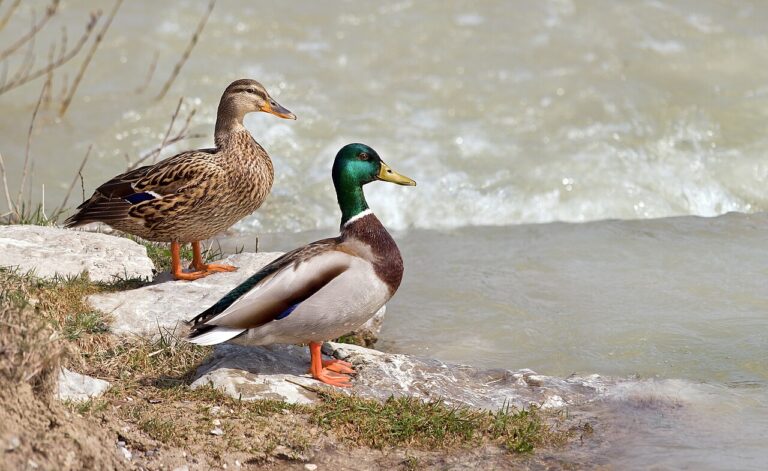
Only the female mallard makes the loud, textbook quack. The sound people picture when they think of a duck is a hen mallard (Anas platyrhynchos) running a descending series of two to ten quacks. The mallard call heard from a drake is something else entirely: a soft, raspy, two-note rasp that barely carries 50 ft (15 m).
Separate those two and the rest of the vocabulary falls into place. Each call below comes with the time of day and the season you hear it, plus the sounds it gets confused with.
Female mallards make the classic loud quack, usually in a descending series of two to ten notes. Male mallards cannot quack; they produce a quiet, raspy two-note call written as raeb raeb. Both sexes also use a rolling feeding chuckle, a sharp alarm note, and whistles during courtship from late fall through early spring.
| Call | Who makes it | Sounds like | When you hear it |
|---|---|---|---|
| Descending quack series | Hen only | QUACK quack quack, fading | Year round, dawn and dusk |
| Hail or greeting call | Hen only | Five to seven loud, spaced quacks | Birds passing overhead |
| Raeb call | Drake only | Low raspy raeb raeb | Year round, close range |
| Feeding chuckle | Both sexes | Rolling ticka ticka ticka | Loafing flocks, midday |
| Alarm note | Hen mostly | Two or three hard quacks | At the moment of a flush |
| Grunt whistle | Drake only | Thin rising pfrrrp, then a grunt | October through April |
| Duckling peep | Young of the year | High, fast peeping | Spring and early summer |
What Sound Does a Mallard Make?
A mallard makes a quack only if it is a female, and the quack is a series rather than a single note. The hen opens loud, then steps down in volume and pitch across two to ten notes, which is why the sound seems to fade even when the bird has not moved.
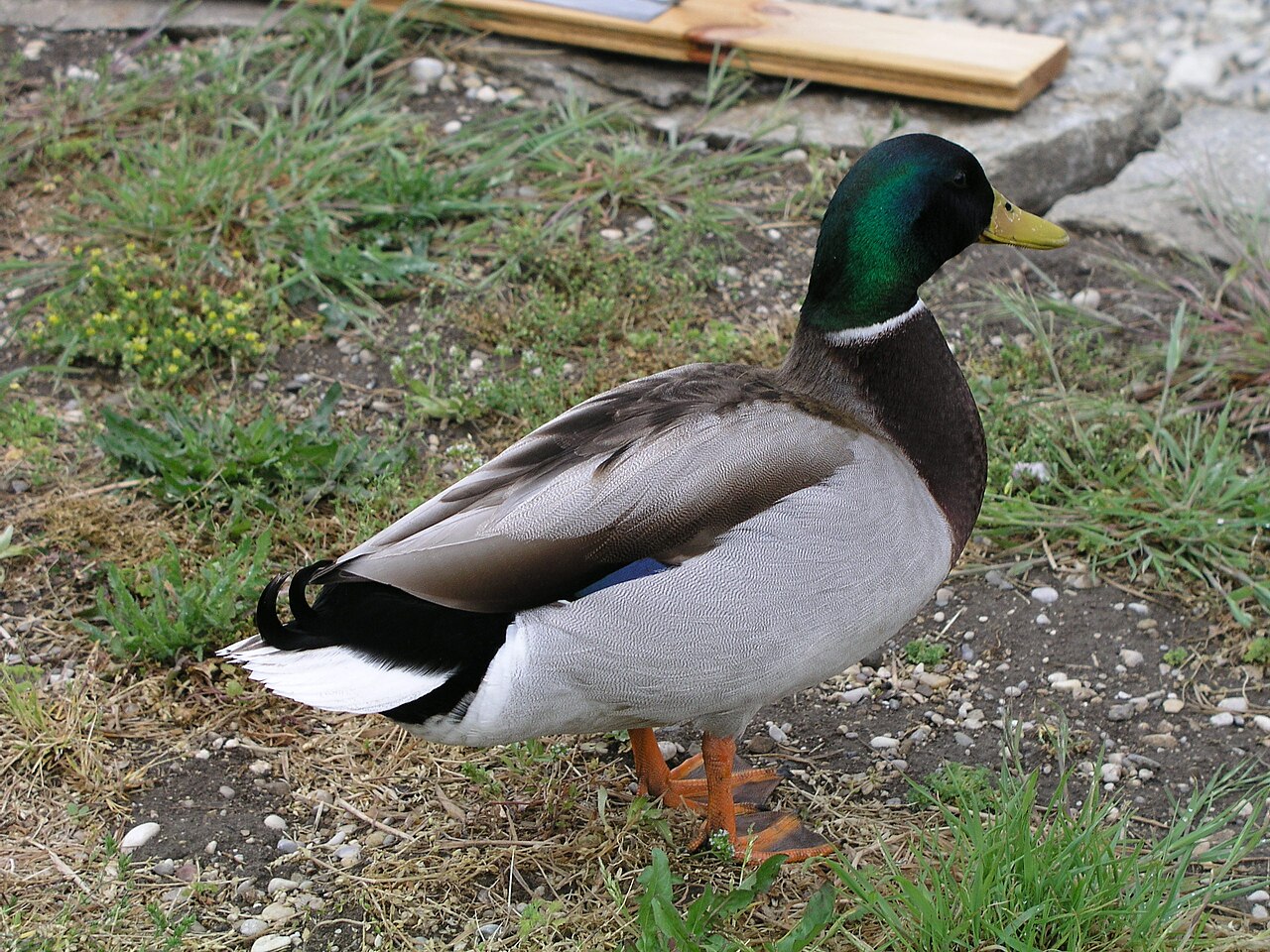
The drake replaces that entirely. His voice produces a low, dry, buzzing raeb, one or two notes, at a volume that disappears into wind or traffic. Hunters call it a raspy quack; up close it sounds closer to a cough.
Both sexes share the quiet social sounds: the feeding chuckle, soft contact notes between paired birds, and a grunt when jostled on the water. Cornell’s reference recordings are worth hearing back to back at All About Birds.
The Hen Quack: The Sound Everyone Knows
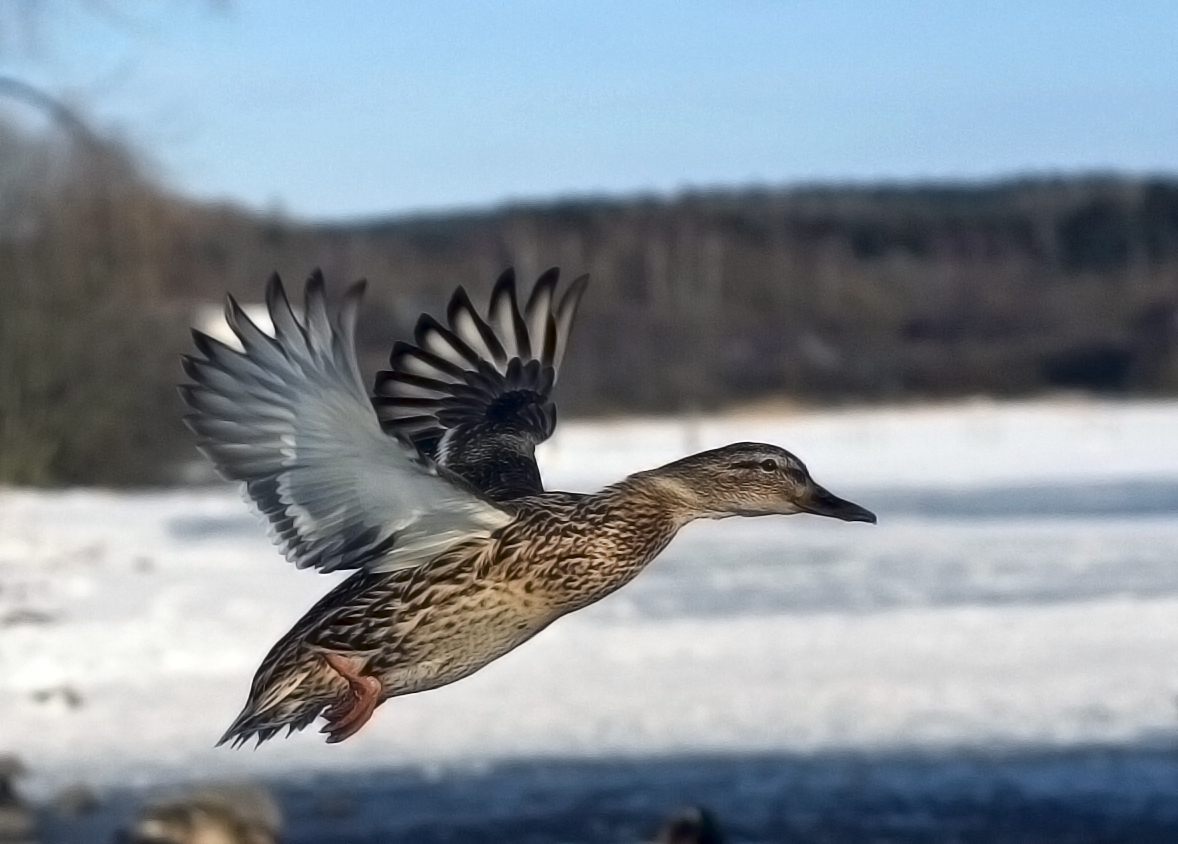
The hen’s descending series is a contact and location call. She uses it to hold a brood together, to reconnect with a mate, and to answer other hens. Volume is remarkable for a bird this size: a determined hen on still water carries well over a quarter mile (400 m).
A longer, louder, more spaced version is the hail or greeting call, aimed at ducks in the air. Five to seven deliberate quacks with gaps between them is a hen working a passing flock.
Expect the quack series most at first light and in the last hour before dark, with a second spike during spring pairing. If the bird doing all the talking is the brown one, our female mallard guide covers her plumage marks.
The Drake Raeb: Why Male Mallards Do Not Quack
Male mallards do not quack because the syrinx and the enlarged bulla at the base of the trachea are built differently from the hen’s. The result is lower, raspier, and almost without carrying power, and no amount of effort produces the classic quack.
The biology fits the job. The hen must be heard across a marsh by ducklings and a mate; the drake only needs to be heard at arm’s length during courtship. Drakes do get loud in one case: a slow raehb raehb raehb from a cluster of males means several are competing for one hen.
That split is a field tool. Quacking from a flock of green-headed birds means there is a hen in there you have not spotted. The full species account is in our mallard profile.
Feeding Chuckle: The Rolling Ticka Ticka
The feeding chuckle is a fast roll of short soft notes, written ticka ticka ticka, made by both sexes in a relaxed flock. It is the sound of ducks that are eating and preening and paying no attention to danger, which is why it reassures birds overhead.
Expect it at midday on sheltered water, on flooded grain, and wherever a group has settled in to loaf. It does not travel far, so hearing it usually means you are within 100 ft (30 m) of the flock.
Mixed into it are single soft quacks and little grunts. That uneven texture is the signature of contentment; a flock that suddenly goes silent has seen something. At dawn the chuckle sits under the songbird layer, often cardinal song in the east.
Alarm Calls and the Flush
The alarm call is short, hard, and loud: two or three clipped quacks with no descending series, almost always from a hen. It arrives a fraction of a second before the flock lifts, and it is the one mallard sound that is unmistakable.
Dogs, people on a shoreline, and overhead raptors all trigger it. Mallards also flush silently when badly surprised, so silence does not mean the birds were comfortable. Repeated alarm calling from a bird that will not leave usually means a nest or brood nearby, and the right answer is to back off.
Ducks in constant human traffic raise their threshold for all of this. Among backyard birds the closest equivalent is the sentinel screaming in our blue jay sounds guide.
Courtship Sounds From Late Fall Into Spring
Mallards pair long before they nest, and their strangest sounds belong to that period, roughly October through April. The grunt whistle is the centerpiece: a drake rears up, flicks a spray of water with his bill, and gives a thin rising whistle followed by a low grunt.
Supporting displays carry their own notes. The head-up-tail-up posture comes with a sharp whistle, the down-up display with a short raeb, and an interested hen nod-swims while repeating a soft quack at one drake. Hens also give a loud inciting series aimed past the drake at a rival.
On a public pond in February, five drakes around one hen with constant whistling and splashing is normal courtship, not a fight, and it is the best time of year to learn the full range.
Duckling Peeps and Hen Contact Calls
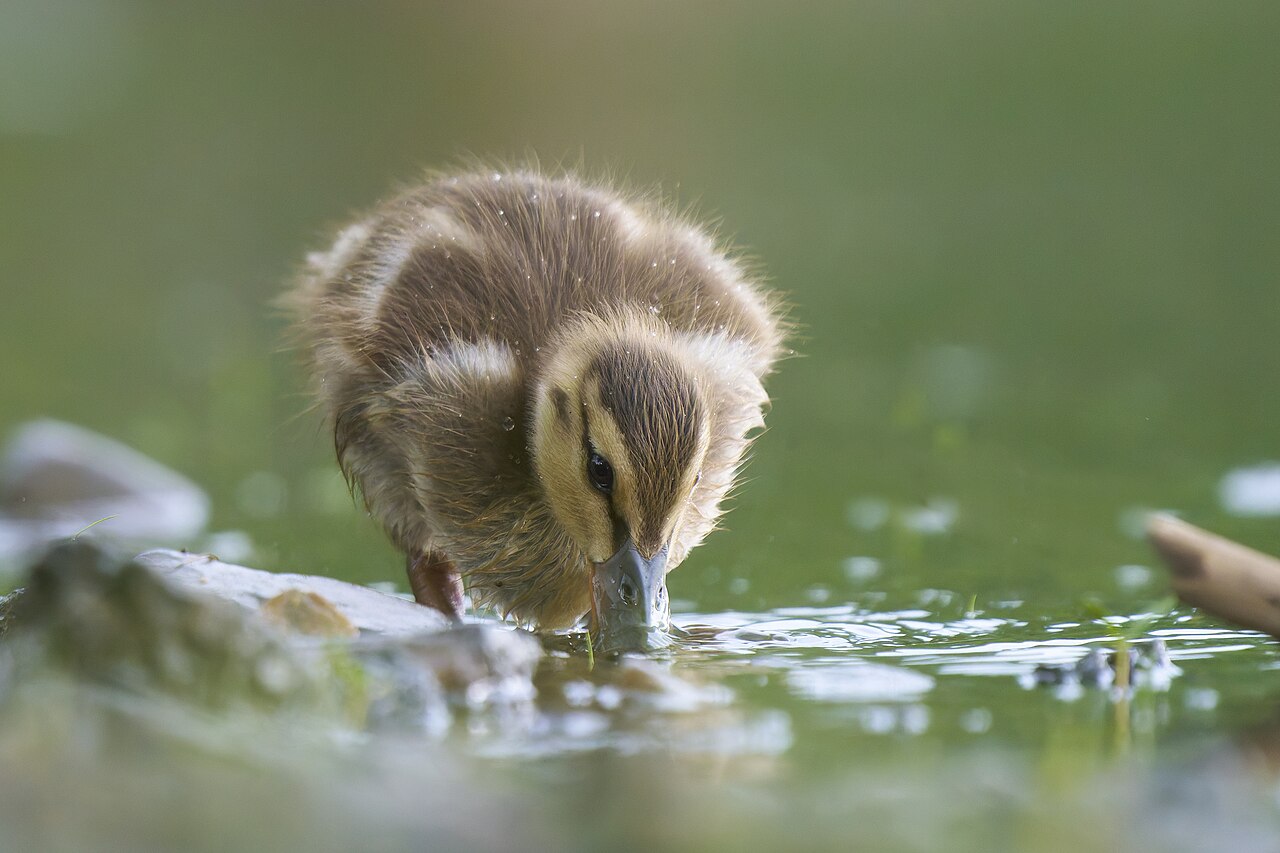
Ducklings peep almost constantly in a high, fast series that changes with mood: loose and irregular when content, rapid and piercing when one is separated. A lost duckling in a storm drain can be heard well over 100 ft (30 m), which is how most rescues start.
The hen answers with a low, soft, repeated cluck that sounds nothing like her quack. That call gathers the brood, moves it over open ground, and puts it under cover. If she switches to the hard alarm note, the ducklings freeze and go silent within a second.
Peeping near a house usually means a nest within 100 ft (30 m). Mallards nest in shrub beds, planters, and courtyards, and a hen may sit silently through three weeks of foot traffic.
Mallard Sounds at Night and Around the House
Mallards are the duck most likely to turn into a household noise problem, because they settle on swimming pools, flat roofs, retention ponds, and courtyard fountains. The sound is the ordinary hen quack series, repeated at intervals through the night, often from a bird 20 ft (6 m) from a bedroom window.
Two seasons account for most complaints. In early spring, pairs prospect for nest sites and the hen calls while the drake trails her; in early summer, a hen with a brood on a pool deck calls almost continuously. Nests are protected, so removal is not the answer during that window.
What works is making the water unattractive: a pool cover, a floating object or two, and no food on the ground. Noise deterrents help for a few days at most, as covered in our notes on bird deterrent sounds. At a pond after dark, check the amphibians before blaming ducks; compare the bullfrog call first.
Related reading: Bluebird Song and Calls.
Frequently Asked Questions
What’s the best mallard call?
For general use, a single-reed acrylic or polycarbonate call pitched for hens handles the quack series, the hail call, and the feeding chuckle. Double-reed calls are more forgiving for beginners because they are harder to blow off pitch. The best mallard call is the one you can run quietly, since most field mistakes are volume mistakes.
How do you call in mallard ducks?
Open with a five to seven note hail call when birds are distant and clearly passing, then cut volume as they turn. Switch to a soft feeding chuckle and occasional single quacks once they work your spread, and stop calling when they commit. Birds that swing wide and leave were usually overcalled at close range.
Do mallards quack at night?
Yes. Mallards feed and move after dark, especially during migration and around a full moon, so nighttime quacking from a pond or flooded field is normal. Birds that have settled on a pool or a flat roof often call at intervals all night, which is the most common reason homeowners look up duck sounds.
Why do mallards quack so much?
Because the quack is a contact call, not an alarm. Hens use it to track mates, broods, and neighbors continuously, so one talkative hen accounts for hundreds of quacks in an hour with nothing wrong. Frequency rises sharply during spring pairing and whenever a brood is on the move.
Can you identify a mallard by sound alone?
Usually, with one caveat: domestic ducks descended from mallards sound nearly identical, and some park hybrids do too. Wild hens quack lower and harsher than most domestic breeds, and the drake raeb is a strong confirmation. Mottled ducks and black ducks are the hard ones, since their calls overlap closely.