Porcupine Poop: Size, Shape and 3 Scat Lookalikes
Porcupine poop looks like a curved, fibrous pellet about 0.4 to 1.2 in (1 to 3 cm) long, tan to dark brown, with visible wood fibers and blunt ends, and it almost never shows up alone. Where one pellet lies, dozens or hundreds usually follow, piled at the base of a hollow tree, a rock crevice or a ledge the animal sleeps in.
That pile is the real fingerprint. North American porcupines (Erethizon dorsatum) use the same winter den for weeks, drop scat straight down from the entrance, and leave a cone of sawdust-colored pellets that no other North American mammal produces. Once you know the shape of a single pellet and the look of that heap, identification takes seconds.
Porcupine scat is a comma or kidney shaped pellet, 0.4 to 1.2 in (1 to 3 cm) long and roughly 0.3 in (8 mm) thick, tan in winter and dark brown in summer. Broken open it is coarse and woody, full of bark and plant fiber. Large accumulations at a den entrance confirm it.
What Do Porcupine Droppings Look Like?
A single porcupine dropping is an elongated pellet with a slight curve, often compared to a cashew or a comma. The ends are blunt rather than pointed, and the surface looks dry and ridged, like compressed sawdust. Fresh pellets are darker and slightly moist; a week in the open bleaches them to pale tan.
Pellets frequently stick together. Coarse plant fiber passes through the gut partly intact, so two or three pellets can hang in a short chain or fuse into a lumpy mass an inch long. In summer, when the diet shifts to leaves and herbs, the pellets soften and clump into irregular blobs that look nothing like the tidy winter pellet.
Porcupine Poop Size and Shape at a Glance
Size is the first filter. Porcupine pellets sit between rabbit and deer scat in volume but are clearly longer than wide, which neither of those lookalikes manages. Use the table below in the field before you look at content or location.
| Feature | Porcupine scat |
|---|---|
| Length | 0.4 to 1.2 in (1 to 3 cm) |
| Width | 0.25 to 0.4 in (6 to 10 mm) |
| Shape | Curved comma or kidney, blunt ends, sometimes chained |
| Color | Pale tan in winter, dark brown to blackish in summer |
| Texture | Coarse, fibrous, visible bark and wood shreds |
| Amount | Dozens to thousands in a den pile, scattered singles on trails |
| Odor | Faint and woody; the den itself smells strongly of urine |
Color and Content: What Is Inside Porcupine Scat
Break a dry pellet with a stick and it falls apart into recognizable plant material. Winter scat is almost pure inner bark and wood fiber from hemlock, pine, maple or basswood, which is why it reads as pale sawdust. Summer scat holds leaf fragments, clover, grasses and sometimes the pulp of fallen apples.
What you will not find matters just as much. Porcupines are strict herbivores, so there is no fur, no bone, no insect shell and no seed cluster from fruit. Any pellet with hair or chitin in it belongs to a carnivore or an insectivore, not a porcupine. Compare it with the insect-filled droppings of a shrew and the difference is obvious under a hand lens.
Where You Find Porcupine Poop
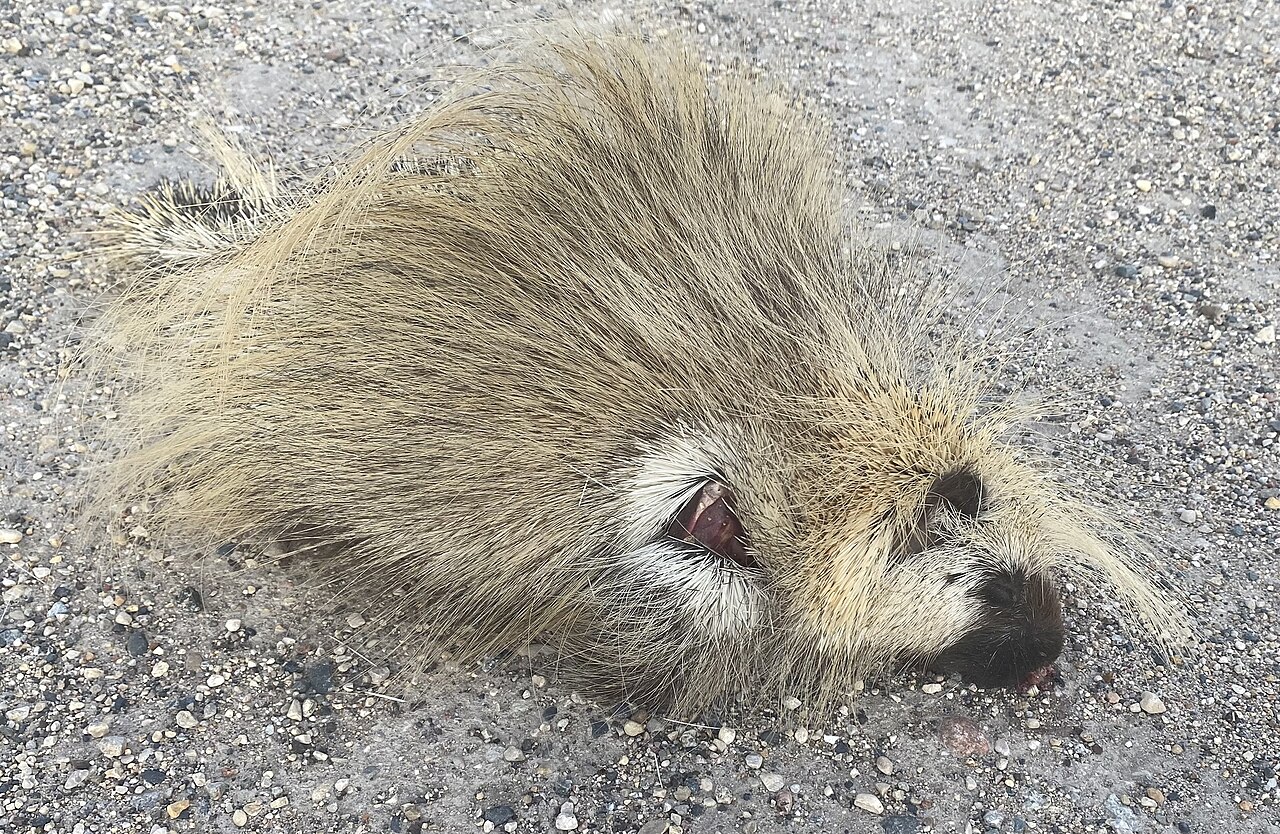
Dens produce the big deposits. Porcupines shelter in hollow logs, rock crevices, abandoned buildings, culverts and the undersides of outbuildings, and they do not carry waste out. The entrance of a well used den can hold a pile a foot deep, mixed with quills, chewed bark and matted urine stains on the rock.
Away from the den, pellets turn up scattered along game trails, at the base of feeding trees with fresh bark damage overhead, in the crotch of a large limb where the animal rested, and on the roofs of sheds. Fresh pellets under a tree with pale, gnawed patches on the upper trunk are a reliable sign the animal is still feeding there.
Winter Scat Looks Different From Summer Scat
Season changes the evidence more than most trackers expect. From November to April the diet is bark, twigs and conifer needles, which produces the classic firm, pale, fibrous pellet and the deep den accumulation. This is the easiest time of year to identify a porcupine from droppings alone.
From May to October the animal eats green leaves, buds, aquatic plants and fruit. Moisture content rises, pellets lose their shape, and the deposit becomes a soft dark mass that can be mistaken for bear or raccoon scat at a glance. In summer, lean on location and feeding sign rather than pellet shape.
Porcupine Poop vs Deer Poop
Deer pellets are the most common misidentification because both animals leave fibrous brown pellets in the same woods. Deer droppings are shorter and rounder, typically 0.5 in (1.3 cm) and roughly as wide as they are long, with one dimpled end and one slightly pointed end. They look smooth and often glossy when fresh.
Porcupine pellets are longer than wide, curved, dull and visibly shredded. Deer leave groups of 50 to 100 loose pellets in open browsing areas; porcupines concentrate everything at a den or feeding tree. A detailed pellet comparison sits in our guide to deer and rabbit droppings.
Porcupine Poop vs Rabbit Poop
Rabbit droppings are near perfect spheres, 0.3 to 0.4 in (8 to 10 mm) across, uniform and dry, with a light brown sawdust interior. They scatter in loose handfuls on lawns, under shrubs and along hedge lines, usually in the open.
The tell is geometry. If the pellet rolls, it is a rabbit; if it has a length and a curve, it is a porcupine. Rabbit scat also lacks the splintered bark pieces that give porcupine pellets their rough edge, and rabbits almost never produce a single concentrated pile deep enough to bury a boot.
Porcupine Poop vs Beaver Poop
Beavers are the other woody-diet specialist, so their scat also contains sawdust-like fiber. Beaver droppings are larger and more oval, up to 1.5 in (4 cm), and they are usually deposited in water, where they break apart quickly. Finding intact beaver scat on dry land is unusual.
Habitat settles it. Porcupine piles sit in dry, sheltered, often elevated spots; beaver sign stays within a few yards of a pond, lodge or stream bank. If the deposit is on rock or in a hollow trunk uphill from water, it is a porcupine. Nearby water also means looking for otter tracks and slides along the bank.
What Attracts Porcupines to Your Yard?
Salt is the strongest draw. Porcupines crave sodium and will chew plywood, sweat-stained tool handles, road-salted tires, boat trailers and pressure treated decking to get it. Many yard visits are salt visits, not food visits.
After that it is woody food and shelter. Fruit trees, ornamental conifers, young hardwoods, fallen apples and gardens near woodland edges all bring them in, and a deck, crawl space, woodpile or barn foundation gives them a daytime den. Rubber hoses and vehicle wiring get gnawed for the same mineral reason, which is how a quiet visitor becomes an expensive one.
What Diseases Can Porcupines Carry?
Porcupine droppings are not tied to a single named human illness the way deer mouse droppings are tied to hantavirus. Like any wild mammal, porcupines can carry rabies, and their feces can hold Salmonella, Giardia and roundworm eggs. The more common problem around a den is the ticks and fleas that drop off the host.
Handle the cleanup the way the Centers for Disease Control and Prevention recommends for animal droppings. Wear gloves and an N95 mask, dampen the material with a disinfectant or a bleach solution instead of sweeping or vacuuming it dry, bag it twice, and wash your hands afterward. Never let dogs work a den pile; quills in the muzzle are the usual outcome.
How Do I Identify Animal Poop in My Yard?
Work through four questions in order: size and shape, content, placement, and quantity. Shape narrows the group, content tells you whether the animal eats plants, insects or meat, placement separates a climber from a ground forager, and quantity reveals whether the animal lives there or passed through.
Photograph the deposit next to a coin for scale before you clean it up, since size memory is unreliable. Then compare against paired guides rather than single species pages, the way squirrel and rat droppings or bat and mouse droppings are separated side by side. For large reptile scat with bone and scale fragments, our alligator scat guide covers the other end of the range.
Frequently Asked Questions
Is it bad to have a porcupine in your yard?
It is not dangerous, but it is costly. Porcupines strip bark from ornamental trees, gnaw salt-rich wood on decks and sheds, chew vehicle hoses and wiring, and pose a real quill risk to dogs. A single animal visiting a fruit tree is tolerable; one denning under a porch usually needs exclusion fencing.
What smell do porcupines hate?
Capsaicin and predator-urine products are sold as repellents, and strong taste deterrents such as hot pepper sprays or commercial bitter coatings do discourage gnawing while they last. No odor reliably clears an area. Hardware cloth around trunks, metal flashing on decks and removing salty objects work far better than scent.
What is the natural enemy of a porcupine?
The fisher is the main specialist predator, and it is skilled enough to attack the face and flip the animal to reach the unquilled belly. Mountain lions, bobcats, coyotes, great horned owls and occasionally black bears also take porcupines, usually young or weakened ones.
Where do porcupines go at night?
Night is their active period. They leave the den after dusk and feed in trees or on the ground until dawn, often spending hours in a single canopy. In winter they may stay in one hemlock for days at a time, then return to a rock or tree den to sleep through daylight.
Are porcupines friendly to humans?
They are slow, nearsighted and non-aggressive, which can read as tame. They do not throw quills, but a cornered animal turns its back, chatters its teeth and swings its tail, and loose quills detach on contact. Give any porcupine several yards of space and it will simply walk away or climb.
Do porcupines poop in the same spot?
Yes, and that habit is the key identification clue. Because they drop scat from the den entrance and reuse dens season after season, the pile grows into an accumulation of hundreds or thousands of pellets, sometimes mixed with quills. Few North American mammals leave such a concentrated, long-lived deposit.