Hornet Nest: Identification, Risk, and Removal
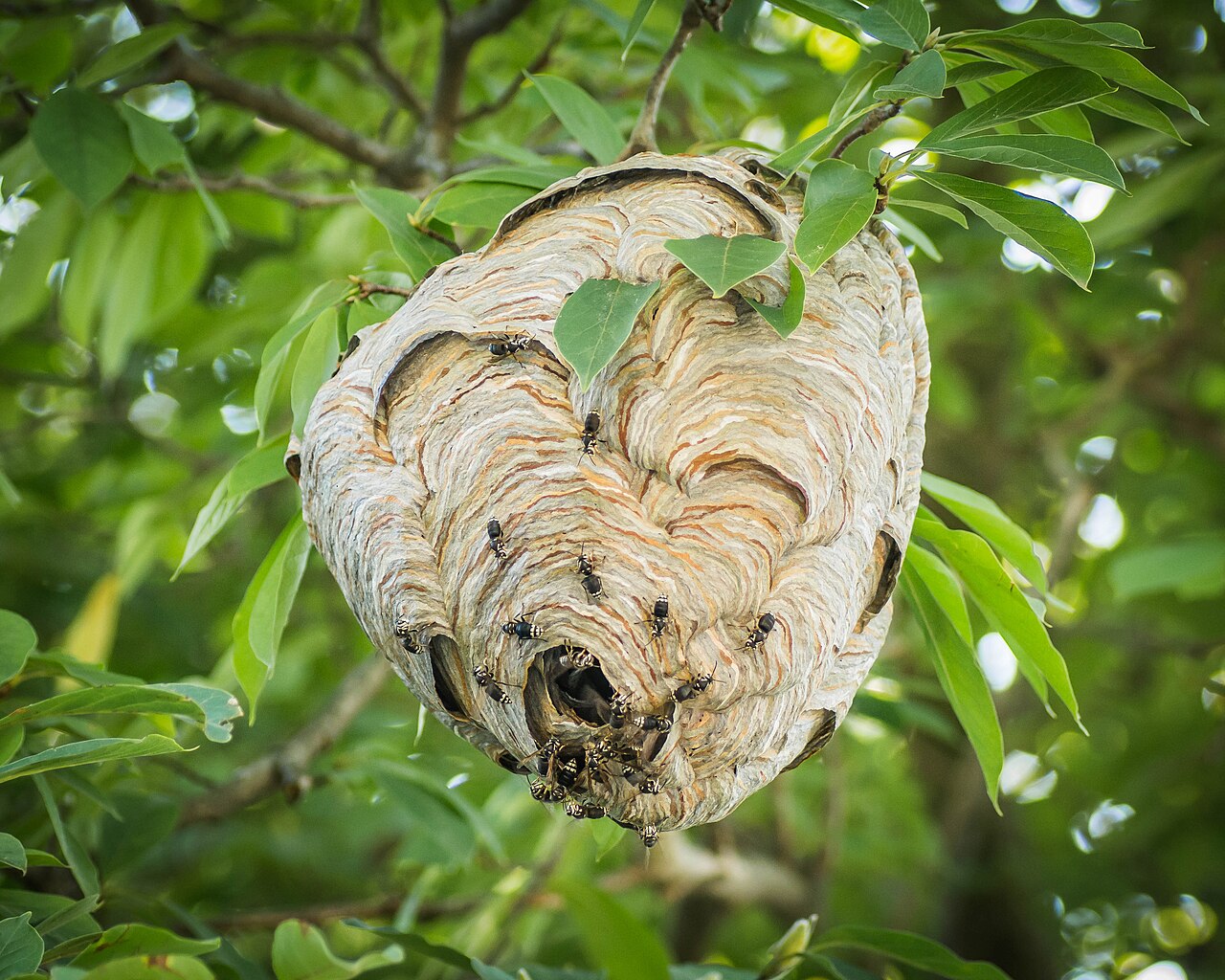
A hornet nest is a grey, papery, enclosed structure roughly the size and shape of a football or a teardrop, hanging from a branch, eave, or shed roof, with a single small entrance hole near the bottom. It is made from chewed wood fibre mixed with saliva, and by late summer it can hold several hundred insects.
The most useful thing to know is that the nest is annual. The colony dies with the first hard frosts, only mated queens survive the winter, and no hornet ever reuses a nest, so a nest hanging in a tree in winter is empty and harmless. Most nests people worry about need nothing done to them at all. This guide covers identification, location, danger, removal, and when it is genuinely worth acting.
A hornet nest is a grey papery enclosed ball or teardrop with a single entrance hole near the bottom, made from chewed wood fibre. Colonies are annual and die with the first hard frosts, and nests are never reused, so a winter nest is empty. Remove a nest only if it is near a doorway, in a wall, or where someone with a sting allergy passes.
| Feature | Hornet Nest |
|---|---|
| Shape | Enclosed ball or teardrop, football sized |
| Colour | Grey, layered, papery |
| Entrance | One small hole near the bottom |
| Location | Tree branches, eaves, sheds, wall voids |
| Peak size | Late summer; several hundred workers |
| Winter | Empty; colony dies, nest never reused |
| Wasp nest comparison | Paper wasp nest is open, umbrella shaped |
What Does a Hornet Nest Look Like?
Grey and fully enclosed. Bald-faced hornets, which are the species most Americans mean by hornet, build a large teardrop or football-shaped nest of layered grey paper, entirely closed except for a single entrance hole near the base, and it hangs from a branch, eave, or overhang.
The paper texture is distinctive: swirled bands of grey, tan, and brown that come from different sources of chewed wood, giving the surface a marbled appearance. Inside are horizontal tiers of hexagonal comb wrapped in several layers of paper envelope, which insulates the colony.
Size depends on the season. A nest begun by a single queen in spring is the size of a golf ball; by August the same nest can be over a foot across and hold 400 to 700 workers. Growth is exponential through summer, which is why a nest seems to appear suddenly. The hornet nest vs wasp nest guide covers the comparison in detail.
How Is It Different From a Wasp Nest?
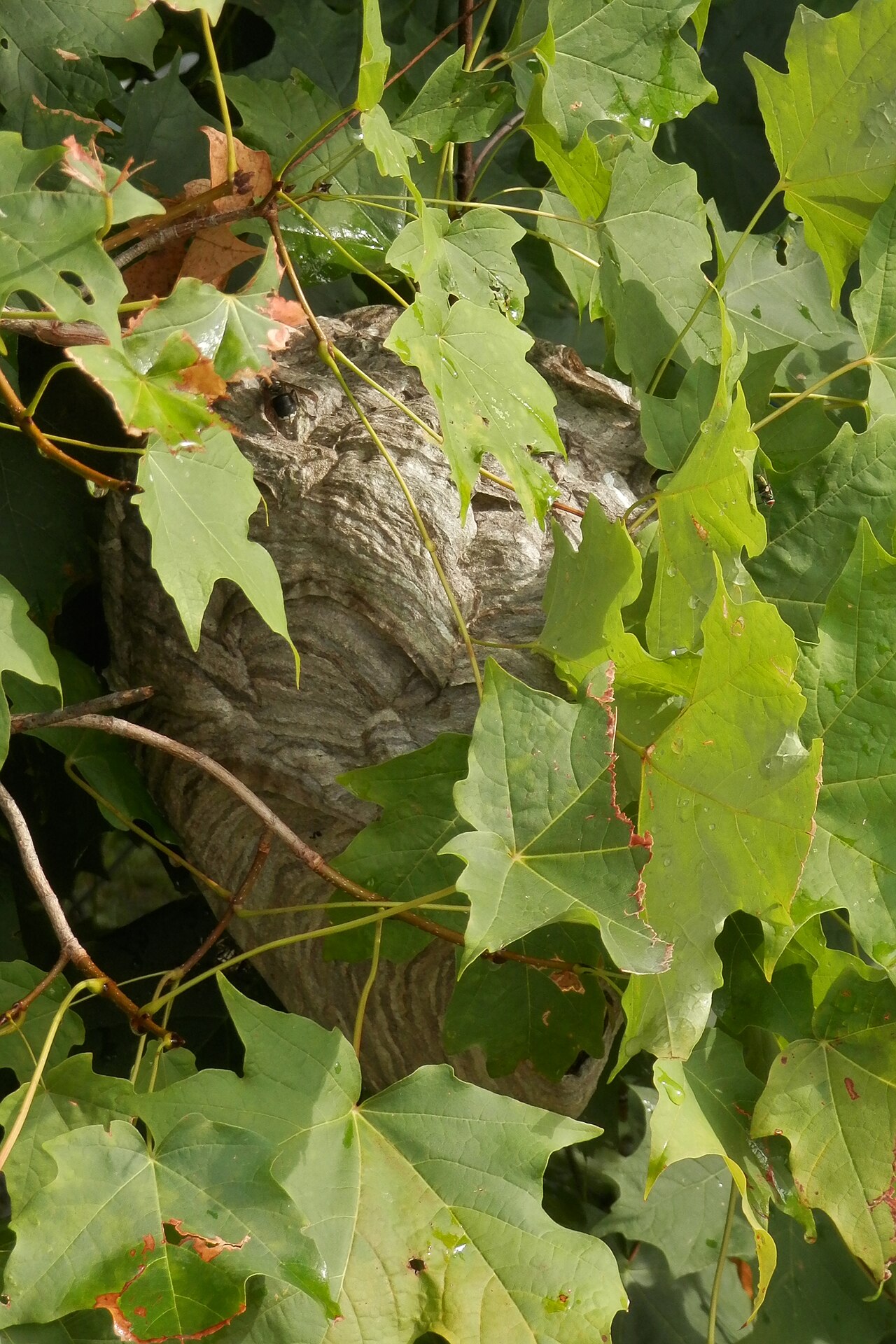
Enclosure is the test. A paper wasp nest is an open, exposed comb shaped like an inverted umbrella, hanging from a short stalk under an eave, deck rail, or shed roof, with the cells clearly visible and the wasps sitting on them. There is no paper envelope around it.
Yellowjacket nests are enclosed like hornet nests but are usually underground in old rodent burrows, or hidden inside wall voids, attics, and dense shrubs, so what you see is a stream of insects going in and out of a hole in the ground or a gap in the siding rather than a hanging structure.
Mud daubers build small tubes of mud on walls and under eaves and are solitary and harmless. Bees build wax comb, which is yellowish and hexagonal, and honeybee colonies in a wall are dealt with by a beekeeper rather than an exterminator. The hornet vs wasp guide covers telling the insects apart.
Where Do Hornets Build Nests?
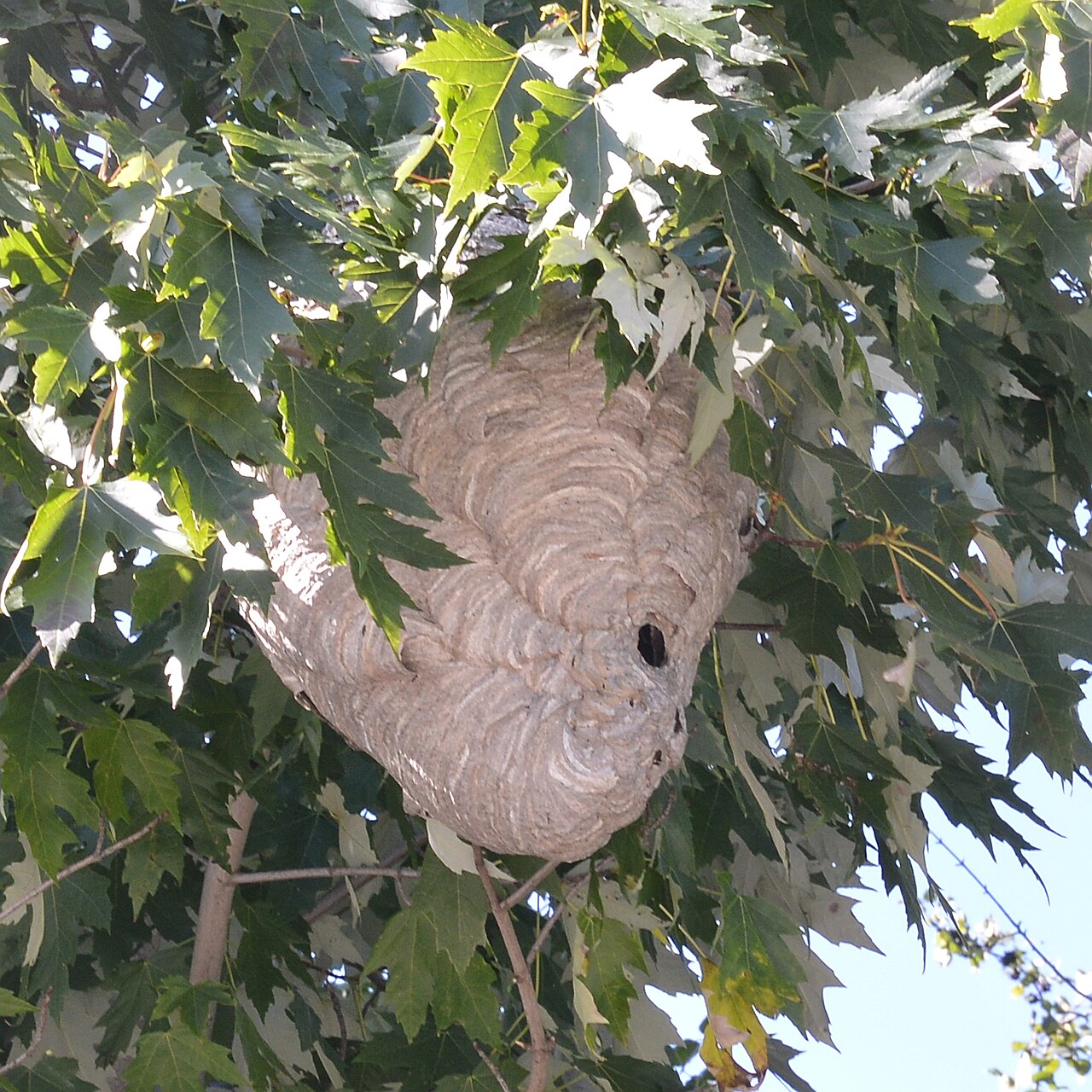
Bald-faced hornets favour tree branches and large shrubs, usually three to sixty feet up, and also build under eaves, on shed and garage overhangs, on the sides of buildings, and occasionally in attics or wall voids. Height varies enormously and a nest at head height in a hedge is not unusual.
European hornets, which are larger and genuinely in the genus Vespa, behave differently. They nest in hollow trees, wall voids, attics, and barns rather than in the open, and they are the species most often found inside a structure. They are also the only hornet in North America that flies at night and is attracted to lights.
Placement is chosen in spring by a single overwintered queen, who builds a small starter nest and raises the first workers alone. That is why a nest found in May can be removed with almost no risk while the same nest in August is a serious undertaking. The murder hornet guide covers the species that caused the recent alarm.
How Do You Tell If You Have One?
Traffic is the clearest sign. A steady stream of large insects going to and from one point, particularly a gap in siding, a hole in the ground, or a spot under an eave, indicates a nest even when the nest itself is hidden. Watch from a distance for a few minutes and the flight line becomes obvious.
For nests in structures, sound and staining matter. A nest in a wall void produces an audible rustling or buzzing through the wall on warm days, and a large nest can cause a damp brown stain on interior plaster as moisture from the paper transfers through.
Chewing marks on weathered wood are an early indicator. Hornets strip wood fibre from fences, sheds, and deck rails, leaving pale shallow grooves, and finding those in spring means a colony is building nearby. Increased insect activity around a specific tree or overhang is worth investigating at that stage rather than in August.
Are Hornets Aggressive?
Near the nest, yes, and bald-faced hornets are among the most defensive social insects in North America. They respond to vibration and to movement close to the nest, will pursue an intruder well away from it, and can sting repeatedly because the sting is smooth rather than barbed.
Away from the nest they are not. A hornet foraging on a flower, a fallen apple, or a patio table is not defending anything and will ignore people unless swatted. The great majority of stings happen within a few metres of a nest, often from mowing, hedge trimming, or leaf blowing near one that had not been noticed.
Alarm pheromone is what turns one sting into several. A hornet that stings or is crushed releases a chemical that recruits nestmates and marks the target, which is why multiple stings are common and why walking calmly away beats swatting. Bald-faced hornets can also spray venom at the eyes of a perceived threat, which causes intense irritation and needs immediate flushing. The red wasp guide covers a species with different behaviour.
What Month Do Hornets Leave the Nest?
They do not leave so much as die. Colonies peak in size in late summer, produce new queens and males in late summer and early autumn, and the workers, the old queen, and the males all die with the first hard frosts, usually October or November depending on latitude.
The new queens mate and disperse to overwinter alone, tucked under bark, in log piles, in leaf litter, and occasionally in sheds and attics. Each surviving queen founds an entirely new colony the following spring in a new location, and no nest is ever reused.
That means a nest found after a hard frost is empty. There is no need to spray it, no benefit to destroying it, and no risk in leaving it, and weather will break it down over the winter. Late autumn is also the only genuinely safe window for removing a nest by hand if it is somewhere it needs to come down.
How Do You Get Rid of a Hornet Nest?
Where possible, wait. If the nest is not near a doorway, a walkway, a wall void, or anyone with a sting allergy, leaving it until the colony dies naturally is the safest and cheapest option, and the colony spends the summer eating caterpillars, flies, and other insects.
Where it genuinely needs to go, a professional is the right call for any large or enclosed nest, and it is not an expensive job. Nests in wall voids, attics, and underground in particular should not be treated by a homeowner, because sealing an entrance drives the colony inward through the wall rather than outward.
If you treat a small exposed nest yourself, do it at night when the whole colony is inside and inactive, in cool weather, using a jet-spray aerosol from as far back as the can allows, with a planned exit route, full covering clothing, and no ladder. Never use a ladder for this and never use fire or fuel, both of which cause serious injuries every year. Extension programmes such as Penn State (psu.edu) publish species-specific guidance.
What Smell or Product Kills Hornets?
Very little of what is marketed works. Peppermint oil, cloves, vinegar, dryer sheets, and citrus sprays are widely recommended online and have little evidence behind them for hornets, and ultrasonic devices do nothing at all. The fake paper nest sold as a deterrent has no supporting evidence either, since hornets do not respect other colonies’ territories in that way.
What does work on contact is a jet-spray wasp and hornet aerosol containing a pyrethroid, applied to the entrance at night, and soapy water, which breaks surface tension and drowns insects on contact and is the safer option for a small exposed nest within reach.
Prevention is more effective than any product. Checking eaves, sheds, and hedges in April and May and knocking down golf-ball-sized starter nests, when a single queen is present and no workers exist yet, removes a colony before it becomes a problem. That five-minute job in spring replaces an expensive one in August. The guide to animals that eat wasps covers the natural predators doing the same job.
Should You Kill Hornets at All?
Often not. Hornets are predators, and a colony hunts caterpillars, flies, beetle larvae, and other insects continuously through the summer to feed its brood, removing thousands from the surrounding area. Removing them reliably increases the insect load in a garden.
They also pollinate, less efficiently than bees because they lack dense body hair, but meaningfully, and late in the season adults feed on nectar and fallen fruit and visit flowers regularly. Hornets are food in turn for badgers, skunks, bears, birds, and dragonflies.
The nests genuinely worth removing are a narrow category: in or beside a doorway, in a wall void or attic, in play equipment, at head height along a path, or anywhere a person with a known sting allergy passes regularly. Everything else is better left to the frost. The guide to birds that eat wasps covers what happens to the colony in the meantime.
Related reading: Hornet Nest Removal.
Related reading: Bald Faced Hornet Nest.
Frequently Asked Questions
What does a hornet nest look like?
A grey papery enclosed ball or teardrop with swirled bands of colour and a single entrance hole near the bottom, hanging from a branch, eave, or overhang. Football sized by late summer.
What is the difference between a hornet nest and a wasp nest?
Enclosure. Paper wasp nests are open umbrella-shaped combs with visible cells; hornet nests are fully wrapped in paper envelope. Yellowjacket nests are enclosed too but usually underground or in walls.
How do you tell if you have a hornet nest?
A steady stream of large insects to and from one point, buzzing audible through a wall, damp brown staining on interior plaster, or pale shallow chewing grooves on weathered fence and deck wood.
Are hornets aggressive?
Highly defensive within a few metres of the nest and largely indifferent away from it. Most stings come from mowing or trimming near an unnoticed nest rather than from foraging insects.
What month do hornets leave the nest?
They die rather than leave, with the colony ending at the first hard frosts in October or November. Only new mated queens survive, and no nest is ever reused, so winter nests are empty.
What kills hornets immediately?
A jet-spray pyrethroid aerosol applied to the entrance at night, or soapy water on a small exposed nest. Peppermint oil, vinegar, dryer sheets, and ultrasonic devices do not work.
Should you remove a hornet nest?
Only if it is beside a doorway or walkway, inside a wall or attic, in play equipment, or where someone with a sting allergy passes. Otherwise leave it; the colony dies at the first frost.

Similar Posts
What Do Moths Eat? Adults, Caterpillars, and Clothes
Adult moths drink nectar and sap, and some never eat at all. Here is what moths eat at every stage, which fabrics larvae damage, and what pantry moths target.
Crested Gecko Care: Habitat, Diet & Lifespan Guide
A complete crested gecko care guide covering habitat setup, diet, shedding, lifespan, and common health issues.
Chipmunk Poop: Identification and Comparison Guide
Chipmunk droppings are small dark pellets you rarely see, because chipmunks use burrow latrines. Here is how to identify them and what they mean.
Clover Mite: Why They Appear and How to Stop Them
Tiny red mites that swarm sunny walls in spring and autumn, do not bite, and stain when crushed. Why vacuuming beats squashing and the one measure that actually works.
Baby Chipmunk: Growth Stages, Nests and What to Do
Baby chipmunks are called pups, born blind and bumblebee-sized. Here is the full timeline from birth to independence and what to do if you find one.
Viceroy Butterfly: The Monarch Mimic and How to Tell Them Apart
The viceroy butterfly copies the monarch almost perfectly, except for one black hindwing line. The mimicry science, the bird-dropping caterpillar, willow host plants, and more.