Pink Fly: 8 Pink Flying Insects People Mistake for Flies
If you saw a pink fly, you almost certainly did not see a fly. True flies in the order Diptera come in grey, black, bronze and metallic green, and no common North American species is pink. The pink insect on your window screen or in your garden is far more likely to be a moth, a dragonfly, an aphid or a rare color morph of a katydid, and each of those is easy to tell apart once you know what to look at.
This guide covers the pink flying insects people in the United States actually photograph and misidentify, starting with the safety question, then working through eight species with size, range and field marks. It also explains why a search for “pink fly” fills up with fishing lures and song titles, which is the single most confusing part of looking this up.
There is no true pink fly in North America. The pink flying insects mistaken for flies are the rosy maple moth, primrose moth, pink spotted hawkmoth, roseate skimmer dragonfly, pink color morphs of katydids and grasshoppers, and winged potato aphids. None of them bite, sting or carry venom, so a pink insect indoors is a harmless visitor.
Are there any true pink flies in the United States?
No. Among the roughly 17,000 Diptera species recorded in North America, none is reliably pink as an adult. Flies rely on structural color and dark pigment, which produces the blues, greens and bronzes you see on blow flies, and the pink end of the spectrum is produced mainly by carotenoid and ommochrome pigments that flies barely use in their cuticle.
The closest a true fly comes is a pinkish tan, which shows up on some crane flies and on freshly emerged midges before their cuticle hardens. Laboratory fruit flies add a footnote: “pink” is the name of a real eye color mutation in Drosophila melanogaster, so pink flies do exist in genetics labs, just not with pink bodies. Our guide to fruit flies covers the wild version you find in your kitchen.
Is a pink fly dangerous? Bites, stings and venom
None of the pink flying insects in this guide is venomous, and none stings. Moths have no biting mouthparts as adults, dragonflies have strong jaws but use them on other insects and cannot sting, and aphids pierce plants rather than skin. A large katydid can deliver a weak nip if you squeeze it, which breaks no skin.
The only real damage is to plants. Winged potato aphids spread plant viruses through tomato and potato beds, and the larva of the pink spotted hawkmoth is the sweet potato hornworm, a crop pest in the South. If you were worried because something bit you and you saw pink, read our guide to bot fly bites and compare, because biting flies are grey and brown, never pink.
Rosy maple moth (Dryocampa rubicunda)
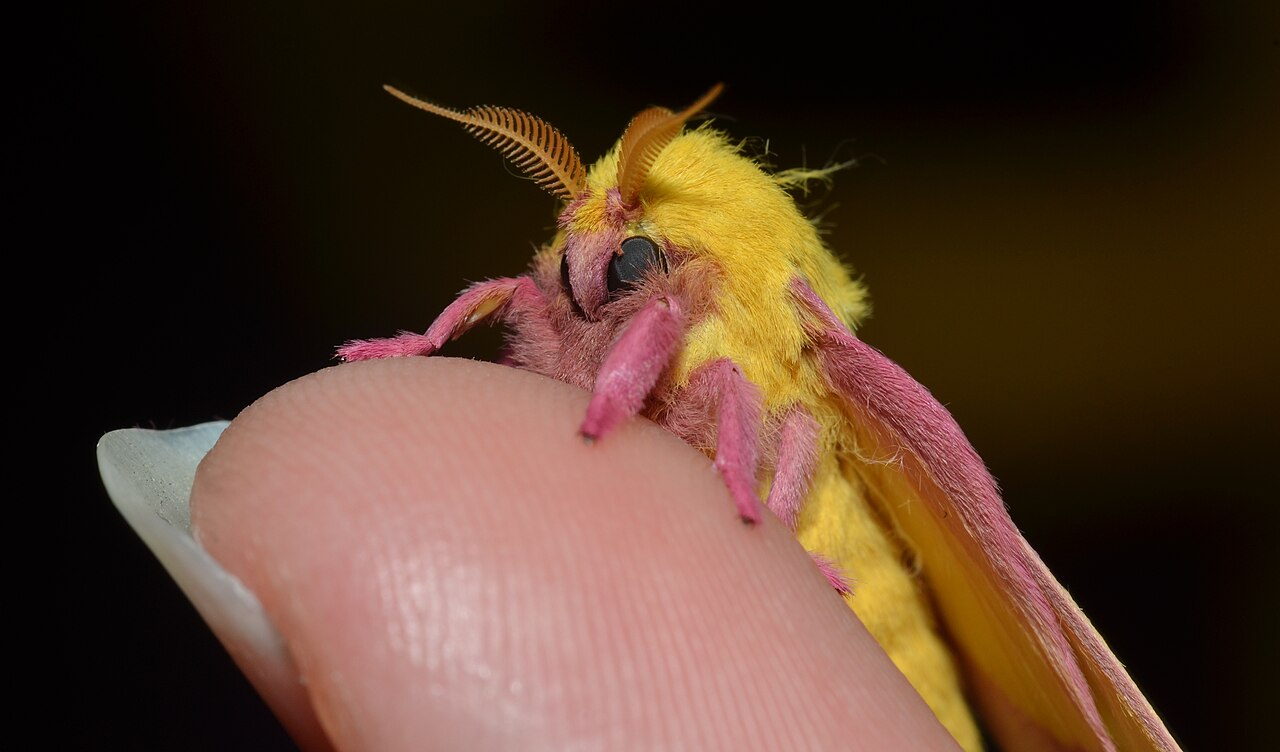
This is the insect behind most pink fly sightings east of the Rocky Mountains. The rosy maple moth is bright pink and creamy yellow, furry across the thorax, with a wingspan of 1.25 to 2 in (32 to 50 mm). It flies at night in late spring and summer, is drawn to porch lights, and often sits motionless on siding until morning.
Field marks are unmistakable: the pink is on the leading edge and outer band of the forewing, the yellow fills the middle, and the legs and antennae are pink too. Adults have no functional mouthparts and never feed. The caterpillar, called the green striped mapleworm, eats maple and oak foliage, which is why suburbs with maple street trees see the most adults.
Primrose moth (Schinia florida)
The primrose moth is the pink insect people find sitting inside a flower in broad daylight. It is smaller than the rosy maple moth, with a wingspan of about 1 in (25 to 30 mm), deep rose pink on the outer two thirds of the forewing and cream white at the base.
Its habit makes identification easy. Adults spend the day head down inside the blossoms of common evening primrose (Oenothera biennis), often two or three to a plant, and fly at dusk. It occurs across most of the United States and southern Canada wherever evening primrose grows along roadsides and in old fields. A pink insect wedged in a yellow flower is this species and nothing else.
Pink spotted hawkmoth (Agrius cingulata)
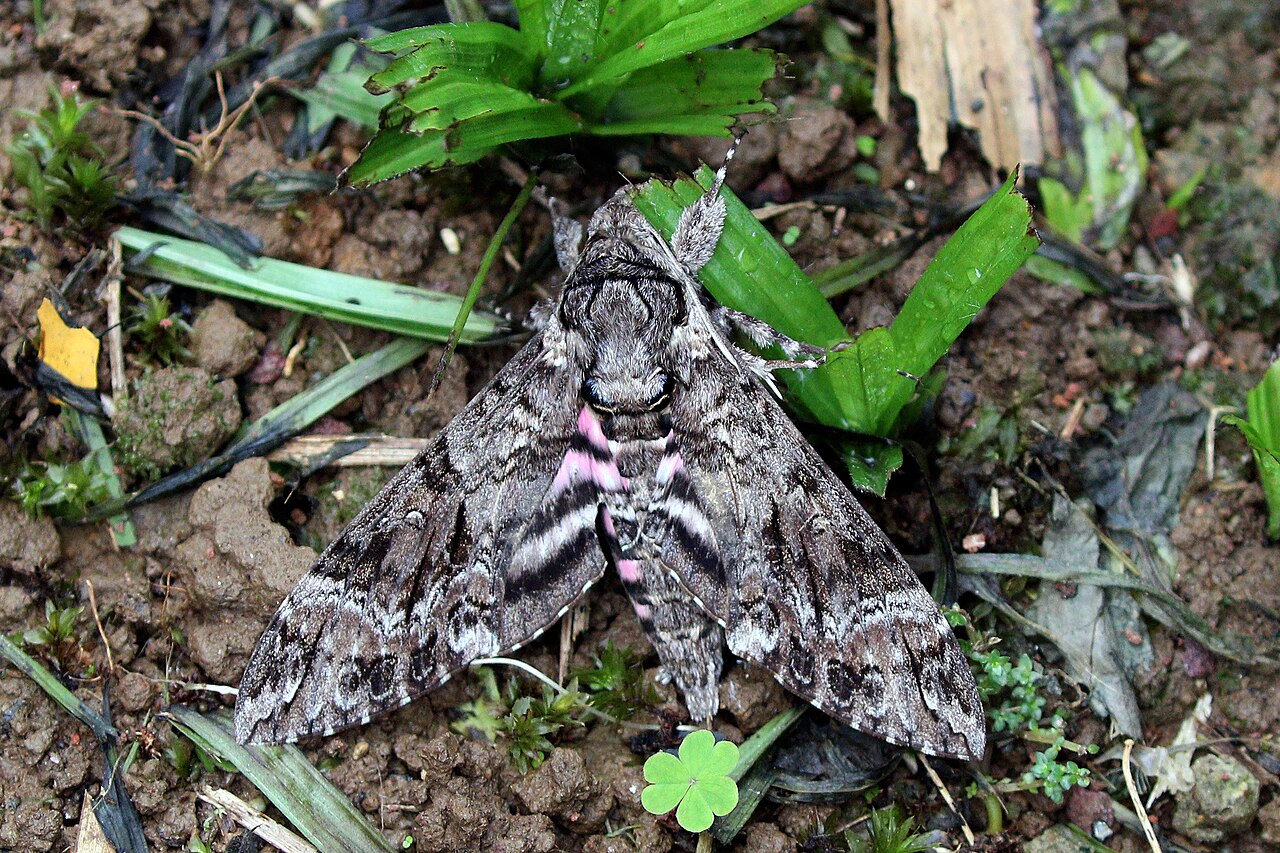
This is the largest pink flier on the list, with a wingspan of 3.75 to 4.75 in (95 to 120 mm). The forewings are mottled grey and brown, which hides the insect on bark, but the abdomen carries bold pink bands and the hindwing shows a pink flush that only appears in flight. Seen hovering at a flower at dusk, it reads as a pink blur the size of a small bird.
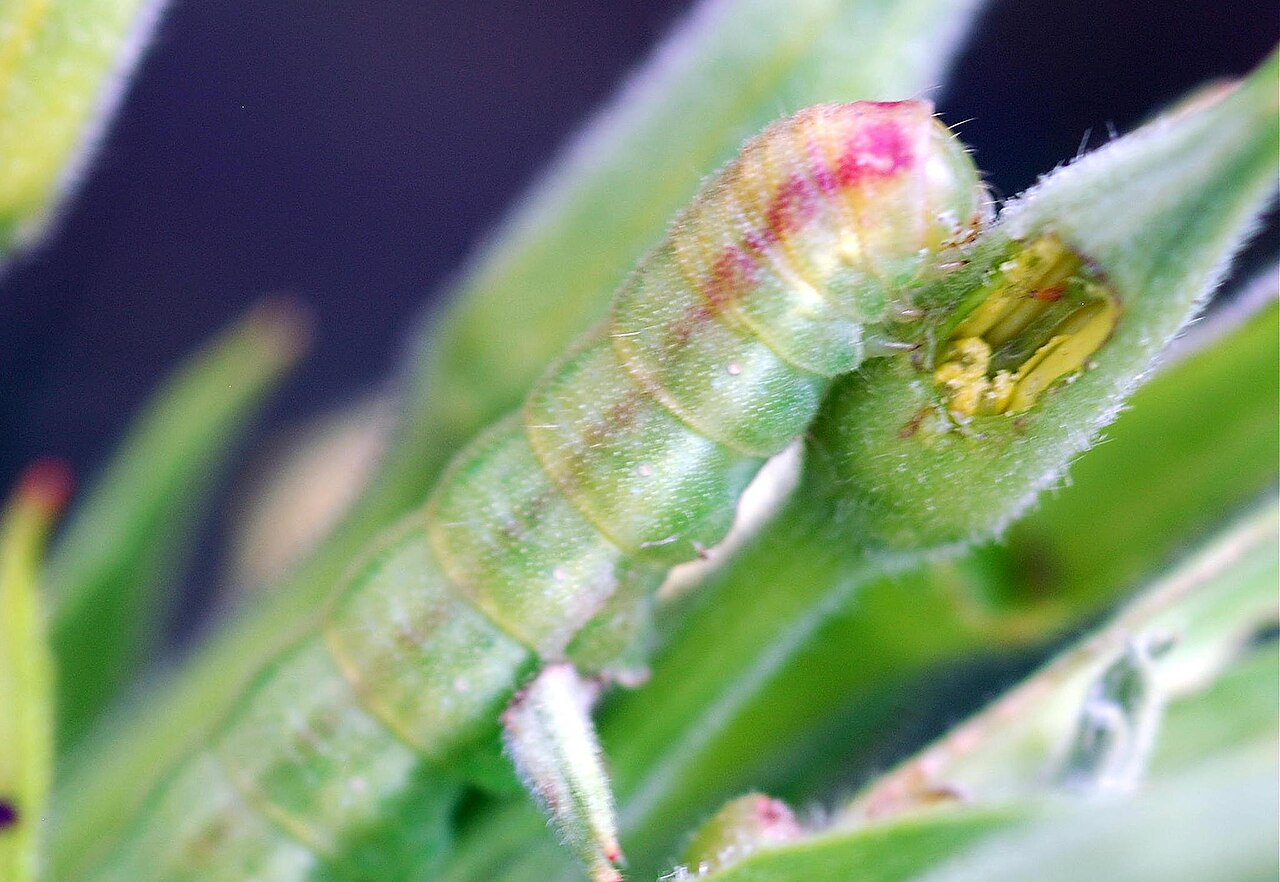
It is a tropical migrant that breeds in the southern states and strays north as far as New England and the Great Lakes in late summer. It feeds on nectar from long tubed flowers while hovering, which is the behavior that gets it called a hummingbird moth. The larva is the sweet potato hornworm, a thick green or dark caterpillar with a curved horn.
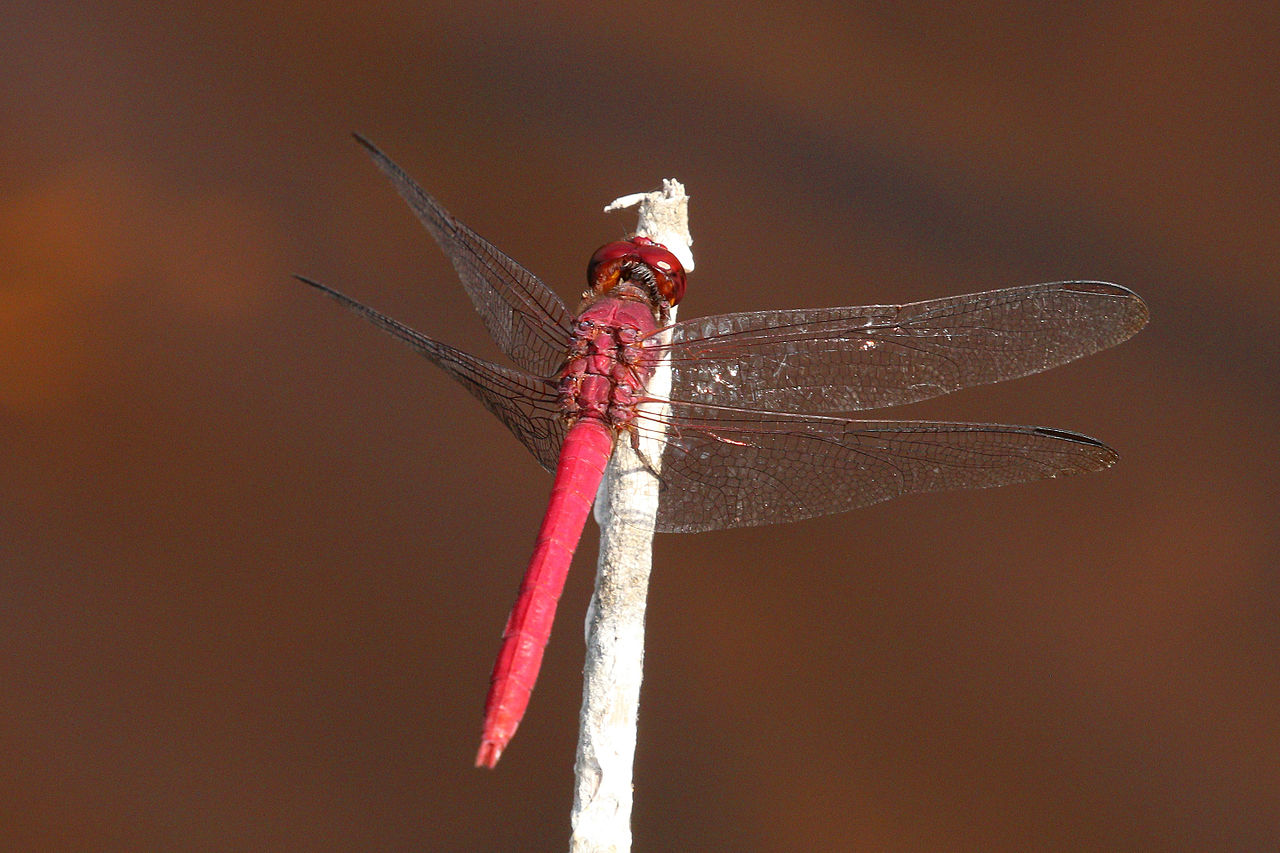
Roseate skimmer (Orthemis ferruginea): the pink dragonfly
Mature male roseate skimmers are genuinely rose magenta on the abdomen with a pale thorax, and at about 2 in (50 mm) long with clear wings they are the most striking pink insect in the South. Females and young males are brown and rust colored, so only part of any population looks pink.
The species is common in Texas, the Gulf states, Florida, New Mexico, Arizona and southern California, and it breeds in ponds, ditches, cattle tanks and anything else that holds still water. It perches on twig tips and returns to the same spot, which makes it easy to photograph. Dragonflies cannot sting, and this one hunts mosquitoes and midges all day.
Pink katydid (Amblycorypha oblongifolia)
A pink katydid is the same insect as a green katydid, carrying a color variant called erythrism. The body, wings and legs all turn shades from salmon to hot pink, the leaf shaped wings stay the same, and the long hind legs and threadlike antennae separate it instantly from any moth. Adults reach 1.5 to 2.5 in (38 to 64 mm).
Pink morphs appear in several Amblycorypha species across the eastern and central United States. Estimates of how often the pink form occurs in the wild run around one in 500 individuals, because the color removes the camouflage that keeps green katydids alive. Most pink katydids people see turn up on flowers, on porches at night, or in insect zoos where they are bred deliberately.
Pink grasshoppers and why pink insects happen
The same erythrism produces pink grasshoppers, most often in meadow grasshoppers and in the nymphs of several field species. The mechanism is a shift in the pigment balance: too little of the dark and yellow pigments that combine into normal green, leaving the red toned pigments visible. In katydids it is inherited as a dominant trait, which is why captive breeders can produce pink lines reliably.
Erythrism also explains the pink individuals of insects that are otherwise famously the wrong color, including the pink forms covered in our guides to pink ladybugs and pink spiders. If your pink insect has the body plan of a familiar green or brown species, color variation is almost always the answer rather than a new species.
Potato aphid (Macrosiphum euphorbiae): tiny pink insects that fly
When people describe clouds of minute pink flies on tomato plants, they are describing winged potato aphids. The pink form of this species is common, winged adults measure 2 to 3 mm, and they fly weakly from plant to plant in summer, which is exactly what a swarm of small flies looks like from arm’s length.
Two details confirm the identification: aphids have a pair of tubes called cornicles projecting from the rear of the abdomen, and they cluster on new growth and flower stems rather than circling in the air. They feed by piercing plant tissue, excrete honeydew that ants harvest, and transmit viruses between crops. Soapy water and a strong hose spray handle them on garden plants.
Crane flies, midges and true flies that look pink
Some true flies do read as pink in the right light. Crane flies in the genus Tipula have slender tan to pinkish bodies, legs several times their body length, and a wobbling flight that gets them mistaken for giant mosquitoes. They have no biting mouthparts at all, as our guide to crane flies explains.
Freshly emerged chironomid midges can look pinkish for a few hours before their cuticle darkens, and their larvae, the bloodworms, are deep red from hemoglobin. The best way to settle whether you have a fly at all is to count wings: true flies have one pair plus two small knobs called halteres, while moths, dragonflies and katydids all have four wings. Compare with our guide to blue flies for the colors that genuinely occur in Diptera.
Pink flying insects at a glance
Use the table to narrow a sighting down in a few seconds. Size and setting separate these species faster than color does, because every one of them is pink.
| Species | Size | Where and when | Key mark | Harmful? |
|---|---|---|---|---|
| Rosy maple moth | 1.25 to 2 in | East of Rockies, night, spring to summer | Pink and yellow furry wings | No |
| Primrose moth | About 1 in | Nationwide, day, inside primrose flowers | Rose wings with cream base | No |
| Pink spotted hawkmoth | 3.75 to 4.75 in | South, strays north, dusk | Grey wings, pink banded abdomen | Larva eats crops |
| Roseate skimmer | About 2 in | Southern states, day, near water | Magenta abdomen, clear wings | No |
| Pink katydid | 1.5 to 2.5 in | East and central, night | Leaf wings, long hind legs | No |
| Pink grasshopper | 0.5 to 1.5 in | Meadows nationwide, day | Short antennae, jumping legs | No |
| Winged potato aphid | 2 to 3 mm | Gardens nationwide, summer | Cornicle tubes, clusters on stems | Plant virus vector |
Where and when you see pink insects in the United States
Timing narrows the list almost as well as geography. Rosy maple moths peak from May through August and show up at lights; primrose moths appear from July to September and are found by checking evening primrose stands in the afternoon. Pink spotted hawkmoths arrive with late summer heat, and roseate skimmers fly from spring through fall wherever winters are mild.
Pink morphs of katydids and grasshoppers show up in late summer when adults are at their largest, and gardeners find them on zinnias, goldenrod and milkweed. Winged aphids appear whenever a colony outgrows its host plant, usually in midsummer. The collections at the Smithsonian National Museum of Natural History hold reference specimens for all of these groups if you want to compare a photograph against verified material.
Why searching “pink fly” returns fishing lures and songs
Most of the top results for pink fly are not about insects at all. In fly fishing, a fly is an artificial lure, and pink patterns are standard gear for pink salmon and steelhead, which fills the search results with tackle pages. Several songs and albums are also titled Pink Fly, and those rank on streaming platforms.
Knowing that saves time. If you want insects, search the body plan instead: pink moth, pink dragonfly or pink katydid will reach identification pages immediately, while pink fly will not. Adding a state name helps further, since range is what rules species in and out. If you are chasing something pink with feathers rather than wings, see our guide to pink birds.
Frequently Asked Questions
Is there such a thing as a pink butterfly?
No North American butterfly is truly pink, though several carry pink markings, including the pink edged sulphur and the rosy patches on some hairstreaks and swallowtail hindwings. Insects that read as fully pink and fly by day are far more likely to be primrose moths or pink morph grasshoppers than butterflies.
What is the Pink Thing Fly?
The Pink Thing is a fishing fly pattern, not an insect. It is a simple pink marabou or chenille streamer used for pink salmon and steelhead in the Pacific Northwest. Searches for it dominate pink fly results, which is why insect identification pages rarely appear on the first page.
What is the best fly for pink salmon?
Anglers overwhelmingly use small pink streamers and pink Clouser or Humpy patterns in sizes 6 to 10 for pink salmon, because the fish respond to pink and chartreuse. This is a tackle question rather than an entomology one, and it has no bearing on identifying a pink insect.
What do salmon flies turn into?
The salmonfly (Pteronarcys californica) is a real insect, a large western stonefly whose aquatic nymph lives in rivers for two to three years before crawling out and emerging as a winged adult with an orange to salmon colored underside. Nymphs do not turn into anything else; the adult is the final stage and lives only a few weeks.
What is the most beautiful fly?
Among true flies, the long legged flies in the family Dolichopodidae win most votes for their metallic emerald and gold bodies, with the bee mimicking hover flies close behind. If the question is really about the most beautiful pink flying insect, the rosy maple moth takes it by a wide margin.
How can I tell a moth from a fly quickly?
Count the wings and look at the antennae. Moths have four scaled wings and feathered or threadlike antennae, and their bodies feel dusty. True flies have two wings plus a pair of small knobs, short stubby antennae, and large wrap around eyes. Pink always means moth, dragonfly, aphid or color morph, never a common fly.