Gray Ladybug Identification: 6 US Species and 3 Lookalikes
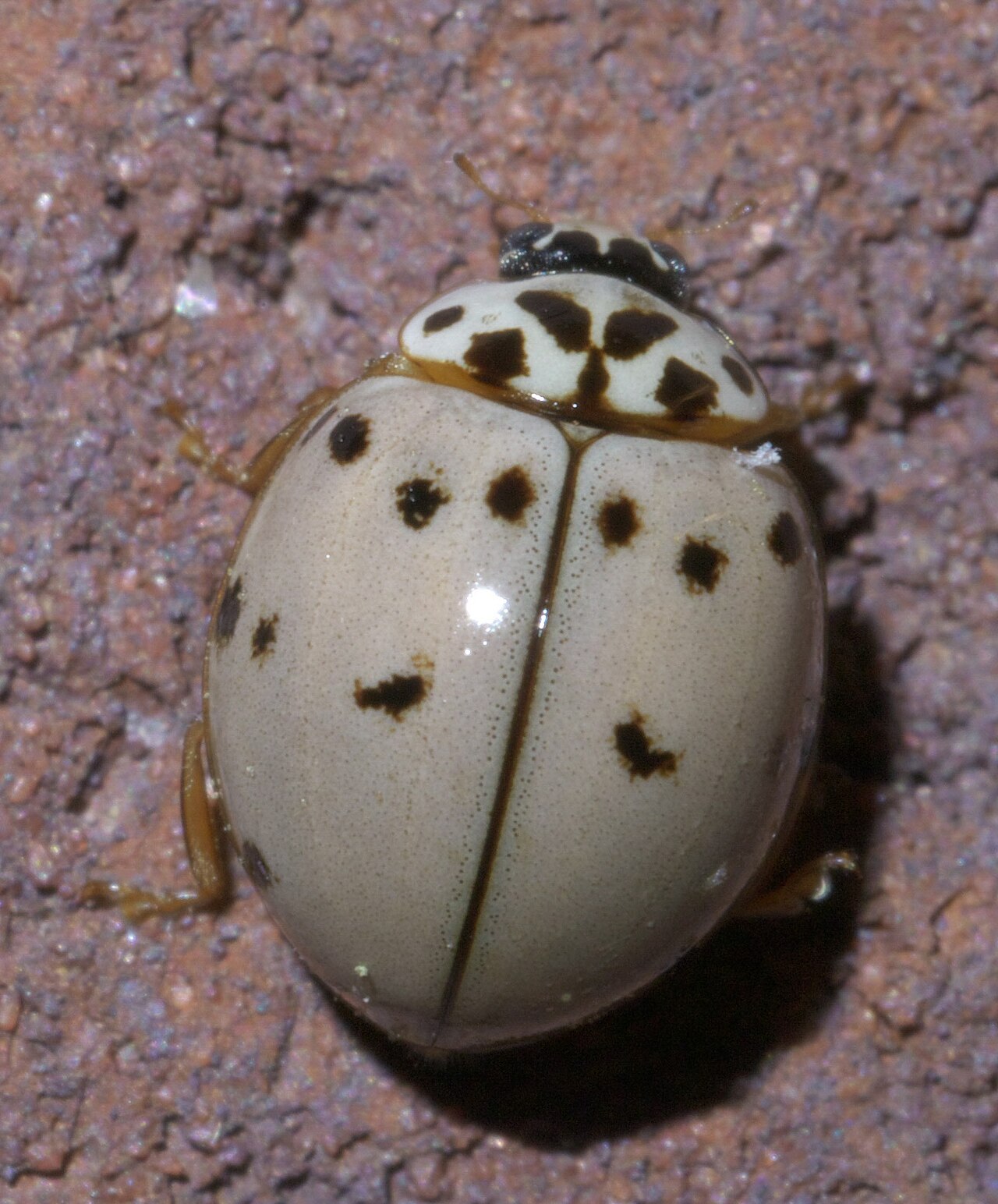
A gray ladybug in the United States is almost always an ashy gray lady beetle, Olla v-nigrum, a pale chalky beetle with scattered black dots that is completely harmless to people, pets and plants. A handful of other species also read as gray, and one common household pest is mistaken for them constantly, so the gray ladybug you are holding is worth two minutes of checking.
None of the beetles on this list can sting you, none is venomous, and none is poisonous to touch. The practical reason to tell them apart is what happens next: three are aphid eaters you want in the garden, one overwinters in walls by the hundreds, and the lookalike at the end eats wool sweaters.
The gray ladybug most people find is the ashy gray lady beetle (Olla v-nigrum), roughly 0.16 to 0.24 in (4 to 6 mm), pale gray with a dozen or more small black spots. It does not bite, sting or carry venom, and it eats aphids and psyllids. Pale Asian lady beetles and the tiny twenty-spotted lady beetle also look gray.
Are Gray Ladybugs Dangerous, Venomous or Poisonous?
No gray lady beetle in North America is dangerous. Lady beetles have no stinger and no venom apparatus, and their mouthparts are built for soft bodied insects, so a bite from one feels like a pinprick at most and breaks skin only rarely. Nothing on this list needs gloves, and nothing on it is a medical concern for children or pets who handle or even swallow one.
Two caveats are worth stating. Lady beetles defend themselves by reflex bleeding, releasing a yellow fluid from the leg joints that smells sharp and stains fabric and light wallpaper. Its alkaloids taste bitter and can make a dog drool or vomit if it eats a large number, which happens during autumn invasions rather than with one beetle.
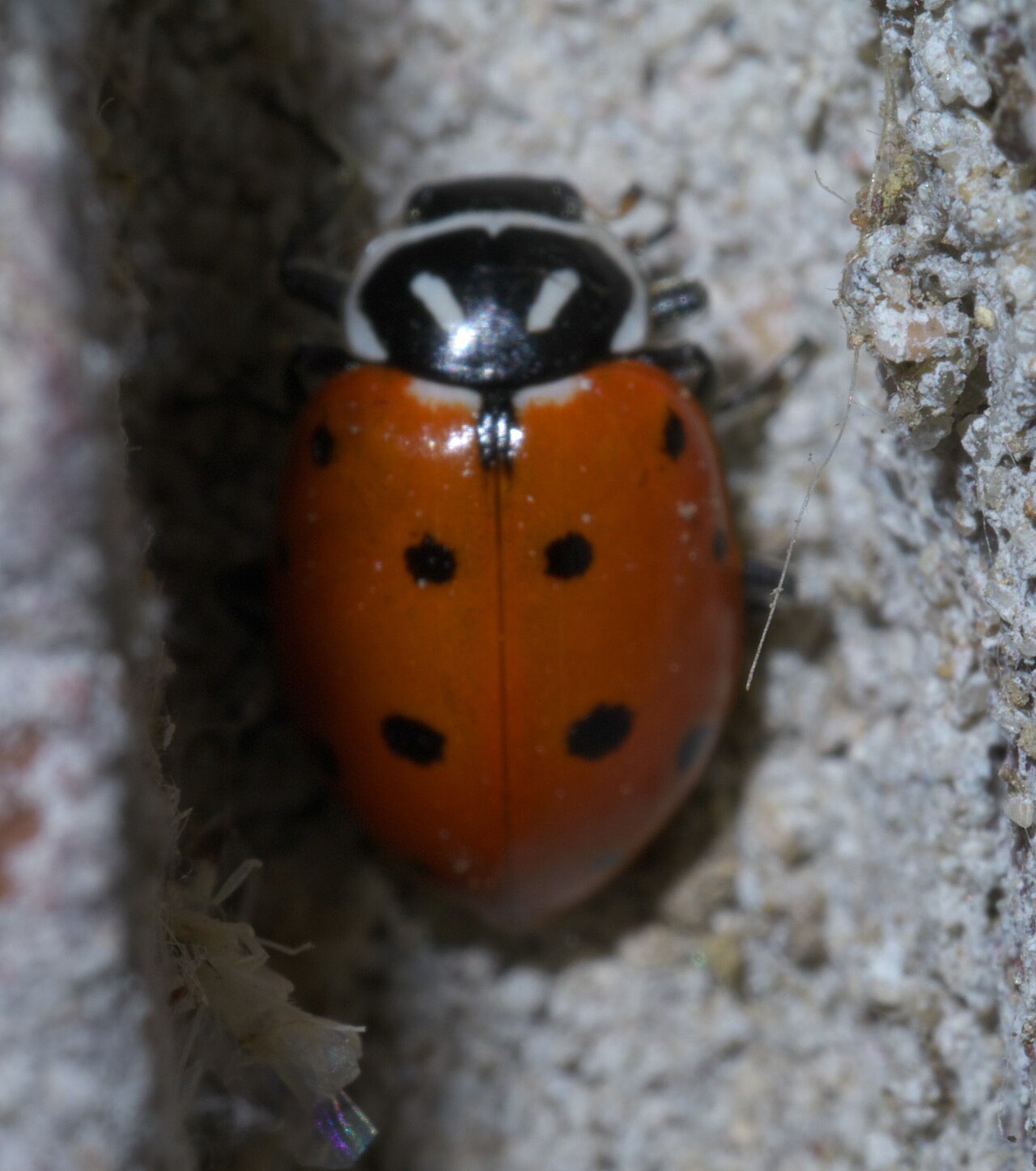
The species that actually causes trouble is the Asian lady beetle, which does bite more readily than native species and has been linked to allergic rhinitis in people who live with heavy indoor infestations. If what you found is cream or tan rather than true gray, read the section on pale Harmonia axyridis below. For the general question of whether these insects bite at all, our guide to ladybug bites covers what the pinch feels like.
Ashy Gray Lady Beetle (Olla v-nigrum)
This is the true gray ladybug and the answer in most cases. The ashy gray lady beetle measures 0.16 to 0.24 in (4 to 6 mm), slightly larger than a sesame seed, with a domed oval shell the color of wood ash or dirty chalk. The black spots vary from about twelve to twenty and are small, round and irregularly placed rather than arranged in neat rows, which is the quickest confirmation.
Olla v-nigrum has a second color form that confuses people in the other direction: jet black with two bold red or orange spots. Both forms are the same species and occur in the same populations. On the gray form the pronotum, the plate behind the head, is pale with a pair of dark marks, and the legs and underside are tan.
The species is found across most of the continental United States and is most common in the South, the Southwest and California, where it hunts aphids and psyllids in pecan, citrus and ornamental trees. Pecan growers count it as a beneficial insect. If you found yours on a tree rather than in a flower bed, that fits. It is entirely harmless and should go back on the plant you found it on.
Twenty-Spotted Lady Beetle (Psyllobora vigintimaculata)
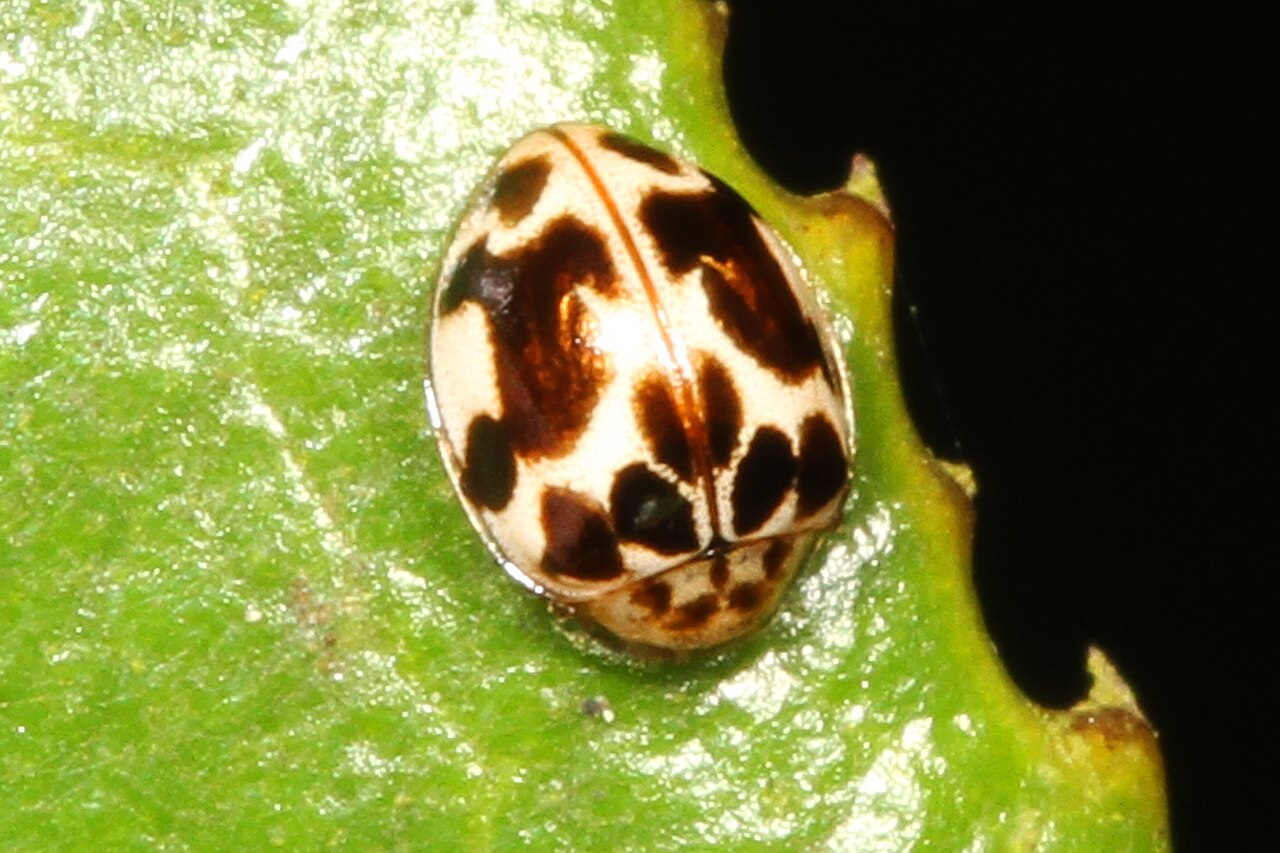
The twenty-spotted lady beetle is the gray ladybug that people describe as tiny and grubby. Adults run just 0.06 to 0.12 in (1.5 to 3 mm), small enough that the spots blur together into a smudged gray and cream pattern at arm’s length. Under a hand lens the ground color is creamy white and the markings are gray brown rather than true black, often fusing into bands.
What makes this one unusual is its diet. Psyllobora species do not eat aphids at all; they graze on powdery mildew, scraping fungal growth off leaf surfaces. Finding them on squash, lilac, phlox or grape leaves usually means you have a mildew problem, and the beetles are the cleanup crew rather than the cause. They are harmless to the plant.
The range covers nearly all of North America, from southern Canada to Mexico, and the species is common wherever humid summers produce mildew. Because the adults are so small, they are often reported as gray aphids or as mold specks that move. If your find is under 0.12 in (3 mm) and came off a mildewed leaf, this is almost certainly it.
Fifteen-Spotted Lady Beetle (Anatis labiculata)
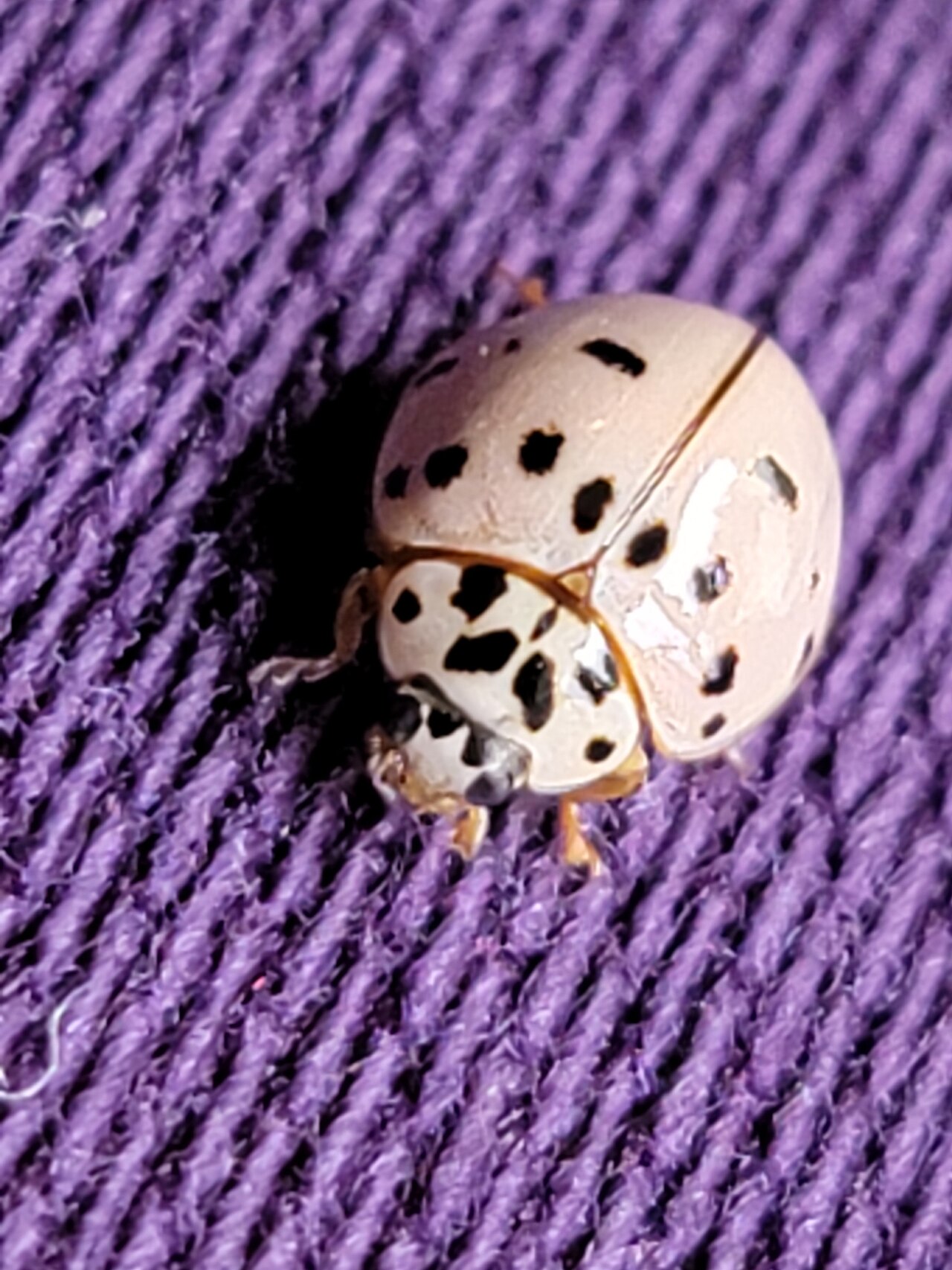
The fifteen-spotted lady beetle is the largest gray ladybug you are likely to meet, at 0.22 to 0.31 in (5.5 to 8 mm). Freshly emerged adults are pale ash gray with fifteen distinct black spots, and the contrast is clean enough that this species often photographs better than the others. The pronotum carries a pattern of dark dashes on a pale background.
Here is the catch that sends people searching: the pale gray form darkens with age. Older individuals turn mauve, deep purple and eventually almost black, with the spots nearly invisible against the background. A gray beetle and a purple one from the same tree can be the same species at different ages, which is why spot count beats color for identifying this one.
Anatis labiculata lives in eastern North America, from the Maritimes and Ontario south to Georgia and west to the Plains, and it hunts aphids in deciduous and pine woods rather than in gardens. It is harmless and distinctly uncommon in houses. For the dark end of the same species, our look at black ladybugs covers which dark beetles are lady beetles and which are not.
Eye-Spotted Lady Beetle (Anatis mali)
The eye-spotted lady beetle is bigger still, 0.24 to 0.39 in (6 to 10 mm), and its ground color sits between tan, buff and gray brown. The diagnostic feature is in the name: each black spot is ringed with a pale halo, giving the shell a row of small eyes. No other gray or tan lady beetle in North America has that ringed pattern, so a single clear photo settles it.
This is a conifer specialist. Anatis mali hunts aphids and adelgids on pine, spruce and fir, and it occurs across the northern United States and most of Canada, reaching south along the Appalachians and the Rockies. People in the Northeast and the Upper Midwest find them on cabin walls and screen doors in late summer, which is when the adults disperse.
It is harmless and does not infest homes, though a few will wander indoors in autumn like most lady beetles. Despite the species name, which means apple, it is not an orchard pest and does not feed on fruit. Lady beetles that look tan rather than gray are a frequent mix up with the brown ladybug group, which includes several unrelated beetles.
Pale and Cream Asian Lady Beetles (Harmonia axyridis)
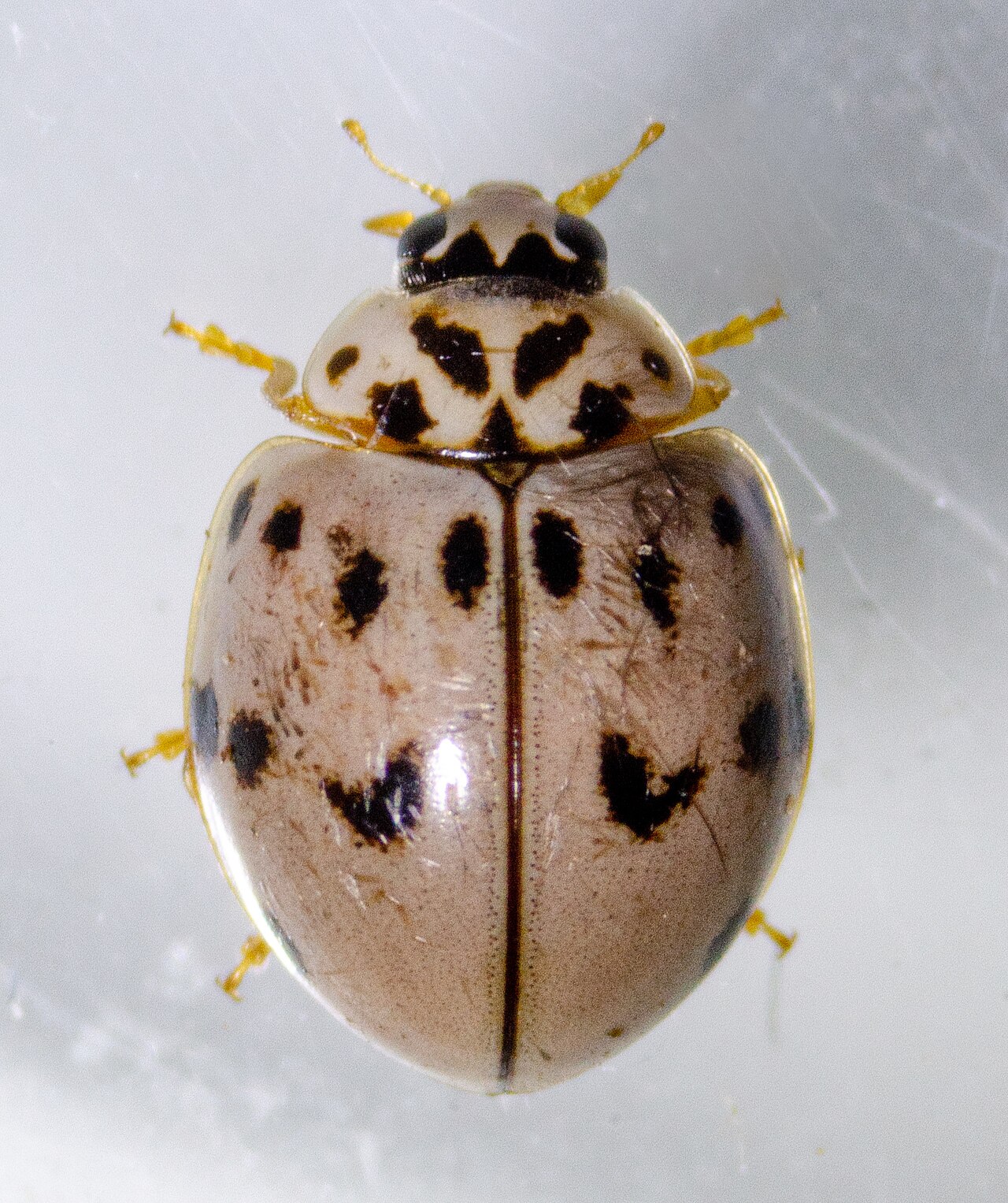
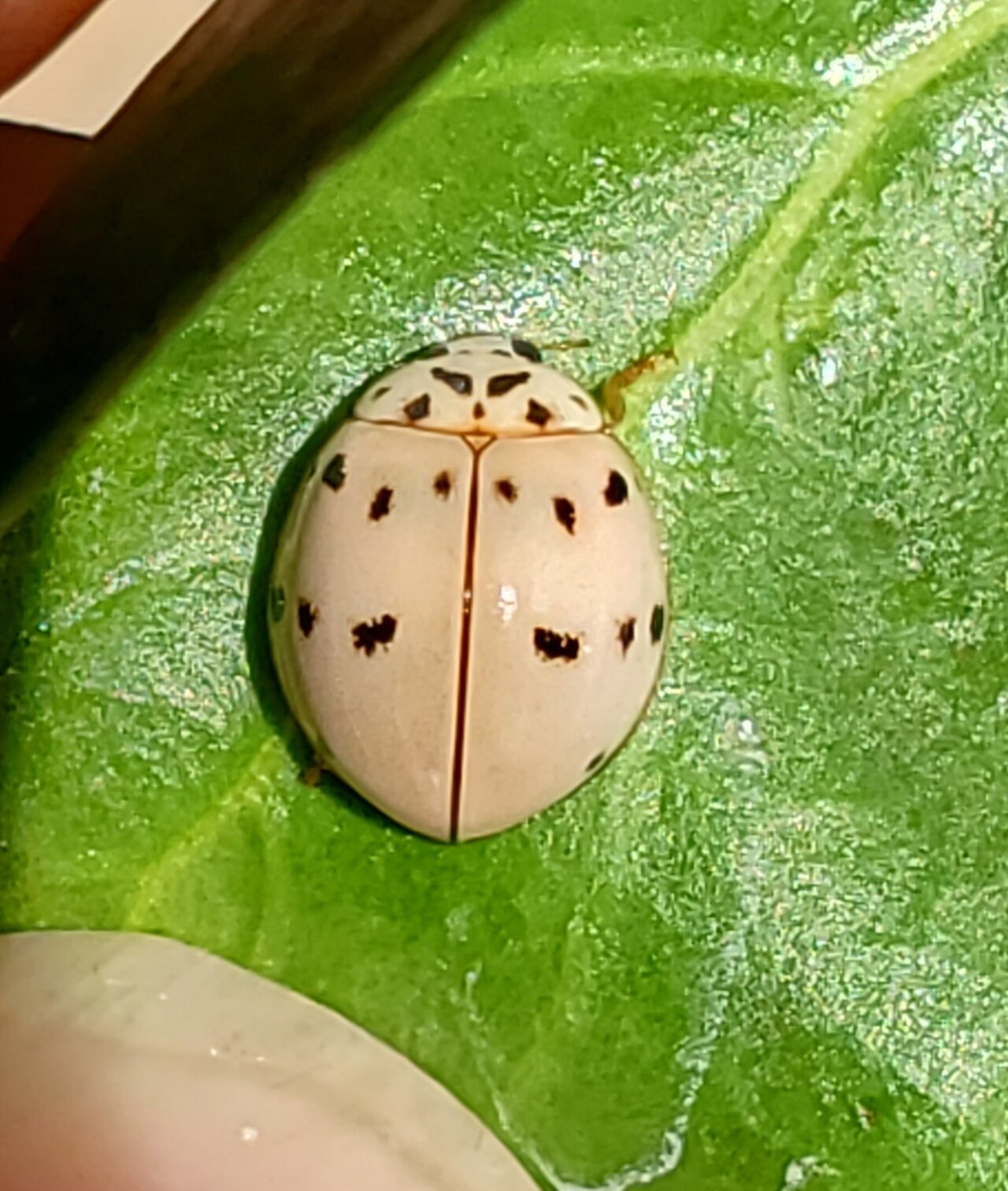
The Asian lady beetle is the most variable lady beetle in North America, and its palest forms read as gray in indoor light. Adults are 0.2 to 0.33 in (5 to 8.5 mm), and the shell ranges from near white and pale cream through tan, yellow, orange and deep red, with anywhere from zero to nineteen spots. A gray looking beetle with a slightly glossy, translucent shell is usually this species.
Two marks confirm it. The pronotum is white or cream with a black pattern that reads as a letter M or W depending on which way you turn the beetle, and that mark is diagnostic. There is also a small keel or ridge at the rear edge of the shell, visible from the side, which native species lack. Both features hold across every color form.
This is the species behind the clusters on south facing walls in October and the beetles in window sills all winter. It was introduced for aphid control, spread across the continent, and now outcompetes several native lady beetles. It bites more willingly than natives, stains surfaces when crushed, and smells. Our Asian lady beetle versus native ladybug comparison walks through the whole checklist.
Mealybug Destroyer (Cryptolaemus montrouzieri)
The mealybug destroyer is a lady beetle that produces the grayest insect on this list, but it is the larva rather than the adult that people find. Mealybug destroyer larvae coat themselves in white and gray waxy filaments and grow to about 0.5 in (13 mm), looking like a walking tuft of dryer lint. Houseplant owners regularly report them as gray fuzzy ladybug babies.
The adult is less striking: 0.12 to 0.16 in (3 to 4 mm), shiny black with a rusty tan head and a tan patch at the rear of the shell. Both stages eat mealybugs and soft scale insects, and the species is sold commercially as a biological control for greenhouses and interior plantings. It is established outdoors in California, Florida and other frost free areas.
If you find these on a houseplant with white cottony clumps on the stems, the beetle is not the problem. The waxy larva mimics its prey closely enough that growers spray it by mistake; left alone, it usually clears the mealybug colony within a few weeks.
Gray Ladybug Larvae: What the Young Look Like
Lady beetle larvae look nothing like the adults, and most of them are gray. The typical larva is elongated and tapered, a bit like a small alligator, dark gray to charcoal with rows of bumps or short spines and patches of orange, cream or yellow along the back. They grow to roughly 0.2 to 0.4 in (5 to 10 mm) before pupating, and they move fast across leaves.
Olla v-nigrum larvae are gray black with pale lateral marks and fine spines, and Psyllobora larvae are much smaller, pale and sluggish because their food does not run away. Harmonia axyridis larvae are the ones most people photograph: black with two bright orange stripes and branched spines that look alarming and are not.
Are lady beetle larvae harmful? No. The spines are soft and cannot pierce skin, the larvae have no venom, and they do not feed on plants. A single larva eats dozens of aphids a day, so finding them on a rose bush is good news. The pupa, a motionless orange and black lump glued to a leaf, is also harmless and should be left in place.
Varied Carpet Beetle and Other Gray Impostors
The insect most often mistaken for a gray ladybug indoors is the varied carpet beetle, Anthrenus verbasci. It is 0.08 to 0.12 in (2 to 3 mm), rounded, and covered in mottled scales of gray, white, brown and black that form irregular wavy bands rather than discrete round spots. Found on a window sill in spring, it is easy to read as a very small dusty ladybug.
The distinction matters because carpet beetles are a genuine household pest. The larvae, bristly tan caterpillar shapes often called woolly bears, feed on wool, silk, feathers, hair and dried pet food, and they damage carpets, upholstery and stored clothing. A gray lady beetle in your house is a visitor. A varied carpet beetle in your house usually means larvae somewhere in a closet or under a baseboard.
| Feature | Ashy gray lady beetle | Varied carpet beetle |
|---|---|---|
| Size | 0.16 to 0.24 in (4 to 6 mm) | 0.08 to 0.12 in (2 to 3 mm) |
| Pattern | Round black dots on pale gray | Wavy mottled bands, no clean dots |
| Shell surface | Smooth and hard, slightly glossy | Dull, covered in tiny scales |
| Antennae and head | Head tucked under pronotum, short clubbed antennae | Head visible from above, clubbed antennae |
| Where you find it | Trees and shrubs outdoors | Window sills, closets, carpet edges |
| Harmful? | No, beneficial predator | Yes, larvae damage wool and textiles |
How to Tell the Gray Species Apart by Size and Region
Size does most of the sorting. Under 0.12 in (3 mm) and found on a mildewed leaf points to the twenty-spotted lady beetle. Between 0.16 and 0.24 in (4 to 6 mm) with clean round dots points to the ashy gray lady beetle. Over 0.24 in (6 mm) means one of the two Anatis species, and the ringed spots separate those.
Region narrows what is left. Olla v-nigrum dominates in the Southeast and Southwest, Anatis mali on conifers is the common one in New England and the Upper Midwest, Anatis labiculata is eastern only, and Harmonia axyridis is everywhere. Range is a tiebreaker rather than a proof.
What Gray Ladybugs Eat and Where They Live
Diet splits the group cleanly. Olla v-nigrum, both Anatis species and Harmonia axyridis eat aphids, psyllids, adelgids and scale insects, Psyllobora vigintimaculata eats fungus, and Cryptolaemus montrouzieri specializes in mealybugs. All of them take pollen and nectar when prey is thin.
Habitat follows the food. Tree feeders stay in the canopy of pecan, citrus, oak, pine and spruce, and the garden species work roses, milkweed and vegetable beds. Adults overwinter as adults, under bark, in leaf litter, in rock crevices and in the case of Harmonia axyridis inside buildings. A full picture of what the whole family feeds on sits in our rundown of the ladybug diet.
Gray Ladybugs in the House in Fall
Lady beetles that appear indoors in October are looking for a frost free crack, not for your food. Native gray species do this in small numbers; Harmonia axyridis does it in the hundreds, drawn to warm, light colored, south and west facing walls. Once inside they sit dormant in wall voids and wake on warm winter days, which is when they end up at windows.
Do not spray and do not vacuum them with a regular bag, because crushed beetles stain and the alkaloids smell for days. Seal the entry points instead: window and door frames, soffit gaps, utility penetrations and torn screens, ideally in late summer before the flights begin. A nylon stocking stretched over the vacuum hose lets you collect and release them outside intact.
The ones you find outdoors should stay outdoors. A single ashy gray lady beetle eats aphids through the growing season, and the color forms across the family are worth knowing for exactly this reason, from orange ladybugs to yellow ladybugs. For regional pest and beneficial insect guidance, University of Minnesota Extension publishes identification sheets that hold up for most of the northern states.
Frequently Asked Questions
What does a gray ladybug mean spiritually?
In modern folk belief a gray ladybug is read as a quiet or neutral message, a pause rather than the bold luck associated with red ladybugs, and some readings tie gray to clarity after confusion. No historical tradition singles out gray ladybugs; the color meanings circulating online are recent. Biologically, gray is just a pigment pattern in several unrelated species.
Are lady beetle larvae harmful?
No. Lady beetle larvae cannot bite or sting people, their spines are soft, and they do not feed on plants or fabric. They are among the most effective aphid predators in a garden, with a single larva eating dozens a day before it pupates. The spiky gray and orange larva on your roses should be left alone.
What is the rarest color ladybug?
Steel blue is the rarest hue in the family, found in Halmus chalybeus of Australia and New Zealand, and no truly blue lady beetle is native to the United States. Within North America the hardest to find are not a color but a species: the nine-spotted lady beetle, Coccinella novemnotata, has collapsed across much of its former range.
Do gray ladybugs bite?
Gray native species such as the ashy gray lady beetle almost never bite, and when they do it is a brief pinch with no venom and no lasting mark. Pale Asian lady beetles bite more readily, especially in large indoor groups. No lady beetle can sting, and none transmits disease, so a bite needs soap and water and nothing more.
What is a ladybug’s biggest predator?
Birds, spiders and ants take the most lady beetles overall, with swallows and warblers hitting the autumn flights hardest. The more specialized threat is the parasitoid wasp Dinocampus coccinellae, which lays an egg inside an adult beetle; the larva develops inside and then pupates beneath the still living host. Frogs, dragonflies and assassin bugs take a share too.
Is killing a ladybug illegal?
No US federal or state law protects common lady beetles, so killing one is not illegal anywhere in the country. Several native species are listed as species of conservation concern, including the nine-spotted lady beetle, but that status carries no criminal penalty. The old warning that killing a ladybug brings bad luck is folklore, not statute.