Purple Dragonfly: 7 US Species That Really Look Purple
A purple dragonfly is real, but almost none of the deeply violet insects in viral photos belong to a North American species. In the United States, purple is produced by a waxy bloom called pruinescence that develops on mature adults, so the same insect can read as blue, lavender, or rose depending on the light, the angle, and its age.
Seven species account for nearly every purple sighting between Florida and the Pacific Northwest, from the rose colored Roseate Skimmer of the southern states to the violet damselflies of eastern creeks. Color alone never settles an identification, so body size, wing pattern, and habitat carry as much weight as the hue itself.
Yes, dragonflies can be purple. No US species is pigmented purple; the color comes from pruinescence, a pale waxy coating over dark cuticle that scatters light into violet and rose tones. The Roseate Skimmer, Purple Skimmer, and Violet Dancer are the three most reliably purple odonates in North America.
| Species | Purple tone | Length | US range | Harmful? |
|---|---|---|---|---|
| Roseate Skimmer (Orthemis ferruginea) | Rose to magenta | 2.0 to 2.4 in (5 to 6 cm) | Southern and southwestern states | No |
| Purple Skimmer (Libellula jesseana) | Violet blue bloom | 1.9 to 2.2 in (4.8 to 5.6 cm) | Florida sand lakes only | No |
| Violet Dancer (Argia fumipennis violacea) | Bright violet | 1.3 to 1.5 in (3.3 to 3.8 cm) | Eastern US | No |
| Slaty Skimmer (Libellula incesta) | Slate with purple sheen | 1.9 to 2.1 in (4.8 to 5.3 cm) | Eastern and central US | No |
| Great Blue Skimmer (Libellula vibrans) | Blue violet | 2.0 to 2.4 in (5 to 6 cm) | Southeast and mid Atlantic | No |
| Carolina Saddlebags (Tramea carolina) | Purple red wing patch | 1.9 to 2.1 in (4.8 to 5.3 cm) | East of the Rockies | No |
| Seaside Dragonlet (Erythrodiplax berenice) | Dark with violet gloss | 1.2 to 1.5 in (3 to 3.8 cm) | Coastal salt marsh | No |
Are Dragon Flies Harmful?
No dragonfly in North America is venomous, and none has a stinger. The long tapering abdomen that people read as a stinger is just the body, and the hooked claspers at its tip are used to hold a mate, not to attack. A large skimmer or darner held in the hand may pinch with its jaws, and a big darner can break skin, but the result is a pinprick rather than a wound that needs treatment.
Dragonflies are also not poisonous to touch, to pets, or to poultry, and chickens eat them without any problem. The one genuine caution is handling: a struggling adult can tear a wing against your fingers. Photograph it where it sits, or let it climb onto a fingertip on its own.
Can Dragonflies Be Purple?
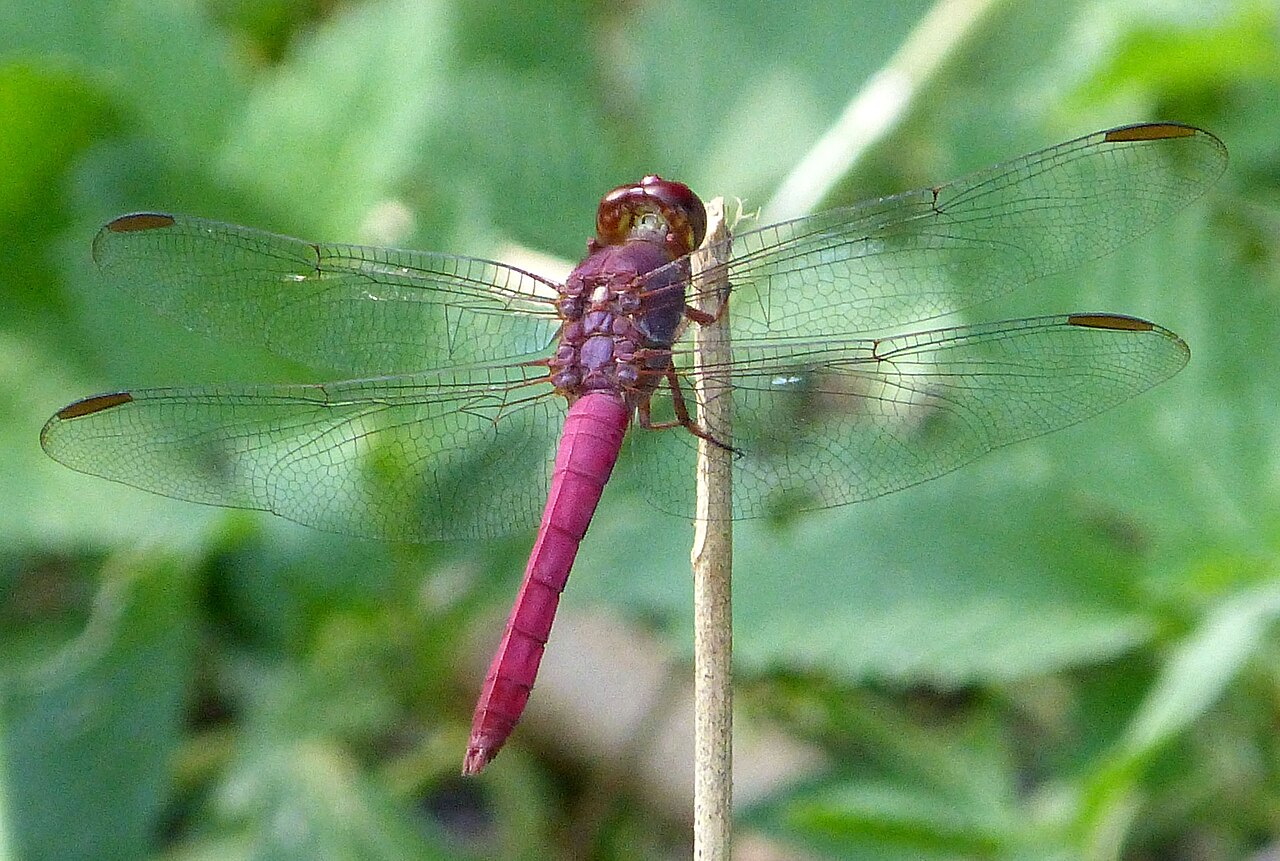
They can, and the mechanism is worth knowing because it explains why the same insect looks different in two photos. Freshly emerged adults wear brown, tan, or dull red. Over the following days many skimmers secrete pruinescence, a fine waxy layer that sits over the dark cuticle beneath. Light scattering through that layer produces blue, lavender, violet, or rose rather than a flat pigment color.
Because the effect is structural, it shifts with viewing angle and with sunlight. A Roseate Skimmer that reads magenta at midday can look dusty mauve in shade, and a Slaty Skimmer shows a violet cast only when the sun strikes it sideways. Compare the same insect to blue dragonfly identification and the overlap becomes obvious: the two color groups share most of the same species.
Roseate Skimmer (Orthemis ferruginea)
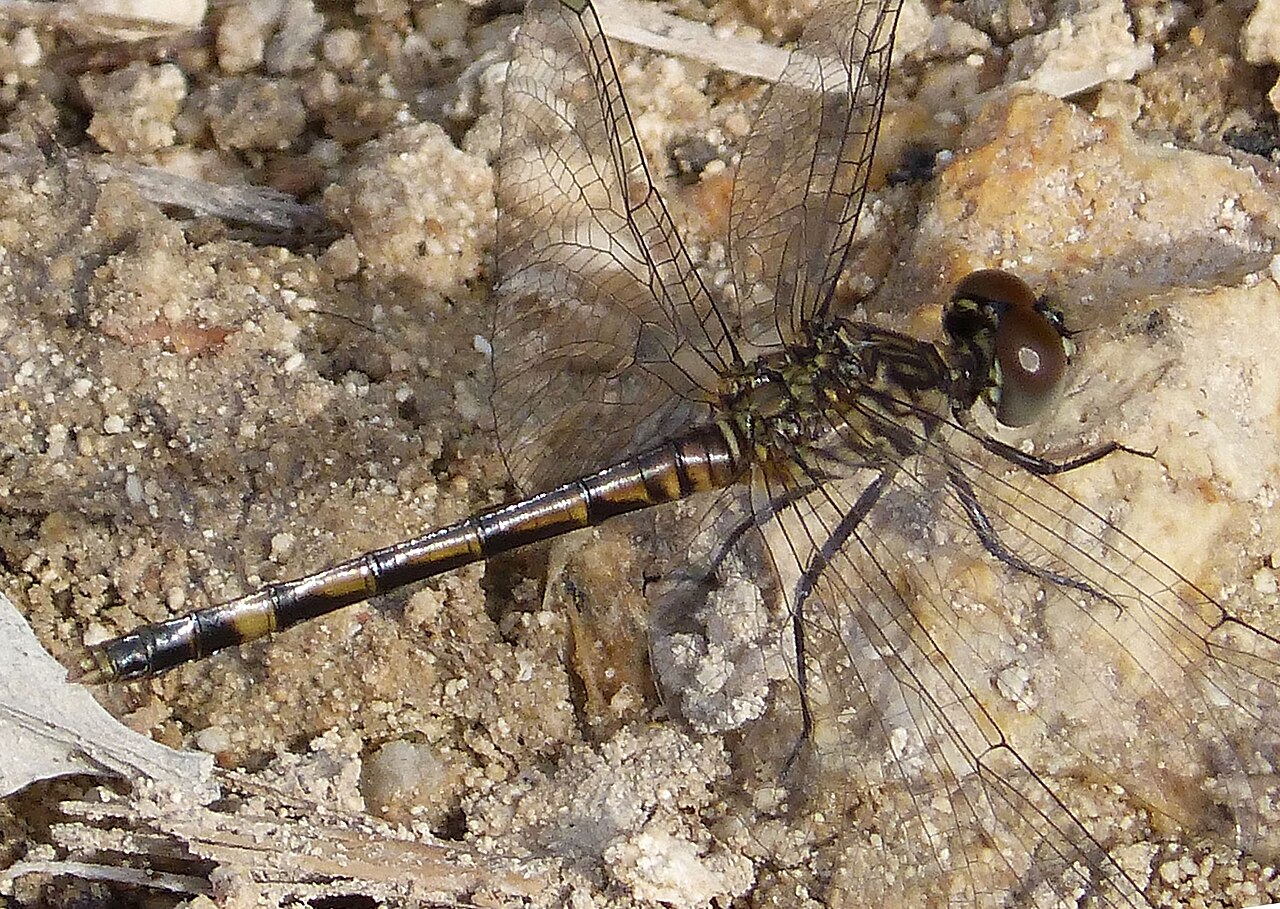
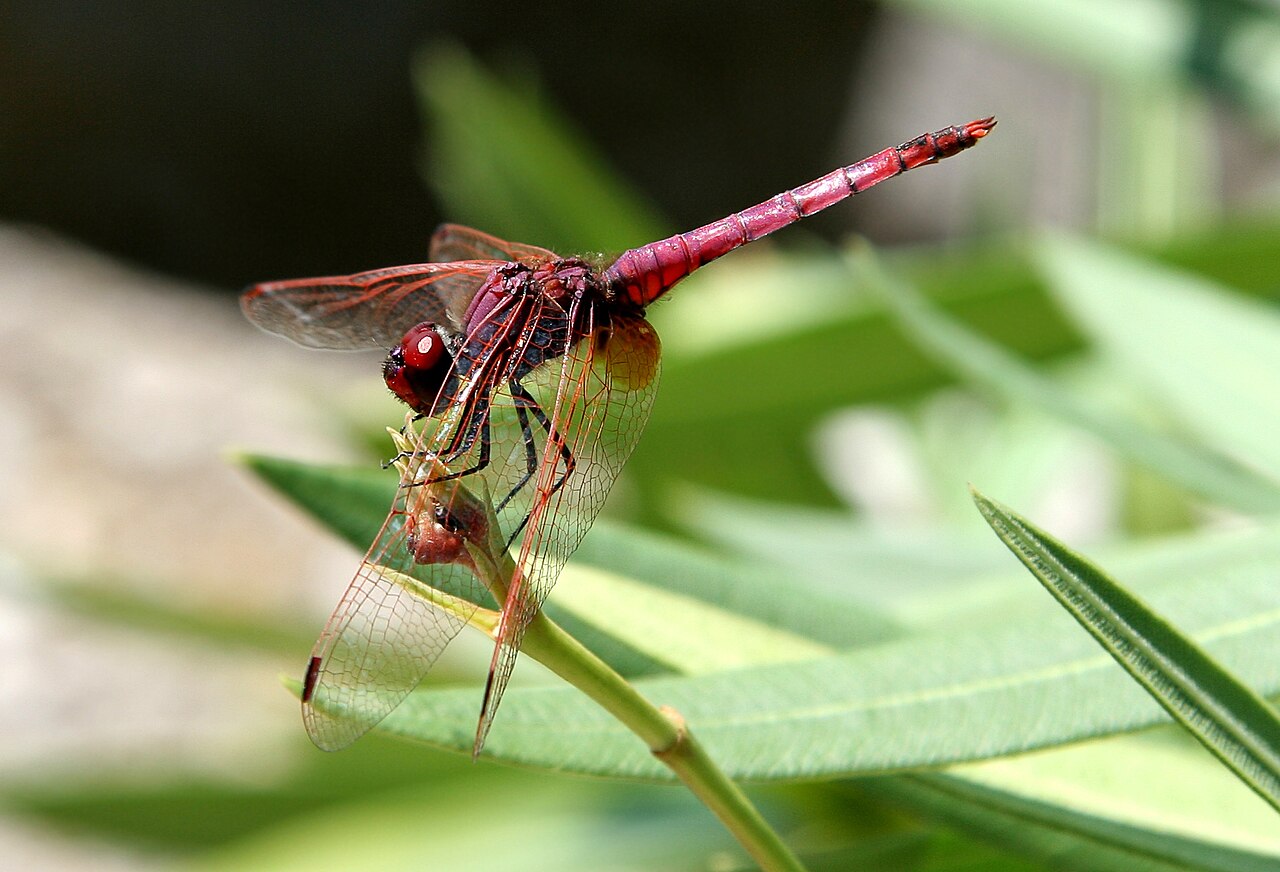
This is the closest thing to a true purple dragonfly in the United States. Mature males carry a rose pink to magenta abdomen over a pale gray thorax, a combination no other US skimmer matches, and the color deepens toward violet as the insect ages. Females and young males stay reddish brown and are routinely mistaken for a different species.
Look for it in Texas, Arizona, New Mexico, Louisiana, Florida, and up the Gulf coast, with scattered records as far north as Kansas. It favors warm still water: cattle ponds, ditches, golf course water hazards, and slow canal edges. Males perch on bare twigs at waist height and return to the same stem after every patrol flight, which makes this one of the easiest purple species to photograph.
Purple Skimmer (Libellula jesseana)
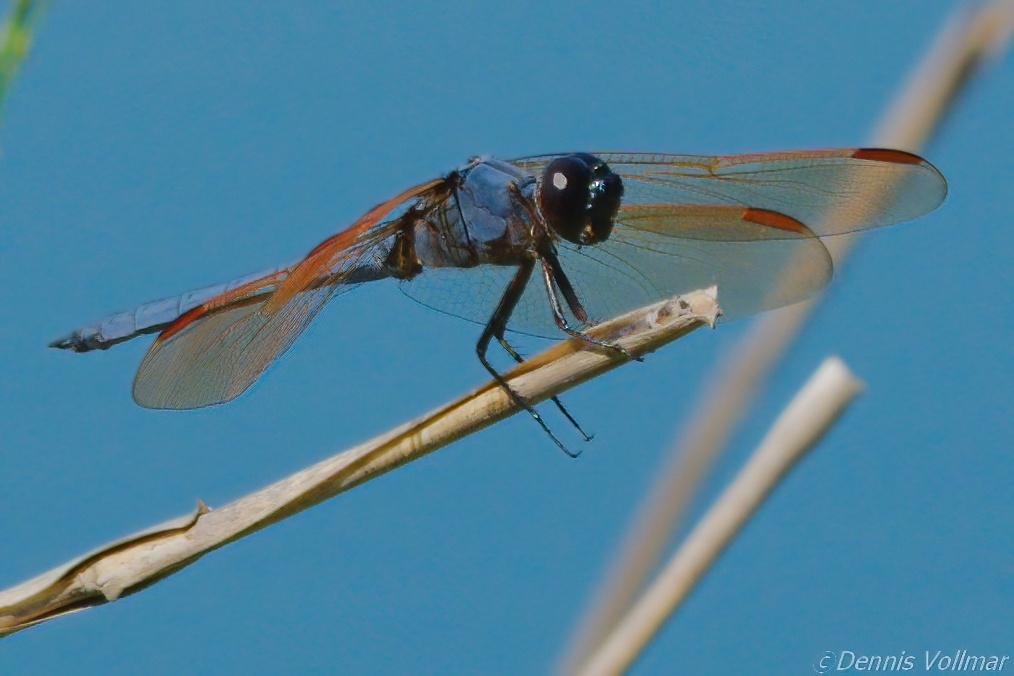
The Purple Skimmer carries the name and lives almost nowhere. It is restricted to clear sand bottomed lakes in a handful of central Florida counties, which makes it one of the most geographically limited dragonflies in the country. Mature males develop a violet blue pruinescence across the abdomen and thorax, with dark wing veins and a faint amber wash at the wing bases.
Body length runs 1.9 to 2.2 in (4.8 to 5.6 cm). Flight season peaks from April into August around lake margins with open sandy shorelines and sparse emergent grass. Habitat loss and shoreline development are the main pressures on it, and anyone outside Florida reporting this species has almost certainly found a Great Blue Skimmer instead.
Violet Dancer (Argia fumipennis violacea)
The brightest violet odonate in the eastern United States is not a dragonfly at all but a damselfly, which is why so many searches for a purple dragonfly end here. Mature males are vivid violet on the thorax and the base of the abdomen, with smoky tinted wings held closed above the back at rest. Dragonflies hold their wings flat and open.
At 1.3 to 1.5 in (3.3 to 3.8 cm) it is noticeably smaller and more slender than any skimmer. It ranges from New England west to the Great Plains and south to the Gulf, along small streams, rocky creek edges, and spring runs. Males perch low on gravel bars and warm stones, often in loose groups of a dozen or more.
Slaty Skimmer (Libellula incesta)
Mature male Slaty Skimmers are described as dark blue in field guides, but in raking light the pruinescence reads clearly violet, and photographs frequently capture that cast. The body is a uniform slaty blue black with a black face and black wing tips, which separates it from every other species on this list. Females are brown with a dark dorsal stripe.
The species spans the eastern and central states from Maine to Texas and is common at ponds, lake coves, and sluggish stream pools with soft bottoms and shaded banks. Males defend small perches over open water and fly from May through September. Among purple candidates this is the one most often photographed by accident.
Great Blue Skimmer (Libellula vibrans)
At 2.0 to 2.4 in (5 to 6 cm) this is one of the largest skimmers in the east and the most frequent source of a mistaken Purple Skimmer report. Mature males carry heavy blue pruinescence that photographs lavender or blue violet in soft light, paired with a white face and pale blue gray eyes. A thin dark stripe crosses each wing tip.
It occupies wooded swamps, shaded forest ponds, and slow seeps across the Southeast and mid Atlantic, extending north to southern New England. Unlike open water skimmers it hunts in dappled shade and perches on low branches well back from the shoreline, so it often turns up on woodland trails rather than at the water itself.
Carolina Saddlebags (Tramea carolina)
The purple on this species is concentrated in the wings. Each hindwing carries a broad dark basal patch that glows purple red when backlit, an effect that reads as a pair of saddlebags when the insect glides overhead. The body is red to reddish purple in mature males, and the forehead shows a distinct metallic violet spot.
Carolina Saddlebags range across the eastern United States and migrate in loose swarms, appearing well north of their breeding ponds in late summer. They spend long stretches soaring rather than perching, which makes a clean photo harder than with any skimmer here. Compare the wing patch with the body color of a red dragonfly before settling on an identification.
Violet Dropwing: The Purple Dragonfly Behind Most Photos
The spectacular wine purple dragonfly that circulates on social media is almost always the Violet Dropwing, Trithemis annulata. Mature males are saturated violet from the face to the abdomen tip, with red wing veins and amber wing bases, and no US species comes close to that intensity. It occurs across Africa, the Mediterranean, and the Middle East, and has been expanding north through Spain, Italy, and France.
It has never been recorded as a wild breeding species in North America. Anyone identifying a backyard sighting from one of those images will be wrong, so match against the Roseate Skimmer and the Violet Dancer instead. The confusion is common enough that it accounts for a large share of misidentified reports on community observation platforms.
Purple Skimmer vs Great Blue Skimmer: Telling Them Apart
These two are the pair most often swapped, because both are large pruinose skimmers in the southeast with a violet cast. Range does most of the work: outside central Florida sand lakes, a Purple Skimmer is effectively off the table. Face color and wing markings settle the rest.
| Feature | Purple Skimmer | Great Blue Skimmer |
|---|---|---|
| Face | Dark, unmarked | Bright white |
| Eyes | Dark brown | Pale blue gray |
| Wing tips | Clear, amber at base | Narrow dark band |
| Habitat | Open sandy lake shores | Shaded swamps and seeps |
| Range | Central Florida only | Southeast to New England |
What Is the Rarest Dragonfly Color?
Pink is the rarest color in North American odonates, and it is scarcer than purple by a wide margin. Only a few species reach genuine pink, and the Roseate Skimmer is the one most people encounter. Pure white is rarer still as a body color, appearing mainly as heavy pruinescence on species such as the Common Whitetail rather than as pigment.
Purple sits in the middle of the scale: uncommon, predictably tied to pruinescence, and present in a short list of species. Green and brown are the most common colors overall, since both serve as camouflage in newly emerged adults and in females of nearly every family.
What Are Dragonflies Attracted To?
Open water and insect prey, in that order. Dragonflies need still or slow water to lay eggs, and the larvae spend months to years submerged before emerging, a stage covered in detail under dragonfly nymph development. A pond of 20 sq ft with sunlit shallows, submerged stems, and no fish will draw breeding adults within a season.
Adults hunt mosquitoes, midges, gnats, and flying ants, so any yard producing those insects attracts hunting dragonflies regardless of water. They also seek warm perches: bare stakes, fence wire, dead branch tips, and pale gravel. Their vision drives all of it, and the structure behind that ability is explained under dragonfly eyes. For regional species records, the US Fish and Wildlife Service maintains survey data for many public waters.
Frequently Asked Questions
Which is the rarest dragonfly in the world?
Several species are known from single sites or a handful of specimens, so the title changes with new surveys. Among well documented cases, the Saint Helena darter is considered extinct, and Hine’s emerald dragonfly is the rarest in the United States, restricted to a few spring fed wetlands in four states.
Are pink dragonflies rare?
Pink dragonflies are rare but not mythical. The Roseate Skimmer is the common example in the southern United States, where mature males reach rose pink to magenta. Outside that species, true pink appears only in a few tropical skimmers, which is why photographs of pink individuals circulate so widely.
When God sends you a dragonfly, what is it taken to mean?
In most popular interpretations it signals transformation and a period of change, drawn from the insect’s shift from aquatic larva to flying adult. The reading is cultural rather than biological, and it varies by tradition. The full range of meanings is collected under dragonfly symbolism.
Are dragonflies signs of angels?
Some spiritual traditions treat a dragonfly landing nearby as a message or a visit from someone who has died, and purple individuals attract that reading more than others because the color is unusual. No biological basis supports it. The insect lands on warm surfaces, including people, because it is seeking heat and a hunting perch.
Do purple dragonflies bite or sting?
Neither one is a practical concern. Dragonflies have no stinger and no venom, and only the largest species can pinch hard enough to be felt. Nothing about purple coloration indicates danger in odonates, unlike the warning colors seen on many purple butterflies and wasps.
How long do purple dragonflies live as adults?
Most skimmers live two to eight weeks after emerging, and males reach full purple pruinescence only in the last two thirds of that span. The larval stage lasts far longer, from a few months in warm southern ponds to two or three years in cooler water, so the colored adult is the shortest part of the life cycle.