Badger Tracks: 5 Toes and Claws Out Front, in Snow or Mud
Badger tracks are five-toed prints with enormous front claws that land well ahead of the toe pads, and the trail turns noticeably inward, as if the animal were walking pigeon-toed. That claw-forward signature is the fastest way to separate badger tracks from the dog, cat and raccoon prints that share the same dusty field edges and muddy stock tanks across the American West.
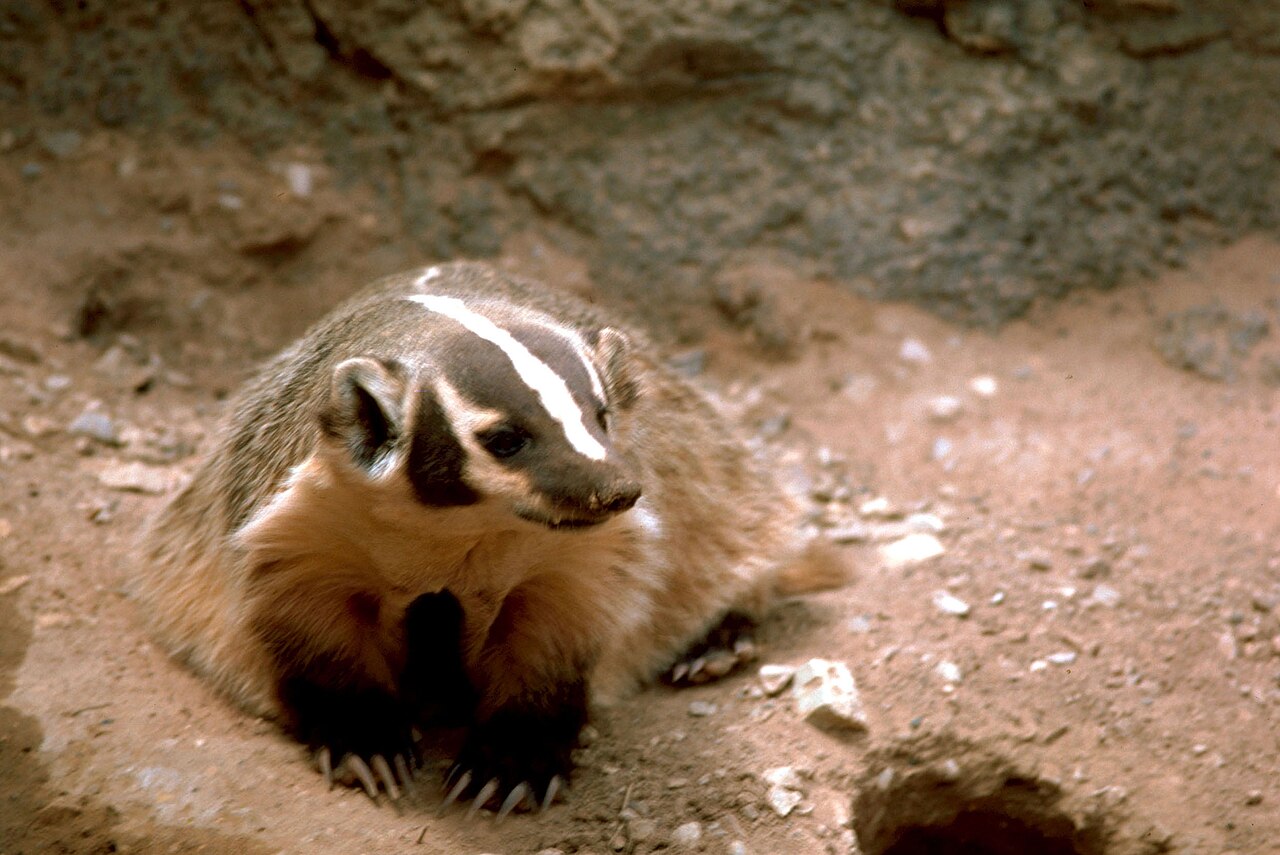
The American badger (Taxidea taxus) is built to dig, and every part of its foot shows it. Short, fat toes sit on a broad palm pad, the front feet carry claws longer than most of the toes themselves, and the low, wide body drags a trail that is as useful for identification as any single print. Snow, mud and dry sand each hide a different part of that picture, so the medium you are reading matters as much as the track.
A badger track shows five toes, a wide palm pad and long claw marks set well in front of the toes. Front prints run about 2 to 2.5 in (5 to 6.4 cm) long without claws, and up to 4 in (10 cm) with them. Hind prints are smaller with short claws. The trail toes inward and the straddle is wide.
How to Identify Badger Tracks at a Glance
Work through four questions in order. Count the toes: five on both front and hind feet, though the small inner toe often fails to register in firm ground. Look for claws: on the front foot they print as deep slots or pits one claw length ahead of the toe pads. Check the shape: badger prints are wider and blockier than they are long.
Then read the trail rather than the print. Badger trails run straight and low with a wide straddle, and the feet angle inward at roughly 20 to 30 degrees. A line of prints that drifts inward like that, in open grassland or pasture, is badger until proven otherwise.
What Do American Badger Footprints Look Like?

The front foot prints as a broad, slightly fan-shaped pad with five short toes arranged in a tight arc and five claw marks strung out ahead of them. The gap between toe tip and claw tip is the giveaway. In soft ground the claws leave a row of narrow punctures that can look like a second, separate track.
The hind foot is a different animal. Its claws measure barely a quarter of the front set, so the hind print reads as a compact five-toed pad with faint nail marks right at the toe tips. Where front and hind land close together, the size and claw contrast tells you which is which.
How Big Are Badger Footprints?

Front tracks measure about 2 to 2.5 in (5 to 6.4 cm) long and 1.5 to 2 in (3.8 to 5 cm) wide when you measure the pad and toes alone. Add the claws and the same track stretches to 3.5 or even 4 in (9 to 10 cm). Front claws themselves run 1 to 1.5 in (2.5 to 3.8 cm) on an adult.
Hind tracks are a touch shorter, roughly 1.75 to 2.25 in (4.4 to 5.7 cm), with claws under 0.5 in (1.3 cm). Always note whether your measurement includes claws. Half the confusion in field notes comes from comparing a claw-inclusive badger print with a claw-free measurement of something else.
Badger Stride, Straddle and Gait

A badger spends most of its night in a slow, rolling walk, and that walk produces a wide trail with a short step. At speed it switches to a 2×2 lope that pairs prints diagonally. The straddle, meaning the full width of the trail, is the measurement most trackers underuse, and on a badger it is unusually generous for the animal’s size.
| Feature | American badger |
|---|---|
| Front track (no claws) | 2 to 2.5 in long, 1.5 to 2 in wide |
| Front track (with claws) | up to 4 in (10 cm) long |
| Hind track | 1.75 to 2.25 in long, short nail marks |
| Toes registering | 5 front, 5 hind (inner toe often faint) |
| Straddle | about 5 to 7 in (13 to 18 cm) |
| Walking stride | about 8 to 12 in (20 to 30 cm) |
| Typical gait | slow pigeon-toed walk, 2×2 lope when pressed |
Badger Tracks in Snow
Winter is tracking season, and snow is where most people meet a badger trail first. Fresh powder under 4 in (10 cm) holds the claw marks well. Deeper snow turns the badger into a plow: the short legs and broad chest cut a trough, prints blur together, and you end up reading a furrow with occasional clean feet in it.
Old snow lies. Sun widens and rounds every print, so a day-old badger track can measure like a small coyote and a day-old deer track can look like something far larger. Judge age by crispness of the claw slots before you trust a single measurement taken off melted snow.
Badger Tracks in Mud
Damp, fine mud at a stock tank, irrigation ditch or pond margin gives the cleanest badger prints you will ever find. Claw tips, individual toe pads and the leading edge of the palm all register, and the inward foot angle is obvious in a line of three or four prints.
Mud also collects everything else in the neighborhood, which is the real advantage. A single muddy margin often holds badger, raccoon and beaver tracks within a few feet of each other, and comparing them in the same substrate teaches more in ten minutes than a month of photographs.
Badger Tracks in Sand and Dry Dust
Dry sand collapses as the foot lifts, so toes merge into one blurred oval and the claws become the only reliable detail. Look for five fine scratches ahead of the mass. On two-track roads and dusty cattle trails, a thin film of silt over harder ground behaves like mud and prints beautifully.
Damp sand just above the waterline is the exception and holds detail nearly as well as mud. In loose dune sand, abandon the individual print entirely and measure the trail instead: straddle, stride and the inward lean still read clearly when the feet do not.
Badger Tracks vs Dog and Coyote Tracks
Dogs and coyotes print four toes, not five. Their claws sit directly above the toe pads and print as small points at the toe tips, never as a separate row out front. The overall track is longer than wide, the opposite of a badger’s blocky outline.
Trail shape separates them even when the ground is poor. A coyote walks an efficient near-straight line with a narrow straddle, while a badger waddles wide and toes in. If you want the canine baseline in your eye first, study coyote tracks in the same substrate before judging anything five-toed.
Badger Tracks vs Cat and Fox Tracks
Cat tracks, including bobcat, show four toes and almost never show claws, since the claws retract. The print is round with a large three-lobed heel pad. Nothing about it resembles the claw-forward badger signature, so a clean cat print rarely causes trouble.
Fox prints are small, oval and often fuzzy with winter fur, and a red fox leaves a distinctive bar-shaped heel pad. Size alone usually settles it, as a fox front track is well under 2 in (5 cm) wide. Comparing bobcat tracks and coyote and fox tracks side by side builds the four-toe reference you need.
Badger Tracks vs Raccoon and Skunk Tracks
Raccoons also print five toes, and this is the mix-up worth real attention. A raccoon’s toes are long, slender and finger-like, splayed around a small palm, and the claws are fine points at the tips. A badger’s toes are short and thick with claws stabbing far ahead. Hand-like means raccoon, paw-like with spikes means badger.
Striped skunks print five toes with long digging claws too, so the pattern matches, but the scale does not: a skunk front track runs about 1 to 1.5 in (2.5 to 3.8 cm) with claws. Bears also show five toes and long nails, and bear tracks dwarf anything a badger leaves.
Where and When to Find Badger Tracks
Badgers favor open country with diggable soil: shortgrass and mixed prairie, sagebrush, pasture, alfalfa and the shoulders of dirt roads. Range covers the Great Plains, the Intermountain West and the Southwest, reaching east into the upper Midwest. Highest densities sit in states such as Nebraska, Kansas, Wyoming, South Dakota and Idaho rather than in Wisconsin, whose Badger State nickname came from lead miners, not from the animal.
Hunt tracks at dawn, when the night’s work is still sharp. Follow a trail and it usually ends at a fresh excavation with a wide fan of soil and an entrance broader than it is tall. State wildlife agencies and the National Park Service publish regional track guides that are worth carrying.
Frequently Asked Questions
How to identify badger tracks?
Count five toes, find claw marks set well ahead of the toe pads, and check that the print is wider than it is long. Then confirm with the trail: a wide straddle and feet angled inward. Front tracks run 2 to 2.5 in (5 to 6.4 cm) without claws, up to 4 in (10 cm) with them.
What is the best bait for badgers?
Meat-based baits work best, since badgers are carnivores: carrion, sardines, chicken scraps or a commercial meat lure. Trapping and baiting badgers is regulated in most states and prohibited in some. Check your state wildlife agency’s rules first. For camera work, a scent lure at a known burrow usually beats food.
What are some common badger sounds?
Cornered badgers hiss, growl, snarl and give an explosive raspy scream. Kits churr and whine near the den, and relaxed adults sometimes purr quietly. Most of what people hear in the field is the warning hiss, delivered with the fur raised and the animal backed into a burrow mouth.
How big are badger footprints?
Front prints measure about 2 to 2.5 in (5 to 6.4 cm) long and 1.5 to 2 in (3.8 to 5 cm) wide excluding claws, and reach 3.5 to 4 in (9 to 10 cm) including them. Hind prints run 1.75 to 2.25 in (4.4 to 5.7 cm) with claws under 0.5 in (1.3 cm).
What is a badger’s natural enemy?
Golden eagles, coyotes, bobcats, mountain lions and bears all kill badgers, mostly young ones, since an adult badger is formidable prey. Coyotes also hunt cooperatively with badgers over ground squirrel colonies. Vehicles and persecution account for far more badger deaths than any wild predator.
Where do badgers go in the day?
They sleep underground. A badger may use a different burrow almost every day in summer, digging a fresh one rather than returning to an old one. Activity is mostly nocturnal and crepuscular, though badgers in remote country are seen hunting in daylight, especially in spring.