Bees That Look Like Yellow Jackets and the Flies Faking It
Bees that look like yellow jackets are honey bees, bumble bees and a few striped sweat bees. The more convincing fakes are flies, beetles and moths that copy the wasp’s colors without its sting. Yellow jackets are the real thing, a group of social wasps that scavenge at picnics and nest in the ground.
Black-and-yellow stripes are a warning signal that many insects copy, so a quick glance at a picnic table misleads people every summer. Harmless insects that wear the stripes borrow that protection for free.
Honey bees, some bumble bees and sweat bees resemble yellow jackets, but bees are fuzzy and thick-waisted while yellow jackets are smooth, shiny wasps with a pinched waist. Hover flies, locust borer beetles and clearwing moths mimic the warning stripes and cannot sting.
Bee or Yellow Jacket? The Body Clues That Settle It
Yellow jackets are wasps, not bees, and their bodies show it. They belong to the genera Vespula and Dolichovespula, the same family as hornets. Bees descend from wasps but switched to a diet of pollen and nectar, and that diet shaped how they look.
Most bees look hairy, at least on the thorax, because branched hairs pick up pollen. A yellow jacket looks smooth, shiny and polished, with crisp black and yellow bands. Yellow bees nearly all wear that fuzzy coat, which no yellow jacket has.
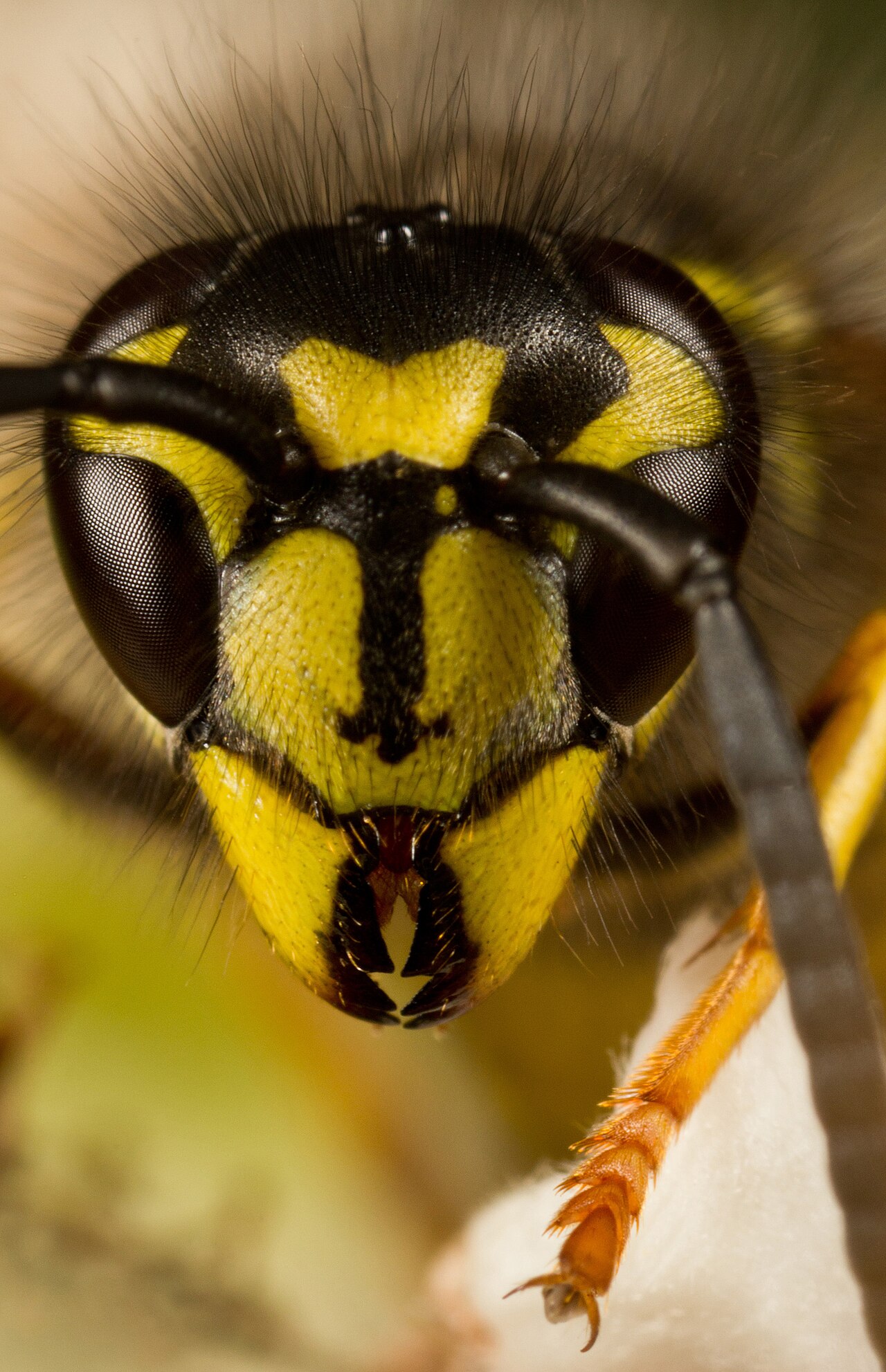
Then check the waist and legs. A yellow jacket has a sharply pinched waist between thorax and abdomen, while a bee looks thick and rounded. Most bees carry pollen loads on their hind legs, and yellow jacket legs are thin and bare. At rest, a yellow jacket folds its wings lengthwise into narrow strips along its back. Up close, a yellow jacket has strong mandibles for chewing meat and wood pulp, while a bee sips nectar through a long tongue folded under its head.
| Insect | Flight style | Quick body clue | Can it sting? |
|---|---|---|---|
| Yellow jacket | Fast zigzags around food | Smooth, shiny, pinched waist | Yes, repeatedly |
| Honey bee | Steady, flower to flower | Fuzzy, golden brown | Yes, once |
| Bumble bee | Slow, heavy, loud hum | Large, round, woolly | Yes, when the nest is disturbed |
| Sweat bee | Quick, low over blooms | Tiny, thin pale bands | Yes, mildly |
| Hover fly | Hangs still, darts sideways | One wing pair, stubby antennae | No |
| Paper wasp | Slow, long legs dangling | Slim body, long waist | Yes |
| Locust borer | Clumsy beetle flight | Hard wing covers, long antennae | No |
Honey Bees: The Most Common Yellow Jacket Mixup
Honey bees (Apis mellifera) are the bees people mistake for yellow jackets most. A honey bee is golden brown with dull bands, not bright lemon yellow.
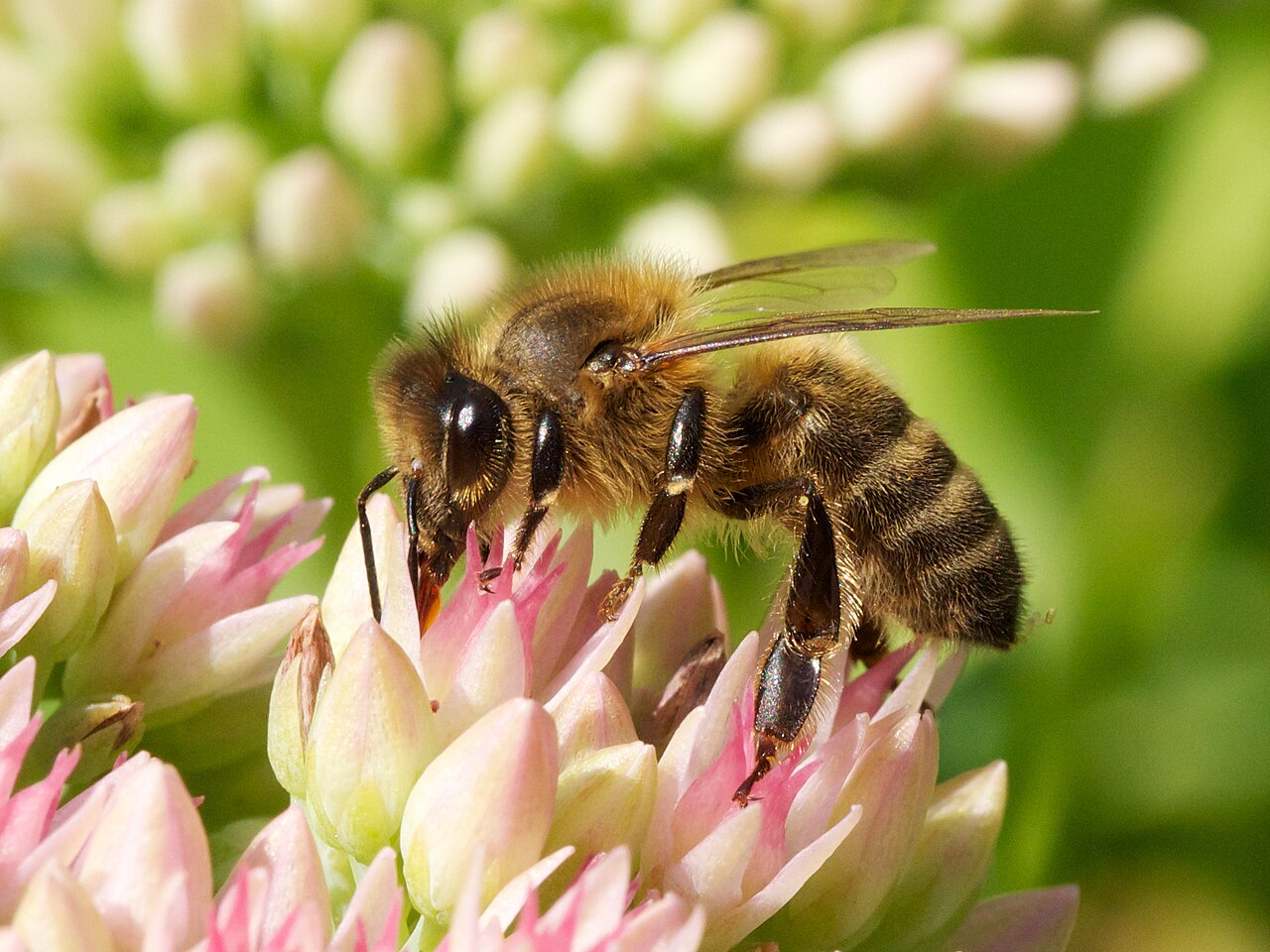
On a honey bee the thorax is fuzzy and tan, with no sharp pattern, while a yellow jacket has a bold yellow face. The honey bee’s abdomen looks soft and striped, and the yellow jacket’s looks painted on.
Honey bees work flowers and carry pollen home to the hive. Yellow jackets hunt insects and scavenge meat and sweet drinks, so they circle picnic plates instead.
Bumble Bees, Including the Ones Nesting in the Ground
Bumble bees (Bombus) are larger and rounder than yellow jackets and covered in dense hair. Their yellow bands look blurry because the color comes from fur, not a hard shell. The woolly coat settles it, since small bumble bee workers can match a yellow jacket in size.

Some bumble bees nest underground, and that is where the confusion grows. A queen may move into an old rodent burrow, much as a yellow jacket queen does. Black bumble bees show how far the color varies within the group, from mostly yellow to nearly all black.
Ground bumble bees are not aggressive unless someone disturbs the nest. In most of the US they are most active from June through August, when colonies peak; queens fly first in early spring. Their flight is slow and heavy, drifting from flower to flower with an audible hum. Yellow jackets fly faster and change direction in sharp zigzags.
Sweat, Carpenter, Mason and Leafcutter Bees
Among the smaller wild bees, a few sweat bees come closest to the yellow jacket look. Some Halictus species show pale stripes on a slender abdomen. They are much smaller than a yellow jacket, and their bands are thin and creamy rather than bold yellow.
Sweat bees also include bright metallic green species that nobody confuses with a wasp. Carpenter bees (Xylocopa) are a different case. They resemble bumble bees but have a shiny, bare, black abdomen.
Mason bees (Osmia) and leafcutter bees (Megachile) are dark and show little yellow. Leafcutters and mason bees carry pollen on a brush of hair under the abdomen, never on the legs. A bee with a dusty belly is a leafcutter or mason bee, not a wasp.
Mimics: Hover Flies, Beetles and Moths in Yellow Jacket Stripes
Hover flies (Syrphidae) are the most convincing yellow jacket fakes, and they are flies. They wear bold black and yellow bands but have one pair of wings instead of two. Their antennae are short stubs, while wasps and bees have long, elbowed antennae.
A hover fly hangs motionless in the air, then darts sideways and stops again. Bugs that look like bees include drone flies (Eristalis), hover flies that copy honey bees instead of yellow jackets.
The locust borer (Megacyllene robiniae) wears yellow jacket bands and gathers on goldenrod in late summer. Clearwing moths (Sesiidae) mimic wasps with transparent wings and slim, banded bodies. None of these insects can sting.
Other Wasps Often Mistaken for Yellow Jackets
Several other wasps share the yellow jacket’s colors, and the European paper wasp (Polistes dominula) is a frequent mixup. It is slimmer, with a longer waist. In flight it dangles its long hind legs below the body. Yellow jackets tuck their legs in and fly fast.
Paper wasps build open, umbrella-shaped combs under eaves and railings, with the cells in plain view. Yellow jackets wrap their nests in a paper envelope or hide them underground. Black and yellow wasps also include solitary potter wasps (Eumenes), which build tiny clay pots for their young and rarely sting people.
Some relatives break the color rule. The bald-faced hornet (Dolichovespula maculata) is in fact an aerial yellow jacket, colored black and white. The European hornet (Vespa crabro) is larger and colored brown and yellow. Cicada killers (Sphecius speciosus) look alarming but ignore people and hunt cicadas.
Where Yellow Jackets Nest and Live
Many yellow jackets nest underground, often in old rodent burrows. The colony enlarges the cavity as it grows through the summer. Others build paper nests in wall voids, attics or dense shrubs. Aerial nests of Dolichovespula hang in trees and bushes.
Constant traffic through one ground hole points to a yellow jacket nest. Workers fly straight in and out, one after another, all day.
Stings and Late Summer Aggression
A yellow jacket is the bigger sting risk, because it stings repeatedly and defends food as well as its nest. Honey bees have a barbed stinger that lodges in skin, so a honey bee stings only once. Bumble bees and yellow jackets have smooth stingers and can sting repeatedly. Anyone with signs of a severe allergic reaction, such as trouble breathing or a swelling face or throat, needs emergency care regardless of the insect.
Yellow jackets turn bolder in late summer. The colony is at its largest, and workers turn to sweet drinks, fruit and meat at picnics and defend those finds.
Ground nests cause the worst encounters. Yellow jackets defend them fiercely when a lawn mower passes over the entrance, and many workers pour out at once to chase the source of the vibration. Mark known nest holes and keep mowers and children well away from them, since that vibration can trigger a mass attack. Have a professional treat nests in lawns that you mow.
Handling Yellow Jackets Without Harming Bees
Control yellow jackets at the food source, not at the flowers. Cover drinks and food outdoors, since yellow jackets follow sugar and meat. A trap baited with meat, hung 20 ft from the table, pulls workers away, and honey bees ignore meat bait.
Pick up fallen fruit under trees and seal trash lids tightly. Never spray flowers. That kills bees and harmless mimics, not the yellow jackets raiding the garbage.
Yellow jackets help gardens by hunting caterpillars and other pests to feed their larvae. In most regions, a nest away from foot traffic can stay until cold weather ends the colony. Large nests and nests inside walls belong to a professional.
Frequently Asked Questions
What kind of bees look like wasps?
Cuckoo bees in the genus Nomada look very wasplike. They are nearly hairless and banded in red or yellow, and they collect no pollen because they lay their eggs in other bees’ nests.
Do yellow jackets make honey?
No. Yellow jackets store no honey at all. Their colonies feed the larvae chewed insects and meat that workers bring back to the nest. Adults live on liquids, including a sugary droplet the larvae give back in exchange for food.
Is a honey bee sting worse than a bumble bee sting?
No. Justin Schmidt’s sting pain index rates honey bee, bumble bee and yellow jacket stings all at 2 on a 4-point scale. A honey bee’s barbed stinger stays in the skin with its venom sac still pumping, so remove it within seconds. A bumble bee keeps its stinger and can sting again.
Is it rare to see a bumble bee?
No. Common bumble bee species are easy to find on summer flowers across North America. The rusty patched bumble bee (Bombus affinis), listed as endangered in 2017, is the rare exception, and sightings can be reported to Bumble Bee Watch. A yard with clover, native wildflowers and undisturbed corners draws them in.
Are hover flies good for the garden?
Yes. Many hover fly larvae eat aphids, which makes them free pest control on roses and vegetables. The adults visit flowers for nectar and pollen and pollinate as they go. Small, open flowers such as sweet alyssum, dill and yarrow draw them into the garden.
Do yellow jackets reuse the same nest every year?
No. In most of North America only the new queens survive the winter, sheltering under bark, in leaf litter or in buildings. The old colony dies off in fall, and each queen builds a fresh nest in spring, so last year’s empty nest stays empty.
Sources
- BeeSpotter, University of Illinois, Mimics
- Ohio State University Extension, Bees vs. Yellowjackets
- Ask Extension, Knowledge Base Answer on Bees and Yellow Jackets