Yellow Bee Identification: 7 US Species and 3 Lookalikes
A yellow bee in a US yard is almost always one of four things: a honey bee, a bumble bee, a male carpenter bee or a yellowjacket wasp that is not a bee at all. Only one of those four will chase you, and it is the one most people misname. Sorting them out takes about three seconds once you know what to look at.
Color alone will not finish the job, because yellow runs from pale straw to deep gold across dozens of species, and the same species can look different in spring and late summer. The identification below works from the features that stay constant: body hair, waist shape, leg position in flight, size and the pattern of yellow bands. Danger first, then species, then the lookalikes.
Most yellow bees in the United States are honey bees (golden brown with dark bands, 0.5 in) or bumble bees (round, very fuzzy, 0.6 to 1 in). Both sting only when threatened. A smooth, shiny, bright yellow and black insect with a pinched waist that comes to your food is a yellowjacket wasp, and that one stings repeatedly.
| Feature | Yellow bee (honey or bumble) | Yellowjacket wasp | Hover fly |
|---|---|---|---|
| Body surface | Dense fuzz, looks soft | Smooth, shiny, almost bare | Nearly bare, slight sheen |
| Waist | Thick, no obvious pinch | Sharply pinched, wasp waist | Thick, fly-like |
| Legs in flight | Tucked under or dangling, hairy | Trailing behind, thin and bare | Tucked, hard to see |
| Yellow pattern | Soft bands blurred by hair | Crisp bands, hooks and dots | Crisp bands, often broken |
| Wings | Four, hard to count | Four, folded lengthwise at rest | Two, held out in a V at rest |
| Eyes | Small, on the side of the head | Kidney-shaped, on the side | Huge, meeting on top of the head |
| Sting | Once (honey bee) or repeatedly, reluctant | Repeatedly, aggressive near the nest | None at all |
Is a Yellow Bee Dangerous?
No yellow bee in the United States is dangerous to a person without a venom allergy. Honey bees sting once and die because the barbed sting tears free. Bumble bees can sting more than once but almost never do, and a bumble bee bumping into you in the garden is navigating, not attacking. Male carpenter bees, the blond fuzzy ones that hover in your face, have no sting at all.
The real risk sits with the insects people call bees by mistake. Yellowjackets sting in volleys, defend an unseen ground nest within about 10 ft (3 m), and account for most late-summer stings at picnics. Anyone who develops hives away from the sting site, swelling of the lips or tongue, or trouble breathing needs emergency care immediately, regardless of which species did it.
What Kind of Bee Has Yellow Stripes?
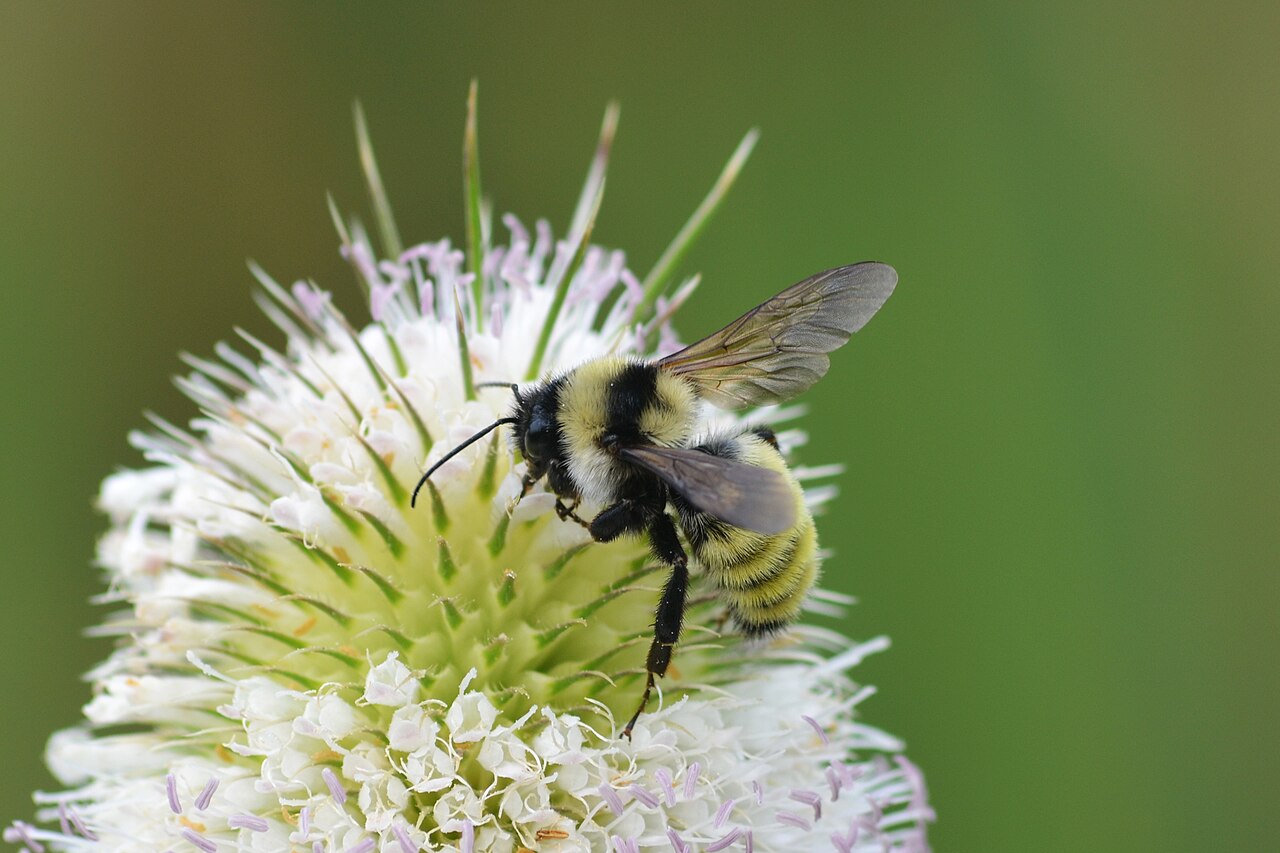
Striping separates the groups fast. Honey bees wear alternating bands of amber and dark brown across the whole abdomen, giving a striped but muted look. Bumble bees carry broad blocks of yellow and black, usually a yellow thorax with one or two yellow abdominal bands, and the fuzz blurs the edges. The bands are soft, never crisp.
If the stripes are sharp-edged, glossy yellow on black with no fuzz between them, you are looking at a wasp. The guide to black and yellow wasps works through those species. Many wasps also add yellow dots, hooks or anchor shapes rather than clean bands, a pattern no bee produces.
Western Honey Bee (Apis mellifera)
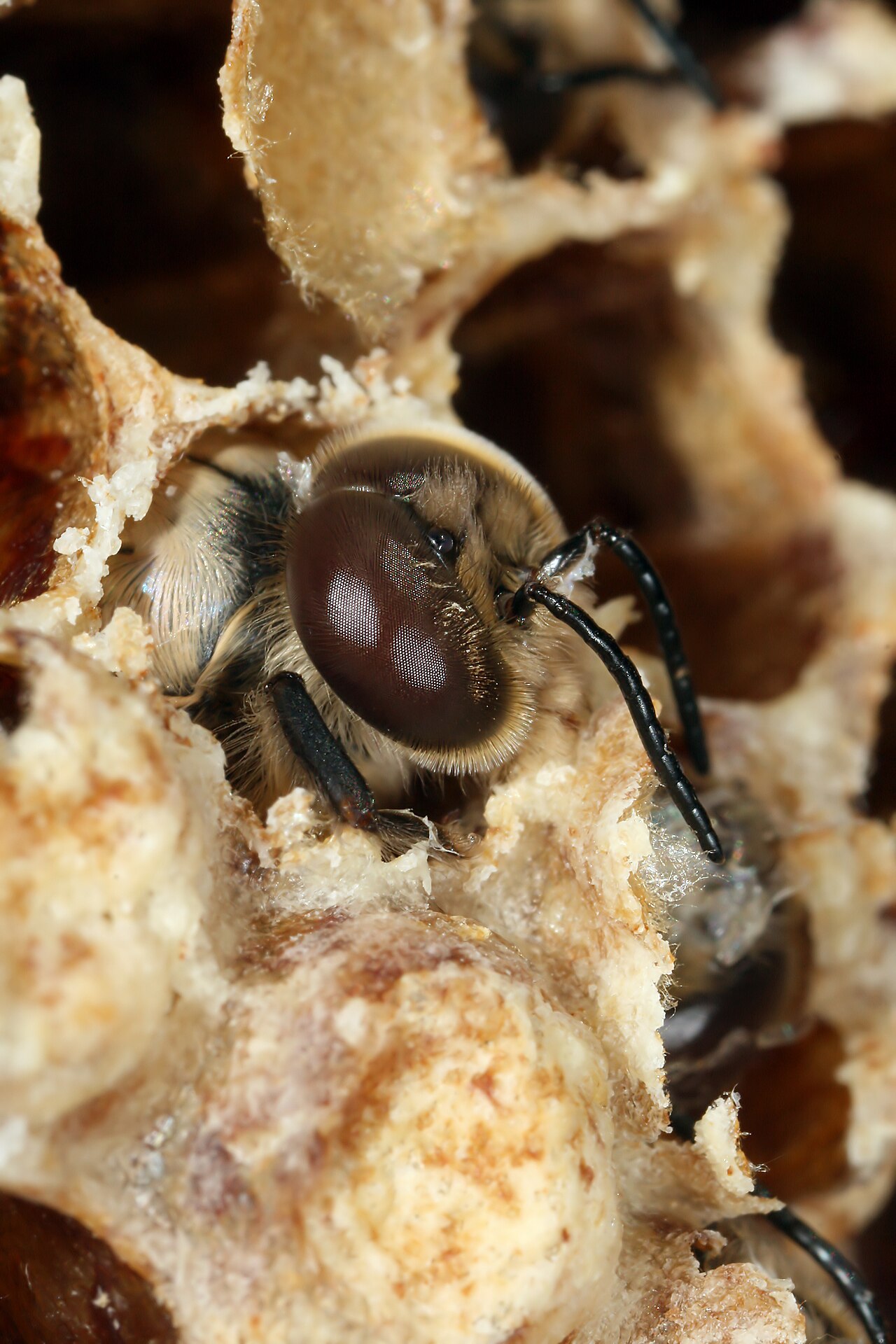
The honey bee is the default yellow bee across all 50 states, around 0.5 in (13 mm) long, slender, with a golden-brown abdomen banded in dark brown and a fuzzy tan thorax. Hind legs often carry visible yellow or orange pollen pellets, a feature wasps never show.
They work flowers steadily from early spring to the first hard frost and are found anywhere there is bloom. Honey bees are mild unless you stand in the flight path of a hive. The single barbed sting means a honey bee dies defending the colony, which is why it only does so with real cause, typically within a few feet of the hive entrance.
Common Eastern Bumble Bee (Bombus impatiens)
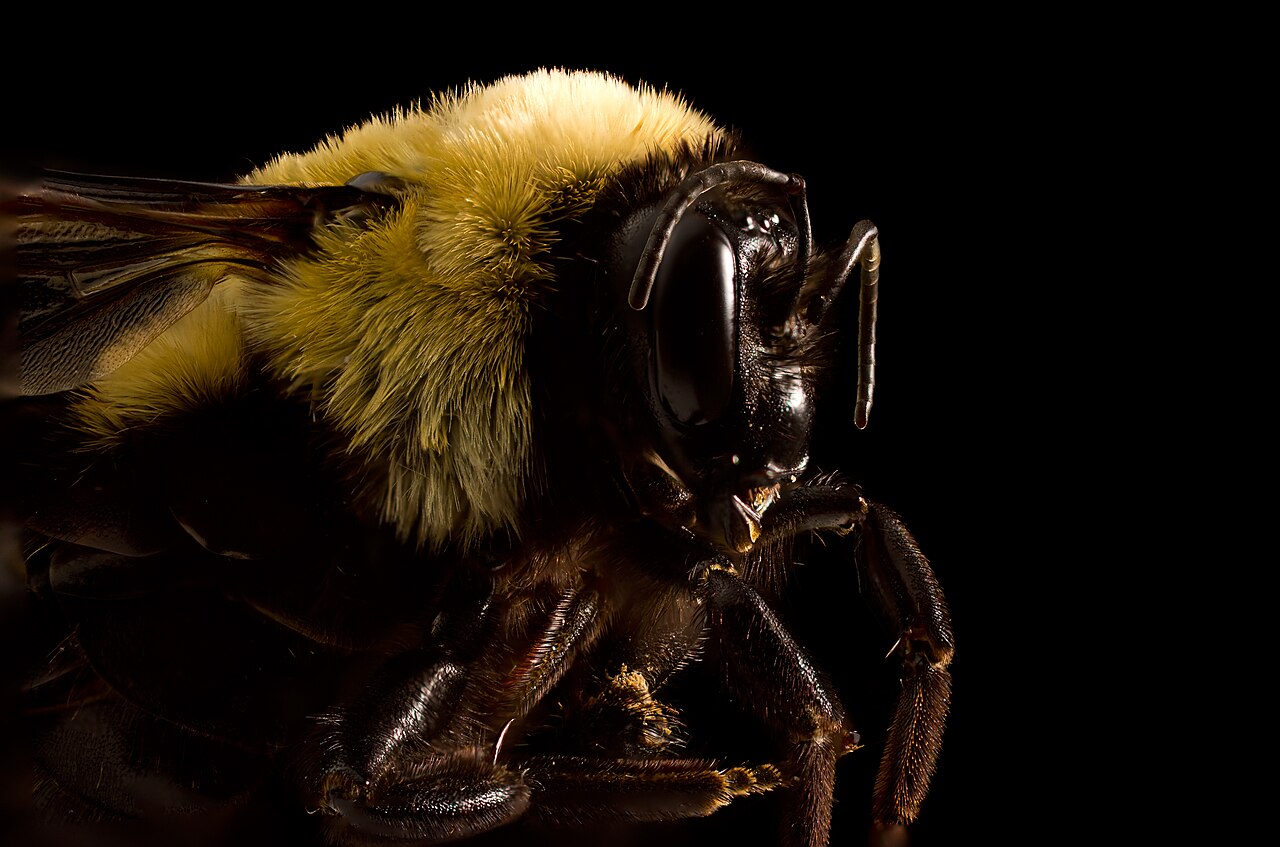
This is the bumble bee most people in the eastern half of the country see, running 0.5 to 0.9 in (13 to 23 mm) depending on caste. The pattern is simple: a bright yellow fuzzy thorax, one yellow band at the front of the abdomen, and solid black behind it. Large and robust, with an audible low buzz.
Its range covers Maine to Florida and west to the Dakotas and Texas, including dense urban areas where it is often the only bumble bee present. Colonies nest underground or in old rodent burrows and hold 50 to 500 workers. Queens appear in March and April, and the last workers die off in October.
Golden Northern Bumble Bee (Bombus fervidus)
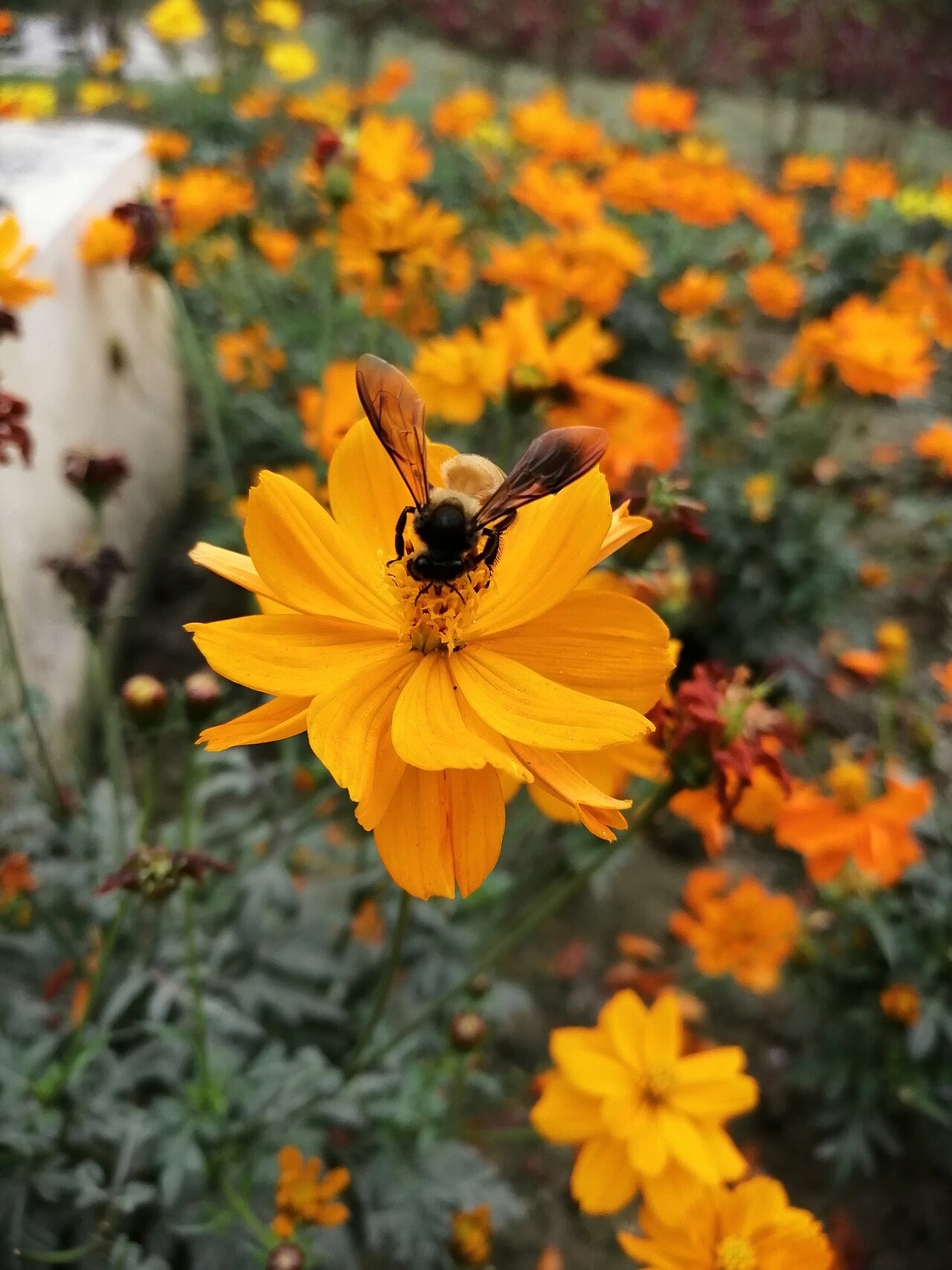
If you have seen a bumble bee that looked almost entirely yellow, this is probably it. The golden northern bumble bee carries yellow across the thorax and the first four abdominal segments, broken only by a black band between the wings and a black tip, and at 0.6 to 1 in (15 to 25 mm) it is one of the larger species.
It ranges across the northeastern and midwestern states into the Great Plains and favors open fields, pastures and roadside clover. This species has a reputation for being the most defensive bumble bee in the East and will sting with less provocation than its relatives, especially within a few feet of a nest in a grass tussock or compost pile.
Yellow-Banded Bumble Bee (Bombus terricola)
The yellow-banded bumble bee shows a black head and thorax with a yellow band behind the wings, then yellow on the second and third abdominal segments and black at the tip. It is medium-sized at 0.4 to 0.8 in (10 to 20 mm) and has a notably short face.
Its stronghold is the Northeast, the Great Lakes and southern Canada, and it is one of the North American bumble bees in documented decline. State wildlife agencies in New England and the upper Midwest list it as a species of conservation concern, so a sighting is worth photographing and submitting to a bumble bee atlas project rather than swatting.
Hunt’s Bumble Bee (Bombus huntii)
West of the Rockies the yellow bumble bee with an orange streak is usually Hunt’s bumble bee, 0.4 to 0.7 in (10 to 18 mm), with a yellow thorax, a black band, yellow abdominal bands and a clear orange-red patch across the middle of the abdomen. That orange is the tell.
It occupies the Intermountain West and the Great Plains from Alberta to northern Mexico, including sagebrush and high desert country where few other bumble bees persist. Colonies are small, often under 100 workers, and nest underground. Like most bumble bees it is reluctant to sting and will usually bump a hand away before considering it.
Eastern Carpenter Bee (Xylocopa virginica)
Carpenter bees get reported as giant bumble bees. The eastern carpenter bee is 0.6 to 1 in (15 to 25 mm) with a fuzzy yellow thorax and a bare, shiny black abdomen that reflects light like plastic. Bumble bees are fuzzy all over, so the glossy rear end settles the identification instantly.
It occurs from the Gulf states north to New England and west to Kansas, and it bores 0.5 in (13 mm) round holes into unpainted eaves, decks, fascia boards and fence rails. Females can sting but rarely do. Males have no sting whatsoever and spend the spring hovering aggressively in front of anything that moves, which is bluff and nothing more.
Valley Carpenter Bee: The Golden Male
The most striking yellow bee in the country lives in the Southwest. Male valley carpenter bees (Xylocopa sonorina) are covered in dense blond to golden fuzz with green eyes, measure close to 1 in (25 mm), and are known locally as teddy bear bees. Females of the same species are solid metallic black, so the sexes look like two different insects.
The range runs through California, Arizona, New Mexico and into Texas, with populations established in Hawaii. Males patrol territories around flowering trees in spring and hover in front of people, which looks alarming at that size. They cannot sting. Females nest in dead agave stalks, yucca and soft dry wood rather than in structural timber.
All Yellow Bumble Bees: Which Are Really Solid Yellow?
No North American bumble bee is completely yellow, but a few come close enough to read that way in the field. The golden northern bumble bee is the leading candidate in the East. In the West, the Nevada bumble bee (Bombus nevadensis) and the central bumble bee (Bombus centralis) both carry extensive yellow with minimal black.
Every one of them keeps a black band between the wings or a dark abdominal tip, so a genuinely all-yellow bumble bee photograph usually turns out to be a washed-out exposure or a freshly emerged bee whose hair has not darkened. For an unusual color report worth a second look, see how often the pink bee reports turn out to be pollen dust rather than pigment.
What Insect Is Mistaken for a Bee?
Yellowjackets lead by a wide margin. These are wasps in the genera Vespula and Dolichovespula, smooth, glossy, sharply banded, with a pinched waist, and they are the insects at your soda can and your grill in August. Bees have no interest in meat or sugar water. Paper wasps are the long-legged ones hanging under eaves on an open umbrella nest.
Hover flies, also called syrphid flies or flower flies, are the harmless group that fools gardeners. They have two wings instead of four, huge eyes meeting on top of the head, and they hang motionless in the air in a way no bee manages. Bee flies, hornets and several yellow beetles round out the list, along with caterpillars sporting the same warning colors, as the black and yellow caterpillar guide shows.
What Do Bumble Bees Look Like?
A bumble bee is round, broad and visibly furry, 0.4 to 1 in (10 to 25 mm) long, with a body shape closer to a marble than a cigar. The whole body including the abdomen is coated in dense hair called pile, which traps pollen and gives the yellow a soft, matte quality. Wings are short relative to the body and the flight is heavy and low.
Pollen rides in a bare, shiny patch on the hind leg called the corbicula, often packed into a bright lump the size of a pinhead. Queens in spring are noticeably larger than the summer workers of the same species, which is why people report impossible size ranges from one garden. Field research across the genus is published by the USDA Agricultural Research Service and its pollinating insect lab.
Yellow in the Rest of the Yard
Yellow is a warning color, and plenty of harmless animals borrow it. Among spiders the pattern shows up on the big garden orbweavers covered in the black and yellow spider guide. Among butterflies it belongs to the swallowtails and sulphurs described in the yellow butterfly identification guide.
Birds use the same palette, and a flash of yellow at a feeder is more often a goldfinch or a warbler than anything with a sting, which the roundup of yellow bird species works through. The useful habit is to check body shape and movement before color, because color is the feature that evolution reuses most often.
Frequently Asked Questions
What are four types of bees?
The four groups a US homeowner actually encounters are honey bees, bumble bees, carpenter bees and the many solitary bees such as mason, leafcutter, mining and sweat bees. Only honey bees and bumble bees are social with large colonies. North America holds roughly 4,000 native bee species, and about 90 percent of them nest alone.
How to befriend a bumblebee?
You cannot tame one, but you can keep it around. Plant a continuous bloom from March to October, skip insecticides including systemic treatments on nursery plants, leave a patch of unmowed grass and bare soil for nesting, and keep a shallow dish of water with pebbles. An exhausted bee can be offered a drop of 1 to 1 sugar water on a spoon.
What month are bumble bees most active?
July and August across most of the country, when colonies hit peak worker numbers. Queens emerge in March and April, workers build through May and June, and new queens and males appear in late summer. Colonies die off with the first frosts in October, leaving only mated queens to overwinter underground.
What is a bumble bee’s enemy?
Skunks and badgers dig out nests for the brood, and mice destroy them. Robber flies, crab spiders and birds take adults at flowers. Cuckoo bumble bees in the subgenus Psithyrus invade colonies and kill the queen, and the parasite Nosema bombi plus habitat loss and pesticides drive the broader declines.
How long will a bee remember you?
Honey bees can learn and retain a human face for at least two days in laboratory tests, and foragers remember flower patches for the length of their adult life, about six weeks. They are not tracking you personally. What they retain is a pattern tied to a reward or a threat, which fades without reinforcement.
What should I do about a yellow bee sting?
Scrape a honey bee sting out sideways with a fingernail or card instead of pinching it, which pumps in more venom. Wash the site, apply a cold pack for 10 to 20 minutes and take an oral antihistamine for the itch. Local swelling up to 4 in (10 cm) is normal. Seek emergency care for hives elsewhere on the body, facial swelling, dizziness or any breathing difficulty.