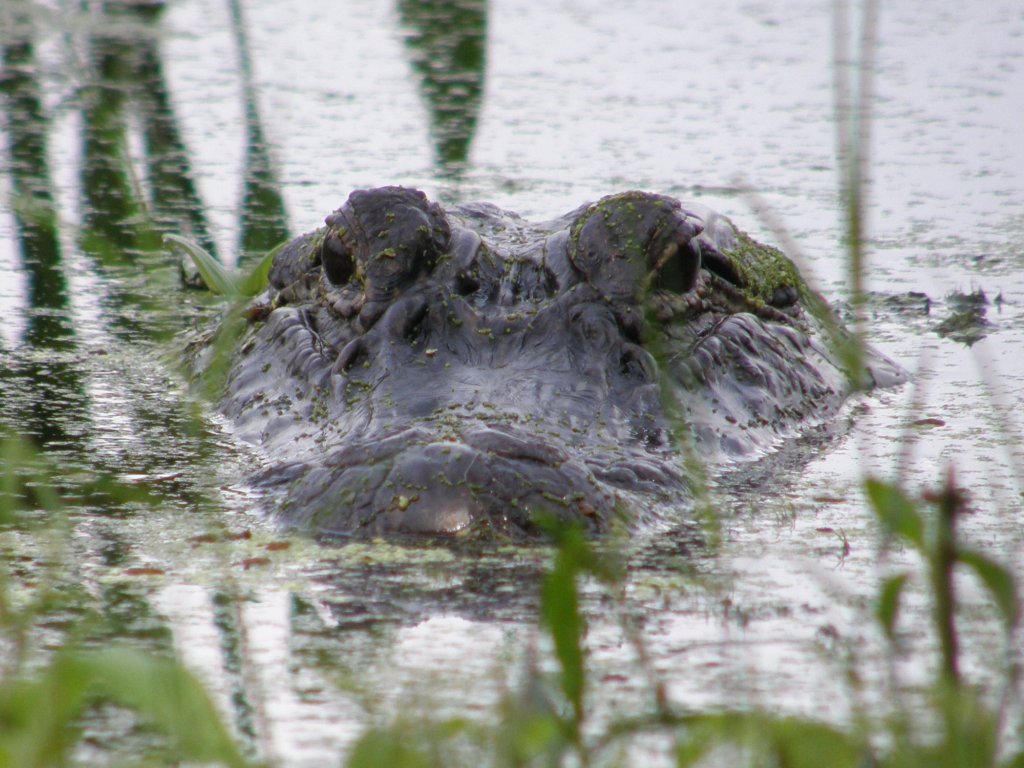
Alligator Tracks: 5 Toes, 4 Toes and a Tail Drag
Alligator tracks are easy to confirm once you know what to count: five toes on the front foot, four on the hind foot, and a tail drag running down the middle of the trail. That combination belongs to no other animal in the United States, and it shows up clearly in wet mud, damp sand and the thin snow that occasionally reaches the Gulf and Carolina coasts.
Most people find alligator tracks by accident, on a pond bank, a sand trap or a boat ramp, and the first question is whether the animal is still nearby. Direction of travel, edge freshness and the depth of the belly drag answer that. What follows covers the foot structure, the three surfaces and the look-alikes.
Alligator tracks show five clawed toes on the front foot and four partly webbed toes on the hind foot, with a smooth tail drag line between the left and right prints. Hind prints run about 3 to 10 inches (8 to 25 cm) long depending on the animal’s size, and the trail usually leads straight between water and a basking spot.
What Alligator Tracks Look Like
An alligator trail reads as a set of paired prints flanking a continuous central groove. The groove is the tail, and it is the single most reliable feature, because the only other American animals that drag a tail across soft ground are beavers, otters and large lizards, all of which leave different feet.
The prints themselves sit wide of the body line. American alligators (Alligator mississippiensis) walk with their legs out to the sides in a sprawled posture or tucked under in a raised posture, and either way the left and right tracks are separated by a gap wider than you would expect from a mammal of the same weight.
Front Feet and Hind Feet: Toes and Claws
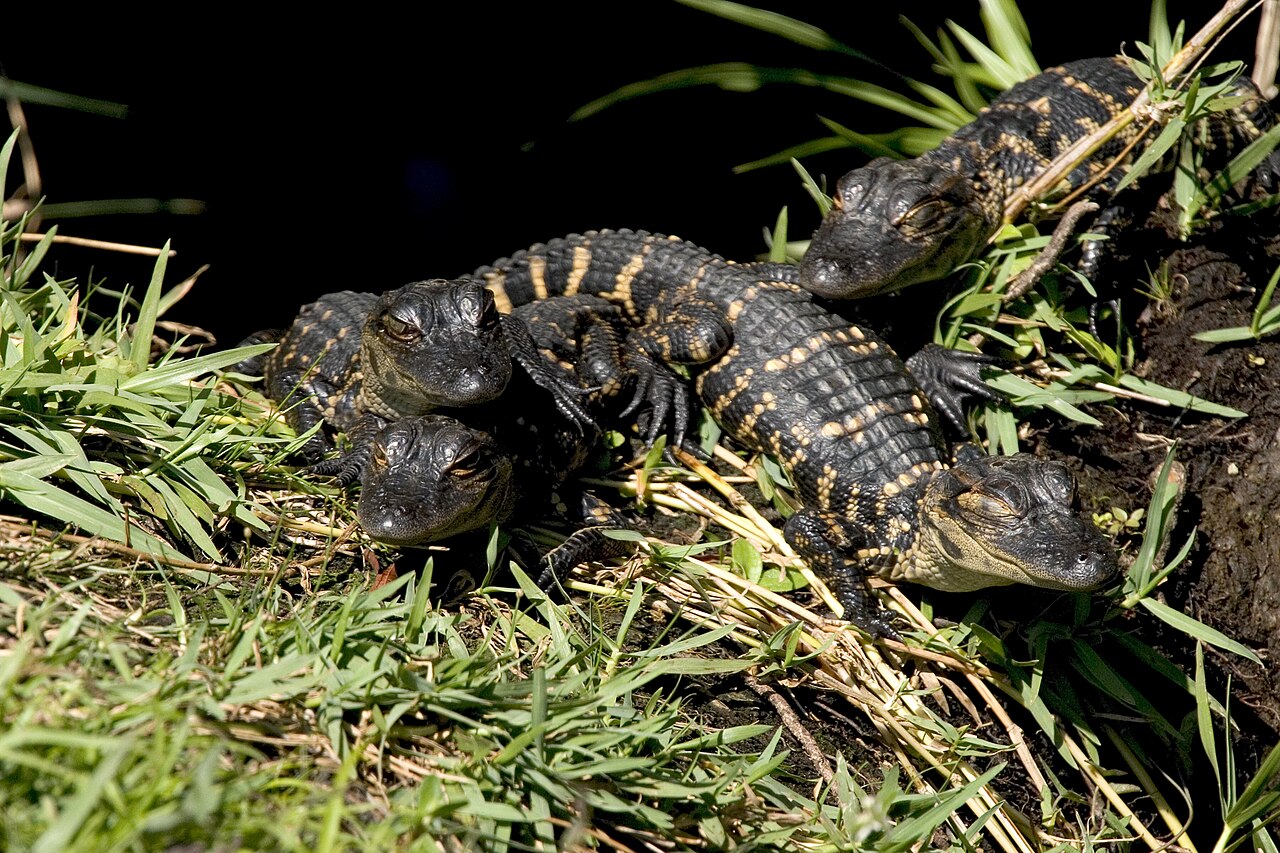
The front foot has five toes and the hind foot has four. That asymmetry is diagnostic, and it is worth checking twice, because a partial print in dry sand can easily hide the fifth toe on a front track.
Claws appear on the inner three toes of each foot. The outer toes are clawless, so a clean track shows three sharp points and one or two blunt ends. The claw marks register as short punctures just beyond the toe tip, usually 0.2 to 0.5 inches (5 to 13 mm) ahead of it in soft mud.
Webbing shows only on the hind foot, and only in fine wet sediment. When it registers, it fills the space between the four hind toes as a faint fan. Front feet are not webbed, which is why a front print looks spread and a hind print looks paddled.
Track Size by Alligator Length
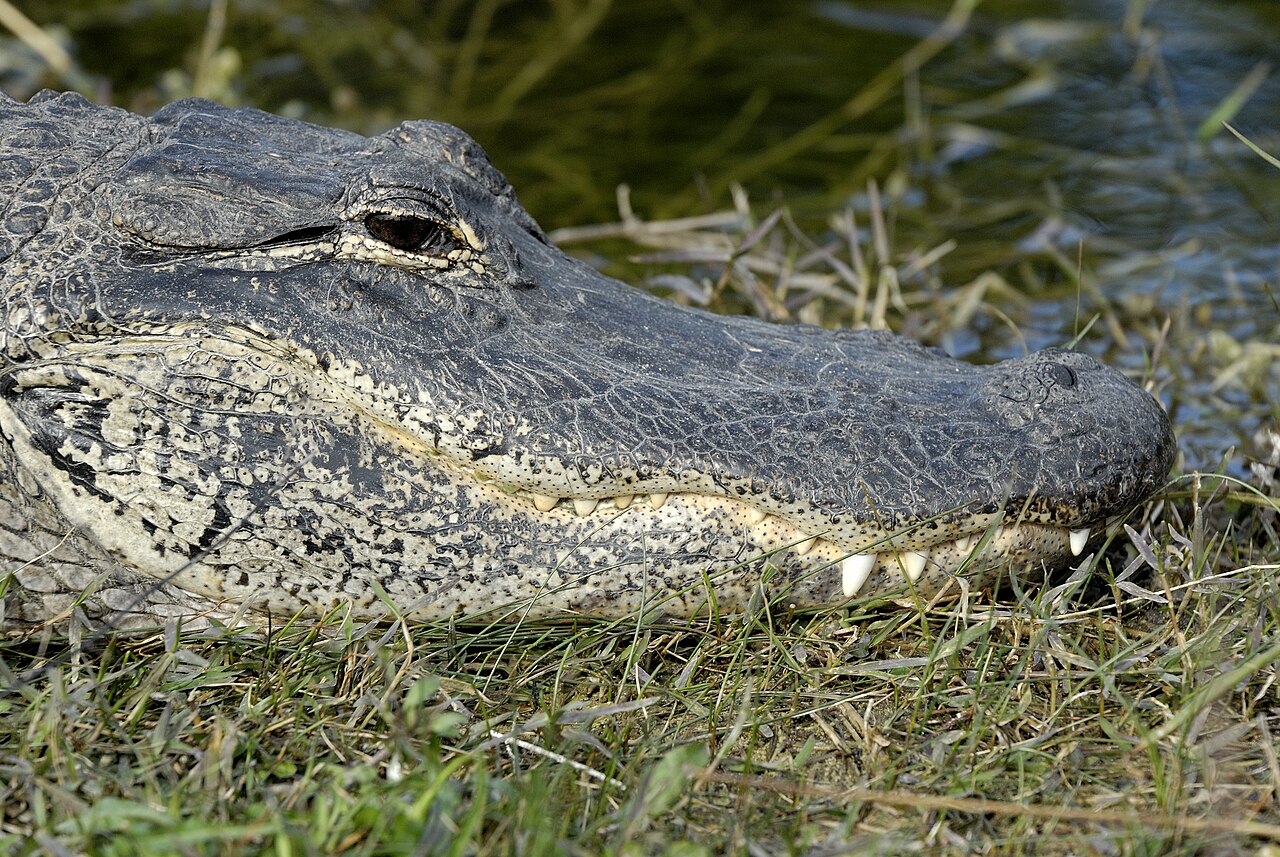
Track size scales with body length closely enough to be useful in the field. A rough field rule is that the hind foot length in inches, multiplied by roughly 12 to 15, approximates the total body length, though this varies with the individual and with how deeply the foot sank.
| Alligator length | Front print | Hind print | Trail width | Tail drag |
|---|---|---|---|---|
| Hatchling, under 1 ft | 0.5 in (13 mm) | 0.8 in (20 mm) | 2 to 3 in (5 to 8 cm) | Thread thin |
| Juvenile, 2 to 4 ft | 1 to 2 in (3 to 5 cm) | 2 to 3 in (5 to 8 cm) | 5 to 9 in (13 to 23 cm) | 0.5 to 1 in wide |
| Subadult, 5 to 7 ft | 2.5 to 3.5 in (6 to 9 cm) | 4 to 6 in (10 to 15 cm) | 10 to 16 in (25 to 41 cm) | 1 to 2 in wide |
| Adult, 8 to 10 ft | 3.5 to 5 in (9 to 13 cm) | 6 to 8 in (15 to 20 cm) | 16 to 24 in (41 to 61 cm) | 2 to 4 in wide |
| Large adult, 11 ft and up | 5 in and up (13 cm) | 8 to 10 in (20 to 25 cm) | 24 in and up (61 cm) | 4 to 6 in wide |
Treat these as working ranges, not measurements. Published track dimensions for alligators are thin compared with the data available for mammals such as white-tailed deer and their seasonal trails, and substrate changes every number in the table.
Next question: Alligator Poop: Why Gator Scat Is White and Where to Find It
The Tail Drag Is the Giveaway
If there is a tail drag, check it before anything else. An alligator tail drag is a smooth continuous furrow with a rounded cross section, often slightly wavy where the animal swung its hips, and it rarely breaks for more than a step or two.
Depth tells you about posture. A deep wide drag with belly scuffing means a low walk, the sprawled gait of a cool animal. A faint broken drag means a high walk, body lifted clear, which is how a traveling alligator moves.
No drag at all does not rule out an alligator. On packed sand, gravel or frozen ground the tail leaves nothing, and the toe count carries the identification alone.
Alligator Tracks in Snow
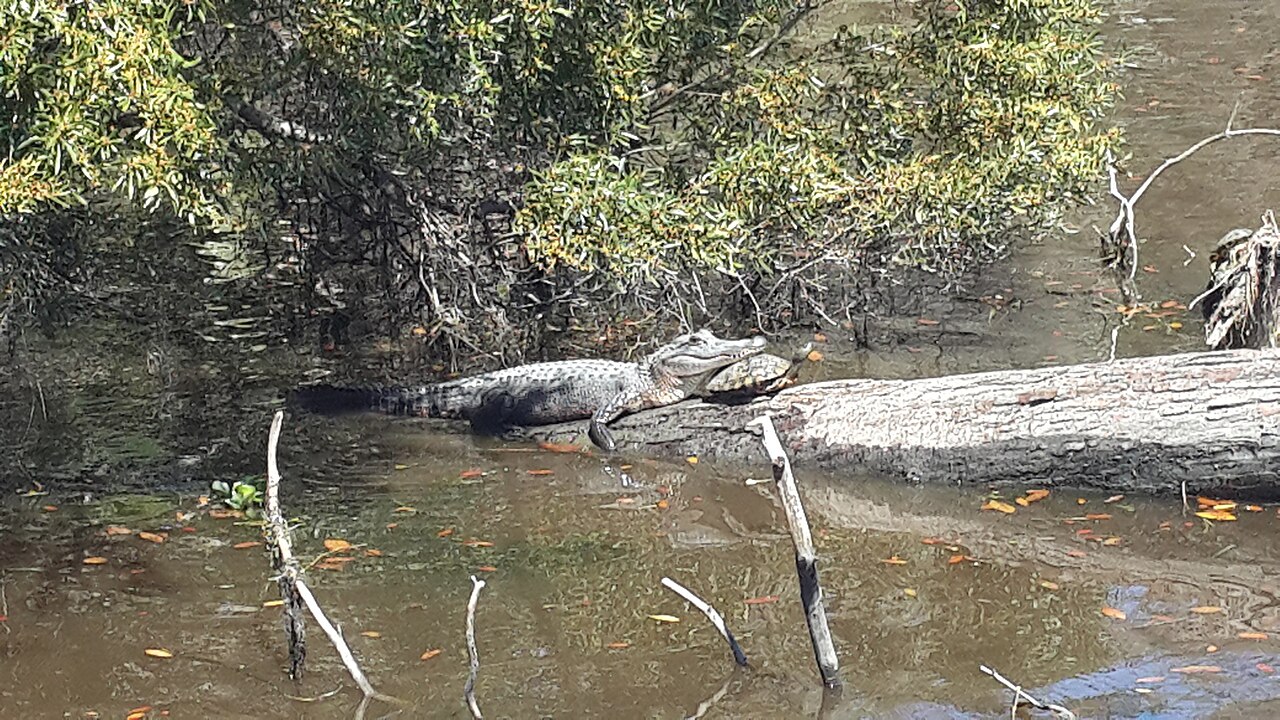
Snow inside alligator range is rare but not unheard of, and it produces the cleanest tracks of any surface. Coastal South Carolina, southern Louisiana and the Texas Gulf Coast pick up measurable snow every few winters, and alligators do move during and after those events.
In snow, expect a shallow, crisply outlined print with the toe streaks preserved and a broad smooth tail groove. Because alligators brumate rather than hibernate, cold weather movement is slow and short range, usually a few yards between a den and open water, so snow trails tend to be brief.
Freshness is easy to judge in snow: sharp crystalline edges mean hours, rounded or glazed edges mean a thaw has passed. A trail ending at an ice hole is the classic winter find, since alligators hold their snouts above the surface of icing ponds for days.
Alligator Tracks in Mud
Mud is the standard substrate and the most informative one. Soft pond margin mud holds claw punctures, webbing and the scale texture of the foot pad, and a good mud print often shows which direction the animal was turning.
The trade off is distortion. Deep mud lets the foot slide, stretching toe marks into streaks, so measure the clearest print in a trail rather than the first one you find.
Mud also records the slide. Alligators entering water from a bank leave a smooth chute 1 to 3 ft (30 to 90 cm) wide with no foot marks at all, and these slides are often mistaken for otter and mink slides along the same banks. The difference is scale and the absence of running water marks.
Alligator Tracks in Sand
Dry sand is the hardest surface to read. Grains collapse into the print within minutes, leaving round shapeless depressions and a tail groove that may be the only usable feature. Many sand reports of alligator tracks are actually unidentifiable.
Damp sand just above the tide line or beside a sand trap is much better, and it is where most beach and golf course photos come from. There the toes register sharply and the trail runs in a straight line between two water bodies, which is itself a clue, since alligators crossing dry ground usually take the shortest route.
Wind matters more than it does in mud: an open sand print softens beyond recognition within an hour on a breezy day, so a sharp sand track means a recent animal.
Gait and Stride: High Walk, Low Walk and Belly Slide
Alligators use three recognizable ways of moving on land, and each leaves its own trail signature. Reading the gait tells you whether the animal was warm, alarmed or simply shifting position.
| Gait | Stride (6 ft animal) | Trail signature | When it is used |
|---|---|---|---|
| Low walk | 8 to 14 in (20 to 36 cm) | Wide straddle, deep tail drag, belly scuffs | Cool weather, short moves |
| High walk | 14 to 24 in (36 to 61 cm) | Narrower straddle, faint or broken tail drag | Traveling between water bodies |
| Fast run | 24 in and up (61 cm) | Toe tips only, soil thrown backward, no drag | Fleeing, short bursts |
| Belly slide | Not applicable | Smooth chute, no prints | Entering water down a bank |
Stride lengths scale with the animal, so the numbers above apply to a roughly 6 ft (1.8 m) alligator. The pattern holds at any size: a drag that disappears means a lifted body and a faster animal.
Alligator Tracks Compared With Dog and Coyote Tracks
Dog and coyote tracks are the most common false alarm, usually because of the straight line trail. The separation is simple: canids leave four toes on every foot, front and hind, and alligators never do.
Shape settles the rest. Canid prints are compact and oval with a single triangular heel pad, while alligator toes splay outward from a broad flat sole. A coyote trail also registers as a near single line of prints, since the animal places its hind foot in the front track, whereas the tight direct register of coyote trails has no equivalent in reptiles.
Tail drag is the final check. Dogs and coyotes carry their tails clear of the ground at every gait, so a central groove rules them out. Cat and fox trails in the same habitat are smaller, rounder and clawless in the case of cats, which makes them easier to separate than canids.
Alligator Tracks Compared With Otter, Beaver and Raccoon Tracks
These three are the genuinely tricky ones, because all of them live on the same banks and two of them drag something. North American river otters leave five toes on all four feet, so a five-toed hind print is an otter, not an alligator.
Beavers also have five toes front and hind, with heavy webbing on the hind foot that produces a print up to 7 inches (18 cm) long. Beaver tail drags are broad and flat rather than rounded, and they are frequently erased by the animal’s own dragging branches. Raccoons leave five long toes on both feet and no drag, which separates them immediately.
When the toe count is unclear, follow the trail instead. Alligator trails run water to water in a straight line, otter trails loop and include slides on wet ground, and beaver trails end at cut stems. Comparing against a larger reference set such as the five-toed prints black bears leave helps calibrate what five toes actually look like in mud. Range maps and species accounts for the American alligator are available through the National Park Service at Everglades National Park.
Where and When to Look, and How to Stay Safe
Look on soft margins: pond banks, canal edges, boat ramps, golf course bunkers, levee roads and the gaps between two water bodies. Early morning is the best time, because overnight dew firms the surface and the day’s foot traffic has not yet crossed it.
Spring is the busiest season for overland movement, when males travel during the April to June courtship period and females look for nest sites. Fresh tracks mean a live animal nearby, often within 100 ft (30 m), and a trail leading away from water is more concerning than one leading toward it.
Keep 30 ft (9 m) between you and any alligator you can see, keep dogs leashed and away from the bank, and never follow a trail into dense vegetation. Bobcat tracks found along the same levees carry no comparable risk, but an alligator trail is a notice that a large predator uses that spot routinely.
Frequently Asked Questions
What scares alligators away?
Loud noise and sudden movement work on most wild alligators, which avoid people by default. Shouting, clapping and stamping usually send one back to the water. Animals that have been fed lose that avoidance, which is why feeding alligators is illegal in every state where they occur.
What US states have wild alligators?
Ten states hold wild American alligators: Florida, Louisiana, Georgia, Alabama, Mississippi, South Carolina, North Carolina, Texas, Arkansas and Oklahoma. Florida and Louisiana account for the large majority, with roughly 1.3 million and 2 million animals respectively. Small numbers reach southern Tennessee as the range creeps north.
How do alligators move?
On land they use a sprawled low walk, a raised high walk, a short fast run and a belly slide for entering water. In water they swim with the tail and hold their legs against the body. The often repeated claim that they gallop applies to some crocodiles, not to alligators.
What is an alligator’s weakness?
Their jaw opening muscles are weak relative to their closing force, which is why handlers tape a captured alligator’s mouth shut with a few wraps. They also tire fast, since their muscles run largely on anaerobic energy, and a sustained chase is not something they can maintain.
Can an average human outrun an alligator?
Yes, over any distance that matters. Alligators reach roughly 11 mph (18 km/h) in a burst of a few body lengths, then stop. They do not chase people across open ground, and running in a straight line away from the animal is the correct response. The advice to run in a zigzag is a myth.
What is the main predator of an alligator?
Adult alligators have no natural predator except larger alligators and humans. Hatchlings and juveniles are eaten by raccoons, wading birds, large fish, otters, bobcats and adult alligators, and fewer than one in five hatchlings reaches its second year.