Snakes That Look Like Rattlesnakes: How to Tell in Seconds
Most snakes that look like rattlesnakes are harmless species copying the pattern, the hiss or the tail buzz of a pit viper. Two real dangers also get confused with rattlers, the copperhead and the cottonmouth.
Bullsnakes and gopher snakes are the classic rattlesnake lookalikes. They hiss and buzz their tails over a blotched back, but they have round pupils and no heat pits, and the tail ends in a point rather than a rattle. Hognoses, water snakes and rat snakes get mistaken too, while copperheads and cottonmouths are venomous lookalikes.
Bullsnake and Gopher Snake, the Classic Rattlesnake Lookalikes
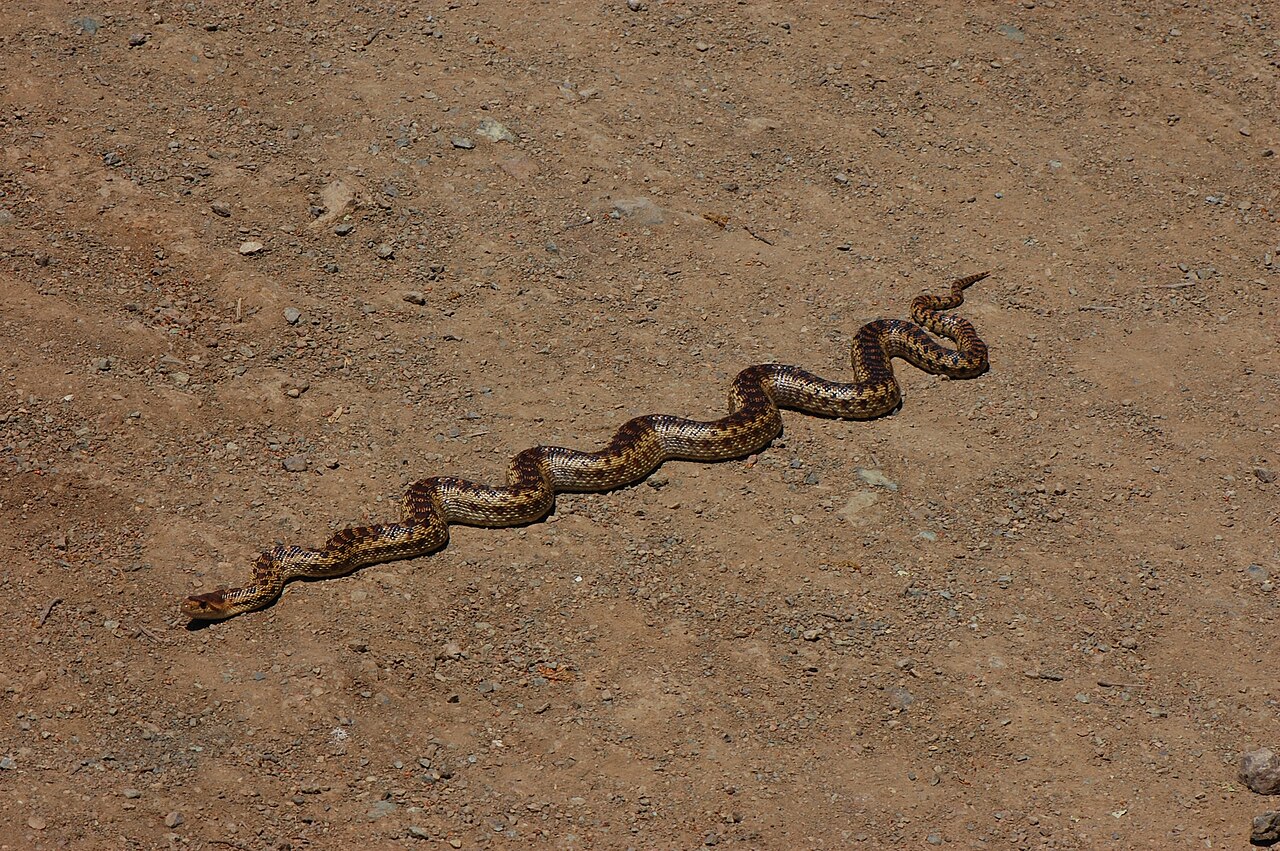
The bullsnake and the gopher snake are one species, Pituophis catenifer, and they are among the best-known rattlesnake mimics in the US. Gopher snake is the name used in the West. The bullsnake (P. c. sayi) is the Great Plains subspecies. Both carry a tan back with brown blotches that reads as a rattlesnake from a distance. Adult bullsnakes often reach 4 to 6 ft, longer than the prairie rattlesnakes that share their range.

The bluff is a full act. A cornered bullsnake hisses loudly, flattens its head, pulls into an S-shaped coil and vibrates its tail.
The tells sit at both ends of the snake. The tail tapers to a fine point with no rattle and no button. The pupils are round, not the vertical slits of a pit viper. Black racers also buzz their tails in leaf litter, but adults are slim, fast and plain, with no blotches at all.
How to Tell a Rattlesnake From a Lookalike
The rattle is the clearest tell. No other snake has one, and even a newborn rattlesnake carries a silent button. A missing rattle clears nothing, because rattles break off, and the Santa Catalina Island rattlesnake (Crotalus catalinensis) has none.
Head shape fails as a test. Bullsnakes, hognoses and water snakes all flatten their heads into a triangle when threatened. Look instead for vertical pupils and the heat pit, a small opening between the eye and the nostril. Every rattlesnake, copperhead and cottonmouth has both.
Sound proves nothing either, because racers, rat snakes, copperheads and cottonmouths buzz their tails too. Baby copperheads add one more trap, a yellow tail tip on a small banded snake that people mistake for a young rattler.
| Snake | Tail tip | Pupil | Defensive bluff | Venomous |
|---|---|---|---|---|
| Rattlesnake | Rattle or button | Vertical | Rattles, coils, strikes | Yes |
| Bullsnake / gopher snake | Pointed, no rattle | Round | Hisses, flattens head, coils, buzzes tail | No |
| Eastern hognose | Pointed, no rattle | Round | Spreads neck, hisses, plays dead | No |
| Northern water snake | Pointed, no rattle | Round | Flattens head, bites | No |
| Young rat snake | Pointed, no rattle | Round | Buzzes tail, strikes | No |
| Copperhead | Pointed, yellow in young | Vertical | Freezes, buzzes tail | Yes |
| Cottonmouth | Pointed, yellow in young | Vertical | Gapes white mouth, buzzes tail | Yes |
Eastern Hognose, the Cobra Bluffer Mistaken for a Rattlesnake
The eastern hognose (Heterodon platirhinos) puts on one of the most dramatic bluffs of any lookalike. It is thick and blotched, and people mistake it for a rattlesnake or a copperhead. When cornered, it spreads its neck like a cobra and hisses loudly.
If the bluff fails, the hognose rolls onto its back, opens its mouth and lets its tongue hang out. It plays dead. The upturned snout and round pupils separate it from any pit viper.
Water Snakes, Rat Snakes and Other Blotched Lookalikes
Water snakes are the lookalikes people meet near lakes and creeks. The northern water snake (Nerodia sipedon) is heavy and blotched, flattens its head when threatened and bites hard if handled. Banded water snakes (Nerodia fasciata) put on the same bluff in the Southeast.
Young black rat snakes (Pantherophis obsoletus) are gray with dark blotches and turn black with age. Eastern milk snakes (Lampropeltis triangulum) carry reddish blotches and get killed as copperheads or rattlers. Snakes that look like coral snakes, such as the scarlet kingsnake (Lampropeltis elapsoides), copy red, black and yellow bands instead of rattlesnake blotches. On the scarlet kingsnake red touches black, while on the eastern coral snake red touches yellow.
Copperheads and Cottonmouths, Venomous Snakes Mistaken for Rattlesnakes
Copperheads and cottonmouths are two venomous pit vipers that get confused with rattlesnakes. The copperhead (Agkistrodon contortrix) wears hourglass crossbands, narrow on the spine and wide on the flanks. Its head is plain and copper toned.
The cottonmouth (Agkistrodon piscivorus) is dark and heavy. When threatened, it gapes to show the white lining of its mouth. Baby cottonmouths are banded and much brighter than the dark adults.
Crotalus, Cascabel and Diamondback Explained
Crotalus is the main rattlesnake genus. The massasaugas and the pygmy rattlesnakes belong to a second genus, Sistrurus. Cascabel is Spanish for rattle, and it names the South American rattlesnake (Crotalus durissus).

Diamondback usually means one of two species, the eastern diamondback (C. adamanteus) or the western diamondback (C. atrox). The red diamond rattlesnake (C. ruber) of southern California and Baja also carries the name. Both main species are named for the diamond-shaped blotches along the back. The eastern diamondback is the largest venomous snake in North America, and the Mojave rattlesnake (C. scutulatus) carries the most potent venom.
Not every rattlesnake wears diamonds. Timber rattlesnakes (C. horridus) carry dark crossbands, and prairie rattlesnakes (C. viridis) carry blotches.
Frequently Asked Questions
What insect sounds like a rattlesnake?
Cicadas and some grasshoppers make a dry, steady buzz that people mistake for a rattle. Insect buzzing comes from trees and tall grass and shifts around, while a rattle comes from the ground and stops when the snake settles or leaves.
What do you smell if a rattlesnake is near?
Usually nothing. Snakes typically release a musky odor only when grabbed or threatened, and a threatened snake may not musk at all, so a smell is no reliable warning. The cucumber smell linked to rattlesnakes and copperheads is folklore, not a warning sign.
Is it safe to pick up a gopher snake or bullsnake?
No, not casually. Bullsnakes and gopher snakes are not venomous, but they bite when grabbed. Reptiles often carry Salmonella in their digestive tracts, so wash your hands with soap and warm water right away. Children younger than 5 should not handle or touch reptiles at all.
Why do people bury a rattlesnake’s head?
A rattlesnake head can still bite by reflex after it is cut off. Burying it keeps pets, children and bare hands away from fangs that can still inject venom. Move a dead rattlesnake’s head only with a long tool.
Sources
- CDC, Healthy Pets, Reptiles and Amphibians
- New York State Department of Health, Salmonella and Amphibians and Reptiles, Questions and Answers