7 Snakes That Look Like Coral Snakes: Check the Snout
Snakes that look like a coral snake are almost always harmless mimics: scarlet kingsnakes, milksnakes, scarlet snakes, mountain kingsnakes and groundsnakes all wear red, black and pale banding on the same soil. Only two coral snake species live in the United States, and both have a feature no mimic copies, which is a solid black snout with no red or pale marking on the nose.
That snout check is faster and far more reliable than the band order rhyme most people remember. Below are the seven snakes mistaken for coral snakes most often in US yards and woodlands, each with its band pattern, size, range and a plain yes or no on venom. The safety question comes first, because a wrong call on a coral snake has real consequences while a wrong call on a kingsnake costs nothing.
The harmless lookalikes are the scarlet kingsnake, eastern milksnake, scarlet snake, Arizona and California mountain kingsnakes and the variable groundsnake. All have a red or pale snout and a blunt, unmarked head. The two venomous coral snakes, eastern and Arizona, have a jet black snout and yellow rings that touch red.
| Feature | Eastern coral snake (Micrurus fulvius) | Scarlet kingsnake (Lampropeltis elapsoides) |
|---|---|---|
| Snout | Solid black to the eyes | Red, sometimes with black speckling |
| Band order | Red touches yellow | Red touches black |
| Band completeness | Rings wrap the full belly | Bands often fade or break on the belly |
| Adult length | 20 to 30 in (51 to 76 cm) | 14 to 20 in (36 to 51 cm) |
| Body shape | Slender, even width, small head | Slightly stouter, head a touch wider |
| Venom | Yes, neurotoxic | No |
The Real Coral Snake: Venom, Range and Size
The eastern coral snake (Micrurus fulvius) runs from southeastern North Carolina through Florida and west into Louisiana and far eastern Texas. Adults reach 20 to 30 in (51 to 76 cm), rarely 48 in (122 cm), and the body stays almost the same width from neck to tail with a head barely wider than the neck. The rings are broad red and black separated by narrow yellow, and they continue unbroken around the belly.
Its venom is neurotoxic rather than tissue destroying, so a bite produces little swelling and almost no immediate pain. That absence of early symptoms is the dangerous part: people assume a dry bite and wait. Coral snakes are also reclusive, spending most daylight hours under leaf litter, logs and debris piles, which is why most encounters happen when someone rakes, moves firewood or lifts plywood in spring and fall.
Can a Person Survive a Coral Snake Bite?
Yes. Deaths from coral snake bites in the United States are extremely rare, and no confirmed fatality has occurred since antivenom became available, though supply has been limited in recent years. Survival depends on getting to a hospital rather than on field treatment, because neurological symptoms including drooping eyelids, slurred speech and difficulty breathing can start hours after a bite that looked harmless.
Treat every suspected coral snake bite as an emergency even with no pain and no swelling. Keep the limb still and below heart level, remove rings and watches, and go to an emergency department rather than driving to a clinic. Do not cut, suck, ice or apply a tourniquet. The CDC maintains current guidance on venomous snake bites at cdc.gov, and poison control at 1-800-222-1222 answers around the clock.
Are Coral Snakes Worse Than Copperheads, Rattlesnakes or Not Poisonous at All?
First the wording, because the search term trips people up: coral snakes are venomous, not poisonous. Poison is swallowed or absorbed, venom is injected, and nothing about a coral snake is dangerous to touch or to eat. When people ask what looks like a coral snake but is not poisonous, they mean the harmless mimics listed below, and those are genuinely safe to handle.
Drop for drop, coral snake venom is more potent than that of a copperhead or most rattlesnakes. In practice coral snakes send far fewer people to hospital: they are small, secretive, and their short fixed fangs and small mouths mean they often fail to deliver much venom through clothing or thick skin. Copperheads cause more bites, rattlesnakes cause more severe tissue damage, and coral snakes cause the fewest but the strangest presentations.
Red Touches Yellow: Where the Rhyme Works and Where It Fails
The rhyme “red touches yellow, kill a fellow; red touches black, venom lack” describes the eastern coral snake accurately and only within the United States. On a coral snake the narrow yellow or white rings sit between red and black, so red and yellow are always neighbors. On scarlet kingsnakes and milksnakes, black separates red from the lighter color.
Three things break the rhyme. Coral snakes in Central and South America scramble the band order entirely, aberrant individuals in Florida show partial or fused rings, and a snake moving through grass simply does not present clean color boundaries to a nervous observer. Our detailed look at the coral snake rhyme and its exceptions covers the documented oddities. Check the snout instead and keep the rhyme as the second opinion.
Scarlet Kingsnake: The Classic Fake Coral Snake
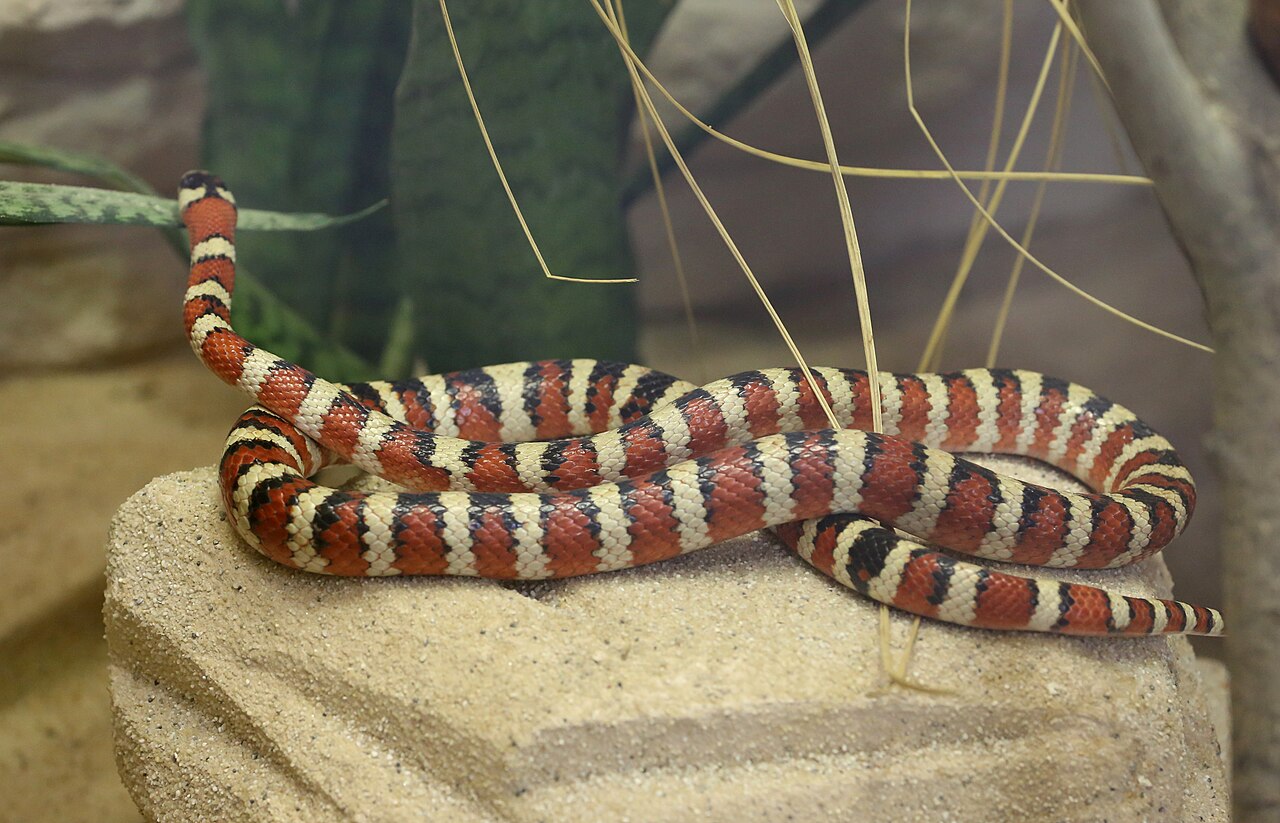
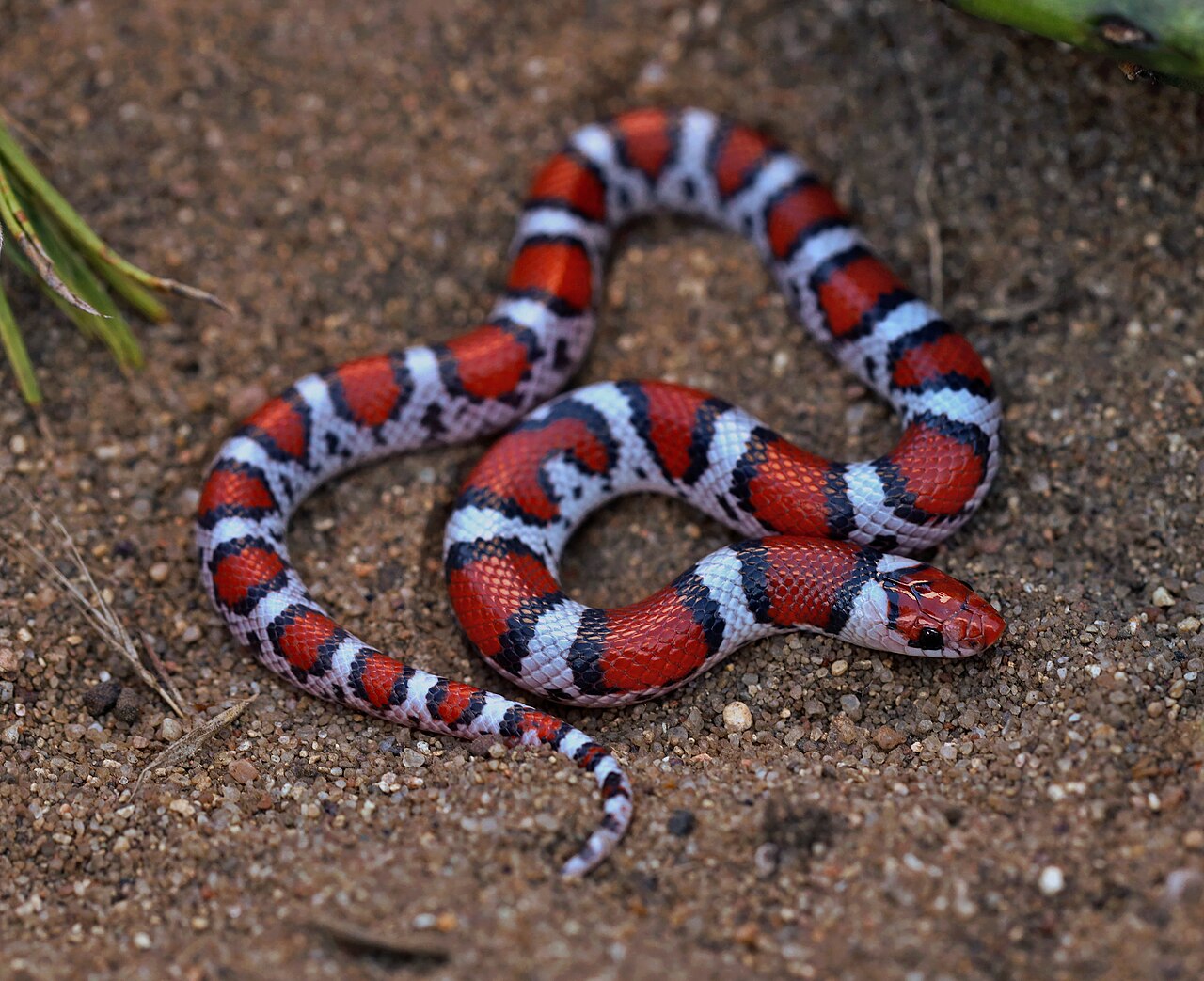
The scarlet kingsnake (Lampropeltis elapsoides) is what most people mean by the fake coral snake. It shares the full southeastern range of the eastern coral snake, from Virginia to Florida and west to eastern Texas, and reaches only 14 to 20 in (36 to 51 cm). Bands run red, black, yellow, black, red, so red never contacts yellow, and the belly banding usually breaks up into blotches.
Its head settles the question in daylight: the snout is red, and the head is slightly broader than the neck with noticeably larger eyes. Scarlet kingsnakes are nocturnal, often found under loose bark on dead pines, and feed heavily on small lizards and skinks. They are completely harmless and rarely even bite when handled. For the one on one comparison, see coral snake versus king snake.
Eastern Milksnake: Blotched Rather Than Banded
The eastern milksnake (Lampropeltis triangulum) covers the eastern half of the country from Maine to Alabama and west to Minnesota, which puts it far north of any coral snake. Adults reach 24 to 36 in (61 to 91 cm). Most populations wear reddish brown saddles edged in black on a gray or tan ground color rather than true rings, and a pale Y or V marks the back of the head.
Southern milksnakes and the red milksnake of the central states look much more coral like, with bold red bands separated by black on a cream background. Even there the pattern stops at the sides and the belly shows a black and white checkerboard. Milksnakes are constrictors that eat rodents, lizards and other snakes, and they will rattle their tail in leaves when cornered, which fools people into thinking rattlesnake.
Scarlet Snake: Belly Gives It Away
The scarlet snake (Cemophora coccinea) is the third southeastern tricolor and the one field guides forget. It grows to 14 to 20 in (36 to 51 cm), lives from New Jersey south to Florida and west to Texas, and burrows in sandy soils where it specializes in eating reptile eggs, slitting them open with enlarged rear teeth.
Two features separate it instantly: the snout is red and distinctly pointed, built for digging, and the belly is plain white or cream with no banding whatsoever. The red saddles on its back are bordered in black and sit on a whitish ground, so again red never meets the pale color. Scarlet snakes are harmless, secretive and most often turned up by garden tilling or found crossing roads on warm nights.
Arizona Mountain Kingsnake: The Western Mimic
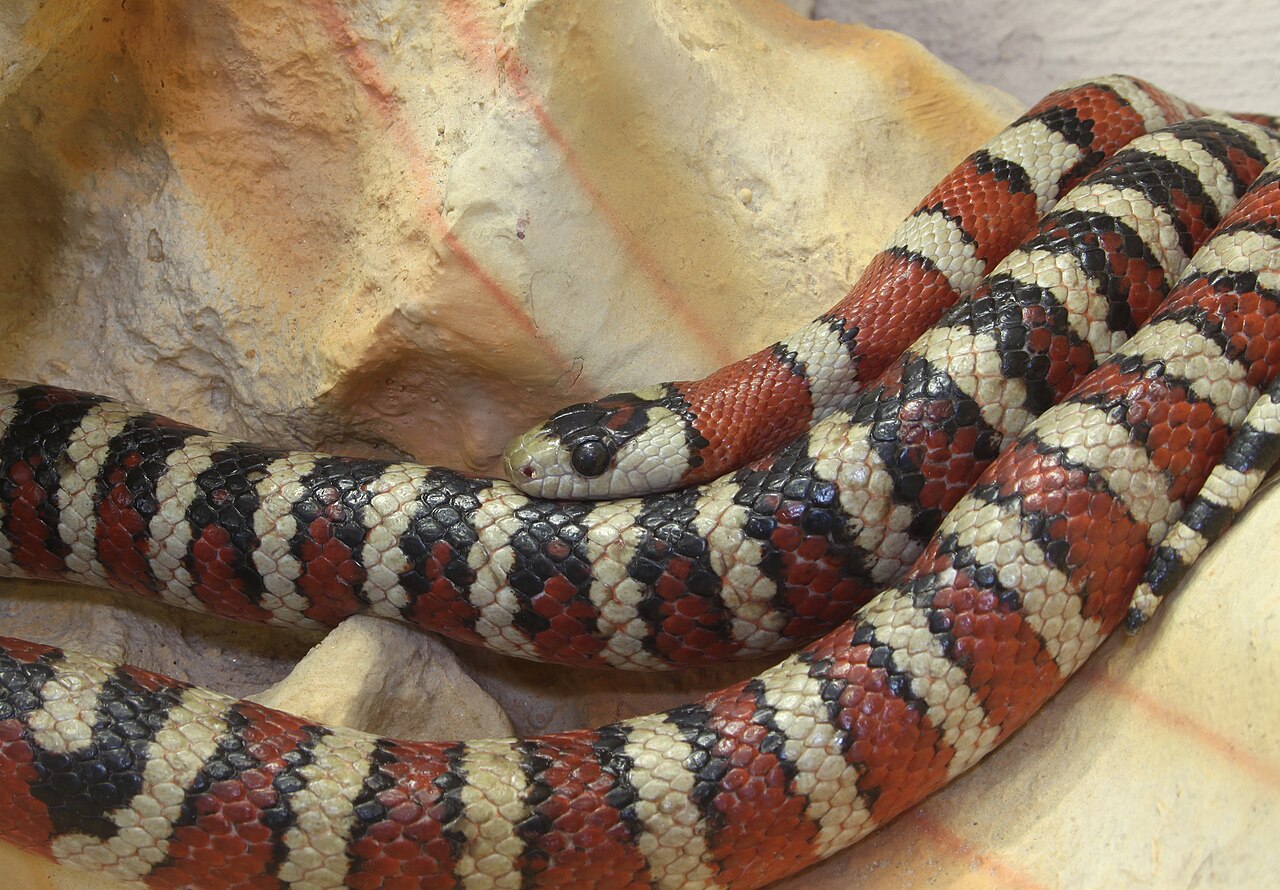
The Arizona mountain kingsnake (Lampropeltis pyromelana) lives in rocky canyons and pine oak woodland of central and southeastern Arizona, western New Mexico, southern Utah and Nevada, usually above 3,000 ft (914 m). Adults reach 24 to 36 in (61 to 91 cm) with crisp red, black and white triads, and the white snout plus a white collar behind the head is diagnostic.
People asking how to tell the difference between an Arizona kingsnake and a coral snake have an easy job, because the two barely overlap in habitat. The Arizona coral snake prefers lower desert and grassland, while the mountain kingsnake sticks to higher, cooler, wetter slopes. Add the white snout against the coral snake’s black one and the call takes a second. Mountain kingsnakes are harmless and highly prized by photographers.
California Mountain Kingsnake: Coastal and Harmless
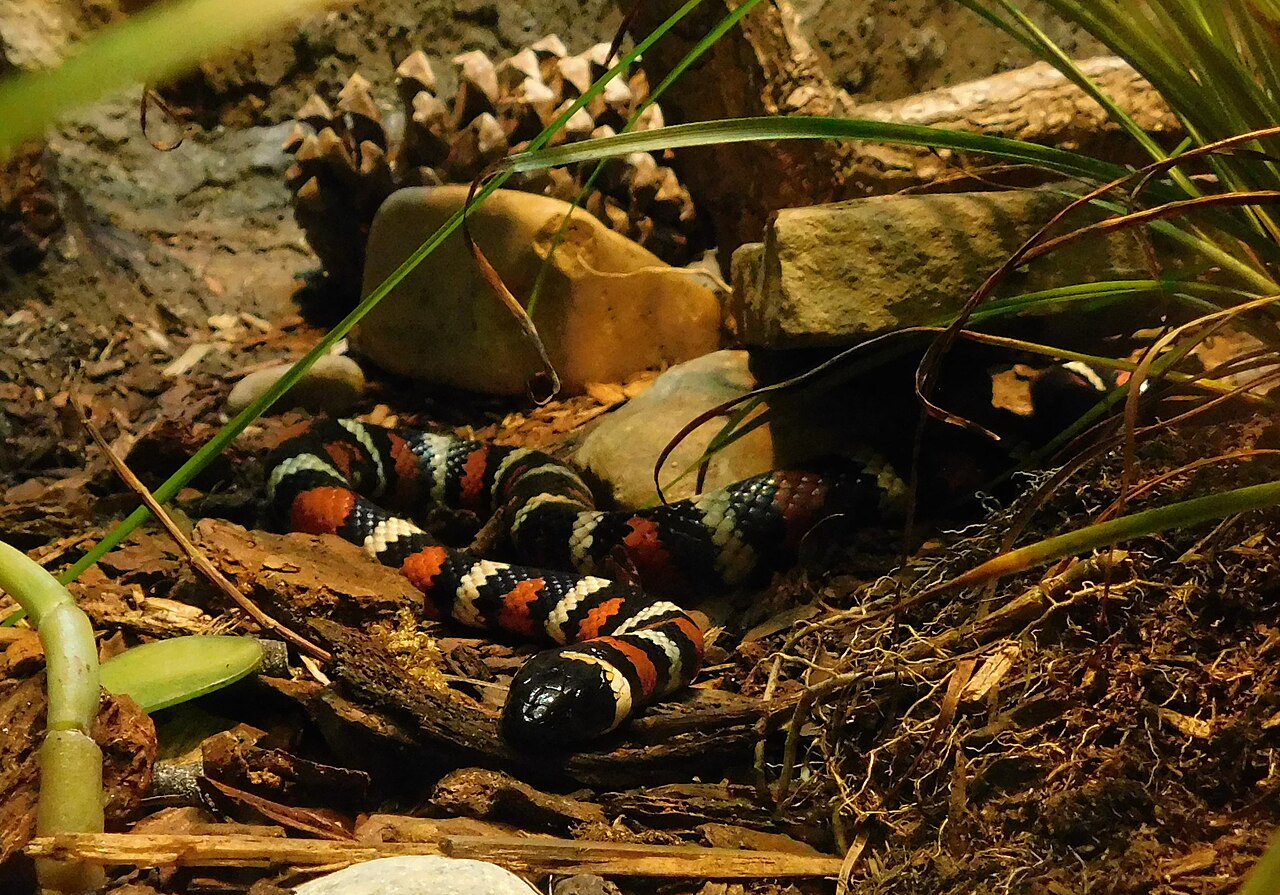
The California mountain kingsnake (Lampropeltis zonata) ranges from Baja California north through the Sierra Nevada and coastal ranges into Washington. No coral snake lives anywhere near it, yet it draws coral snake reports every summer from hikers who recognize the banding and not the geography. Adults run 20 to 40 in (51 to 102 cm).
Its triads are red, black and white with the black bands often widest, and many individuals show heavy black intrusion into the red, giving a darker overall look. The snout is black in some populations, which is the one real trap on this list, so fall back on range and band order: red contacts black, never white. It is harmless, cool adapted and most active in spring near rock outcrops and creek corridors.
Variable Groundsnake: Small, Banded and Everywhere in the Southwest
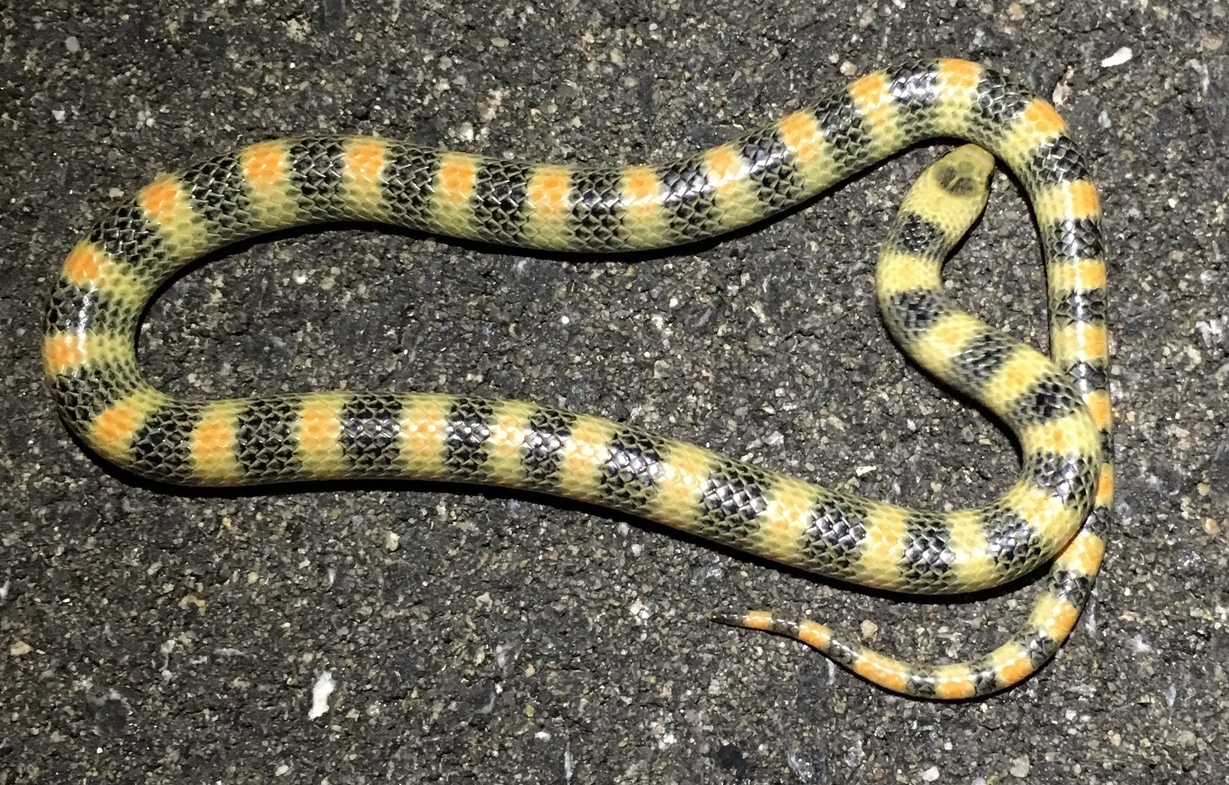
The variable groundsnake (Sonora semiannulata) earns its name honestly. Across Kansas, Texas, New Mexico, Arizona, Nevada and Utah it appears plain gray, striped, or banded in orange and black, and the banded form on orange ground reads as a tiny coral snake to anyone who finds one under a flowerpot. Adults are only 8 to 12 in (20 to 30 cm) and pencil thin.
Its bands stop at the sides and the belly stays unmarked cream. The head is small, flat and the same color as the body, and the snake is far too slender to be mistaken for a coral snake once it is on a flat surface. Groundsnakes eat spiders, centipedes and insect larvae, pose no risk at all, and are among the most frequently photographed snakes of southwestern suburbs.
Arizona Coral Snake: The Second Venomous One
The Arizona coral snake (Micruroides euryxanthus) is the species people forget exists. It occupies central and southern Arizona, extreme southwestern New Mexico and adjacent Mexico, staying mostly below 5,800 ft (1,768 m) in desert grassland, thornscrub and rocky canyon bottoms. Adults are tiny at 11 to 21 in (28 to 53 cm), with glossy rings of red, black and broad yellowish white.
It follows the same rules as its eastern relative: black snout, pale rings contacting red, rings continuing across the belly. Its venom is neurotoxic and no human fatality has ever been recorded from this species, partly because of its small mouth and partly because it would rather flee, cloaca pop and hide its head than bite. Treat any bite as a hospital trip regardless.
How to Tell If It’s a Coral Snake or Not in Three Seconds
Run the checks in this order and the answer arrives before you need the rhyme. First the snout: black means coral snake, red or white means mimic. Second the rings: if the pale color touches red, suspect coral snake. Third the belly, if the snake is already dead or photographed from below, since coral snake rings wrap all the way around while mimic patterns fade or break.
Geography is the fourth filter and cuts out most reports. Outside the southeastern coastal plain and the Arizona desert, a banded tricolor is a kingsnake, milksnake, scarlet snake or groundsnake. Never handle a snake to run these checks; use a phone with zoom. Coral snakes are also easy to confuse with black and white banded species, and the harmless caterpillars that mimic snakes fool people the same way.
What State Has the Most Coral Snakes?
Florida, by a wide margin. The eastern coral snake occurs throughout the entire peninsula and panhandle in sandy pine flatwoods, hammocks, scrub and suburban mulch beds, and Florida reports more coral snake encounters than the rest of the range combined. Georgia, Alabama, Mississippi and southeastern North Carolina hold smaller populations, and Arizona is the center for the separate Arizona coral snake.
Mimic diversity peaks in the same places, which is exactly why the confusion persists. A Florida yard can hold the eastern coral snake, the scarlet kingsnake and the scarlet snake on the same lot, all red, black and pale, all roughly the same length. Learning one feature, the color of the snout, resolves nearly every one of those encounters, and knowing what hunts them, covered in birds that eat snakes, explains why the mimicry evolved in the first place.
Related reading: Snakes That Look Like Copperheads.
Related reading: Snakes That Look Like Rattlesnakes.
Frequently Asked Questions
What snake is mistaken for coral snake?
The scarlet kingsnake most often, followed by the eastern and red milksnakes, the scarlet snake, the Arizona and California mountain kingsnakes and the variable groundsnake. All are harmless. Each has a red or white snout and banding that fades on the belly, while coral snake rings are complete and start behind a solid black nose.
What is the fake coral snake called?
There is no single official name, but scarlet kingsnake is what people usually mean, and false coral snake is the common label applied loosely to any tricolor mimic. In Central and South America the name false coral snake refers to several unrelated genera, so a regional field guide beats the nickname every time.
What looks like a coral snake but is not poisonous?
Scarlet kingsnakes, milksnakes and scarlet snakes in the east, mountain kingsnakes and groundsnakes in the west. None are poisonous or venomous and none pose any danger. Coral snakes themselves are venomous rather than poisonous, since the toxin must be injected by a bite to have any effect at all.
Which is deadlier, a rattlesnake or a coral snake?
Coral snake venom is more toxic by volume, but rattlesnakes cause far more serious injuries and nearly all US snakebite deaths. Rattlesnakes are larger, more defensive, deliver much more venom and produce severe tissue destruction. Coral snake bites are rare, often deliver little venom, and respond well to hospital treatment.
How can I tell the difference between an Az king snake and a coral snake?
The Arizona mountain kingsnake has a white snout, a white collar and red bands bordered by black, and lives in cool pine oak canyons above roughly 3,000 ft (914 m). The Arizona coral snake has a black snout, pale rings touching red, and lives in low desert and grassland. Their habitats barely overlap.
What should I do if a coral snake bites me?
Go to an emergency department immediately even if there is no pain or swelling, since neurotoxic symptoms can appear hours later. Keep still, keep the limb below heart level, remove tight jewelry and call poison control at 1-800-222-1222 on the way. Details on symptoms and treatment appear in our guide to the coral snake bite.