Crab Dream Meaning: Symbols, Scenarios and Luck
Symbolically, a crab in a dream stands for self-protection, firm boundaries, and an indirect way of reaching a goal. The shell guards something soft, the claws hold on, and the sideways walk avoids the straight line. That makes the crab dream meaning less about fate and more about how you are guarding yourself right now.
Context does the rest. Where the crab appears, what it does, and how you feel when you wake all shift the reading. A crab on a beach you love lands differently from one scuttling across your bedroom floor.
In modern dream interpretation, a crab stands for self-protection, boundaries, and an indirect route to a goal. A pinch points to a boundary under strain, a chase to a problem you sidestep, and a hiding crab to withdrawal. A calm encounter is a favorable image of secure boundaries, while fear or pain warns of pressure or withdrawal.
What does a crab mean in a dream?
A crab in a dream points to how you protect yourself and how you move toward what you want. The image works through three parts of the animal. The hard shell is armor around a soft body. The claws grip, defend, and refuse to let go, and the sideways walk of many crabs suggests reaching a goal by a roundabout path.

Each part turns into a question about your waking life. A thick shell asks whether you have closed off to stay safe, or whether you are protecting something that truly needs it. Gripping claws ask what you are holding onto, such as a job, an argument, or a person. The sideways walk asks whether you are dodging a direct conversation or wisely going around an obstacle.
None of this amounts to a personality diagnosis. The dream holds up a picture, and you decide whether it fits. Cats in dreams also change meaning with context, from independence to intuition, depending on what the animal does.
Is a crab dream different from seeing a real crab?
Yes, a real crab sighting is an encounter with an animal, while a crab dream is an image your mind builds. Seeing a crab can carry the same symbolic themes of boundaries and self-protection. On a beach or a dock, the animal responds to its surroundings: an Atlantic ghost crab (Ocypode quadrata) may retreat into its burrow when disturbed.
A dream crab can draw on a recent encounter, a memory, or an imagined scene. Its guarded body and gripping claws point to self-protection, holding on, or an indirect approach. A beach sighting also deserves enough distance for the animal to retreat.
The two can overlap. A crab that pinched your toe on vacation sometimes returns in a dream days later. Then the dream replays the event, and the meaning sits in the leftover tension, not in the crab.
How do the crab’s actions change the dream’s meaning?
The crab’s action names the pressure, and your feeling decides whether that pressure helps or harms. A pinch is the sharpest version. It points to a boundary someone crossed, or to a moment when you gripped too hard and hurt someone else. If you were pinched, ask where you feel nipped at. If you were the crab, ask where you have been defensive.
| Dream scenario | Feeling in the dream | What it points to |
|---|---|---|
| A crab pinches you | Pain or shock | A boundary crossed or a grip held too hard |
| A crab chases you | Fear | A problem you keep stepping away from |
| A crab rests in a sheltered crevice | Calm | Rest and recovery you needed |
| A crab hides under a rock | Anxiety | Avoidance of a hard conversation |
| Many crabs swarm around you | Overwhelm | Small worries piling up at once |
| You catch or hold a crab | Control | Facing a defensive situation head on |
| You find an empty crab shell | Curiosity or loss | A phase you have outgrown |
A chasing crab points to a problem you keep stepping away from. The animal is small, so the fear in the dream is often larger than the issue itself. A hiding crab, tucked under a rock or sheltered in a crevice, points to withdrawal. Calm hiding shows rest you needed, and anxious hiding shows avoidance. Alligators in dreams carry a much heavier sense of threat, so compare how big the danger felt.
Bees in dreams point to defensive boundaries when a sting follows an intrusion, a useful comparison when the crab pinches after you approach. A defensive pinch is a reaction, not an attack. In that case the dream points to your own guarded side, not to an enemy waiting for you.
What do several crabs in one dream mean?
Several crabs point to many small pressures arriving together rather than one big threat. A single crab is a focused issue. A beach crawling with crabs suggests a week of minor demands, each one manageable, all of them tiring at once. If the crabs ignore you, the pressures are background noise. If they close in, the load feels personal.
Ants in dreams create a similar crowd effect, though ants point toward cooperation where crabs point toward defense. The difference matters when you sort out what the swarm stands for in your week.
Use the dream as a prompt to look at your own part. Ask which pressure would shrink the pile if you dealt with it first. Then ask whether you need more protection or fewer walls. A crowd of crabs that scatters when you stand still shows that some worries leave on their own.
Are crabs lucky?
A crab can be a favorable dream symbol when it feels calm or protective; a painful pinch or frightening chase shifts the meaning toward a warning about strained boundaries. Catching a crab comfortably points to handling a difficult situation, while being overwhelmed by crabs points to mounting pressure.
In the Roman mythographer Pseudo-Hyginus’s Astronomica 2.23, a crab bites Hercules during his fight with the Hydra. Hercules kills it, and Juno places it among the stars as Cancer. This constellation story gives the crab a specific association with divine favor after conflict. A dream echoing that story points to recognition after a struggle.
Black cats in dreams raise the same luck question, and their reading also turns on context rather than omen. With both animals, the useful question is what the dream shows about you, not what it predicts about next week.
What does the Bible say about crabs?
The Bible addresses crabs only indirectly, through the dietary law for water animals. Leviticus 11:9 to 12 allows anything in the waters that has fins and scales and calls the rest an abomination. Deuteronomy 14:9 to 10 repeats the rule in shorter form. Crabs have neither fins nor scales, so the law places them among the forbidden water creatures.
Neither passage names the crab. The texts define a category, and crabs fall into it by their body plan. No verse gives the crab a dream meaning, so a biblical crab dream reading is a modern application, not a statement of Scripture.
If a crab dream unsettles you for reasons of faith, read the two passages yourself. They concern food and the line between clean and unclean animals. They say nothing about dreams, omens, or luck.
What do crabs eat, and what are they afraid of?
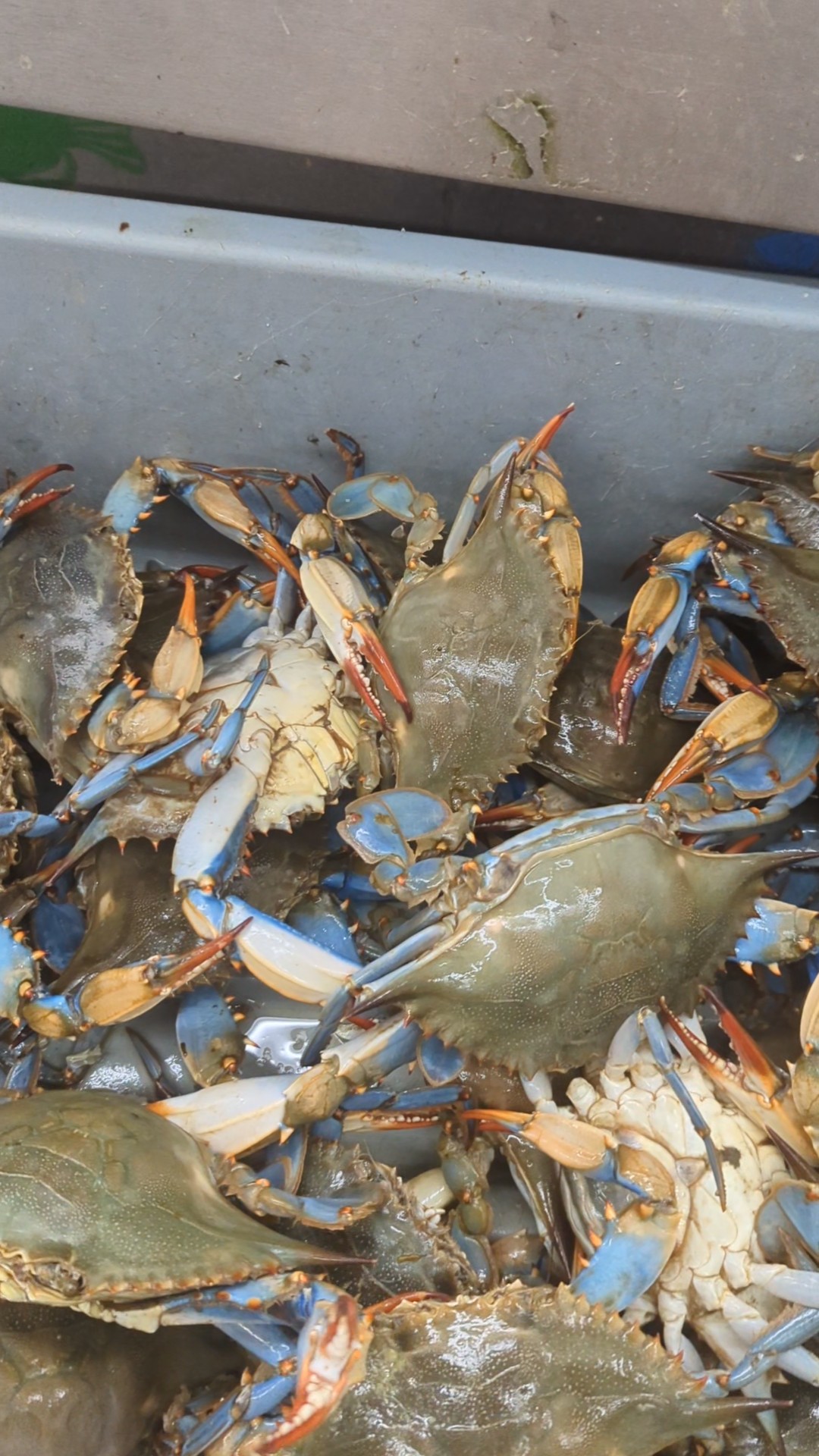
Crabs eat different foods according to species and respond to threats by fleeing, hiding, or defending themselves; no single favorite food fits them all. The blue crab (Callinectes sapidus) of the Atlantic and Gulf coasts eats clams, snails, small fish, plant material, dead animals, and smaller crabs. Fiddler crabs sift tiny food particles from mud and sand. Ghost crabs hunt and scavenge along the beach at night.
Predators, approaching animals, and sudden disturbance can trigger escape or defense. Depending on species and surroundings, a crab may flee, burrow, retreat into a crevice, or raise its claws. These observable reactions help explain what threatens a crab without assigning it a particular human emotion.
Molting adds risk. After a crab sheds its old shell, the new one stays soft for a while, and the animal hides more until it hardens.
What is a crab’s natural enemy?
A crab has no single natural enemy, because predators change with the species, the habitat, and the crab’s life stage. Crab larvae drift in open water, where fish and other plankton feeders eat great numbers of them. Young crabs shelter in seagrass and marsh edges, where fish, wading birds, and larger crabs hunt them.
Adult blue crabs are eaten by predators including red drum (Sciaenops ocellatus), striped bass (Morone saxatilis), and sea turtles, and people harvest them. Blue crabs also eat each other, and cannibalism claims many juveniles. On open beaches, ghost crabs fall prey to gulls and raccoons.
Habitat shapes the list as much as species does. A crab in a tide pool meets shorebirds and octopuses, while a crab in a salt marsh meets herons and fish that move in with the tide. The shell, the claws, and the quick retreat are all answers to this pressure, and the same traits give the crab its meaning as a dream image.
Are crabs killed before cooking, and what about welfare?
Some crabs are killed or stunned before cooking and others are cooked alive, and no single rule applies worldwide. Practice depends on the kitchen, the species, and the local law. Crabs, crayfish, and lobsters are separate animals, so advice for one group does not carry over to the others without care. If welfare matters to you, ask a seafood seller how the animals are handled before you buy.
Stunning and killing are different steps. Effective stunning renders an animal unconscious, while killing ends its life. Electrical stunning equipment requires settings suited to the species and size. The LSE review of crustacean sentience and welfare warns that chilling may immobilize crustaceans without making them unconscious and recommends against boiling them alive without effective prior stunning.
The law depends on the jurisdiction. The United Kingdom’s Animal Welfare (Sentience) Act 2022 includes decapod crustaceans, such as crabs and lobsters, within its recognition of animal sentience. It establishes scrutiny of UK government policy through the Animal Sentience Committee; this recognition alone does not impose a kitchen slaughter method.
Frequently Asked Questions
What is the spiritual meaning of crabs?
The crab stands for protection and renewal. Its shell guards a soft body, and every molt shows the animal leaving old armor behind in order to grow. Seen this way, a crab invites two checks. Ask what you are guarding, and ask which armor you have outgrown and could finally shed.
What foods attract money?
Food guarantees money or financial success. Eating crab or any other dish has no proven effect on income or wealth. A food tied to good fortune belongs to a specific custom, and that custom needs a named origin before it deserves attention. Treat financial promises attached to a meal as wishes, not as advice.
Does a crab dream automatically refer to the Cancer zodiac sign?
No, a crab dream does not require an astrological reading. In English, Cancer is also the name of the zodiac sign drawn as a crab, which invites the link. If astrology plays no part in your life, the dream concerns the animal, its shell, and its claws, not your birth chart.
Does an empty shell in a dream necessarily represent a crab?
No, an empty shell alone does not identify a crab. A crab carapace, a clam or mussel shell, and a snail shell are separate dream images. A crab shell left after molting points to growth you have completed, while a seashell on the sand belongs to a different animal and carries its own meaning.
Is dreaming of eating crab a good sign?
Often yes, because eating crab in a dream shows you getting past a hard shell to reach what you want. Cracking the shell takes effort, so the dream points to work that pays off. If the meal felt wrong or made you sick, it points to something you took on that does not agree with you.
What does a red crab mean in a dream?
A red crab points to strong emotion, such as anger, urgency, or passion, added to the defensive mood the crab already carries. Red is also the color of a cooked crab, so a red crab on a plate points to a situation that is finished. A pale crab points to vulnerability, like a freshly molted shell.
Sources
- Bible Gateway, Leviticus 11:9 to 12 (KJV)
- Bible Gateway, Deuteronomy 14:9 to 10 (KJV)
- legislation.gov.uk, Animal Welfare (Sentience) Act 2022