Peacock Feathers: Science & Symbolism Explained
Peacock feathers are famous for two entirely different reasons: the genuine physics behind their shifting, iridescent color, and the centuries of symbolic meaning cultures around the world have attached to them, from divine protection in Hinduism to warnings against vanity in medieval Christianity. This guide covers both sides, how the feathers actually produce their color, why only males grow the elaborate train, and what peacock feathers have symbolized across different traditions.
| Aspect | Detail |
|---|---|
| Color source | Structural coloration (nanostructure), not pigment |
| Who grows the train | Only males (peacocks); females (peahens) do not |
| Time to grow full train | About 3 years |
| Common Eastern symbolism | Protection, wealth, divine beauty (Hinduism, Buddhism) |
| Common Western symbolism | Pride, vanity, but also immortality and rebirth |
Why Are Peacock Feathers So Colorful?
Peacock feathers achieve their brilliant, shifting blues, greens, and golds through structural coloration rather than pigment, meaning the color comes from how the feather’s physical nanostructure interacts with light rather than from colored dyes within the material itself. According to research published in PNAS, the cortex of each colored barbule contains a two-dimensional photonic-crystal structure made of melanin rodlets arranged in a precise lattice, and simply varying the spacing of that lattice produces the entire range of colors seen across a single feather. This is why a peacock feather actually looks brown or dull when wet or soaked in glycerin, since submerging the structure disrupts the precise nanoscale spacing responsible for the color, confirming that pigmentation plays only a background role beneath the true structural mechanism.
The Science of Iridescence
Iridescence, the shifting of color depending on viewing angle, happens because light waves reflecting off the layered nanostructure interfere with each other constructively or destructively depending on the angle of light and the observer, a phenomenon governed by the same physics as Bragg’s law used to describe crystal diffraction. Structures on the order of 200 to 250 nanometers, roughly half the size of the structures in a Blu-ray disc, are specifically responsible for producing the iridescent blues and violets visible in peacock plumage. Princeton researchers studying bird feathers more broadly found that a specific evolutionary tweak to this underlying nanostructure has more than doubled the range of iridescent colors birds are capable of displaying, helping explain how such a complex and precise color-generating mechanism could have evolved into the spectacular displays seen in peacocks and other iridescent bird species today.
Why Only Male Peacocks Have Colorful Feathers
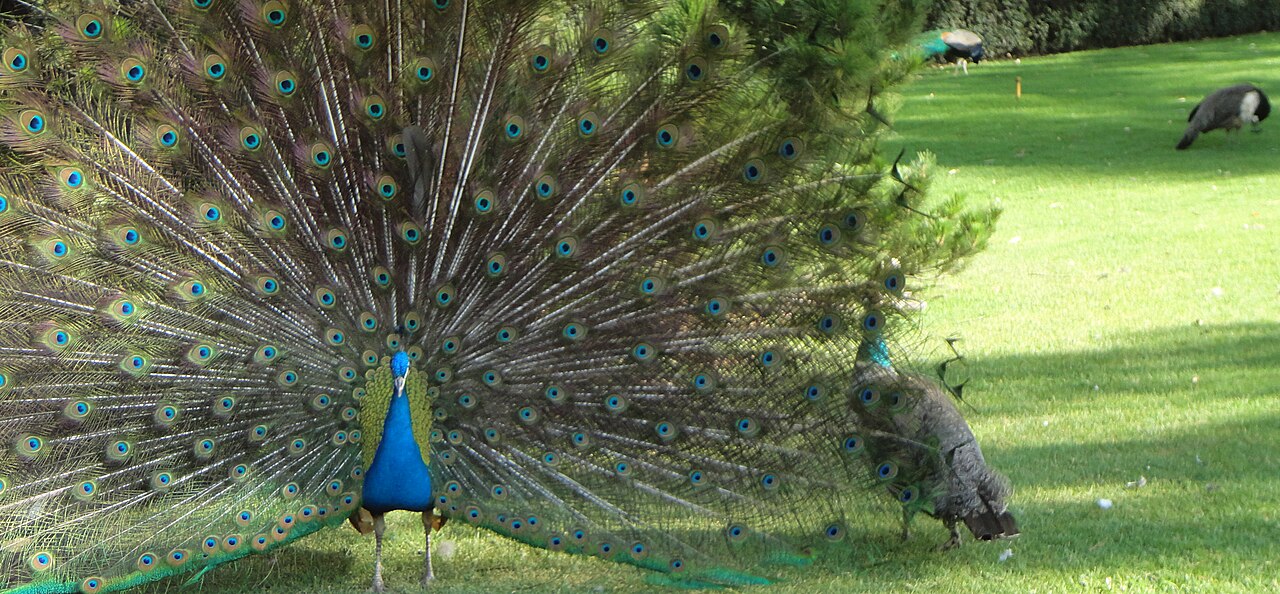
Technically, the word “peacock” refers only to the male of the species; females are called peahens, and the general species term is peafowl. Only males grow the elaborate, eye-patterned train feathers used in courtship display, while peahens have a far more muted, brownish coloration suited to camouflage while nesting and caring for chicks. This pronounced sexual dimorphism exists because the male’s plumage functions specifically as a costly courtship signal, a visual demonstration of health and genetic quality to prospective mates, while the female’s understated coloration prioritizes concealment and safety during the vulnerable incubation period instead.
How Long Does It Take a Peacock to Grow Its Train?
A male peacock takes approximately three years to develop its full, mature train, and each year after the breeding season concludes, typically around July or August, the peacock sheds all of its ornamental feathers entirely. The bird then regenerates an even more elaborate set before the following breeding season, a cycle of loss and regrowth that has fed directly into much of the feather’s rebirth and renewal symbolism across cultures, since the physical process of shedding and regenerating a spectacular new train each year mirrors those exact themes of transformation observed in nature.
Peacock Feather Symbolism in Hinduism and Buddhism
In Hinduism, peacock feathers carry deep sacred significance, closely associated with the god Krishna, who is frequently depicted wearing a peacock feather in his crown, and with Kartikeya, who rides a peacock as his divine vehicle symbolizing the triumph of higher knowledge over ego. The feathers are widely believed to bring wealth, luck, and protection, and historically adorned the thrones and garments of Indian royalty as visible symbols of prosperity and elevated status, most famously embodied in the legendary Peacock Throne. In Buddhist tradition, the peacock is associated with purity, and its many-eyed tail is interpreted as a symbol of vigilant, all-seeing spiritual awareness.
Peacock Feather Symbolism in Western Culture
Western interpretations of the peacock feather have historically been more divided. Medieval Christian moral teaching frequently linked the bird’s extravagant, ostentatious display to the sin of pride, a connection reinforced by period artwork depicting the devil in robes trimmed with peacock feathers as a visual shorthand for vanity and earthly excess. At the same time, other Western traditions embraced more positive associations: peacock feathers have also long represented royalty, immortality, and rebirth in European heraldry and decorative art, showing that even within a single broad cultural tradition, the same natural symbol could carry sharply contrasting meanings depending on the specific context and era.
Do Peahens Ever Grow Colorful Feathers?
Almost never, though rare exceptions do occur. In extremely uncommon cases, an aging or hormonally atypical peahen can develop some male-pattern plumage later in life, a phenomenon documented in various pheasant-family birds generally, including some captive-bred variants of related pheasant-family species. These cases remain genuine rarities rather than a normal part of peahen development, and the vast majority of female peafowl retain their muted brown camouflage coloration throughout their entire lives, reinforcing just how strongly this trait is tied to male reproductive display rather than any inherent species-wide capacity for iridescent color.
Are Peacock Feathers Bad Luck?
The belief that peacock feathers bring bad luck or invite misfortune into a home is a persistent but geographically specific superstition, rooted primarily in Western folklore, particularly a medieval European association between the bird and the devil. This superstition contrasts sharply with most Eastern traditions, where India, China, and Persia have long regarded peacock feathers as highly auspicious and protective rather than something to fear or avoid. A commonly cited variant of the Western superstition connects the “eye” pattern on each feather to the evil eye, interpreting the eyes as inviting misfortune rather than offering the protection those same eye-like markings represent in most other cultural traditions.
Peacocks in Mythology Beyond India
Beyond Hindu and Buddhist traditions, peacocks and their feathers appear across a surprising range of mythological systems. In Greek mythology, the peacock is associated with the goddess Hera, who is said to have placed the many eyes of the slain giant Argus onto the peacock’s tail as a memorial, directly explaining the bird’s distinctive eye-pattern in that particular cultural tradition. This kind of origin myth, explaining a natural feature through a dramatic supernatural backstory, is a common pattern across mythologies worldwide, and this vivid story reflects just how visually striking and attention-demanding the peacock’s plumage has been to human observers across a genuinely wide range of otherwise unconnected cultures and eras.
Peacock Feather Meaning Today
In contemporary spiritual and decorative use, peacock feathers are frequently incorporated into home altars, meditation practices, and smudging rituals, generally intended to invite protection, beauty, and confidence rather than any of the negative Western folklore associations. The single “eye” marking on each feather is commonly interpreted today as a symbol of intuition, vision, and the metaphorical “third eye,” an idea echoed across multiple traditions regardless of whether the broader cultural stance toward the bird itself skews positive or superstitious. For many people encountering a naturally shed feather, the modern interpretation leans toward self-expression and authenticity: a reminder to display one’s genuine gifts and personality with the same unapologetic confidence a peacock shows in its own elaborate display, a symbolic parallel worth considering alongside the equally striking plumage of a golden pheasant or the folklore surrounding a cardinal sighting.
Related reading: Albino Peacock.
Related reading: Emu vs Ostrich.
Related reading: Female Peacock.
Related reading: Baby Peacock.
Frequently Asked Questions
Why are peacock feathers so colorful?
Peacock feathers get their brilliant color from structural coloration, a nanoscale photonic-crystal pattern in the feather that interacts with light, rather than from pigment. This is why the feather looks brown when wet, since water disrupts the structure.
Why do only male peacocks have colorful feathers?
Only males, technically called peacocks, grow the elaborate iridescent train used in courtship display to attract females (peahens), whose muted brown coloration instead prioritizes camouflage while nesting.
How long does it take a peacock to grow its full tail?
A male peacock takes about three years to develop its full mature train. Each year after breeding season, the peacock sheds all its ornamental feathers and regenerates an even more elaborate set before the next season.
What do peacock feathers symbolize?
Symbolism varies widely by culture. In Hinduism and Buddhism, they represent protection, wealth, purity, and divine beauty. In Western tradition, they have represented both pride and vanity, and separately, immortality and rebirth.
Are peacock feathers considered bad luck?
This is primarily a Western superstition tied to medieval associations between peacocks and the devil. Most Eastern traditions, including India, China, and Persia, consider peacock feathers highly auspicious and protective instead.
What does the eye pattern on a peacock feather mean?
The eye-like marking is commonly interpreted as a symbol of vigilance, intuition, and spiritual vision, sometimes linked to the concept of a metaphorical third eye across several cultural and spiritual traditions.
Why do peacocks lose their tail feathers every year?
Male peacocks molt their entire ornamental train after each breeding season, typically in July or August, then regrow an even more elaborate set before the next season, a natural cycle tied to their annual breeding cycle.
Whether approached as a subject of genuine physics research or centuries of cultural symbolism, the peacock feather remains a rare case where the scientific explanation is nearly as remarkable as the folklore built up around it.
Comparing the peacock’s elaborate, seasonally molted display against the more subtle year-round plumage of birds like owls highlights just how differently evolution has solved the same basic challenge of visual signaling across the avian world, whether through elaborate seasonal display or, as with hawks, through more subtle year-round cues layered with rich cultural symbolism of their own.
Anyone genuinely fascinated by the interplay of biology and cultural meaning in the natural world will find the peacock an unusually rich case study, since so few natural phenomena manage to be simultaneously this well understood scientifically and this deeply layered with centuries of accumulated human symbolism.
The next time an iridescent feather catches the light, it is worth appreciating both halves of the story at once: precise nanoscale physics and centuries of layered human meaning, woven together in a single, genuinely remarkable natural object, not unlike the layered folklore and biology surrounding hawks in a completely different cultural context.