Hercules Beetle: Size, Strength, Life Cycle, and Care
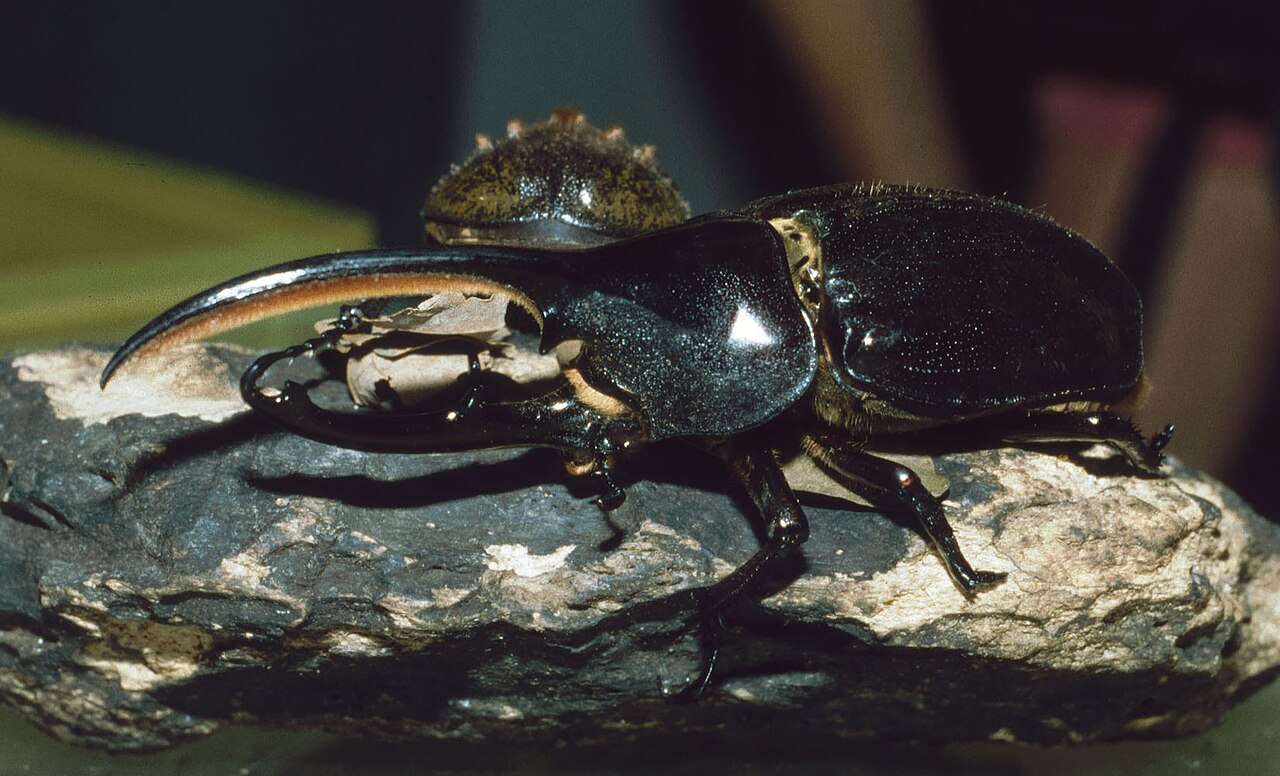
The Hercules beetle (Dynastes hercules) is the longest beetle in the world, with exceptional males reaching about 7 in from the tip of the thoracic horn to the end of the abdomen. Roughly half that length is horn. It lives in the rainforests of Central and South America and the Lesser Antilles, and despite its size and armor it is entirely harmless, feeding on rotting fruit and tree sap.
North America has its own version. The eastern Hercules beetle (Dynastes tityus) ranges across the southeastern United States, reaches about 2.5 in, and turns up regularly at porch lights in summer, which is why so many people meet one without ever visiting a rainforest. This guide covers both species, the truth behind the famous strength claim, how to tell males from females, the long larval stage, what they eat, and what keeping one actually involves.
| Quick Facts | Hercules Beetle |
|---|---|
| Scientific name | Dynastes hercules |
| Max length | About 7 in including horn, world record for beetle length |
| Range | Central and South America, Lesser Antilles |
| US relative | Eastern Hercules beetle (Dynastes tityus), about 2.5 in |
| Larval stage | 1 to 2 years, grubs up to 4.5 in |
| Adult lifespan | 3 to 6 months |
What Is a Hercules Beetle?
The Hercules beetle belongs to the rhinoceros beetle subfamily Dynastinae within the scarab family, a group defined by the horns males carry on the head and thorax. Dynastes hercules is the largest member and the longest beetle described, though the title of heaviest goes to the Goliath beetle and the longest excluding horns to the titan beetle.
The body is built in two visually distinct halves. The head and thorax are glossy black and carry the horns, while the elytra covering the wings are olive green to yellowish with scattered black spots, a color combination that makes a large male look almost artificial. Females are entirely black and finely textured, with no horns at all.
Those elytra do something unusual. In low humidity they appear olive or yellowish, but as moisture rises they darken toward black, because the color comes from a spongy layer beneath the surface that changes optical properties as it absorbs water. It is one of the more striking examples of humidity-responsive structural color in insects.
How Strong Is a Hercules Beetle Really?
The widely repeated claim is that Hercules beetles can lift 850 times their own body weight. That figure is not supported by controlled measurement, and it appears to have propagated through popular articles rather than through any published study. Treated as a fact it is misleading.
What research actually shows is still impressive. Studies of rhinoceros beetles have measured sustained carrying of roughly 30 to 100 times body weight, with the higher end coming from short bursts rather than steady loads. For an insect that weighs a fraction of an ounce, dragging a load a hundred times its own mass is a genuinely extraordinary feat of biomechanics.
The physics behind it is a matter of scale rather than muscle quality. Muscle force scales with cross-sectional area, which grows as the square of body length, while body weight grows as the cube. Small animals therefore have far more force available relative to their mass, which is why no beetle-sized strength translates to anything a large animal could match. The horns themselves are used in wrestling matches between males over females and feeding sites, where a male levers a rival off a branch rather than lifting weight for its own sake.
The Eastern Hercules Beetle
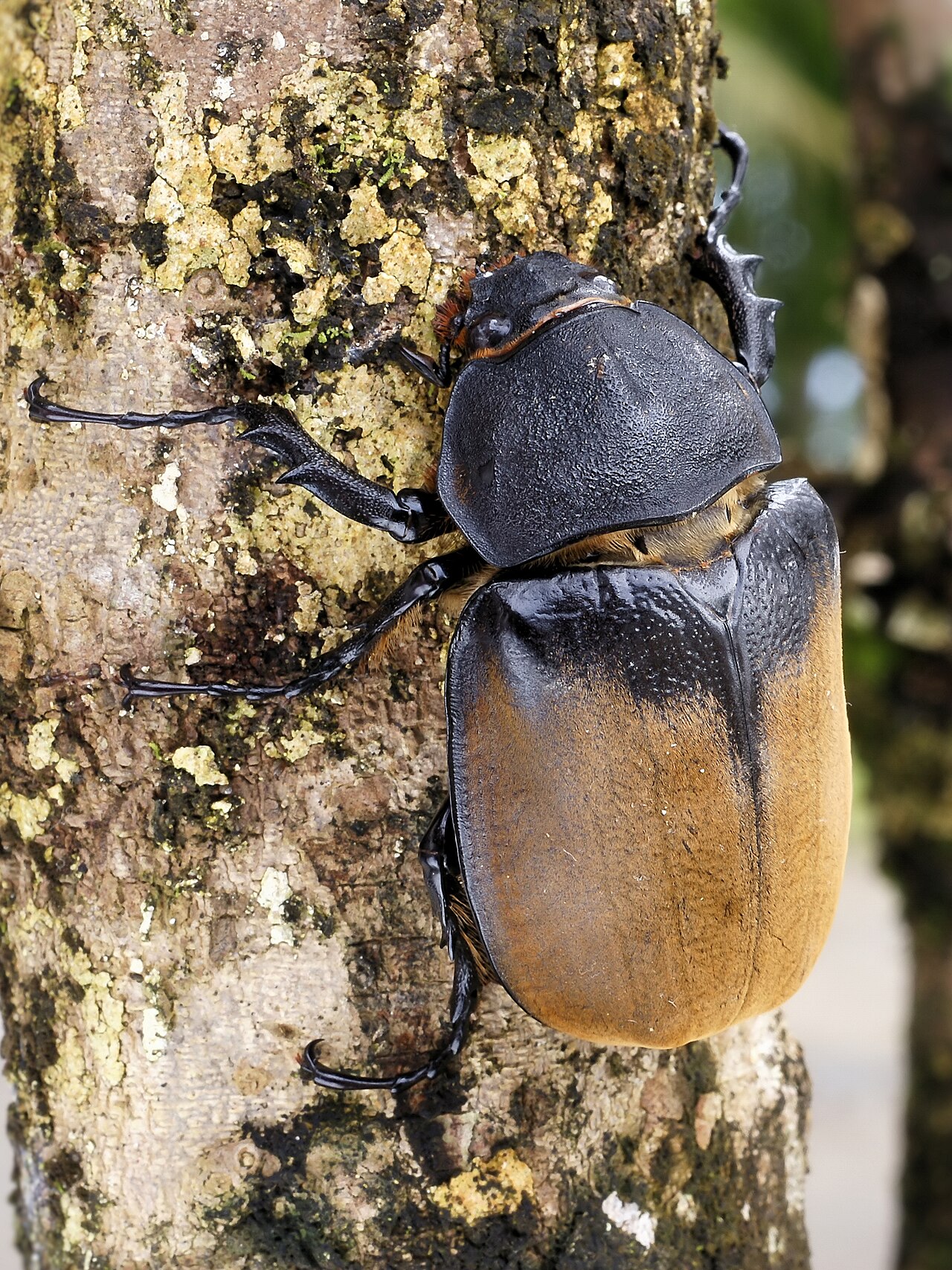
Dynastes tityus is the species most Americans actually encounter, ranging from New York and the Ohio Valley south through Florida and west to Texas. Males reach about 2 to 2.5 in and carry the same paired horn arrangement in miniature, while the elytra are gray to greenish with black mottling.
Its habits mirror the tropical species. Larvae develop in rotting hardwood, particularly ash, oak, and other decaying logs and stumps, and the adults emerge in summer and are strongly attracted to lights. That combination is why porch light sightings drive so much of the interest in this species, and why they turn up on doorsteps in July.
They are completely harmless. Eastern Hercules beetles do not bite, sting, or damage living trees, and their larvae accelerate the breakdown of dead wood, which makes them useful decomposers. Wood-boring insects that do attack live trees are an entirely different group, and the confusion sometimes leads people to kill a beneficial species. Other large, alarming-looking insects get the same treatment, including the one covered in our guide to the potato bug. Other large beetles that cause the same alarm are covered in our guide to the black beetle.
Male vs Female Hercules Beetles
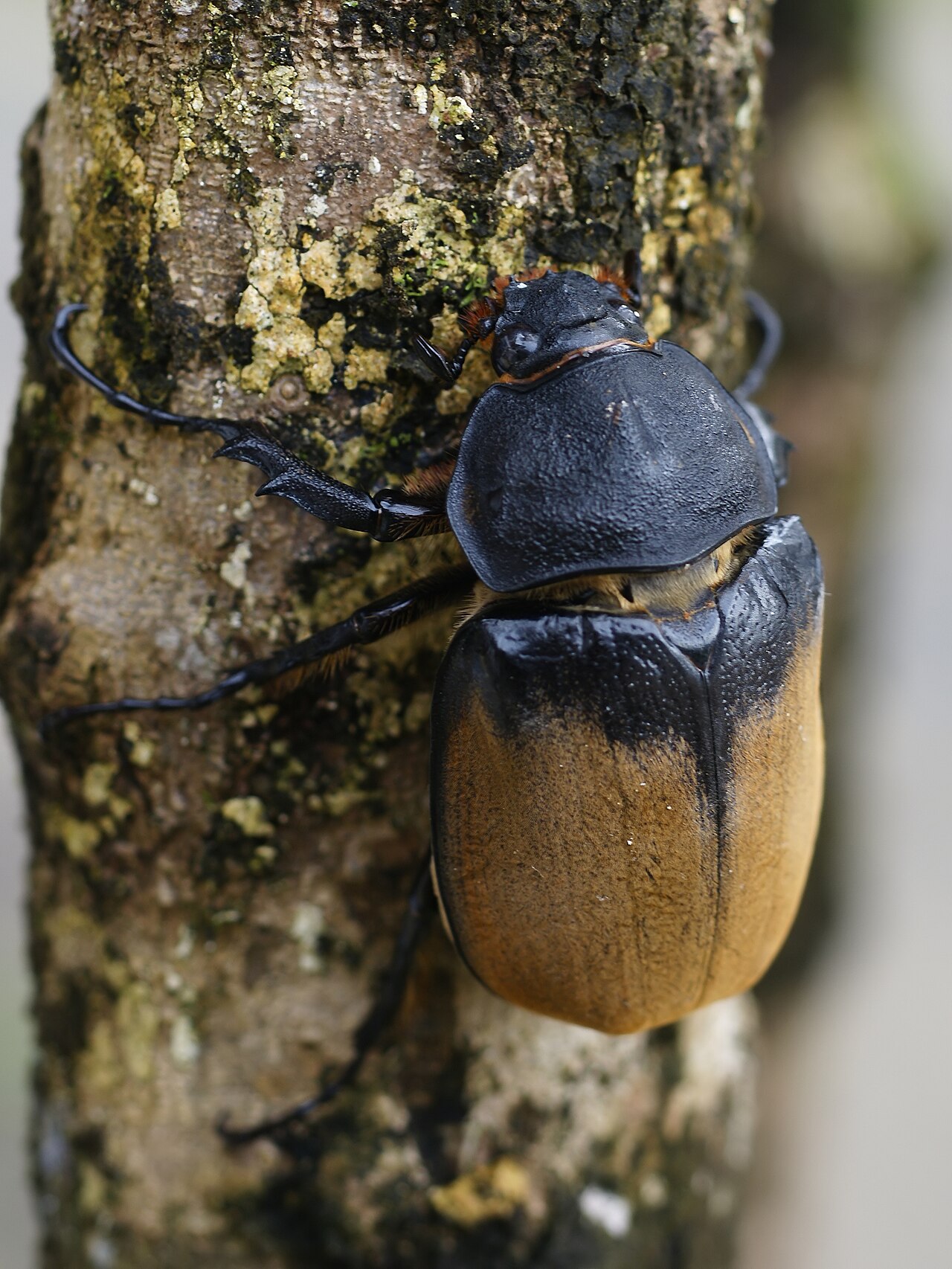
Only males have horns, and the difference is dramatic. A male carries a long upper horn projecting forward from the thorax and a shorter lower horn from the head, which together form a pincer he can close on a rival. Females have no horns whatsoever and a rounded, unadorned head.
Body texture separates them too. Female elytra are matte black and finely granulated, sometimes described as velvety, while male elytra are smooth and glossy with the characteristic olive coloring. Females are also shorter overall, though their bodies can be comparably bulky once you subtract the horn from the male’s measurement. Sexing beetles by color and marking alone is unreliable across the whole family, as our guide to the yellow ladybug shows for a much smaller relative.
Horn size varies enormously among males, and the reason is developmental rather than genetic. Larvae that grow large on good food produce adults with disproportionately long horns, while those that develop under poor conditions produce small-horned males that adopt different mating tactics, sneaking access to females rather than fighting for it. Horn length is therefore a fairly honest signal of larval nutrition.
Life Cycle: From Grub to Giant
Most of a Hercules beetle’s life happens underground and out of sight. Females lay eggs in decaying wood or rich rotting organic matter, and the larvae hatch and feed on that material for one to two years, passing through three instars. The final instar grub is enormous, reaching 4.5 in long and weighing more than 3 oz, larger than most of the adult beetles people are familiar with.
Pupation follows a period in which the larva constructs a chamber from compacted substrate and its own secretions. Inside that cell the insect restructures completely over several weeks to a few months, and the adult horn develops during this stage. A newly formed adult often remains in the chamber for weeks before emerging, hardening its cuticle.
The adult stage is brief by comparison, typically three to six months. Adults do not grow, so a small beetle never becomes a large one, and the size an individual reaches is set entirely by how well it fed as a larva. That inverted life history, years underground and months above it, is shared with many large scarabs and with the caterpillars covered in our guide to the fuzzy caterpillar.
What Do Hercules Beetles Eat?
Larvae eat decaying wood. They tunnel through rotting logs, stumps, and leaf-rich soil, consuming the softened lignin and cellulose along with the fungi growing in it, and the fungal component appears to matter for their nutrition. This is why captive larvae are raised on fermented hardwood flake soil rather than fresh sawdust.
Adults switch to sugar. They feed on rotting fruit, tree sap, and decaying plant matter, using brush-like mouthparts adapted for lapping liquid rather than chewing. In captivity they take banana, apple, and commercial beetle jelly, and an adult eats surprisingly little relative to its size.
Neither stage causes economic damage. Adults do not bore into living trees, larvae only consume wood that is already dead and decomposing, and the family as a whole functions as a decomposer that speeds nutrient cycling in forests. The one exception among relatives is the coconut rhinoceros beetle in the Pacific, which does attack live palms and is a serious agricultural pest, but Dynastes species do not behave that way.
Where Hercules Beetles Live
Dynastes hercules occupies humid lowland and montane rainforest from southern Mexico through Central America into Bolivia and Brazil, with several recognized subspecies across that range and on Caribbean islands including Guadeloupe and Dominica. Subspecies differ in size, horn shape, and elytra color, and hercules hercules from the Lesser Antilles produces the largest recorded specimens.
Habitat requirements are specific despite the wide range. The beetles need mature forest with substantial deadwood, since larvae depend on large decaying logs that take decades to form. Logging and forest fragmentation therefore reduce populations even where adults can still fly through the remaining trees.
The eastern Hercules beetle occupies the same ecological role in North American hardwood forest and is far more tolerant of disturbed habitat, turning up in suburban neighborhoods with mature trees. Both species are nocturnal, spending the day beneath leaf litter or bark and becoming active after dark, which is when the light attraction that brings them to porches kicks in.
Keeping a Hercules Beetle as a Pet
Beetle keeping is a large hobby in Japan and increasingly elsewhere, and Hercules beetles are among the most prized species. Larvae are raised in deep containers of fermented hardwood flake soil at roughly 68 to 77 F, with the substrate replaced periodically as they consume it. A larva may need a container of several gallons by its final instar.
The commitment is the main thing to understand before starting. One to two years of larval care produces an adult that lives three to six months, and disturbing a pupal chamber at the wrong moment kills the insect or produces a deformed adult. Patience is not optional in this hobby.
Legality is the other constraint, and in the United States it is decisive. Importing live exotic beetles requires USDA APHIS permits, and Dynastes hercules is generally not permitted for private import because of plant pest risk, which makes most domestic sales of live specimens legally questionable. The native eastern Hercules beetle can usually be collected and kept legally, subject to state rules, and it is the sensible starting point for anyone in North America who wants the experience. Other invertebrates commonly kept in the same way are covered in our guide to the jumping spider and its enclosure setup.
Frequently Asked Questions
How big do Hercules beetles get?
Exceptional males of Dynastes hercules reach about 7 in including the horn, making it the longest beetle in the world, though roughly half that length is horn. The eastern Hercules beetle of the United States reaches about 2 to 2.5 in. Females of both species are shorter and hornless.
Can a Hercules beetle lift 850 times its weight?
No, that figure is not supported by controlled measurement and appears to have spread through popular articles rather than research. Measured performance in rhinoceros beetles runs roughly 30 to 100 times body weight, which is still extraordinary and reflects how muscle force scales relative to mass in small animals.
Are Hercules beetles dangerous?
No. They do not bite, sting, or carry venom, and the horns are used in wrestling matches between males rather than for defense against large animals. A large male can grip a finger firmly enough to be startling, but it causes no injury.
What do Hercules beetles eat?
Larvae eat decaying wood and the fungi growing in it, tunneling through rotting logs and stumps for one to two years. Adults feed on rotting fruit and tree sap using brush-like mouthparts, and in captivity they take banana, apple, and beetle jelly. Neither stage damages living trees.
How long do Hercules beetles live?
One to two years as a larva, several weeks to a few months as a pupa, and three to six months as an adult. Adults do not grow after emerging, so final size is determined entirely by how well the larva fed.
How do you tell a male from a female Hercules beetle?
Only males have horns, with a long thoracic horn and a shorter head horn forming a pincer. Females are entirely black with matte, finely granulated elytra and a rounded hornless head. Male horn length varies with larval nutrition, so small-horned males are common.
Can you keep a Hercules beetle as a pet in the US?
Importing live Dynastes hercules requires USDA APHIS permits that are generally not granted for private keeping, which makes most domestic sales legally questionable. The native eastern Hercules beetle can usually be kept legally subject to state rules and is the practical choice for North American keepers.