Cricket vs Grasshopper: Every Reliable Difference
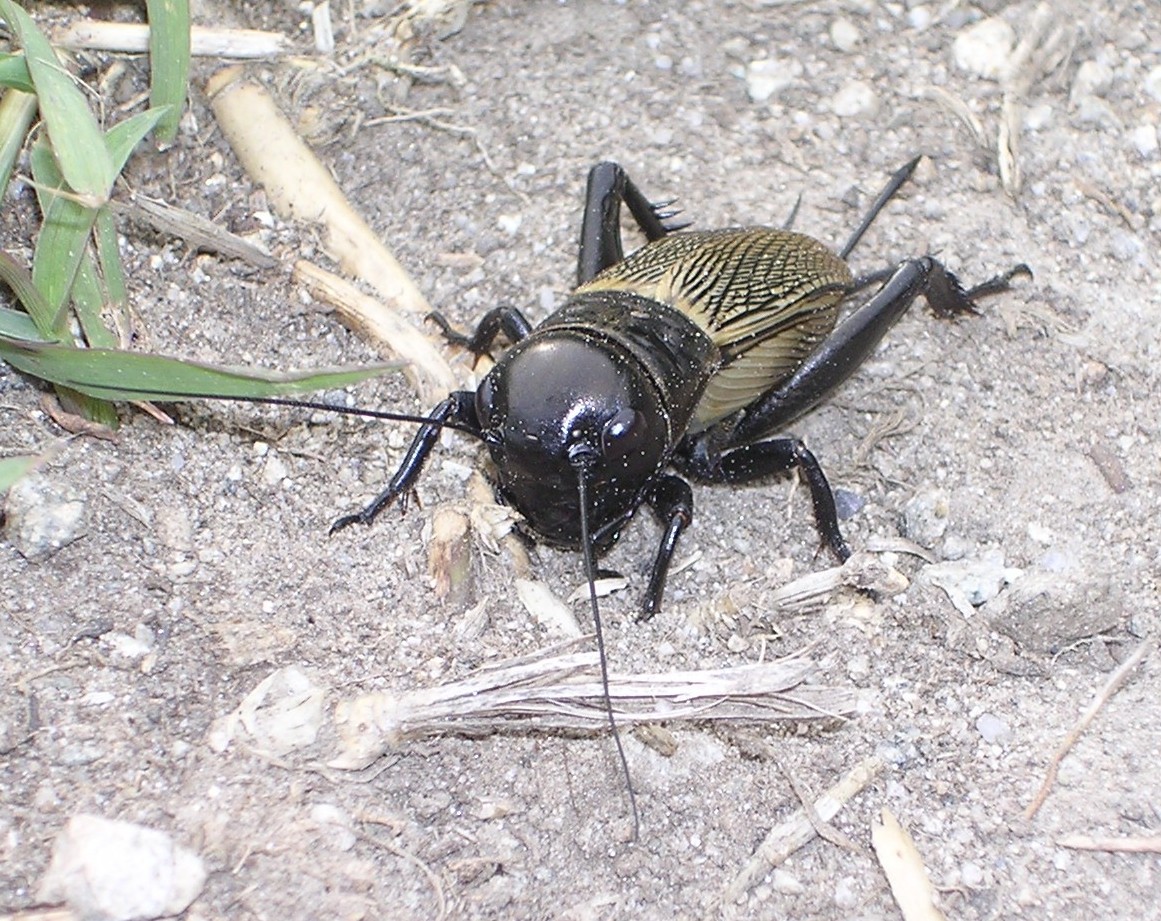
The quickest way to separate a cricket from a grasshopper is to look at the antennae. Crickets have long thread-like antennae that are usually as long as the body or longer, while grasshoppers have short stubby antennae rarely reaching a third of the body length. That single feature settles nearly every case.
The rest follows from their different lives. Grasshoppers are day-active plant eaters that sing by rubbing a leg against a wing, and crickets are night-active omnivores that sing by rubbing their wings together. This guide covers every reliable difference, how katydids and locusts fit in, what each one eats, whether they bite, and what their presence means in a garden or a house.
| Feature | Cricket | Grasshopper |
|---|---|---|
| Antennae | Long, often longer than the body | Short, under a third of body length |
| Active | Night | Day |
| Sound made by | Rubbing wing against wing | Rubbing hind leg against wing |
| Ears located | On the front legs | On the abdomen |
| Diet | Omnivore, plants plus animal matter | Herbivore, almost entirely plants |
| Body | Flattened, rounded, often dark | Cylindrical, elongated, often green or brown |
Cricket vs Grasshopper: The Fast Answer
Antennae first, because it works at a glance and needs no equipment. Cricket antennae are fine, thread-like, and long, frequently exceeding the length of the entire body and waving constantly as the insect explores. Grasshopper antennae are short, thick, and stubby, and they look almost vestigial by comparison.
Then consider when and where you found it. Grasshoppers are diurnal and are seen jumping through grass and vegetation in daylight, while crickets are nocturnal and hide under stones, logs, and debris during the day, emerging after dark. A singing insect at midnight is a cricket, and one leaping ahead of you across a sunny meadow is a grasshopper.
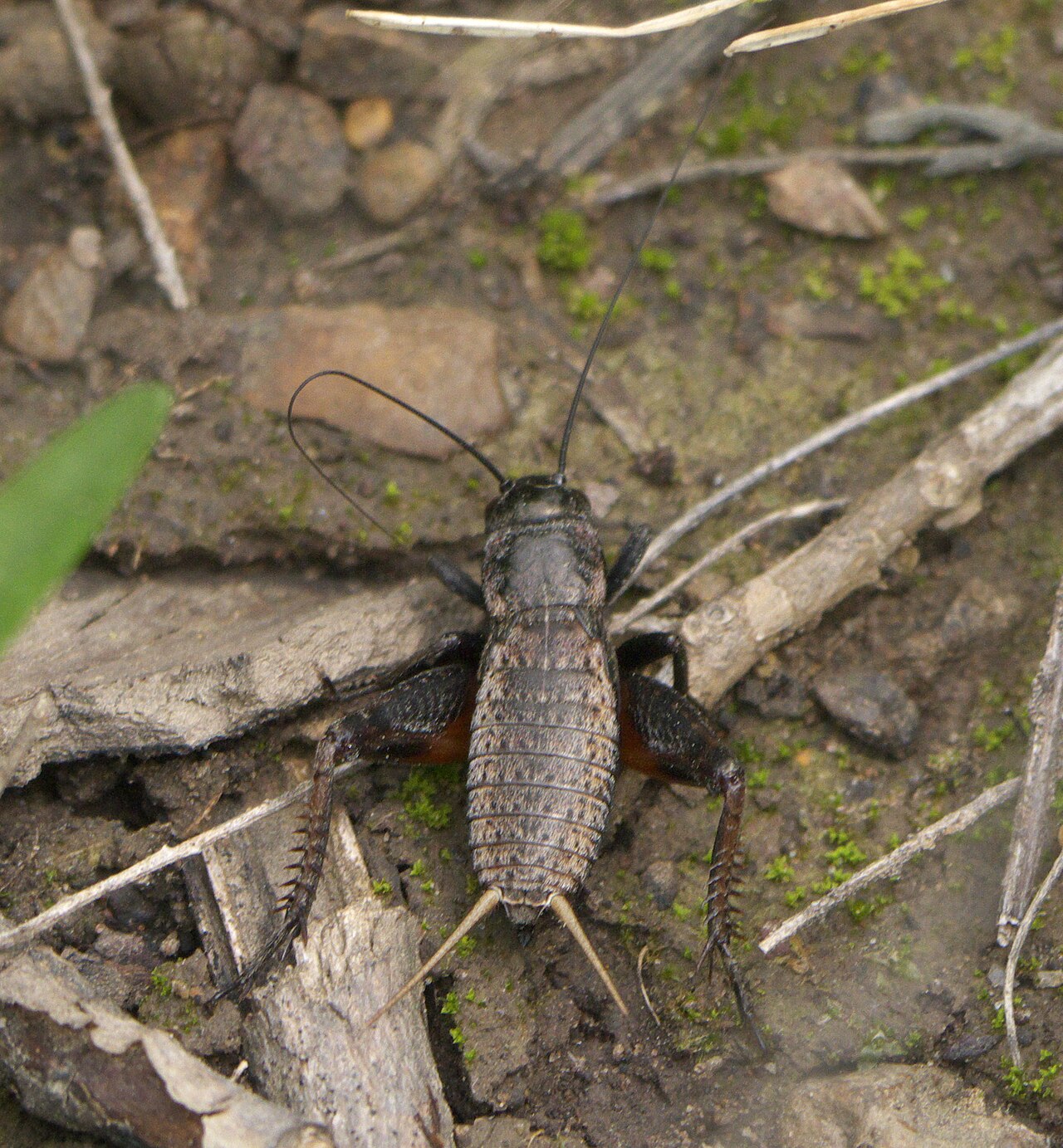
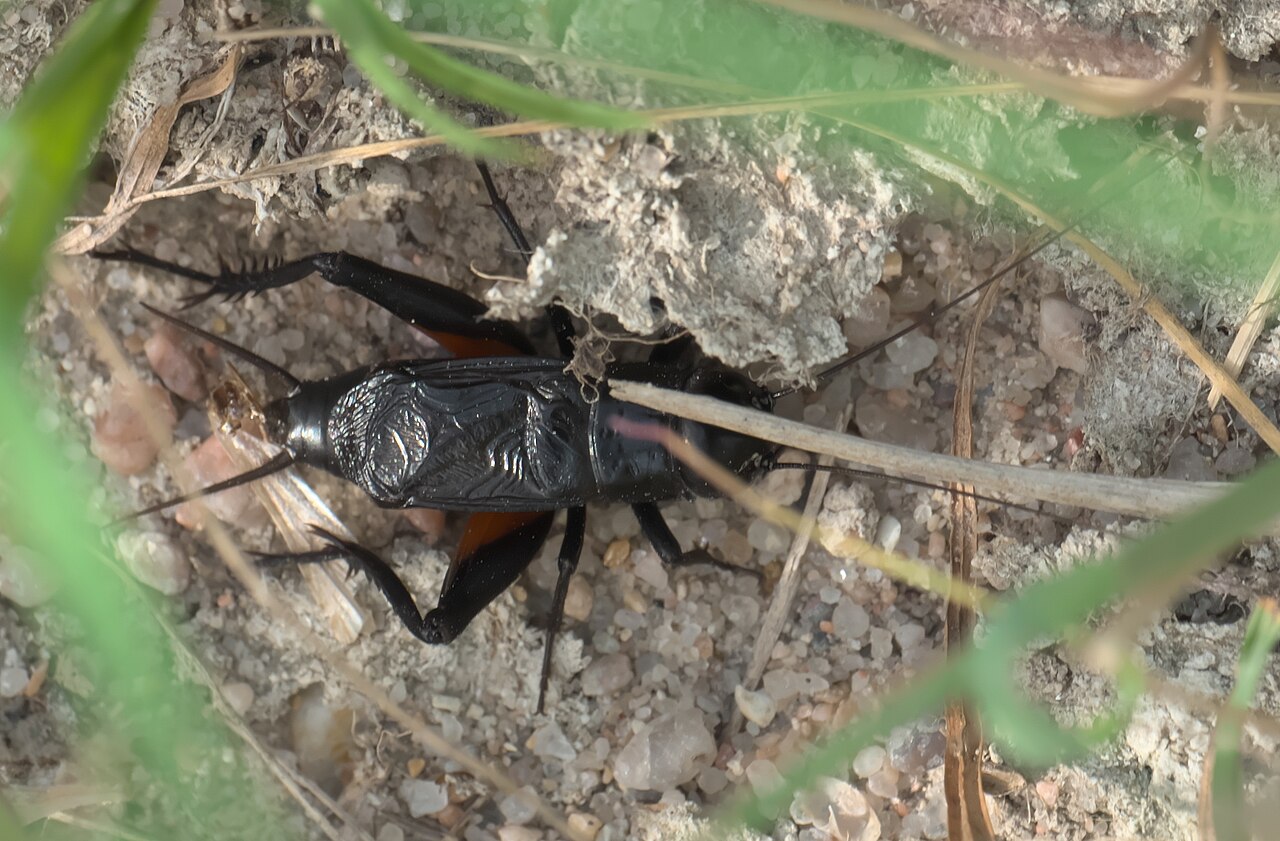
Body shape confirms it. Crickets are flattened and more rounded, often dark brown or black, built for squeezing into crevices. Grasshoppers are cylindrical and elongated with a more angular head, usually green or brown for camouflage against vegetation.
How Each One Makes Sound
Both sing by stridulation, meaning they rub body parts together, but the mechanism differs completely and produces quite different sounds.
Crickets rub wing against wing. The male raises his forewings and draws a scraper on one wing across a file of ridges on the other, producing the clear rhythmic chirp everyone recognizes. The wings act as a resonator, and some species amplify further by singing from the mouth of a burrow shaped like a horn.
Grasshoppers rub leg against wing. The male draws a row of pegs on the inside of the hind femur across a hardened vein on the forewing, producing a buzzing, rasping, or clicking sound rather than a musical chirp. Many species also make a crackling sound in flight called crepitation. In both groups it is almost always the male singing, and the purpose is attracting females and warning off rival males.
Ears in Unexpected Places
Neither insect has ears on its head, and the locations differ between the two groups in a way that tracks their evolutionary split.
Crickets hear through tympanal organs on their front legs, just below the knee joint. Sound reaches these membranes both externally and through an internal tube system connecting to spiracles on the body, which gives the cricket directional hearing precise enough to locate a singing male across a field.
Grasshoppers hear through tympanal membranes on the sides of the first abdominal segment, tucked beneath the wings. The placement is different, the sensitivity is tuned to different frequencies, and the two arrangements evolved independently, which is one of several reasons the groups are placed in separate suborders despite superficial similarity.
What They Eat
Grasshoppers are herbivores, and this is where they become an agricultural concern. They feed on grasses, leaves, stems, and crops, and a large population can strip pasture and field crops, consuming roughly their own body weight in vegetation daily.
Crickets are omnivores with a much broader diet. They eat plant matter, seeds, decaying vegetation, fungi, and animal material including dead insects, other crickets, and occasionally fabric and paper indoors. That flexibility is why crickets thrive as scavengers and why they turn up in basements eating almost anything organic.
The dietary difference explains their different reputations. Grasshoppers damage growing plants and are treated as pests in agriculture, while crickets are mostly harmless outdoors and act as decomposers, though indoor populations can damage fabric and stored goods. Our guide to what crickets eat covers the cricket side in detail, including gut-loading for anyone raising them as feeders.
Katydids and Locusts
Katydids are the third member of the confusion and they sit on the cricket side of the family tree. They belong to the same suborder as crickets, share the long thread-like antennae, and hear through their front legs, but they look like grasshoppers because they are typically bright green with leaf-shaped wings.
The name comes from the song of the common true katydid, whose rasping call is heard as the phrase katy-did. They are nocturnal like crickets, and their leaf mimicry can be extraordinarily precise, with some tropical species showing false leaf veins and imitation insect damage on the wings.
Locusts are not a separate group at all. A locust is a grasshopper, specifically one of a handful of species capable of a density-dependent behavioral change called gregarious phase. Under crowding, these species change color, physiology, and behavior, forming the swarms that devastate crops. The desert locust is the classic example, and the same insect at low density is a solitary, unremarkable grasshopper.
Jumping: The Mechanics Behind the Leap
Both groups jump using enlarged hind femurs packed with muscle, and both store energy before releasing it rather than relying on muscle contraction speed alone. A cuticle structure in the knee acts as a spring, compressed by slow muscle contraction and released suddenly, which multiplies the available power well beyond what muscle could deliver directly.
Grasshoppers are the stronger jumpers, covering twenty times their body length or more and using the leap to launch into flight. Crickets jump shorter distances and use it mainly to escape into cover rather than to travel, which fits their crevice-dwelling habits.
University entomology departments use both insects as standard teaching examples of this catapult mechanism, since the anatomy is large enough to dissect and the physics are straightforward to demonstrate. The same principle appears across unrelated groups, including fleas and click beetles.
Do Crickets or Grasshoppers Bite?
Both can, and neither meaningfully does. Crickets have chewing mandibles and a large individual can deliver a pinch if held tightly, though most cannot break skin. It is a defensive response to being grasped rather than aggression, and no venom is involved.
Grasshoppers are similar, and the larger species such as lubber grasshoppers can produce a noticeable nip if handled roughly. Some also regurgitate a brown fluid when picked up, commonly called tobacco juice, which stains but is harmless.
Neither transmits disease to humans through a bite. The realistic concerns are entirely different: crop damage from grasshoppers, and from crickets the noise, occasional fabric damage, and the fact that large indoor populations attract predators. Neither warrants alarm on encountering one.
Life Cycle and Where You Find Them
Both undergo incomplete metamorphosis, hatching as nymphs that resemble small wingless adults and growing through successive molts, with wing pads enlarging until a final molt produces the winged adult. Neither has a pupal stage.
Egg-laying differs. Female grasshoppers use a short ovipositor to deposit egg pods directly into soil, often several dozen eggs in a foam-covered mass, and in temperate regions those eggs overwinter and hatch in spring. Many crickets lay eggs singly into soil or plant tissue using a long needle-like ovipositor, which is often mistaken for a stinger and is completely harmless.
Habitat follows behavior. Grasshoppers occupy open sunny grassland, meadows, roadsides, and crop fields, staying on vegetation. Crickets favor dark damp sheltered spots under stones, logs, mulch, and debris, in burrows, and in basements and crawl spaces. Finding an insect under a rock points to a cricket, and finding one on top of a grass stem in sunlight points to a grasshopper.
What They Mean in Your Garden or House
Grasshoppers in numbers indicate a genuine problem for a vegetable garden, and control relies on row covers, encouraging birds and predatory insects, and in serious cases a biological product based on the pathogen Nosema locustae. Broad-spectrum insecticide is counterproductive because it removes the parasitic wasps and flies that suppress populations naturally.
Crickets indoors are usually a moisture and entry problem rather than an infestation. Camel crickets and field crickets enter basements and crawl spaces seeking damp shelter, and the durable fixes are reducing humidity with a dehumidifier, sealing gaps at doors and foundations, and clearing mulch, leaf litter, and woodpiles away from the walls.
Both are important food-web species worth tolerating outdoors. Crickets and grasshoppers together form a substantial part of the diet of birds, lizards, spiders, and small mammals, and a yard with none of them supports far fewer of everything else. Our guides to what jumping spiders eat, what lizards eat, and what peacocks eat all cover predators that depend heavily on this group, and the spiders in our guide to the baby wolf spider hunt them on the ground at night.
Related reading: Cricket Sounds.
Related reading: Green Grasshopper.
Frequently Asked Questions
What is the main difference between a cricket and a grasshopper?
Antennae length. Crickets have long thread-like antennae usually as long as the body or longer, while grasshoppers have short stubby ones under a third of the body length. Crickets are also nocturnal omnivores and grasshoppers diurnal herbivores.
How do crickets and grasshoppers make sound differently?
Crickets rub wing against wing, drawing a scraper across a file of ridges to produce a clear rhythmic chirp. Grasshoppers rub a row of pegs on the hind leg against a hardened wing vein, producing a buzzing or rasping sound. In both, it is the males singing.
Is a katydid a cricket or a grasshopper?
Neither exactly, but it sits on the cricket side of the family tree, sharing long antennae and ears on the front legs. Katydids look like grasshoppers because they are typically bright green with leaf-shaped wings, and they are nocturnal like crickets.
What is the difference between a locust and a grasshopper?
A locust is a grasshopper. A handful of species can undergo a density-dependent change called gregarious phase, altering color, physiology, and behavior under crowding to form swarms. The same insect at low density is an ordinary solitary grasshopper.
Do crickets or grasshoppers bite people?
Both can pinch with chewing mandibles if held tightly, but neither meaningfully bites and no venom is involved. Larger species such as lubber grasshoppers can nip noticeably. Some grasshoppers regurgitate a harmless brown fluid when handled.
Where do their ears sit?
Crickets hear through tympanal organs on their front legs below the knee, which gives them directional hearing precise enough to locate a singing male across a field. Grasshoppers hear through membranes on the sides of the first abdominal segment, beneath the wings.
Can you really tell temperature from cricket chirps?
Roughly, using a snowy tree cricket. Count chirps in 14 seconds and add 40 for an approximate figure in degrees Fahrenheit. The relationship works because the muscle contractions driving the chirp accelerate as the insect warms, and it is known as Dolbear’s law.