Baby Coyote: Pups, Dens, and What to Do If You Find One
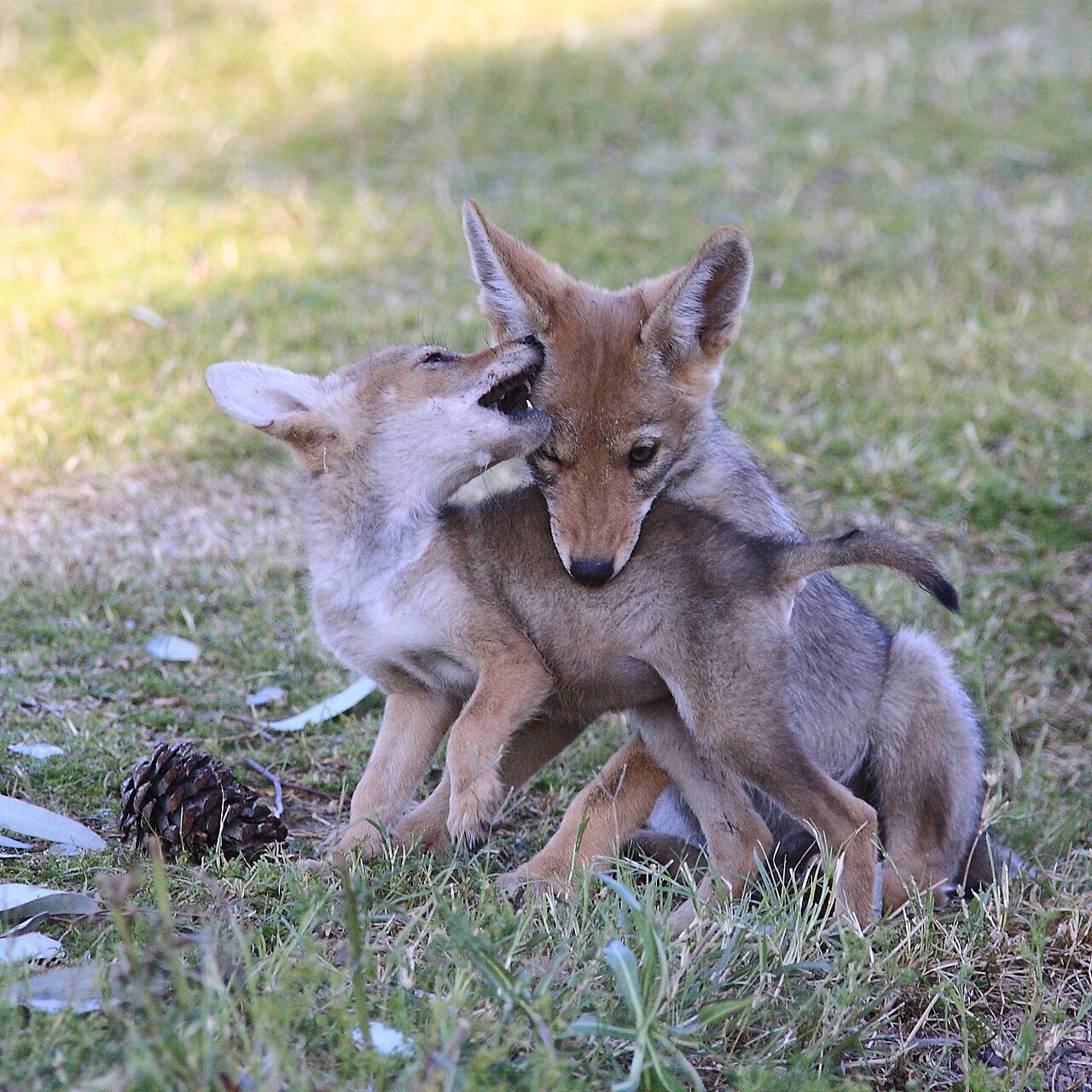
Baby coyotes are called pups, born in litters of four to seven in spring after a gestation of around 63 days. They emerge blind, deaf, and covered in fuzzy grey-brown fur weighing roughly 8 to 10 oz, stay underground in a den for their first two to three weeks, and are raised by both parents rather than by the mother alone.
They are also the animal most often mistaken for something else. A coyote pup found alone looks like an abandoned puppy, and people take them home every spring, which is illegal in most states, harmful to the animal, and unnecessary since the parents are almost always nearby. This guide covers development, how to distinguish pups from dog and fox young, the den season, and what to do if you find one.
| Quick Facts | Coyote Pups |
|---|---|
| Called | Pups |
| Litter size | 4 to 7, occasionally up to 12 |
| Born | April to May in most of the range |
| Birth weight | Roughly 8 to 10 oz |
| Eyes open | Around 10 to 14 days |
| Independent | Disperse at 6 to 9 months |
Birth and the First Weeks
Coyotes breed once a year in late winter, and pups arrive in April or May across most of North America. The female digs or adopts a den, often enlarging a badger or fox burrow, or uses a hollow log, rock crevice, culvert, or space beneath a shed or deck in suburban areas.
Newborns are entirely helpless. They are born with eyes and ears closed, cannot regulate their own temperature, and depend on the mother for warmth as well as milk, which is why she remains in the den almost continuously for the first ten days or so while the male brings her food.
Development is rapid after that. Eyes open at around 10 to 14 days, the pups begin walking unsteadily soon after, and by two to three weeks they emerge from the den mouth to play in daylight. That first emergence is when most people see them, and a scatter of tumbling pups outside a den is the classic spring sighting.
Weaning and Learning to Hunt
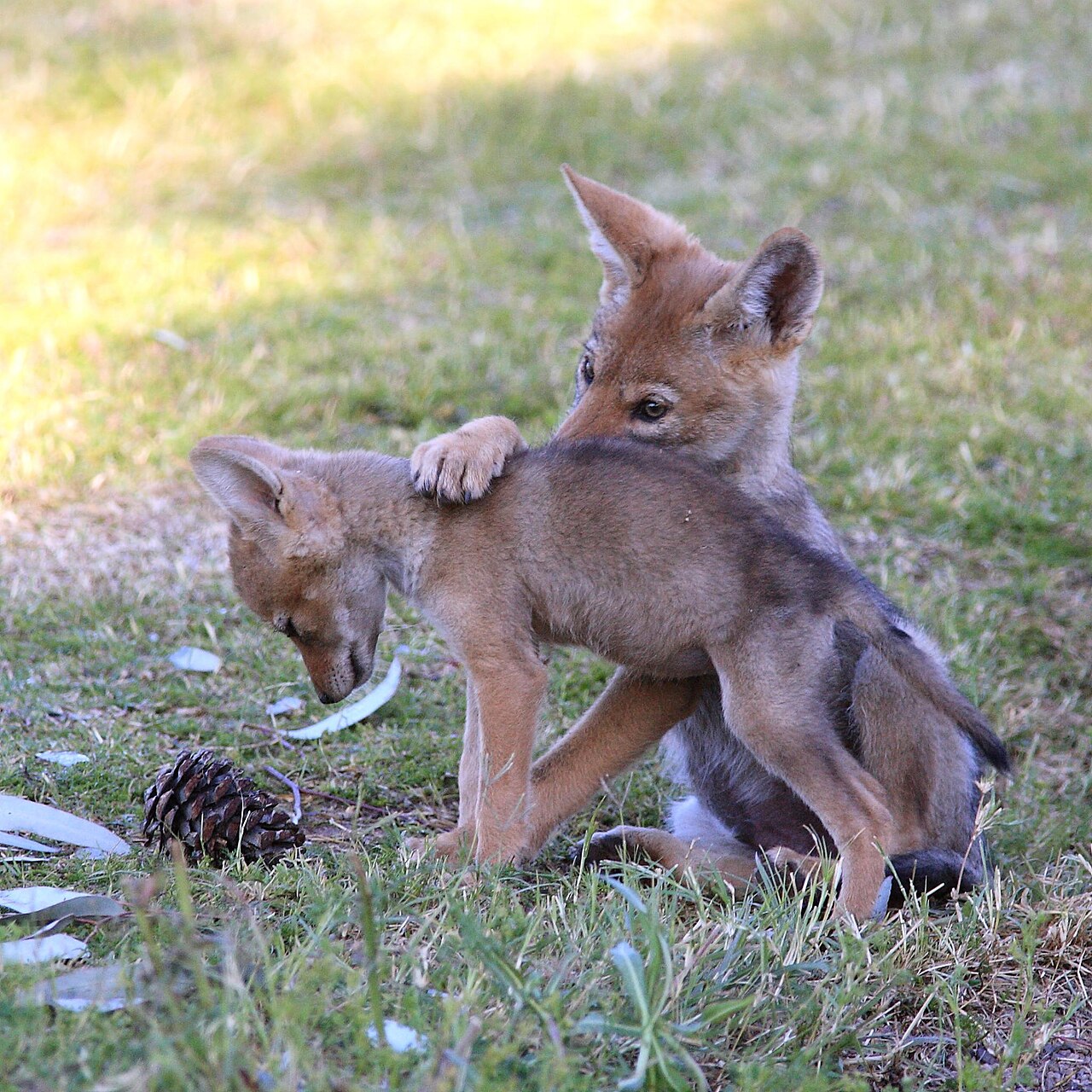
Weaning begins around five to seven weeks and both parents contribute. Adults return to the den and regurgitate partly digested food for the pups, which is a normal and important stage rather than a sign of a sick animal, and it bridges the gap between milk and solid prey.
Hunting lessons follow through summer. Adults bring back injured or freshly killed prey for the pups to handle, and later lead them on hunts, and this is the period when the young learn what is food and how to catch it. Coyotes are opportunistic omnivores, so the curriculum includes rodents, rabbits, insects, fruit, and carrion.
The family stays together into autumn. Pups reach near-adult size by six months, and dispersal typically happens between six and nine months, with young animals travelling considerable distances to establish their own territories. Some remain with the parents as helpers for a further year, assisting with the next litter, and our guide to coyote sounds covers how the family communicates.
Coyote Pup or Puppy?
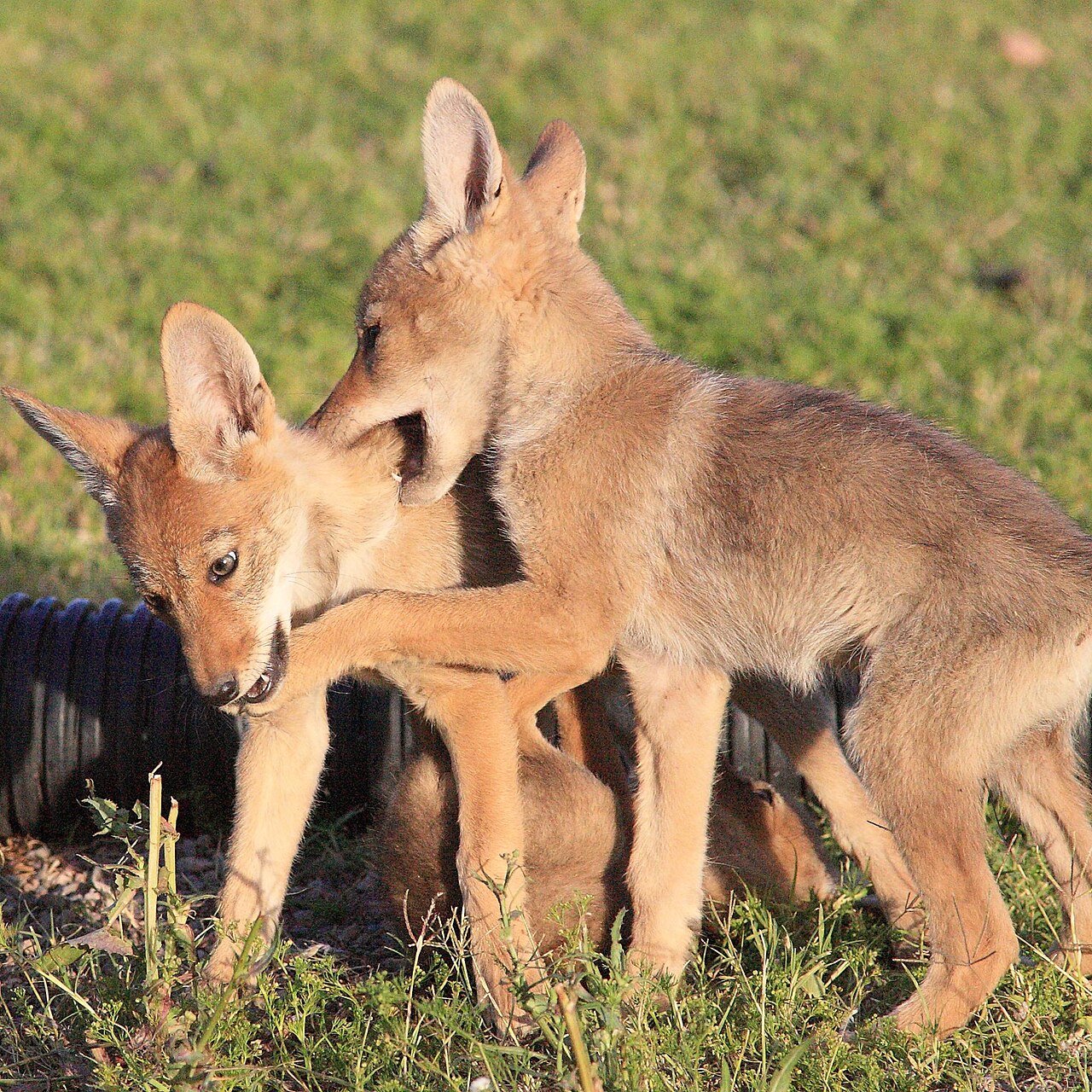
This is the identification that matters most because it drives the wrong decisions. Coyote pups have proportionally longer legs, a narrower muzzle, larger pointed ears relative to the head, and a distinctly bushy tail even when young.
Coat and color help. Coyote pups are grey-brown with a fuzzy texture and often a darker back, without the patchy or piebald coloring common in domestic puppies, and they lack the rounded head and short muzzle of most dog breeds.
Behavior is the strongest signal. A coyote pup old enough to move is wary, avoids eye contact, and retreats or freezes rather than approaching, while a domestic puppy of similar age typically approaches people readily. A young canid that will not come to you and watches from a distance is almost certainly wild.
Coyote Pup, Fox Kit, or Wolf Pup?
Fox kits are smaller and differently proportioned. Red fox kits are born earlier, in March and April, and start out grey-brown before developing the rust coloring, with shorter legs, smaller frames, and a white tail tip that appears early and is diagnostic.
Wolf pups are considerably larger at the same age, with broader muzzles, blockier heads, and heavier bone, and they occur only within actual wolf range, which in the contiguous United States is limited to parts of the northern Rockies, Great Lakes region, and southwest. Anywhere else, a large wild canid pup is a coyote.
Size at a given date separates them in practice. A canid pup in June that seems too large for a fox and too small for a dog of that build is usually a coyote. Our guides to the baby wolf, the baby fox, and coyotes versus wolves work through the adult distinctions.
Den Season and Bold Behavior
Coyotes behave differently when they have pups, and this explains most conflict reports in spring and early summer. Adults defending a den become far bolder, and behavior that would be unusual at other times becomes normal.
Escorting is the specific behavior people misread as stalking. A coyote that follows a person walking a dog near a den is escorting them away rather than hunting, and it will typically maintain distance, watch, and turn back once the perceived threat leaves the area. It looks alarming and is a defensive response.
Dogs are the trigger far more often than people. Coyotes perceive domestic dogs as territorial competitors, and most reported aggressive encounters involve a loose or leashed dog near a den site. Keeping dogs leashed and short in known coyote areas from April through July resolves most incidents, and our guide to foxes versus coyotes covers the wider behavioral picture.
Suburban Dens
Coyotes den under decks, sheds, porches, and in storm drains, culverts, and dense landscaping, and suburban den sites are increasingly common because the food supply is reliable and larger predators are absent.
The usual advice is to wait rather than act. Coyote families leave den sites naturally by midsummer once pups are mobile, so a den under a shed in May will be empty by July, and disturbing an active den scatters the pups without removing the family from the area.
If waiting is not possible, harassment rather than trapping is the recommended approach. Making the site unpleasant with noise, light, and human activity encourages the family to move the pups to an alternative den, which coyotes do readily. Sealing access under structures should happen only after the family has definitely left, or you will trap pups inside.
If You Find a Pup
The default action is to leave it alone and observe from a distance. Coyote parents leave pups unattended regularly and will not return while people or dogs are visible nearby, so a lone pup is normal rather than evidence of abandonment.
Genuine signs of trouble are specific: visible injury, obvious emaciation, flies or maggots on the animal, continuous crying over many hours, or a confirmed dead parent nearby. Those warrant a call to a licensed wildlife rehabilitator or your state wildlife agency rather than intervention.
Never take one home. Keeping wildlife without a permit is illegal in most states, coyote pups raised by people lose their fear and become dangerous or are euthanized as adults, they cannot be released successfully once habituated, and they can carry parasites and diseases transmissible to pets and people. Never feed one either, since a fed coyote becomes a habituated coyote and that outcome is bad for everyone including the animal.
What Pups Sound Like
Coyote families are vocal and the pups contribute their own repertoire. Young animals produce high yips, whines, and squeals around the den, particularly during play and when soliciting food, and these sounds carry surprisingly far on still evenings.
The group chorus that people find unsettling is often mostly pups. A family group of two adults and five or six young produces a wildly overlapping mix of yips, howls, and barks that sounds like far more animals than are actually present, an effect sometimes called the beau geste phenomenon.
That acoustic illusion has practical consequences. People routinely report packs of a dozen or more coyotes when the group is a single family, which drives disproportionate concern and control demands. Recognizing the sound as a family group with pups rather than a large pack changes how alarming it seems.
Survival and Population
Pup mortality is high, with published figures commonly putting first-year survival somewhere between 20 and 50 percent depending on region, food supply, and pressure. Starvation, disease, predation, vehicles, and human control account for most losses.
Coyote populations respond to pressure in a way that surprises people. Where coyotes are heavily hunted or trapped, litter sizes increase, more females breed, and pup survival rises, which is a compensatory response documented across multiple studies. Removal programs frequently fail to reduce populations for exactly this reason.
The species has expanded dramatically rather than declined. Coyotes now occupy nearly all of North America including every major city, an expansion driven by the removal of wolves, which suppressed coyotes where they overlapped, and by the animal’s adaptability. Our guide to coyote droppings covers the field signs that reveal how widely they range.
Frequently Asked Questions
What is a baby coyote called?
A pup. Litters of four to seven arrive in April or May after about 63 days of gestation, born blind and deaf at roughly 8 to 10 oz, with eyes opening at 10 to 14 days and first emergence from the den at two to three weeks.
How do I tell a coyote pup from a puppy?
Coyote pups have longer legs, a narrower muzzle, larger pointed ears, and a bushy tail, in fuzzy grey-brown without patchy coloring. Behavior is the clearest signal: a coyote pup avoids people and retreats, while a domestic puppy approaches readily.
I found a coyote pup alone, is it abandoned?
Almost certainly not. Parents leave pups unattended while hunting and will not return while people or dogs are nearby. Watch from a distance for several hours. Only visible injury, emaciation, maggots, or continuous crying over many hours warrant calling a rehabilitator.
Why are coyotes bolder in spring?
Because they are defending a den. Adults escort perceived threats away from pups, which looks like stalking but is defensive, and dogs trigger it far more often than people. Keeping dogs leashed and close from April through July resolves most incidents.
There is a coyote den under my shed, what should I do?
Usually wait, since families leave naturally by midsummer once pups are mobile. If waiting is not possible, use noise, light, and human activity to encourage them to move the pups elsewhere. Seal access only after confirming the family has left, or pups get trapped.
Can I raise a coyote pup?
No. It is illegal in most states without a permit, habituated coyotes lose their fear and become dangerous or are euthanized as adults, they cannot be released successfully, and they carry parasites transmissible to pets and people.
Does killing coyotes reduce their numbers?
Often not. Heavily pressured populations respond with larger litters, more breeding females, and higher pup survival, a compensatory effect documented across multiple studies, which is why removal programs frequently fail to reduce numbers.