Baby Groundhog: Kit Timeline, Rescue Rules, and the Burrow Calendar
A baby groundhog is called a kit, pup, or chuckling, born in April or May in a litter of 2 to 6 deep inside an underground burrow chamber. Newborns are pink, hairless, blind, and about 4 inches long, roughly the size of a stick of butter, and they stay entirely below ground for their first 5 to 6 weeks, which is why yards with a resident groundhog suddenly seem to sprout several small ones out of nowhere in early June.
Those June emergences, plus midsummer dispersal when juveniles wander into window wells, garages, and new territories, are when people actually meet baby groundhogs and need answers: is this one orphaned, is it dangerous, why is it so unafraid, and what does a litter under the shed mean for the garden. This guide covers the full growth timeline, found-a-baby triage, and the burrow calendar that makes humane eviction possible.
| Fact | Baby Groundhog (Kit) |
|---|---|
| Name | Kit, pup, or chuckling |
| Litter size | 2 to 6 |
| Born | April to May, underground |
| First emergence | 5 to 6 weeks old (early June) |
| Weaned | Around 6 weeks |
| Disperses | 2 to 3 months old, midsummer |
What Is a Baby Groundhog Called?
Baby groundhogs go by kit or pup, with “chuckling” as the charming folk option, a nod to the groundhog’s other name, woodchuck. The species (Marmota monax) is North America’s largest widespread member of the squirrel family, and its babies follow the marmot pattern: born extremely undeveloped, raised entirely underground, and matured on a compressed schedule dictated by the coming winter.
Timing is unusually synchronized. Groundhogs emerge from hibernation in late winter, males first, and mate almost immediately in March, so after a roughly 32-day pregnancy, virtually all kits in a region are born within the same few April-to-May weeks. One litter per year is the rule, which makes each litter a high-stakes project for the mother.
The father is long gone by the birth; male groundhogs leave the female’s burrow before kits arrive, and the mother raises the litter alone in a grass-lined nursery chamber that sits deeper and drier than the rest of the burrow system. Everything about a kit’s first month happens in that one dark room.
Growth Timeline: Butter Stick to Burrow Owner
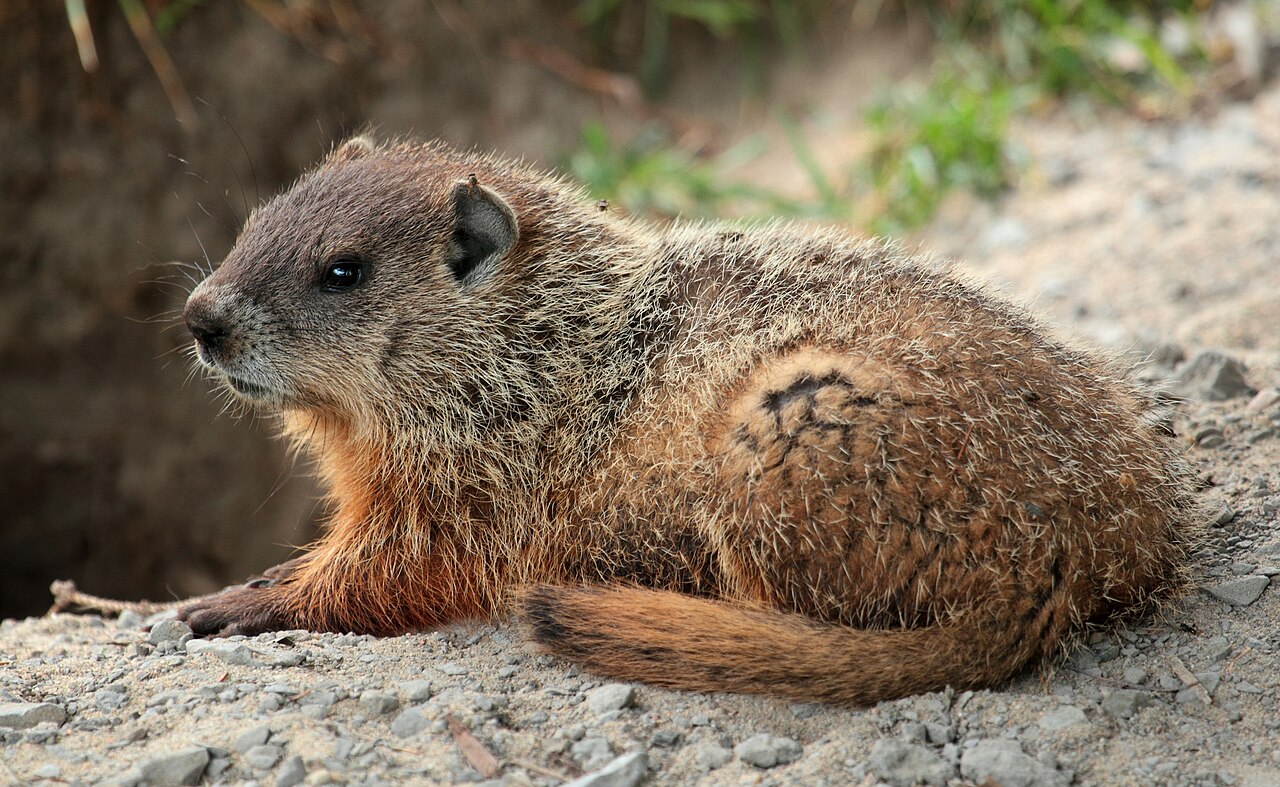
Newborn kits weigh about an ounce, blind, hairless, and utterly dependent. Fur arrives over the first two weeks, eyes open around 4 weeks, and by week 5 the kits are miniature groundhogs practicing walking in the nursery chamber. At 5 to 6 weeks they follow their mother up the tunnel for the famous first emergence, blinking into daylight as a wobbly group at the main entrance.
Weaning happens fast, around 6 weeks, because the summer clock is merciless: a kit must reach hibernation weight by October. Juveniles switch to the adult menu of grasses, clover, dandelions, and, notoriously, garden vegetables, and they eat with purpose, roughly tripling their weight between emergence and dispersal, on the way to the 5 to 10 pounds a first winter demands.
At 2 to 3 months, in midsummer, the litter breaks up. Juveniles disperse to dig their own starter burrows, usually within a few hundred yards but sometimes crossing roads and neighborhoods, which is exactly when lone, palm-sized groundhogs turn up in window wells, garages, and gardens far from any known burrow. A healthy dispersing juvenile looks lost; it is actually commuting.
Why Baby Groundhogs Seem So Tame
The question people ask most about a juvenile groundhog is why it just sits there while they approach. The answer is inexperience, not illness: young groundhogs emerge knowing burrow-diving as their only defense and have not yet calibrated humans as threats, so a juvenile grazing at midday may let you get startlingly close before waddling off, or freeze flat to the ground hoping to be missed.
Daylight activity is also completely normal. Groundhogs are among the most strictly diurnal mammals in the yard, with juveniles feeding through mid-morning and late afternoon; unlike a raccoon or fox, a groundhog out at noon requires no health explanation at all. Whistling alarm calls, the sharp “chuck” that names the woodchuck, come later, learned at the burrow entrance from the mother.
Genuine warning signs are specific: circling, dragging limbs, visible wounds, heavy tick loads with lethargy, or aggression without escape attempts. Groundhogs can contract rabies like any mammal, and an adult-sized animal behaving abnormally warrants distance and a call to animal control, but the merely-unbothered juvenile eating clover on your walkway is exhibiting the standard confidence of a species with a bunker ten steps away.
Found a Baby Groundhog? Triage in Three Questions
First: is it actually orphaned? A furred, mobile juvenile out alone in summer is a disperser and needs nothing from you; walking away is the correct rescue. Genuine orphan candidates are the exceptions: eyes-closed or barely furred kits above ground (they cannot climb out of the burrow themselves, so surface appearance means something went wrong), kits crying at a burrow where the mother is confirmed dead, roadkill nearby being the common confirmation, or any kit cold, thin, fly-covered, or injured.
Second: can the mother fix this? If an intact young kit is at or near a burrow entrance and the mother’s status is unknown, give reunion a chance: place the kit just inside the burrow mouth or in a shallow box beside it, keep people and pets away, and watch from a distance for a few hours. Mothers retrieve wandered kits routinely; they do not retrieve kits guarded by an audience.
Third: if rescue is real, do the boring version. Wearing gloves, box the kit with a soft cloth and a warm rice sock beside it, keep it dark and quiet, offer nothing to eat or drink, and call a licensed wildlife rehabilitator the same day, since groundhogs, as a rabies-vector species in many states, must legally go to specially licensed rehabbers. The no-feeding rule is the same one that governs every found infant, from a baby rabbit to a baby chipmunk: warm and empty beats fed and dying.
The Burrow: Where Kits Actually Live

Everything about baby groundhogs happens in architecture worth respecting. A maternal burrow system runs 20 to 40 feet of tunnels with 2 to 5 entrances, a main hole marked by a fan of excavated dirt, plus hidden drop-holes dug from below with no dirt apron, and includes the nursery chamber, a hibernation chamber below frost line, and a separate latrine chamber, which is why groundhog droppings are almost never found on the surface.
Under sheds, decks, and porches, that engineering is the actual conflict: burrow systems can undermine slabs and footings over years, and the entrance fan of fresh soil against a foundation is the diagnostic sign a family has moved in. Kits amplify activity visibly in June, multiple animals, widened entrances, flattened vegetation paths radiating to feeding areas.
The burrow is also a neighborhood asset in disguise: abandoned groundhog systems become homes for rabbits, foxes, skunks, and, in much of the country, the primary winter refuge for other wildlife. That afterlife is one reason wildlife agencies recommend exclusion over extermination; the hole outlives the digger, and something will use it either way, so controlling access beats controlling animals.
Kits and Your Garden: The Honest Damage Assessment
A litter turns one groundhog appetite into several, and June-to-August is peak damage season as juveniles bulk for winter. The signature is wholesale, low, and tidy: beans, peas, lettuce, and brassicas eaten to stubs, wide bites from low-hanging tomatoes, and clover and dandelion patches mowed flat, with feeding concentrated within a short waddle of the burrow, since groundhogs rarely forage far from their escape hatch.
Separating groundhog work from the lookalikes saves misdirected effort. Rabbit damage is razor-clipped at 45 degrees and stays under 18 inches with pellets nearby, per the sign in our rabbit poop guide; deer browse higher with ragged tears; and groundhogs leave broad, flat-bottomed cropping plus the unmistakable burrow within sight. No burrow within about 100 feet usually means a different culprit.
Effective defense is physical and specific: a 3 to 4 foot fence with the top foot bent outward unattached (groundhogs are surprisingly good climbers who dislike floppy tops) and the bottom foot buried in an L-shape against digging protects a vegetable plot essentially permanently. Repellents and ultrasonic devices have weak track records against an animal this food-motivated; the Penn State Extension (extension.psu.edu) puts fencing and burrow exclusion at the center of woodchuck management for exactly that reason.
Evicting a Family Humanely: The Calendar Method
The cardinal rule of groundhog eviction is never seal a burrow between April and late June, when flightless, er, walk-less kits are underground. Closing entrances then starves the litter in place and drives a frantic mother to excavate destructively; every humane playbook, and several state regulations, builds around the kit calendar instead.
The winning schedule: harass in July and August, after kits are mobile but before hibernation prep locks the family in, using the standard pressure kit of used cat litter or ammonia-soaked rags placed at (not in) entrances, a radio, and repeated trampling of the entrance fan. Most families relocate to a backup burrow within days; groundhogs maintain several.
Once activity stops, verify with the paper test, loosely stuff entrances with newspaper and confirm it stays undisturbed for 3 to 5 days, then excavate each entrance to about a foot and install an L-footer of buried hardware cloth, or fit a one-way door on the last active hole for stragglers. Sealing is the permanent step trapping never achieves, since new groundhogs adopt vacant burrows; and if trapping is ever on the table, know that many states prohibit relocating this rabies-vector species, another reason exclusion wins.
A Baby Groundhog’s First Year and the Long Game
The kit that disperses in July faces a brutal freshman schedule: dig a burrow, learn a territory, and gain enough fat by October to survive 3 to 5 months of true hibernation, body temperature near 40 degrees, heartbeat slowed to a handful of beats per minute, entirely on stored reserves. First-winter mortality is high, and the plump juvenile demolishing your clover in September is quite literally eating for its life.
Survivors wake in late winter into the adult cycle: males emerge first, sometimes into snow, which is the germ of truth inside Groundhog Day, and yearling females typically breed in their second spring. Adults live 3 to 6 years in the wild, anchoring the same burrow systems for their whole tenure, so the family under the old shed may be a multi-year institution with generational turnover rather than a passing visit.
Ecologically, that tenure earns its keep even when the beans suffer: groundhogs aerate and turn over hundreds of pounds of subsoil per burrow, their diggings seed the burrow-dependent wildlife economy, and their sharp whistles serve as a neighborhood alarm system other species eavesdrop on, joining the dusk-and-dawn information network alongside the callers in our fox sounds and coyote sounds guides. The kit in your June garden is next year’s excavation department; whether that is a problem or a feature depends mostly on where the fence goes.
Related reading: Groundhog Lifespan.
Frequently Asked Questions
What is a baby groundhog called?
A kit or pup, folksily a chuckling. Litters of 2 to 6 are born underground in April or May and first surface at 5 to 6 weeks old, usually in early June.
What should I do if I find a baby groundhog alone?
If it is furred and mobile in midsummer, it is dispersing normally; leave it be. Rescue only eyes-closed kits above ground, or any kit that is cold, injured, fly-covered, or at a burrow with a confirmed-dead mother, and route it to a licensed rehabilitator without feeding it.
Why is a baby groundhog not afraid of me?
Juveniles have not yet learned humans as threats and rely on freezing or burrow-diving. Daytime activity and mild boldness are normal; circling, dragging limbs, or aggression are the actual warning signs.
When do baby groundhogs leave their mother?
At 2 to 3 months, in midsummer, dispersing to dig their own burrows nearby. That is when lone juveniles show up in window wells, garages, and new yards.
Why can’t I block a groundhog hole in spring?
Kits stay underground until 5 to 6 weeks old, so sealing between April and late June traps the litter inside. Evict with harassment in July and August, verify with the newspaper test, then seal with buried hardware cloth.
Do baby groundhogs carry rabies?
Groundhogs are a rabies-vector species in many states, so kits must go to specially licensed rehabilitators, and any groundhog behaving abnormally warrants distance and a call to animal control. Healthy juveniles pose little risk if unhandled.
How many babies do groundhogs have?
One litter per year of 2 to 6 kits, born after a roughly 32-day pregnancy following the March breeding season. The single annual litter is why June’s emergence is so synchronized.