Black and Blue Butterfly: The Pipevine Swallowtail Explained
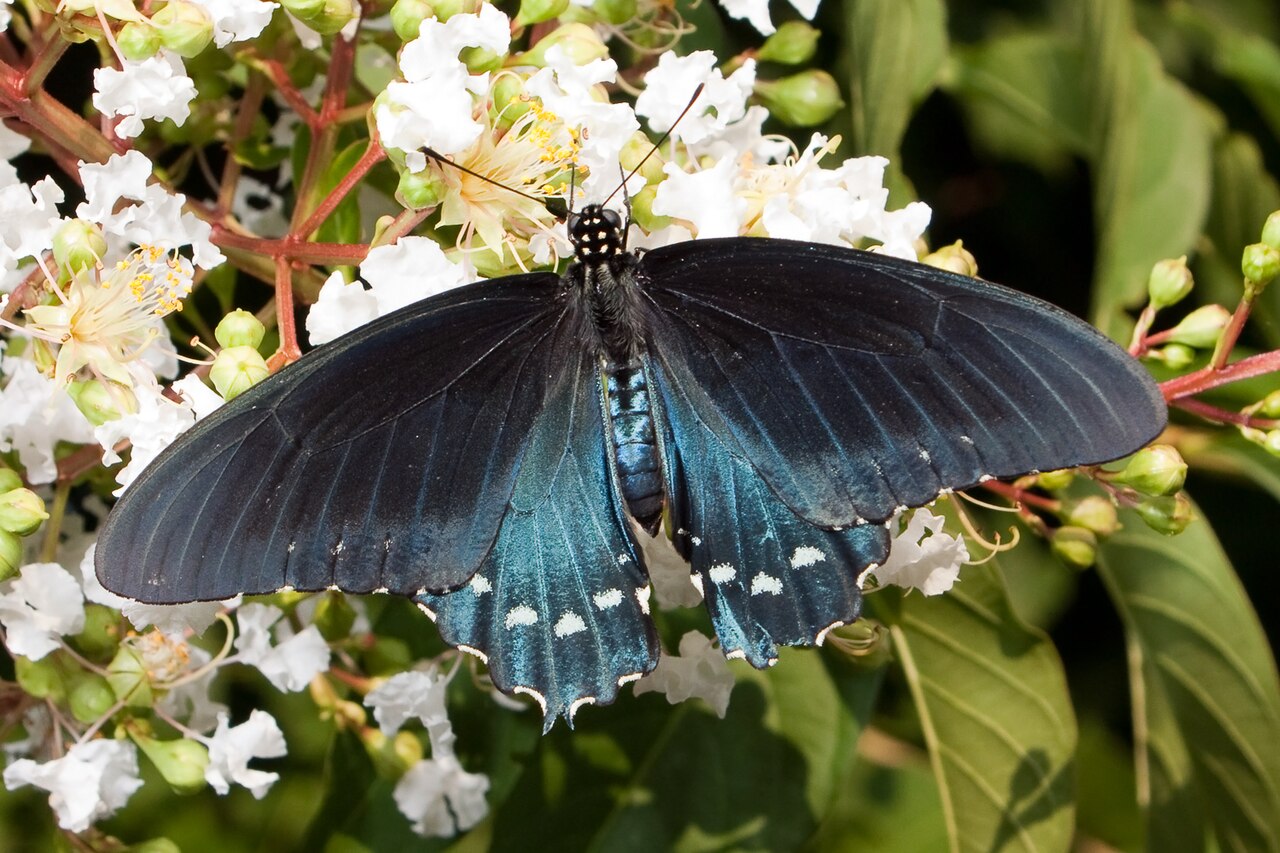
A black and blue butterfly spotted in the United States is most often the pipevine swallowtail, whose iridescent blue-black hindwings shimmer with a metallic quality visible mainly at certain angles, backed by a black body and forewings that create a striking overall dark, jewel-toned appearance quite different from the more familiar bright yellow-and-black swallowtail pattern many people picture first. This species carries genuine ecological importance beyond its striking looks, since its caterpillars feed exclusively on toxic pipevine plants, making the adult butterfly poisonous to predators and the center of a documented mimicry system that several other butterfly species have evolved to copy for their own protection.
Beyond the pipevine swallowtail specifically, a few other black-and-blue patterned species and color forms round out the identification possibilities depending on region and specific viewing conditions, including certain color morphs of other swallowtail species and, more rarely, tropical strays that occasionally wander into southern states. This guide covers the pipevine swallowtail in detail, the mimicry system built around its toxicity, other black-and-blue possibilities worth knowing, and the specific field marks that separate this striking color combination from its various lookalikes.
| Species | Key Pattern Detail |
|---|---|
| Pipevine swallowtail | Iridescent blue-black hindwings, toxic |
| Dark-form tiger swallowtail (female) | Nearly black with faint blue shadow-striping |
| Spicebush swallowtail | Blue-green hindwing patch, black body |
| Red-spotted purple | Iridescent blue, no tails, mimics pipevine |
Pipevine Swallowtail: The True Black and Blue Butterfly
The pipevine swallowtail (Battus philenor) stands as the definitive black-and-blue butterfly across most of the United States, displaying black forewings and a body with hindwings that shimmer an iridescent blue to blue-green depending on the angle of light, an optical effect produced by microscopic wing scale structure rather than pigment alone, giving this species a genuinely different visual quality than butterflies relying purely on colored pigments for their patterns.
This iridescent shimmer means the species can appear almost entirely black in flat or shaded lighting, only revealing its characteristic blue quality when sunlight catches the hindwings at the right angle, a viewing-condition-dependent appearance that occasionally leads to identification uncertainty until an observer catches the butterfly at the correct angle to see the full blue iridescence the species is named for.
Ranging across most of the eastern and southern United States and into parts of the Southwest, pipevine swallowtails specifically require pipevine plants (Aristolochia species) as their exclusive caterpillar host, a toxic plant relationship considerably more restrictive than the varied diets many orange butterfly species rely on, rendering the adult butterfly genuinely unpalatable and mildly toxic to most predators, setting up the extensive mimicry system covered in the next section that several unrelated butterfly species have evolved to exploit for their own protection.
The Mimicry System: Why So Many Butterflies Copy This Pattern
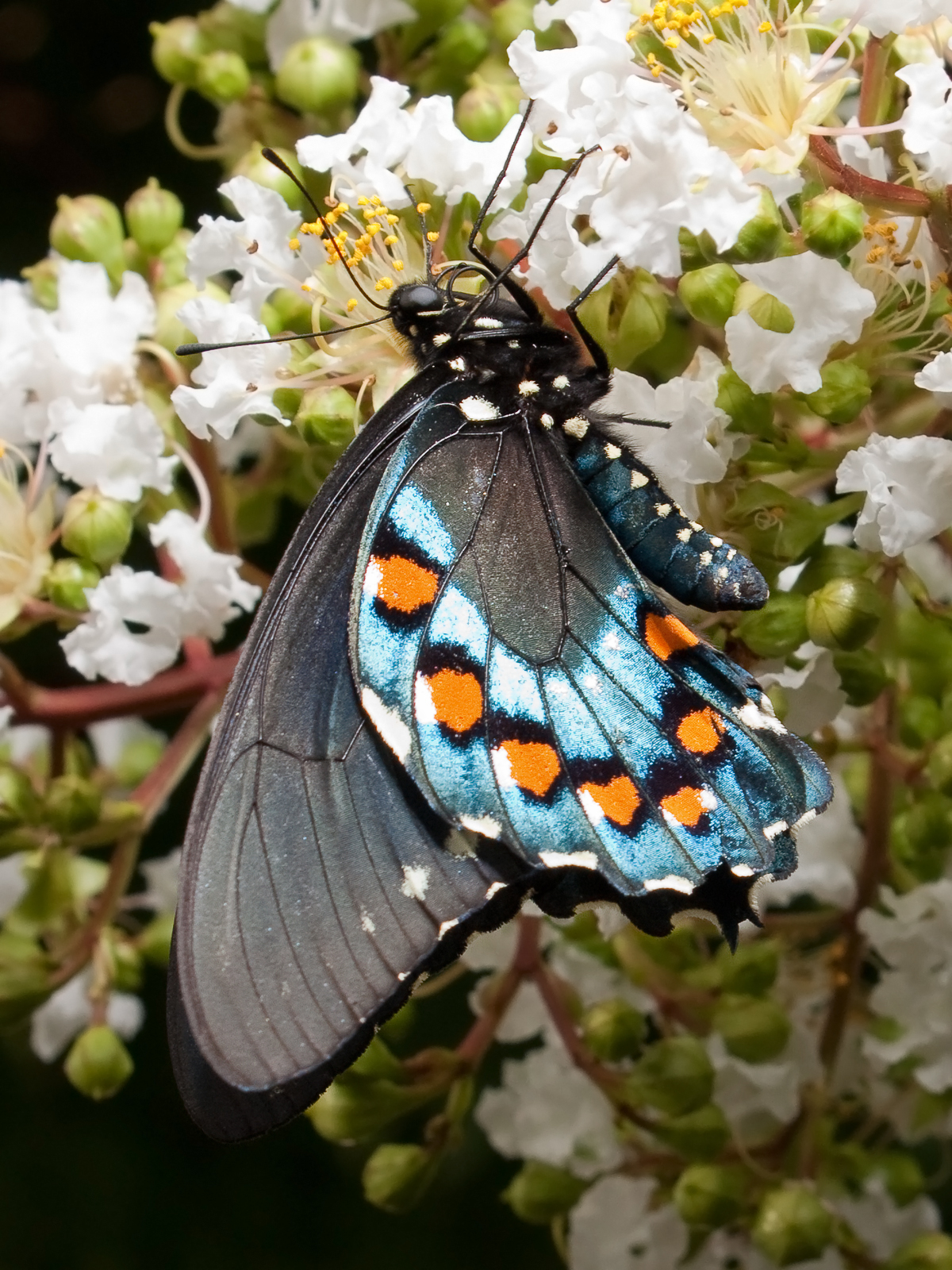
Because pipevine swallowtails are genuinely toxic and predators, particularly birds, learn to avoid their distinctive blue-black pattern after a bad experience, several other butterfly species have evolved to closely mimic this same pattern despite being entirely non-toxic themselves, a well-documented evolutionary strategy called Batesian mimicry in which a harmless species gains protection by resembling a genuinely dangerous or unpalatable one.
The red-spotted purple, a form of the same species that produces the white-banded white admiral further north, shows this mimicry particularly clearly in its southern range, displaying the same iridescent blue-black coloration as the pipevine swallowtail but lacking the pipevine swallowtail’s characteristic tails, since red-spotted purples belong to an entirely different butterfly family without the tail structure true swallowtails possess.
Female dark-form eastern tiger swallowtails, mentioned in passing as an alternative possibility below, and spicebush swallowtails, covered in the next section, both also show mimicry-driven dark coloration with blue elements believed to provide similar protection by association with the genuinely toxic pipevine swallowtail, meaning encountering several superficially similar black-and-blue butterflies in the same region often reflects this documented mimicry complex rather than several unrelated species happening to share the same coloration by pure coincidence.
Spicebush Swallowtail: A Close Relative in the Mimicry Complex
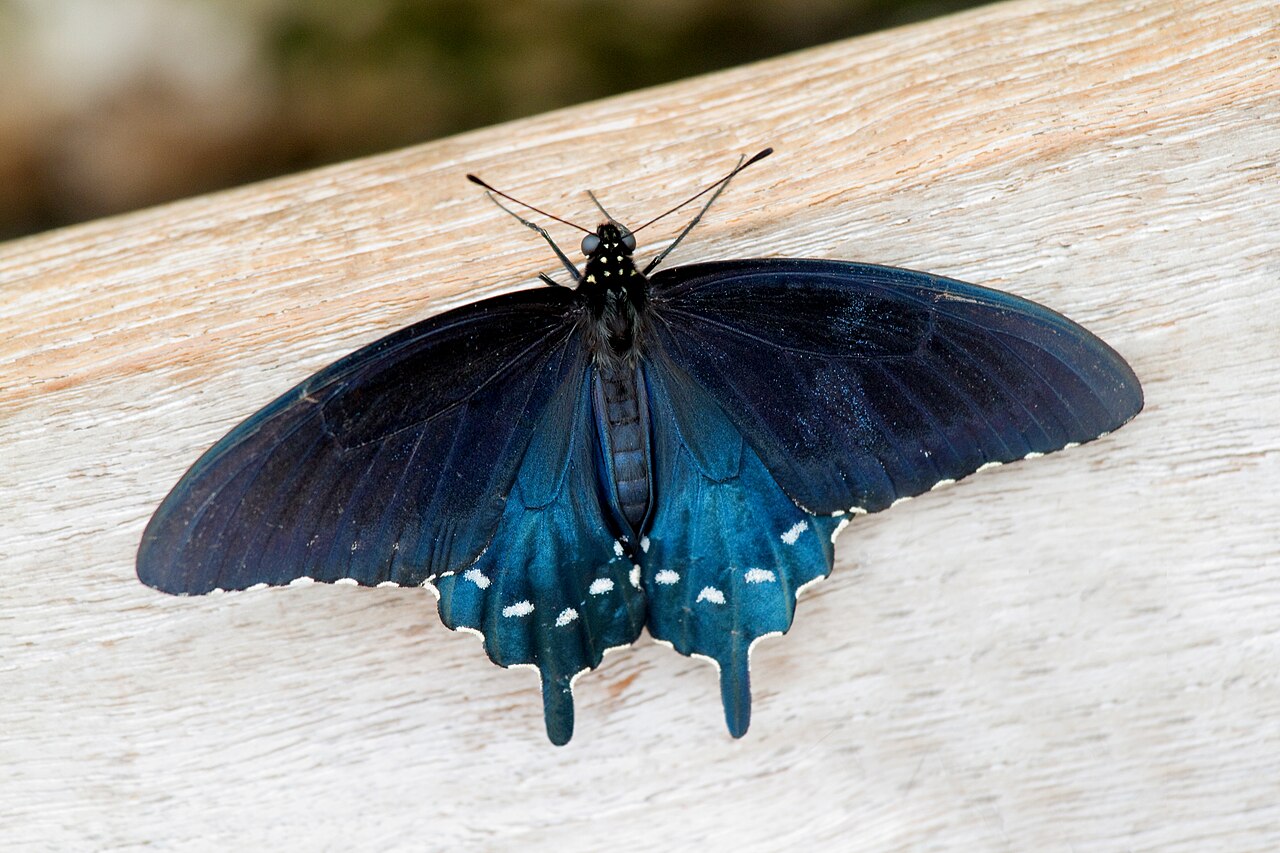
The spicebush swallowtail presents another commonly encountered black-and-blue patterned species, displaying black wings overall with a distinctive blue-green patch on the hindwing in males, or a somewhat more blue-toned equivalent patch in females, plus pale spots along the wing margins that provide a useful distinguishing detail from the more uniformly dark pipevine swallowtail.
This species also participates in the same pipevine-mimicry complex covered above, its dark coloration and hindwing patch believed to provide some degree of predator protection through resemblance to the genuinely toxic pipevine swallowtail, despite spicebush swallowtail caterpillars actually feeding on spicebush and sassafras rather than any toxic pipevine plant, making this species non-toxic itself despite benefiting from the visual association.
Ranging across much of the eastern United States, overlapping considerably with pipevine swallowtail range, spicebush swallowtails are best distinguished from their toxic model by checking for the pale marginal spots and the specific hindwing patch shape and color, features that, while requiring somewhat closer observation than the pipevine swallowtail’s more uniform iridescent blue-black pattern, become reasonably reliable once specifically looked for in a clear view of the resting or slow-flying butterfly.
Dark-Form Tiger Swallowtail Females
As mentioned in discussions of the classic yellow-and-black tiger swallowtail pattern, some female eastern tiger swallowtails occur in an entirely different dark color form, nearly black overall rather than the typical yellow-and-black striped pattern, and this dark form can show faint blue or blue-gray shadow striping visible mainly in certain lighting, adding yet another possibility to the black-and-blue identification puzzle for anyone specifically encountering this less common female color variant.
This dark form is also understood as part of the broader pipevine-mimicry complex covered throughout this guide, providing female tiger swallowtails additional predator protection through resemblance to the toxic pipevine swallowtail model, a documented example of how widespread and evolutionarily significant this particular mimicry relationship has become across several genuinely unrelated butterfly lineages sharing overlapping range with the toxic model species.
Distinguishing this species from a true pipevine swallowtail generally requires checking for faint shadow-striping remnants of the typical tiger pattern, visible mainly in good lighting and closer observation, along with overall wing shape and size differences between the two species, since tiger swallowtails run somewhat larger on average than pipevine swallowtails despite the superficial coloration overlap in this particular female color form, a size distinction that echoes the general species-scale comparisons covered in our green butterfly guide.
Research Behind the Mimicry Complex
The pipevine swallowtail mimicry complex ranks among the most thoroughly studied examples of Batesian mimicry in North American butterflies, with research published through university entomology departments documenting the specific toxic compounds pipevine swallowtail caterpillars sequester from their host plant and confirming predator avoidance learning through controlled feeding experiments with birds exposed to the toxic model species.
This body of research has also traced how closely each mimic species’ pattern matches the model across different portions of their overlapping range, finding that mimicry accuracy, how closely a harmless species’ coloration matches the toxic pipevine swallowtail, tends to be strongest where the toxic model is most abundant, a pattern consistent with the evolutionary logic that mimicry provides the greatest protective benefit precisely where predators have the most opportunity to learn genuine pipevine swallowtail avoidance.
Understanding this well-documented research background helps explain why so many genuinely unrelated butterfly species and color forms converge on such a similar iridescent blue-black appearance across the same general range, a striking example of convergent evolution driven by shared predator pressure rather than any close genetic relationship between the black and white patterned and blue-black patterned butterflies found across similar overlapping territory.
How to Distinguish the Lookalikes
When facing an uncertain black-and-blue butterfly, checking for tails provides one of the fastest initial sorting features, since true swallowtails, including pipevine, spicebush, and dark-form tiger swallowtails, all display the characteristic tail projections extending from the hindwing, while the red-spotted purple, despite its similar iridescent blue-black coloration, lacks tails entirely, belonging to a different butterfly family without this particular wing structure.
Among the tailed swallowtail possibilities specifically, checking for a distinct hindwing patch versus more uniform coloration helps separate spicebush swallowtail, with its notable blue-green or blue patch plus pale marginal spots, from the more uniformly iridescent blue-black pipevine swallowtail, which lacks this same kind of distinct patch and marginal spotting pattern.
Size and overall proportions offer a final useful check, since dark-form tiger swallowtails run somewhat larger overall than either pipevine or spicebush swallowtails, reflecting the larger baseline size of tiger swallowtails as a species regardless of which color form a specific individual happens to display, making a notably large black-and-blue swallowtail somewhat more likely to represent this dark tiger swallowtail form than either of the other two more common possibilities covered above.
Host Plants and Where to Find Each Species
Finding pipevine swallowtails specifically requires locating pipevine plants, since females lay eggs exclusively on this toxic host, meaning gardens and natural areas with established pipevine growth, whether wild Dutchman’s pipe or cultivated ornamental varieties, represent the most reliable places to encounter this species, particularly in the eastern and southern portions of its range where pipevine grows more commonly.
Spicebush swallowtails follow their namesake host plants instead, spicebush and sassafras specifically, meaning woodland edges and understory areas where these shrubs and small trees grow provide the best opportunities for encountering this species, a somewhat different habitat association than the more varied settings where pipevine swallowtails, tied to their own specific toxic host plant, tend to concentrate instead.
Dark-form tiger swallowtail females, sharing the same general host plant preferences as typical tiger swallowtails, including wild cherry and tulip tree among others, appear in similar garden and woodland edge habitat as their more commonly seen yellow-and-black counterparts, meaning this particular dark form requires no special habitat search beyond simply encountering tiger swallowtails generally and specifically checking whether any female individuals present show the darker color form rather than the more typical striped pattern.
Symbolism of Black and Blue Butterflies
Blue butterflies broadly carry folk associations with joy, rare good fortune, and communication or messages arriving, drawing on blue’s relative rarity in nature and its generally positive color symbolism across many traditions, associations explored in more depth in our blue butterfly guide, while the addition of black in a combined black-and-blue pattern is sometimes read as adding depth, mystery, or a more serious, transformative undertone to that underlying blue symbolism.
This combined black-and-blue interpretation connects to the broader framework of butterfly symbolism centered on transformation, covered throughout our butterfly tattoo meaning guide, with some traditions specifically reading the pipevine swallowtail’s iridescent, shifting quality, appearing black in some light and vividly blue in others, as symbolic of hidden depths or truths revealed only from the right perspective or under the right conditions.
As with all butterfly color symbolism throughout this broader series of guides, these interpretations reflect folk tradition and personal meaning-making rather than any claim about the insects’ biology itself, and the genuinely fascinating ecological story behind this species, its toxicity and the extensive mimicry complex built around it, offers its own kind of wonder entirely separate from any symbolic reading someone might choose to layer onto an encounter with this striking butterfly.
Related reading: White Butterfly.
Related reading: Blue Morpho Butterfly.
Related reading: Eastern Tailed-Blue Butterfly.
Related reading: Xerces Blue Butterfly.
Related reading: Karner Blue Butterfly.
Related reading: Miami Blue Butterfly.
Related reading: Blue Carpenter Bee.
Frequently Asked Questions
What is a black and blue butterfly called?
Most commonly the pipevine swallowtail, recognized by its iridescent blue-black hindwings and black forewings and body. This species is toxic to predators due to its caterpillars feeding exclusively on pipevine plants.
Are black and blue butterflies poisonous?
The pipevine swallowtail specifically is toxic to predators, having absorbed toxic compounds from its pipevine host plant as a caterpillar, though this poses no danger to humans handling or observing the butterfly.
Why do so many butterflies look like the pipevine swallowtail?
Several species, including the red-spotted purple, spicebush swallowtail, and dark-form female tiger swallowtails, have evolved similar blue-black coloration through mimicry, gaining predator protection by resembling the genuinely toxic pipevine swallowtail without being toxic themselves.
How can I tell a pipevine swallowtail from a red-spotted purple?
Check for tails: pipevine swallowtails display the characteristic tail projections all true swallowtails have, while red-spotted purples lack tails entirely despite showing similar iridescent blue-black coloration.
What plant do pipevine swallowtail caterpillars eat?
Exclusively pipevine plants (Aristolochia species), which contain toxic compounds the caterpillars absorb and retain into adulthood, making the adult butterfly unpalatable to most predators.
Is the blue color on these butterflies from pigment?
No, the iridescent blue seen on the pipevine swallowtail and its mimics comes from microscopic wing scale structure reflecting light rather than blue pigment, which is why the color can appear to shift or disappear depending on viewing angle.
What does a black and blue butterfly mean spiritually?
In various folk traditions, blue suggests joy and good fortune while black adds depth or transformative meaning, with some interpretations specifically reading the pipevine swallowtail’s shifting iridescence as symbolizing hidden truths revealed from the right perspective.