Baby Iguana: Size, Diet, Care, and How Fast They Grow
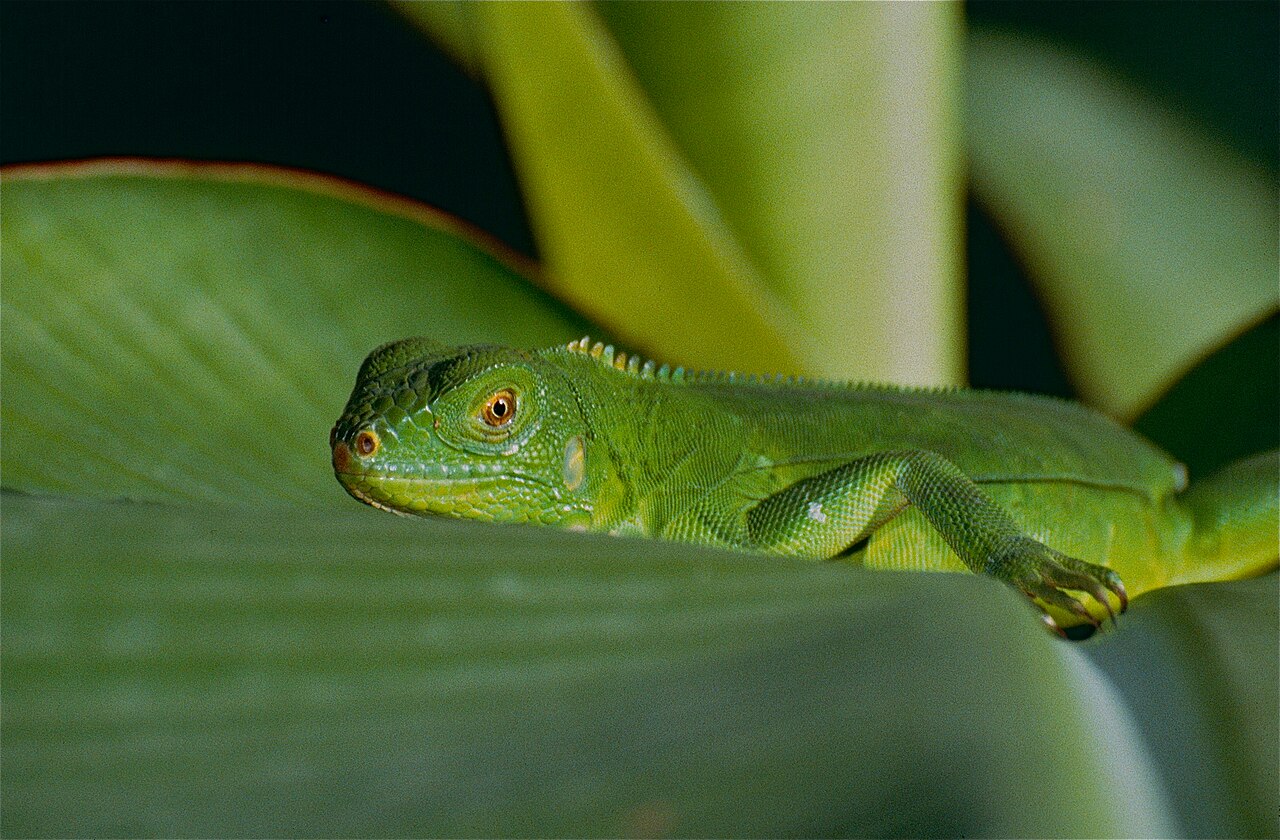
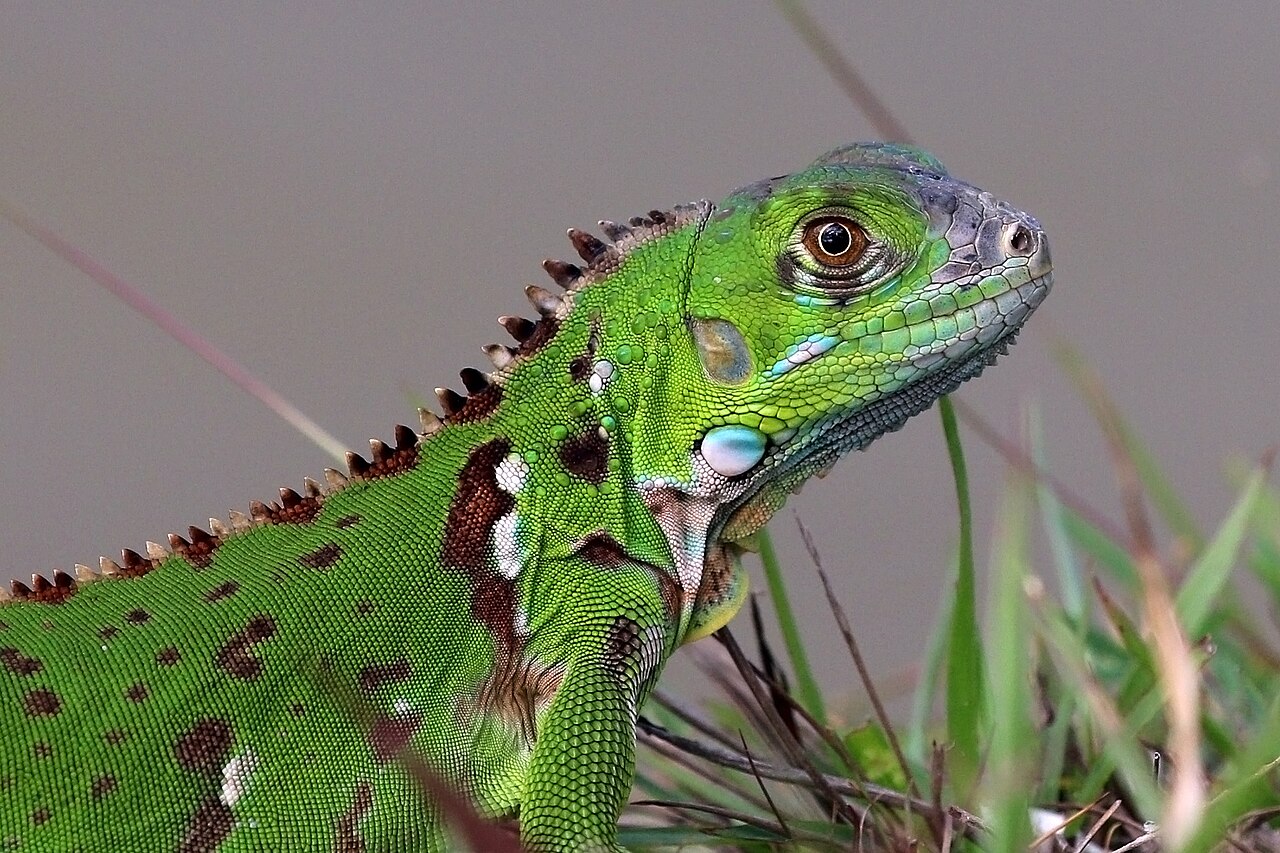
A baby iguana is a hatchling green iguana (Iguana iguana) that measures roughly 6 to 12 inches from snout to tail tip and weighs less than an ounce at hatching. It is bright emerald green, has a whip-thin tail that makes up two thirds of its total length, and is fully independent from the moment it digs out of the nest. Nothing about a baby iguana prepares first-time keepers for what comes next: this palm-sized lizard grows into a 4 to 6 foot animal weighing 10 to 20 pounds within about four years.
That growth curve is the single most important fact about the species, and it drives every care decision from the first week onward. Hatchlings are strict herbivores, need intense ultraviolet light to build bone, and outgrow a starter tank in a matter of months. Wild hatchlings face the opposite problem: almost everything in a Central American forest eats them, so they hatch in large groups and scatter fast. Both stories are worth knowing before a baby iguana ever comes home.
| Scientific name | Iguana iguana (green iguana) |
| Size at hatching | 6 to 12 inches total, tail included |
| Adult size | 4 to 6 feet, 10 to 20 pounds |
| Clutch size | 20 to 70 eggs, buried in sandy soil |
| Diet | Herbivore from day one, no animal protein |
| Basking temperature | 95 to 100 degrees Fahrenheit |
| Lifespan | 10 to 20 years in good captive care |
What a Baby Iguana Looks Like
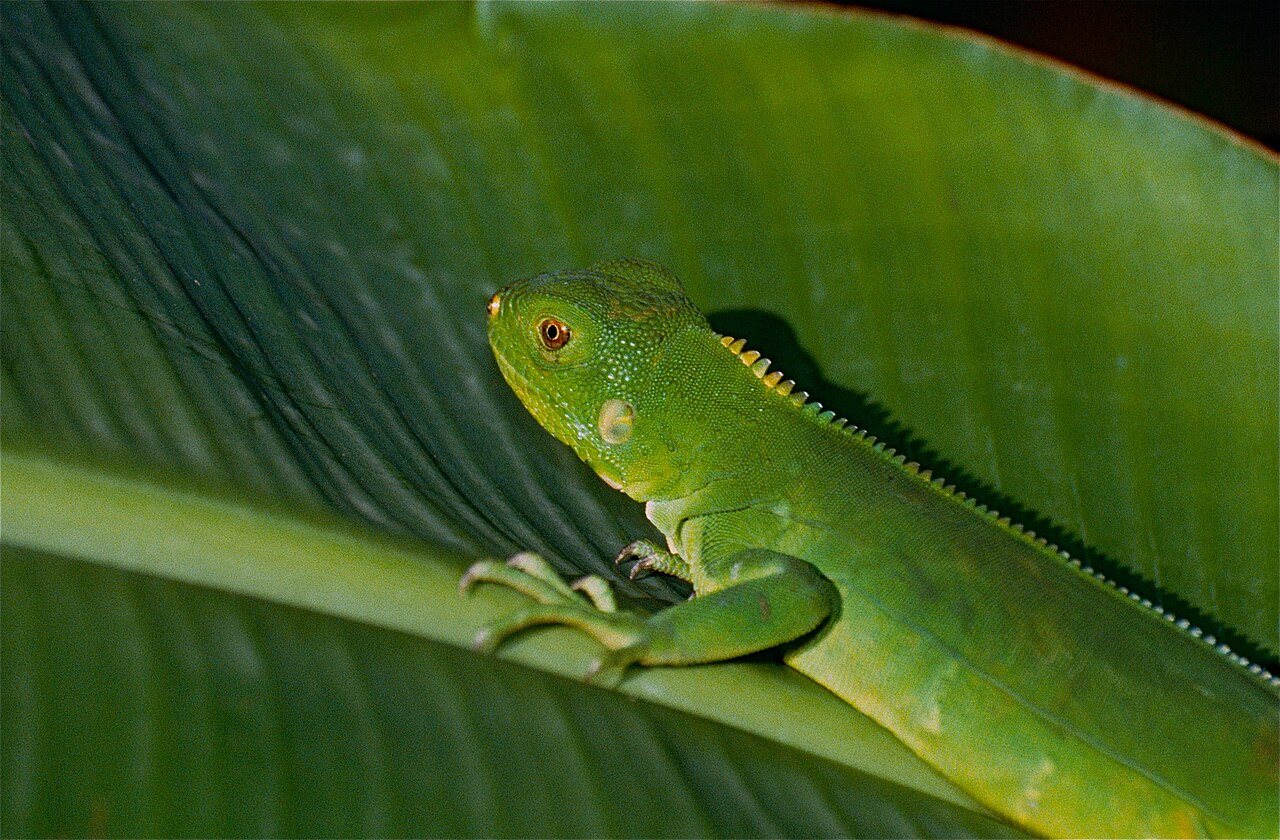
Hatchling green iguanas are a saturated, almost artificial green that adults lose as they mature into duller olive, gray-green, or orange tones. The body itself is only 2 to 4 inches long; the rest of that 6 to 12 inch measurement is a slender banded tail that the animal uses for balance, swimming, and defense. The dorsal crest that makes adult iguanas look prehistoric is already present at hatching, but the spines are soft, short, and barely raised. The dewlap, the flap of skin under the throat, is a small triangle rather than the dinner-plate fan an adult male eventually develops.
Two features on a hatchling surprise people who have only kept geckos. The first is the parietal eye, a pale scale on top of the head that contains light-sensitive tissue. It does not form images, but it detects shadows passing overhead, which is exactly the early warning system a six-inch lizard needs when hawks hunt the canopy above it. The second is the claw set: baby iguanas already have needle-sharp, curved claws built for gripping bark, and they will leave scratches on human forearms long before they are big enough to cause any real harm.
Sex is essentially impossible to determine at hatching without veterinary examination. Femoral pores, jowls, and the enlarged dewlap that separate males from females do not appear until an iguana is well over a year old. Color offers no clue either, since both sexes hatch the same shade of green. Anyone selling a hatchling as a guaranteed male or female is guessing, which matters because adult males are the larger, more territorial, and more demanding animals of the two.
How Big Do Baby Iguanas Get
Growth is fast, sustained, and the reason most pet iguanas are surrendered. A well-fed hatchling typically doubles its snout-to-vent length in the first year and reaches roughly 2 to 3 feet in total length by 12 months. By year two it commonly passes 3 feet, by year three or four it approaches adult size at 4 to 6 feet, and weight climbs from under an ounce to 10 to 20 pounds over the same period. Some large males exceed 6 feet, and reports of 7 foot animals in ideal conditions are not unusual.
That trajectory means the enclosure that fits a hatchling is obsolete within a few months, and the enclosure that fits a yearling is obsolete within a year of that. Keepers who budget for the hatchling setup and nothing else usually end up housing a 4 foot lizard in a tank designed for a corn snake, which produces stunted growth, spinal problems, and chronic stress. Planning the adult enclosure before the baby arrives is the difference between a healthy 15 year animal and a rescue case.
Growth also slows dramatically if temperature, ultraviolet light, or calcium is wrong, which makes size a rough health indicator. A baby iguana that is still hatchling-sized at eight months is not a convenient dwarf; it is an animal whose metabolism is not functioning. Compare that with a species like the crested gecko, which tops out around 8 inches for life and genuinely suits a modest enclosure. The two animals are marketed side by side in the same shops, and they could hardly be less alike in long-term commitment.
What Baby Iguanas Eat
Green iguanas are herbivores from the moment they hatch, which sets them apart from nearly every other lizard sold as a starter pet. The daily base should be dark leafy greens: collard greens, mustard greens, turnip greens, dandelion greens, and endive. Kale and bok choy are useful in rotation but contain goitrogens, so they work better as part of a mix than as a staple. Shredded squash, green beans, snap peas, and small amounts of bell pepper round out the vegetable portion, and fruit such as papaya, mango, or berries belongs in the diet as a garnish rather than a course.
The critical ratio is calcium to phosphorus, which should sit near 2 to 1. Greens high in calcium and low in oxalates support bone growth; spinach, beet greens, and rhubarb bind calcium and should stay off the menu. Hatchlings eat daily, often twice a day, and food should be chopped or grated fine enough that a lizard with a half-inch mouth can handle it. Anything uneaten after 24 hours goes in the bin, since warm enclosures turn leftover produce into a bacterial culture quickly.
Animal protein is the single most common feeding mistake. Crickets, mealworms, dog food, and eggs all get offered by keepers who assume any lizard eats bugs, and the result is progressive kidney damage that may not become obvious for years. This is the opposite of what most keepers learn from insectivorous species, and the contrast with what other lizards eat is worth understanding before the first meal. A calcium supplement with vitamin D3, dusted onto food once or twice a week, completes a hatchling diet that otherwise runs slightly short.
Setting Up a Baby Iguana Enclosure
A hatchling can start in an enclosure around 18 by 18 by 36 inches, with the height mattering more than the floor space because iguanas are arboreal and climb constantly. Sturdy branches set at multiple heights, a broad basking shelf directly under the heat source, and a hide at ground level give the animal the vertical range it uses in the wild. Everything inside needs to be genuinely secure, since even a small iguana is strong enough to shift decor and will fall if a branch rolls under its weight.
Substrate for hatchlings should be simple and non-ingestible: paper towel, reptile carpet, or a tightly woven cage liner. Loose substrates like gravel, calcium sand, or bark chips create impaction risk in an animal that tears at food with its mouth against the floor. Cleaning is easier too, and daily spot cleaning matters because droppings in a warm humid enclosure are a bacterial reservoir. Learning to read what comes out is genuinely useful, and the general patterns in lizard droppings apply to iguanas as well.
The adult enclosure is where realistic planning matters. A minimum of 6 feet long by 3 feet deep by 6 feet tall is the usual recommendation, and many experienced keepers dedicate an entire room or build a custom cage. Aquariums are unsuitable at every stage past the first few months because they lack height and ventilation. Budgeting a few hundred dollars for a hatchling setup while ignoring the four-figure adult build is how iguanas end up in cramped tanks.
Heat, UVB, and Humidity Requirements
Baby iguanas need a thermal gradient, not a single temperature. A basking spot of 95 to 100 degrees Fahrenheit lets the animal reach the body temperature it needs to digest plant matter, while the cool end should sit between 75 and 85 degrees so it can shed heat when it wants to. Nighttime can drop into the low 70s safely. Measuring with a digital probe or infrared thermometer at basking-surface level, not with a stick-on dial on the glass, is the only way to know what the lizard actually experiences.
Ultraviolet B light is not optional for this species. Without UVB, an iguana cannot synthesize vitamin D3, cannot absorb dietary calcium, and develops metabolic bone disease regardless of how good its diet looks on paper. A linear UVB tube spanning most of the enclosure length outperforms a compact bulb, and it must be mounted where the animal can bask within the manufacturer’s stated effective distance. Output fades long before the bulb stops emitting visible light, so replacement every 6 to 12 months according to the manufacturer’s guidance is part of routine care.
Humidity belongs at roughly 60 to 80 percent, which reflects the tropical forests these lizards come from. Daily misting, a large water bowl, and a humidity-retaining setup keep shedding clean and support kidney function. Chronic low humidity causes stuck sheds around the toes and tail tip that can constrict and cause tissue loss. A hygrometer placed at mid-enclosure height, checked daily, catches drift before it becomes a problem.
Health Problems in Baby Iguanas
Metabolic bone disease is the defining illness of poorly kept young iguanas. It develops when calcium, vitamin D3, or UVB exposure falls short, and the body pulls calcium out of the skeleton to keep blood levels stable. Early signs include a rubbery lower jaw, swollen limb joints, tremors, reluctance to climb, and a jaw that no longer closes properly. Advanced cases involve fractures from ordinary movement, and while treatment can stabilize an animal, deformity is often permanent. Prevention through correct lighting and diet is dramatically easier than treatment.
Respiratory infections are the second common problem, usually driven by enclosures that are too cool or too damp without adequate ventilation. Open-mouth breathing, bubbling around the nostrils, wheezing, and lethargy all warrant a visit to a reptile-experienced veterinarian rather than a wait-and-see approach. Internal parasites are common in wild-caught and imported hatchlings, which is why a fecal examination in the first weeks is standard advice. Thermal burns from unguarded heat lamps and heat rocks round out the list of avoidable injuries.
Salmonella deserves its own mention. According to the CDC (cdc.gov), reptiles and amphibians commonly carry Salmonella bacteria in their digestive tracts and shed them in droppings even when the animal appears completely healthy. The agency advises washing hands thoroughly after handling reptiles or anything in their enclosures, and recommends against reptiles in households with children under five, adults over 65, or anyone with a weakened immune system. Keeping the enclosure out of kitchens and never washing enclosure equipment in a food-preparation sink handles most of the practical risk.
Handling and Temperament
Hatchling iguanas are naturally skittish because in the wild almost every larger animal is a predator. Early handling should be short, frequent, and calm: a few minutes at a time, supporting the whole body, never grabbing from above the way a bird of prey would. Iguanas that are handled consistently through their first year usually become tolerant adults, while those left alone until they are large often stay defensive for life. Consistency in the first six months does more for adult temperament than anything attempted later.
Even tame babies use their defenses. The tail is a whip that stings, the claws scratch deeply, and the bite from a hatchling is more startling than damaging. Tail autotomy is real in young iguanas, meaning a tail grabbed or trapped can break off; it regrows, though never with the original banding or length. Never restrain an iguana by the tail, and never let a small child carry one unsupervised.
Sexually mature males, typically from around 18 months to 3 years, go through a seasonal period of heightened aggression that catches many keepers off guard. Head bobbing intensifies, the dewlap flares, and an otherwise calm animal may lunge at the person it has known its whole life. This phase passes each season but recurs annually. It is the point at which many iguanas are surrendered, and it is entirely predictable, which is why serious keepers plan for it rather than react to it. First-time reptile keepers are usually better served by a smaller, more forgiving animal such as a baby leopard gecko or a Mediterranean house gecko.
Wild Baby Iguanas and Florida’s Invasive Population
In their native range across Mexico, Central America, and northern South America, female green iguanas dig burrows in sandy soil near water and lay 20 to 70 eggs in a single clutch. Incubation runs roughly 10 to 15 weeks depending on soil temperature, and hatchlings emerge together, dig their way to the surface, and disperse without any parental care. Group hatching is a survival strategy: predators can only take so many at once, so synchronized emergence improves the odds for the group even though individual mortality stays high.
Wild hatchlings live higher in the canopy than adults do, feeding on tender new growth and staying near water where they can drop and swim to escape. Green iguanas are strong swimmers and will submerge for extended periods when threatened, a behavior that shows up even in captive-bred babies given a large enough water bowl. Their predators include hawks, snakes, raccoons, and large fish, which is why that parietal eye and the instinct to freeze against a branch develop so early.
Florida is now home to a large established population descended from escaped and released pets, and the Florida Fish and Wildlife Conservation Commission classifies the green iguana as an invasive species. Hatchlings appear in canal banks, seawalls, and suburban yards across South Florida, where the burrows adults dig undermine sidewalks and flood-control infrastructure. Cold snaps periodically knock out large numbers of them, producing the widely reported phenomenon of iguanas dropping from trees when temperatures fall into the 40s. The population is a direct consequence of the mismatch between how small these animals start and how large they become, the same mismatch that ends most private iguana keeping. Anyone wanting a manageable reptile that stays modest for life would do better with a baby box turtle and its very different long-term needs.
Frequently Asked Questions
How big is a baby iguana when it hatches?
A hatchling green iguana measures roughly 6 to 12 inches from snout to tail tip and weighs under an ounce. The body itself is only 2 to 4 inches long, since the tail accounts for about two thirds of the total measurement. That size lasts a matter of months before rapid growth begins.
What do baby iguanas eat?
Baby iguanas are herbivores from hatching and eat dark leafy greens such as collard, mustard, turnip, and dandelion greens, plus squash, green beans, and small amounts of fruit. Food should be finely chopped and dusted with a calcium and vitamin D3 supplement once or twice weekly. Animal protein of any kind can damage the kidneys over time.
How fast do baby iguanas grow?
A healthy hatchling usually reaches 2 to 3 feet in total length within its first year and approaches adult size of 4 to 6 feet by age three or four. Weight climbs from under an ounce to 10 to 20 pounds over the same period. Growth that stalls typically signals a problem with UVB, temperature, or calcium.
Do baby iguanas bite?
They can, though a hatchling bite is startling rather than injurious. Young iguanas more often defend themselves by whipping the tail or scratching with sharp claws. Consistent gentle handling during the first year substantially reduces defensive behavior in adulthood.
Can a baby iguana live in a 20 gallon tank?
Only very briefly, and it is not a good starting point. A hatchling needs vertical space to climb, so an enclosure around 18 by 18 by 36 inches works better, and even that is outgrown within months. The adult enclosure should be at least 6 feet long by 3 feet deep by 6 feet tall.
Why is my baby iguana turning dark or brown?
Darkening often means the animal is too cool and is absorbing more heat, since darker skin warms faster. It can also indicate stress, illness, or an approaching shed. Check basking temperature first, then look for other symptoms such as lethargy or refusal to eat.
How long do iguanas live?
Green iguanas commonly live 10 to 20 years in good captive care, and some individuals exceed 20 years. Poor lighting, incorrect diet, and undersized enclosures cut that dramatically, and many pet iguanas die within their first few years. The lifespan is a genuine multi-decade commitment.