What Is a Group of Penguins Called? Waddle, Raft, and Colony
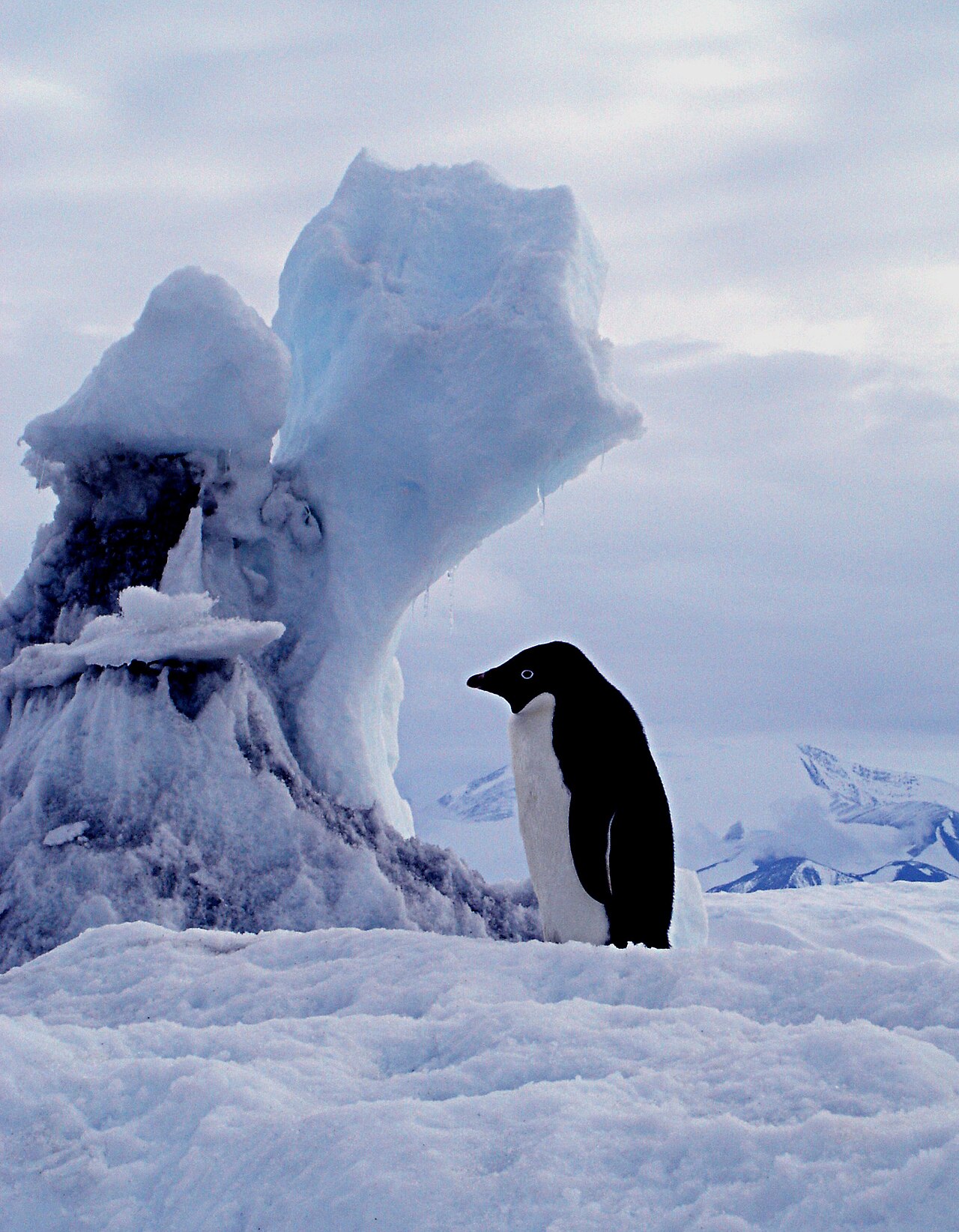
A group of penguins is called a waddle when the birds are on land, a raft when they are in the water, and a colony or rookery when they are nesting. The often-repeated claim that a group of penguins is called an embarrassment is an internet joke with no basis in any dictionary or reference work, though it has spread far enough that it now appears on merchandise. What is a group of penguins called therefore has three real answers depending on where the birds are, plus one persistent myth.
The land and water distinction is the same system English applies to ducks and geese, and for penguins it is especially apt, since no animal looks more different in its two environments. On land a penguin is comic and ungainly; in water it is a fast, precise predator that can swim at 15 miles per hour and dive to depths that would kill a human. This guide covers every term for a group of penguins, explains where waddle and rookery come from, describes the huddles that keep emperor penguins alive through the Antarctic winter, and sorts out what to call chicks.
A group of penguins is called a waddle on land, a raft in the water, and a colony or rookery when nesting. A group of chicks left together is a crèche, and a tight winter cluster of emperor penguins is a huddle. The claim that a group of penguins is called an embarrassment is an internet joke, not a real collective noun.
| Situation | Term |
|---|---|
| On land, walking | Waddle |
| In the water | Raft |
| Nesting together | Colony or rookery |
| Chicks grouped together | Crèche |
| Emperor penguins in winter | Huddle |
| Baby penguin | Chick |
| Not a real term | Embarrassment (internet joke) |
Why Is a Group of Penguins Called a Waddle?
A group of penguins on land is called a waddle because of how they walk. Penguins have short legs set far back on the body, an adaptation for swimming that makes them efficient in water and awkward on land, and the resulting side-to-side rocking gait is the single most recognizable thing about them. Waddle as a collective noun is descriptive rather than metaphorical, which is why it feels so natural.
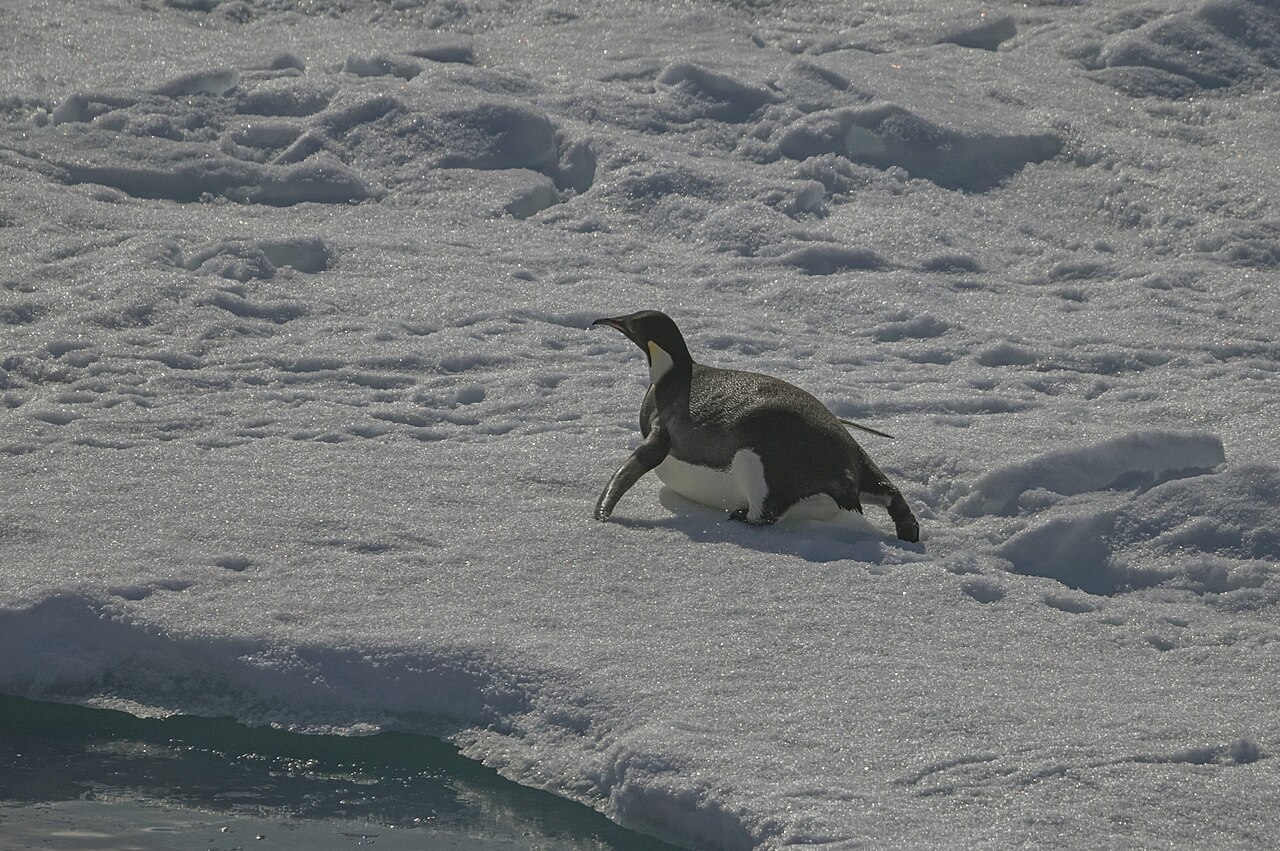
The gait is less inefficient than it looks. Research using force plates has shown that the rocking motion actually conserves energy by allowing penguins to recover mechanical energy with each step, much as a pendulum does. Penguins are still costly walkers compared with other birds of similar mass, but the waddle is the best available solution for a body shaped for underwater flight. On ice they often abandon walking entirely and toboggan on their bellies, pushing with feet and flippers, which is far faster.
Waddle as a term is modern rather than medieval, which is unsurprising given that Europeans did not encounter penguins until the age of exploration. It belongs to the same recent tier as a flamboyance of flamingos and a parliament of owls, invented by later writers extending the old tradition to species the original compilers never saw. It is now the standard answer, appearing in dictionaries and reference works.
What Is a Raft of Penguins?
A raft of penguins is a group of penguins floating or swimming together at the surface, using the same term that applies to ducks on water. Penguins raft before coming ashore and after leaving, often gathering in dense groups just offshore, and the behavior has a clear purpose: safety in numbers against leopard seals, sea lions, and orcas that patrol the water directly outside a colony.
The tension of that moment is famous. Adélie and gentoo penguins will mill in a raft at the ice edge for extended periods before anyone commits to entering the water, and once one bird goes, the rest follow in a rush. The same happens in reverse when returning, with the group porpoising in fast and exiting the water in a burst. Both behaviors reduce any individual’s odds of being the one taken.
Penguins in water are transformed animals. Emperor penguins routinely dive to 500 feet and have been recorded below 1,700 feet, holding their breath for over 20 minutes, and gentoos are the fastest swimming birds at up to 22 miles per hour. Their wings have become rigid flippers, their bones are dense rather than hollow, and they steer with feet and tail. A raft of penguins is a group of some of the most accomplished divers among all birds.
Is a Group of Penguins Called a Rookery or a Colony?
Both terms are used for a penguin breeding site, and colony is the more technically correct one. Rookery originally referred to a breeding colony of rooks, the European corvid that nests in dense treetop groups, and the word was later applied by analogy to seals, penguins, and other animals that breed in crowded assemblies. Many biologists now prefer colony precisely because rookery carries that borrowed sense, but rookery remains in common use and is not wrong.
Penguin colonies are among the largest bird breeding aggregations in the world. A chinstrap penguin colony on Zavodovski Island in the South Sandwich Islands has been estimated at over a million breeding pairs, and Adélie colonies at Cape Adare hold hundreds of thousands. Emperor penguin colonies, discovered in recent years partly by spotting guano stains on satellite imagery, typically number a few thousand to tens of thousands of pairs.
Colony density is extraordinary and constant. Nesting penguins of most species space themselves at roughly the distance one bird can reach with its bill, so a colony is a grid of birds each just out of pecking range of its neighbors. The noise is continuous, the smell is powerful, and the ground turns pink or white with guano depending on diet. Despite the chaos, pairs return to the same nest site year after year and locate each other by voice.
Is a Group of Penguins Called an Embarrassment?
No. The claim that a group of penguins is called an embarrassment is a joke that spread through social media and listicles and has no basis in any dictionary, collective noun list, or scientific source. It is not recorded in the Book of Saint Albans or in any of the historical compilations, and it does not appear in Merriam-Webster or the Oxford English Dictionary as a term for penguins.
The joke likely spread because it is funny and because collective nouns are exactly the kind of trivia people repeat without checking. It has become common enough to appear on T-shirts and in quiz answers, which creates a feedback loop where the claim gets cited to itself. A similar pattern produced “a congress of turkeys” and “a fluffle of rabbits,” neither of which is traditional either, though fluffle at least has entered some informal dictionary listings.
None of this means you cannot use it for fun. Collective nouns are a playful tradition and new ones do enter the language; waddle itself was invented in the modern era. The distinction worth maintaining is between terms that reference works record, such as waddle, raft, colony, and rookery, and terms that are jokes presented as facts. If a quiz expects one answer for penguins, waddle is the safe one.
What Is a Group of Baby Penguins Called?
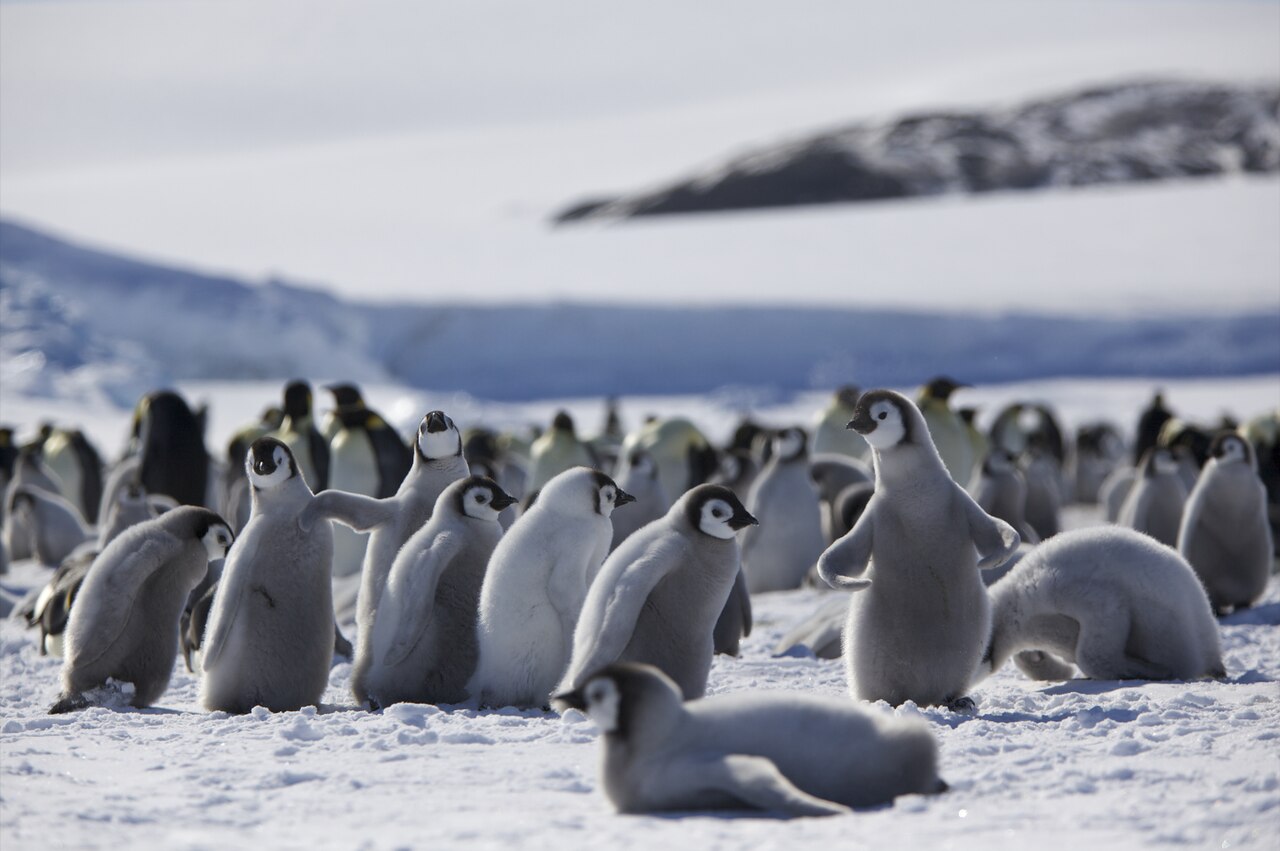
A group of penguin chicks is called a crèche, and this is a genuine technical term in ornithology rather than a fanciful one. Once chicks have grown enough to regulate their own body temperature, usually a few weeks after hatching, they leave their parents and gather into dense groups supervised by a small number of adults while both parents travel to the sea to feed. Crèches can contain hundreds or thousands of chicks.
The crèche solves a specific problem. A single chick needs more food than one parent can supply on solo trips, and a chick left alone is vulnerable to skuas, giant petrels, and cold. Crèching frees both parents to forage simultaneously while keeping the chick warm and defended. Returning parents locate their own chick by call among thousands, and chicks that beg from the wrong adult are rejected and sometimes chased.
Emperor penguin chicks are the most striking example, standing in gray downy masses on the sea ice while adults commute up to 50 miles each way to open water. Baby penguins are called chicks; there is no separate term equivalent to gosling or duckling. Very young emperor and king penguin chicks are sometimes informally called woolly chicks because of their thick down, which they must fully molt before they can safely enter the water.
What Is a Penguin Huddle?
A huddle is the tight cluster emperor penguins form to survive the Antarctic winter, and it is one of the most extreme social behaviors in the animal kingdom. Emperor penguins breed in winter, with males incubating a single egg on their feet for about 65 days in temperatures down to minus 40 degrees Fahrenheit and winds over 100 miles per hour, while females are away at sea. The huddle is what makes this survivable.
Densities inside a huddle reach roughly 10 birds per square meter, and temperatures at the center can exceed 70 degrees Fahrenheit while the outside air is far below zero. The huddle is not static: it moves constantly in slow travelling waves, with birds taking tiny coordinated steps every 30 to 60 seconds, and this wave motion gradually rotates individuals from the sheltered center to the exposed edge and back. Nobody stays cold and nobody overheats.
Research published by the Alfred Wegener Institute has shown that these waves are triggered by individual birds and propagate through the huddle like a compression wave in a fluid, without any leader or coordination signal. The result is one of the clearest examples of a self-organizing system in animal behavior, and it lets a male emperor penguin lose about 45 percent of his body weight over the incubation fast and still survive to hand the chick over when the female returns.
Do All Penguins Live in Groups?
Almost all of the 18 penguin species are colonial breeders, but the degree varies substantially. Adélie, chinstrap, king, and emperor penguins form enormous dense colonies. Gentoo penguins nest in smaller, looser groups. At the other end, the yellow-eyed penguin of New Zealand nests solitarily in coastal forest, with pairs deliberately out of sight of each other, and will abandon a site if neighbors are too close.
Little penguins, smaller than most seabirds and roughly the size of the goslings people see on spring ponds, nest in burrows and rock crevices along the southern Australian and New Zealand coasts, and while they are colonial they are far more dispersed than Antarctic species. Their nightly return from the sea in loose groups is the basis of the famous penguin parade at Phillip Island in Victoria, where the birds cross the beach after dark in exactly the rafting-then-waddling sequence the collective nouns describe.
Only two species breed on the Antarctic continent itself, the emperor and the Adélie. The rest are spread across the sub-Antarctic islands, southern South America, southern Africa, Australia, New Zealand, and, in the case of the Galápagos penguin, right at the equator. The popular association of penguins with ice and snow describes a minority of the family, and the notion that penguins and polar bears share a habitat is wrong by the width of the planet: polar bears live only in the Arctic.
Collective Nouns for Penguins Compared With Other Birds
Penguins fit the same land-and-water pattern that English applies to other waterbirds, which is what makes their vocabulary coherent rather than arbitrary. Ducks are a raft on water and a flock in flight; geese are a gaggle on the ground and a skein in the air; swans are a bevy on water and a wedge flying. Penguins, which cannot fly, get waddle for land and raft for water, and the pattern holds.
Other terms cluster by behavior across unrelated birds. Colony and rookery apply to any species that breeds in dense assemblies, from penguins to gannets to herons. Crèche applies to any species whose chicks gather in supervised groups, which includes penguins, flamingos, eiders, and ostriches. These are functional ornithological terms rather than folklore, and they transfer freely between species.
The contrast with the fanciful tradition is instructive. A parliament of owls describes birds that do not gather; a waddle of penguins describes something anyone can watch. Penguin terminology stayed grounded because the birds were named after the invention of modern natural history rather than during the medieval fashion for elaborate hunting vocabulary. The group of ducks guide covers the raft term as it applies to waterfowl, and the group of geese guide handles the gaggle and skein system that penguins parallel on land and water. For the flamingo version of the crèche system, see the baby flamingo guide, and for how a comparable colony works in a very different animal, the group of bats guide.
Frequently Asked Questions
What is a group of penguins called?
A group of penguins is called a waddle on land, a raft in the water, and a colony or rookery when nesting. A group of chicks is a crèche, and a tight winter cluster of emperor penguins is a huddle.
Is a group of penguins called an embarrassment?
No. That is an internet joke with no basis in any dictionary or collective noun list, despite appearing widely on merchandise and in quiz answers. The real terms are waddle, raft, colony, and rookery.
Is a group of penguins called a waddle?
Yes, when they are on land. Waddle describes the side-to-side rocking gait produced by short legs set far back on the body, an adaptation for swimming that makes walking awkward.
What is a group of penguins in water called?
A raft, the same term used for ducks. Penguins gather in rafts offshore before landing and after departing, which reduces any individual’s risk from leopard seals and orcas patrolling the water near colonies.
What is a group of baby penguins called?
A crèche. Chicks old enough to regulate their own temperature leave their parents and gather in large supervised groups, freeing both parents to forage at sea. Baby penguins are simply called chicks.
What is a group of emperor penguins called?
The same as any penguin: a waddle, raft, or colony. During the Antarctic winter, emperor penguins form huddles, dense clusters that reach 10 birds per square meter and move in slow waves to rotate birds between the warm center and cold edge.
Do penguins live in groups all year?
Most species do, though they disperse to sea outside the breeding season and return to colonies to nest. Yellow-eyed penguins are the main exception, nesting solitarily in coastal forest and avoiding sight of other pairs.