What Is a Group of Turkeys Called? Rafter, Flock, and Gang Explained
A group of turkeys is called a rafter, and that is the collective noun you will find in most dictionaries and birding references. In everyday American English, a group of turkeys is also simply called a flock, and biologists at state wildlife agencies use “flock” almost exclusively. Two other terms appear in older lists: a gang of turkeys, usually applied to a band of young males, and a posse, which is a modern joke that stuck. What is a group of turkeys called therefore has three honest answers, rafter, flock, and gang, and each one tells you something about how wild turkeys actually live.
The word rafter is the one that surprises people, because it seems to have nothing to do with birds. It almost certainly comes from an old sense of “raft” meaning a large, loose collection of things, the same root that gives us a raft of ducks on the water. Wild turkeys spend their nights roosting in trees, often in a long row along a single branch, and that image of birds lined up like beams under a roof may have reinforced the term. This guide sorts out every name, explains where each came from, and looks at how real turkey flocks form, split, and reunite across the year.
A group of turkeys is called a rafter, which is the traditional collective noun. A group of turkeys is also correctly called a flock, the term wildlife biologists prefer, and a band of young males is sometimes called a gang. Baby turkeys in a group are poults, and a hen with her poults is a brood.
| Question | Answer |
|---|---|
| Standard collective noun | Rafter of turkeys |
| Everyday and scientific term | Flock of turkeys |
| Group of young males | Gang of turkeys |
| Hen with her young | Brood (the young are poults) |
| Typical flock size | 5 to 50 birds, larger in winter |
| Roosting habit | In trees, in loose rows on branches |
| Not correct | Gaggle (geese) or congress (internet myth) |
Why Is a Group of Turkeys Called a Rafter?
A group of turkeys is called a rafter because of an old English use of the word “raft” to mean a large, jumbled quantity of anything, as in “a raft of problems.” That sense of raft dates to at least the 1600s and survives in birding as “a raft of ducks,” the standard term for waterfowl floating together in a dense group. Rafter for turkeys appears in the same lists of collective nouns that were fashionable among English writers from the 15th century onward, when inventing clever group names for animals was a sport for the educated class. Many of those names, like a parliament of owls or an exaltation of larks, were never used by hunters or farmers and simply persisted in books.
A second explanation ties the word to the architectural rafter, the sloping beam that supports a roof. Wild turkeys roost in trees every night, and in winter it is common to see a dozen or more perched in a line along one or two heavy branches of a mature oak or cottonwood, silhouetted at dusk. Anyone who has looked up into a roost tree understands the comparison: the birds sit like beams laid across the framework of the canopy. Whether this image created the term or simply helped it stick is impossible to prove, but it explains why rafter, rather than some other archaic word, has survived into modern usage.
The etymology matters less than the practical point that rafter is the answer expected in quizzes, crossword puzzles, and most reference books. The Merriam-Webster and Oxford dictionaries both list it. If a child asks what a group of turkeys is called, rafter is the word that will earn full marks, even though it is not the word you will hear from a state wildlife biologist explaining fall flock counts. Both are correct; they simply belong to different registers of the language.
Is a Group of Turkeys Called a Flock?
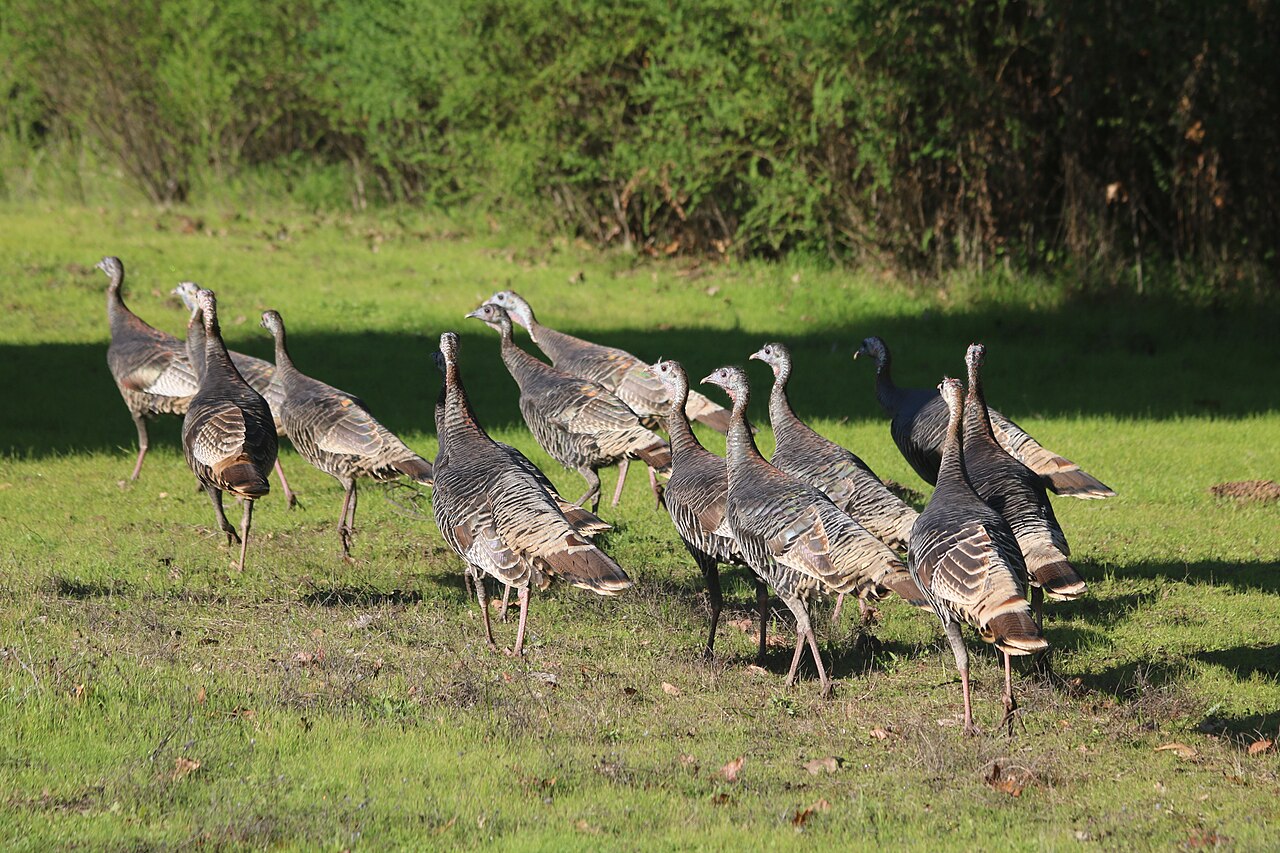
Yes, a group of turkeys is correctly called a flock, and this is the term used by nearly every wildlife agency, hunting guide, and ornithologist in North America. The National Wild Turkey Federation and state agencies such as the Pennsylvania Game Commission describe “winter flocks,” “brood flocks,” and “bachelor flocks” without ever reaching for the word rafter. Flock is the general term for any group of birds, so it is never wrong for turkeys, and it carries the advantage of being understood instantly by everyone.
The distinction between flock and rafter is one of formality, not accuracy. Rafter is the specific collective noun, the kind of word that belongs on the same list as a murder of crows or a charm of finches. Flock is the working vocabulary of people who count, manage, and hunt turkeys for a living. If you are writing a school report or answering a trivia question, use rafter. If you are describing the birds that cross your yard every morning, flock is the natural choice and nobody will correct you.
Biologists also subdivide flocks by composition, because turkey social structure is strongly sorted by age and sex for most of the year. A brood flock is a hen with her poults, sometimes two or three hens combining their broods. A bachelor flock is a group of adult toms. A jake flock is made up of first-year males that have left their mothers but are not yet accepted by the older toms. These labels describe real, observable groupings, which is exactly what makes them more useful in the field than any single collective noun.
What Is a Gang of Turkeys?
A gang of turkeys is a term traditionally applied to a group of young male turkeys, called jakes, that travel together after leaving the hen in late summer or fall. The label fits their behavior remarkably well. Jakes are loud, restless, and prone to shoving matches as they work out a pecking order, and a gang of six or eight of them moving through a field looks and sounds like a group of teenagers with nowhere to be. The term appears in older American hunting literature and has been picked up by modern collective noun lists, where it is often given alongside rafter without explanation.
Gang is not a scientific term, and it is rarely used for mixed flocks or for hens. It works as a description of one specific social unit rather than as a general name for turkeys. Adult toms in a bachelor group are less often called a gang, partly because mature males spend much of the year in small groups of two to five and behave with more restraint than jakes. The word carries a hint of mischief that suits first-year birds better than eight-year-old gobblers with two-inch spurs.
You will also see “posse” offered as a collective noun for turkeys, particularly online. This is a humorous coinage with no history in dictionaries or field guides, and it should be treated as a joke rather than a fact. The same is true of “congress of turkeys,” which spread across social media as a punchline about politicians and is sometimes repeated as if it were traditional. Neither term is wrong to use for fun, but neither is the answer to a serious question about what a group of turkeys is called.
Are a Group of Turkeys Called a Gaggle?
No, a group of turkeys is not called a gaggle. Gaggle is the collective noun for geese on the ground, and it comes from the noisy, cackling calls a flock of geese makes when it is walking or feeding. Turkeys make a very different set of sounds, and their group names developed separately. Confusion arises because both are large, ground-feeding birds common on American farms, and because gaggle is one of the few collective nouns most people can name from memory.
The correct comparison is instructive. Geese get gaggle for a group on land and skein or wedge for a group in flight, because their flying formation is so distinctive. Turkeys are strong short-distance fliers but rarely form organized flight groups, so there is no separate word for turkeys in the air. A group of turkeys is a rafter or a flock whether it is feeding, roosting, or flying up into a tree at dusk. If you want to read more about the goose side of the comparison, the Canada goose guide covers gaggles and skeins in detail.
The same rule applies to other collective nouns people borrow by mistake. A group of turkeys is not a covey, which belongs to quail and grouse, and it is not a brood unless you are specifically describing a hen with her own young. Getting these right matters mainly for trivia and writing, but it also reflects a real difference in how the birds behave: coveys of quail number a dozen or so tight-knit birds, while a winter turkey flock can exceed a hundred.
What Are Baby Turkeys Called, and What Is a Group of Them?
Baby turkeys are called poults, and a group of poults with their mother is called a brood. A single hen typically lays 10 to 12 eggs and hatches most of them over about 28 days of incubation, so a fresh brood in late May or June often numbers 8 to 12 poults. Poults can walk and follow the hen within a day of hatching, and they roost on the ground under her wings for the first two weeks, which is when predation losses are highest. By two to three weeks they can fly up into low branches, and survival improves sharply after that.
Two or more hens often combine their broods in midsummer, producing a brood flock of 20 to 30 birds with several adult females. This is one of the most common turkey groups people see in July and August, a loose parade of hens and half-grown young crossing a road or working the edge of a hayfield for grasshoppers. The female turkey guide explains how to tell the hens from their young at this stage, when the poults have grown their first true feathers but still lack the size and color of adults.
Young turkeys have their own names as they mature. A first-year male is a jake, and a first-year female is a jenny. Jakes are recognizable by their short, stubby beards and the uneven tail fan in which the central feathers are longer than the outer ones. Jennies look like small hens. Both terms are used constantly by hunters and biologists and are worth knowing if you want to describe a flock accurately rather than just counting heads.
How Big Is a Typical Group of Turkeys?
A typical group of turkeys ranges from 5 to 50 birds, with the size depending heavily on the season. Spring flocks are smallest because the birds break up to breed, with toms displaying alone or in pairs and hens slipping off to nest. Summer brings brood flocks of one or a few hens and their poults, usually 10 to 30 birds. Fall and winter produce the largest gatherings, when broods merge, jakes form gangs, and toms group into bachelor flocks; in good habitat with abundant acorns or waste grain, winter flocks of 50 to 100 turkeys are common, and flocks of 200 or more have been documented in agricultural areas of the Midwest.
Flock size is tied directly to food. Wild turkeys are opportunistic feeders that eat acorns, beechnuts, seeds, insects, and green vegetation, and in winter they concentrate wherever food is reliable. A harvested cornfield next to a stand of mature oaks can hold an enormous rafter through January and February. The guide to what turkeys eat details how the diet shifts from insects and soft mast in summer to hard mast and grain in winter, which is exactly the shift that drives the seasonal changes in group size.
Researchers have documented these patterns for decades. The U.S. Geological Survey (usgs.gov) and state wildlife agencies track winter flock counts as an index of population health, and long-term data show that wild turkey numbers in the United States climbed from an estimated 30,000 birds in the early 1900s to roughly 6 to 7 million today after restoration programs. That recovery is why large winter rafters, once a rare sight, now turn up in suburban yards and on golf courses across much of the country.
How Do Turkey Flocks Behave and Communicate?
Turkey flocks are organized around a strict pecking order that is established through fights and displays, particularly among males. Within a bachelor flock, the dominant tom does most of the breeding-season strutting and gobbling while subordinate males stand nearby, and the hierarchy is stable enough that biologists can identify the top bird from one visit to the next. Hens have their own dominance order that governs access to food and roost positions. This structure is why a flock feeding across a field moves in a loose but consistent arrangement rather than as a random crowd.
Communication holds the group together. Turkeys use more than two dozen distinct calls, from the soft purr of contented feeding birds to the sharp alarm putt that sends an entire flock running or flying in an instant. The assembly call, a series of loud yelps from a hen, gathers scattered poults after a disturbance, and the gobble of a tom can carry a mile on a still spring morning. Understanding these sounds is the fastest way to interpret what a flock is doing, and the turkey sounds guide covers each call with its meaning.
Flocks also share sentinel duty. Wild turkeys have exceptional eyesight, estimated at roughly three times sharper than human vision, and a wide field of view. In a feeding group, several birds usually have their heads up at any moment while others feed, and a single alarm from one bird triggers the whole rafter. This cooperative vigilance is one of the main advantages of living in a group and is the reason lone turkeys are far more vulnerable to coyotes, bobcats, and great horned owls than birds in a flock.
Where Do Groups of Turkeys Roost and Sleep?
Groups of turkeys roost in trees at night, flying up at dusk and down again around sunrise. They prefer large, mature trees with strong horizontal branches, often on a slope or near water where they can hear approaching danger and glide away easily. A single roost tree may hold an entire flock, or a big winter rafter may spread across several adjacent trees. Roosting off the ground protects the birds from ground predators, which is why poults move into trees as soon as they are physically able, usually by their third week.
Roost sites are often used repeatedly, and the ground beneath a favored tree accumulates droppings and molted feathers that make the site easy to recognize. Turkey droppings are distinctive: tom droppings are J-shaped or straight and about 2 inches long, while hen droppings are smaller and spiral or clumped. The same trees may be used for weeks in winter, then abandoned as the flock shifts to follow food. In the wild turkey species guide, the roosting section describes how to find and interpret these sites without disturbing the birds.
Turkeys are not entirely silent on the roost. Soft tree yelps and clucks before fly-down are normal, and a flock that has been alarmed will sometimes sit in the branches and call back and forth for several minutes. Domestic turkeys, by contrast, have largely lost the instinct and physical ability to roost high, which is one of the clearest behavioral differences between wild birds and the heavy commercial breeds. The types of turkeys guide explains how the wild subspecies differ from domestic and heritage varieties.
Collective Nouns for Turkeys Compared With Other Birds
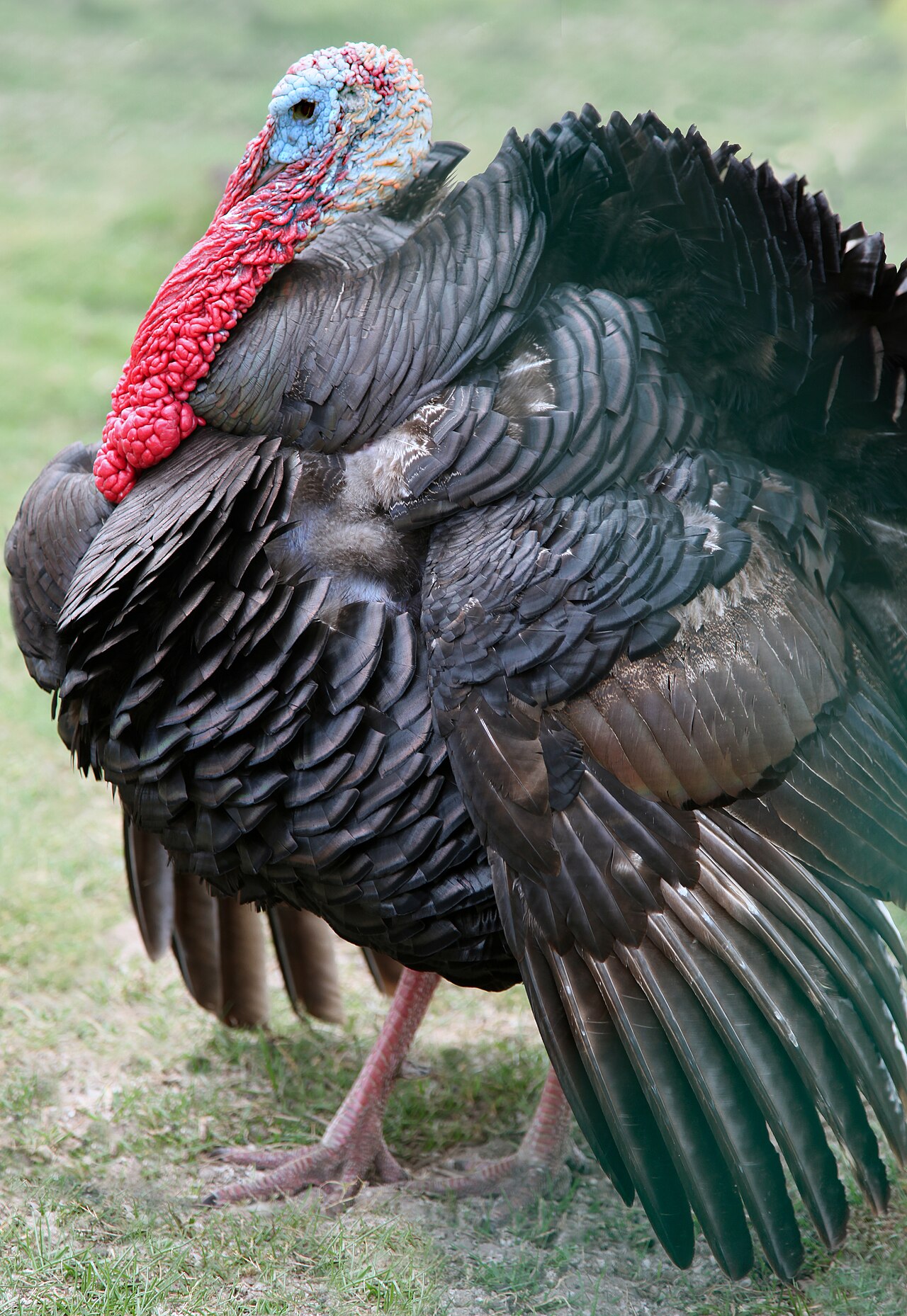
Turkeys are one of many birds with a memorable collective noun, and the comparisons help explain why rafter feels odd while other terms feel natural. A group of geese is a gaggle on the ground and a skein in flight. A group of crows is a murder, and a group of ravens is an unkindness or a conspiracy. Owls gather in a parliament, vultures in a committee or a wake, and hummingbirds in a charm. Most of these are literary inventions rather than working terms, and almost all of them are outnumbered in real use by the plain word flock.
What sets turkeys apart is that their traditional noun, rafter, has a plausible behavioral origin in the roosting habit, while many other collective nouns are pure wordplay. A murder of crows reflects medieval superstition rather than crow behavior, and a parliament of owls comes from a C.S. Lewis novel. The turkey terms, rafter and gang, both describe something you can actually observe: birds lined up on a branch and a rowdy band of young males. That grounding is part of why they have survived where dozens of other invented nouns faded away.
For anyone who enjoys the full list, the Cornell Lab of Ornithology (allaboutbirds.org) notes that collective nouns are a matter of tradition rather than science, and that “flock” is always acceptable for any bird. The wild turkey is North America’s largest game bird, and it stands out in the collective noun lists for the same reason it stands out in the field: the birds are big, social, and easy to watch, so people have been naming their groups for as long as they have been hunting them.
Related reading: what is a group of ravens called.
Related reading: what is a group of crows called.
Related reading: what is a group of flamingos called.
Related reading: what is a group of owls called.
Related reading: what is a group of penguins called.
Related reading: what is a group of vultures called.
Related reading: what is a group of pigs called.
Related reading: what is a group of eagles called.
Related reading: what is a group of cows called.
Related reading: what is a group of hummingbirds called.
Related reading: what is a group of parrots called.
Related reading: Animal Group Names.
Frequently Asked Questions
What is a group of turkeys called?
A group of turkeys is called a rafter, the traditional collective noun found in dictionaries and quiz answers. It is also correctly called a flock, which is the everyday term and the one wildlife biologists use. A group of young male turkeys is sometimes called a gang.
Why is a group of turkeys called a rafter?
The term comes from an old sense of “raft” meaning a large, loose collection of things, the same root as a raft of ducks. The habit of wild turkeys roosting in rows along tree branches, like beams under a roof, likely helped the word stick to turkeys specifically.
Is a group of turkeys called a gaggle?
No. A gaggle is a group of geese on the ground. Turkeys are a rafter or a flock, and there is no separate term for turkeys in flight because they do not fly in organized formations the way geese do.
Is a group of turkeys called a congress?
No, “congress of turkeys” is an internet joke about politicians, not a traditional or dictionary-recognized collective noun. The recognized terms are rafter, flock, and gang. Posse is another humorous coinage with no historical basis.
What is a group of baby turkeys called?
Baby turkeys are called poults, and a hen with her poults is called a brood. When two or more hens combine their young in summer, the resulting group of 20 to 30 birds is called a brood flock.
What is a group of female turkeys called?
There is no special collective noun for female turkeys; a group of hens is simply a flock of hens or a hen flock. Biologists describe hens with young as a brood flock and groups of adult males as a bachelor flock.
How many turkeys are in a typical flock?
Most flocks contain 5 to 50 birds. Spring groups are smallest because the birds separate to breed, while fall and winter rafters in good habitat often reach 50 to 100 birds, and flocks of 200 or more have been recorded in agricultural areas.