Red Admiral Butterfly: ID, Nettles, and Why It Lands on You
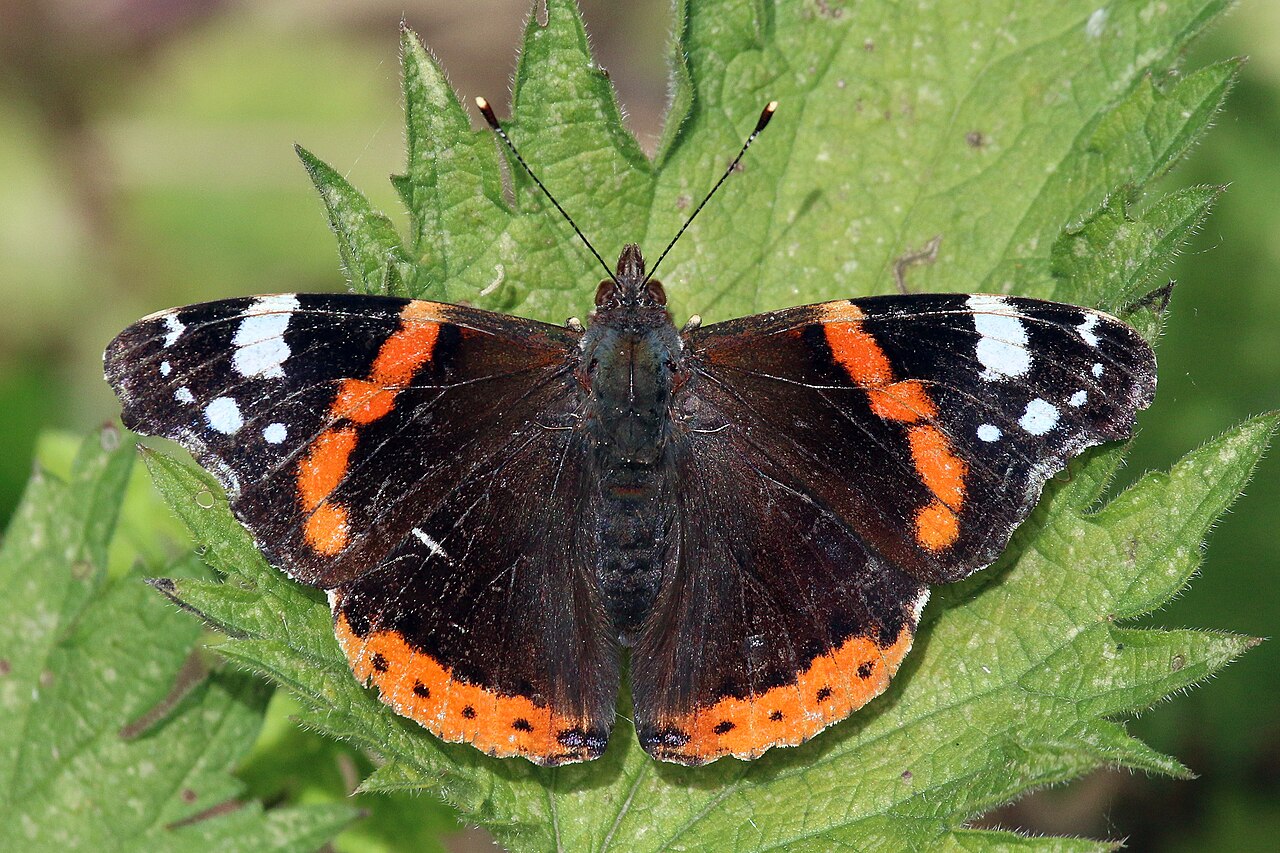
The red admiral is a black butterfly crossed by a bright orange-red band on each forewing and a matching band along the hindwing margin, with white spots near the forewing tips and a wingspan of about 1.75 to 3 inches. It is one of the most widespread butterflies in the northern hemisphere and one of the most approachable, regularly landing on people and returning to the same perch again and again.
Red admirals are also migratory and cannot survive hard winters in most of their North American range, so northern populations are rebuilt each spring by butterflies moving up from the south. That makes their abundance swing wildly between years. This guide covers identification, host plants, the migration, why they land on people, the symbolism, and how to attract them.
The red admiral is a black butterfly with bright orange-red bands across the forewings and along the hindwing margins, spanning 1.75 to 3 inches. Caterpillars feed on nettles. Adults migrate north each spring because they cannot survive hard freezes, and they are unusually bold, landing on people and returning to the same perch repeatedly.
| Feature | Red Admiral |
|---|---|
| Scientific name | Vanessa atalanta |
| Wingspan | 1.75 to 3 in |
| Pattern | Black with orange-red bands, white tip spots |
| Host plants | Nettles, pellitory, false nettle, hops |
| Food | Sap, rotting fruit, dung, then nectar |
| Adult lifespan | About 2 weeks; overwintering ones far longer |
| Winter | Migratory; cannot survive hard freezes in the north |
What Does a Red Admiral Look Like?
Black above with a broad diagonal orange-red band crossing each forewing and a narrower orange-red band running along the outer edge of each hindwing, often with small black spots inside it. The forewing tips are black with a scatter of white spots, and the effect is bold and unmistakable at a distance.
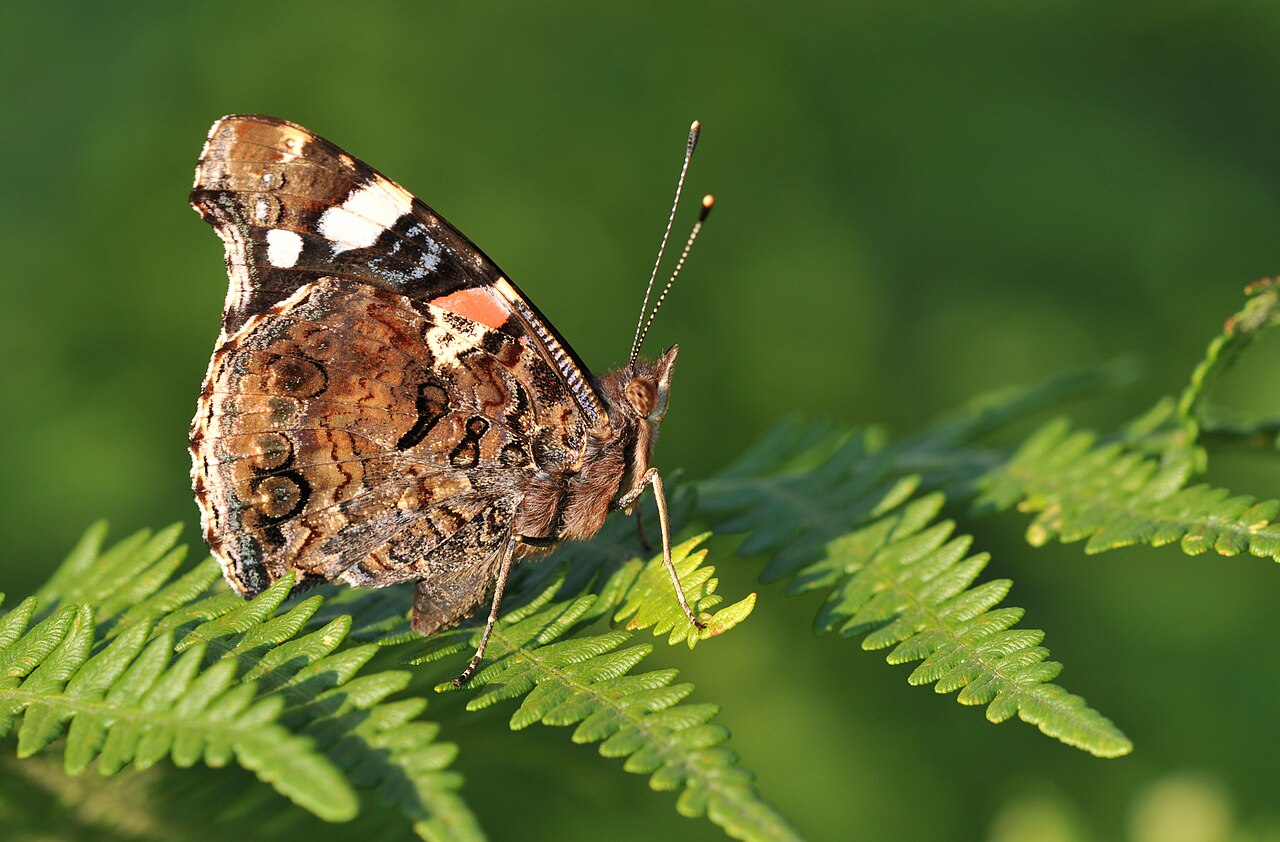
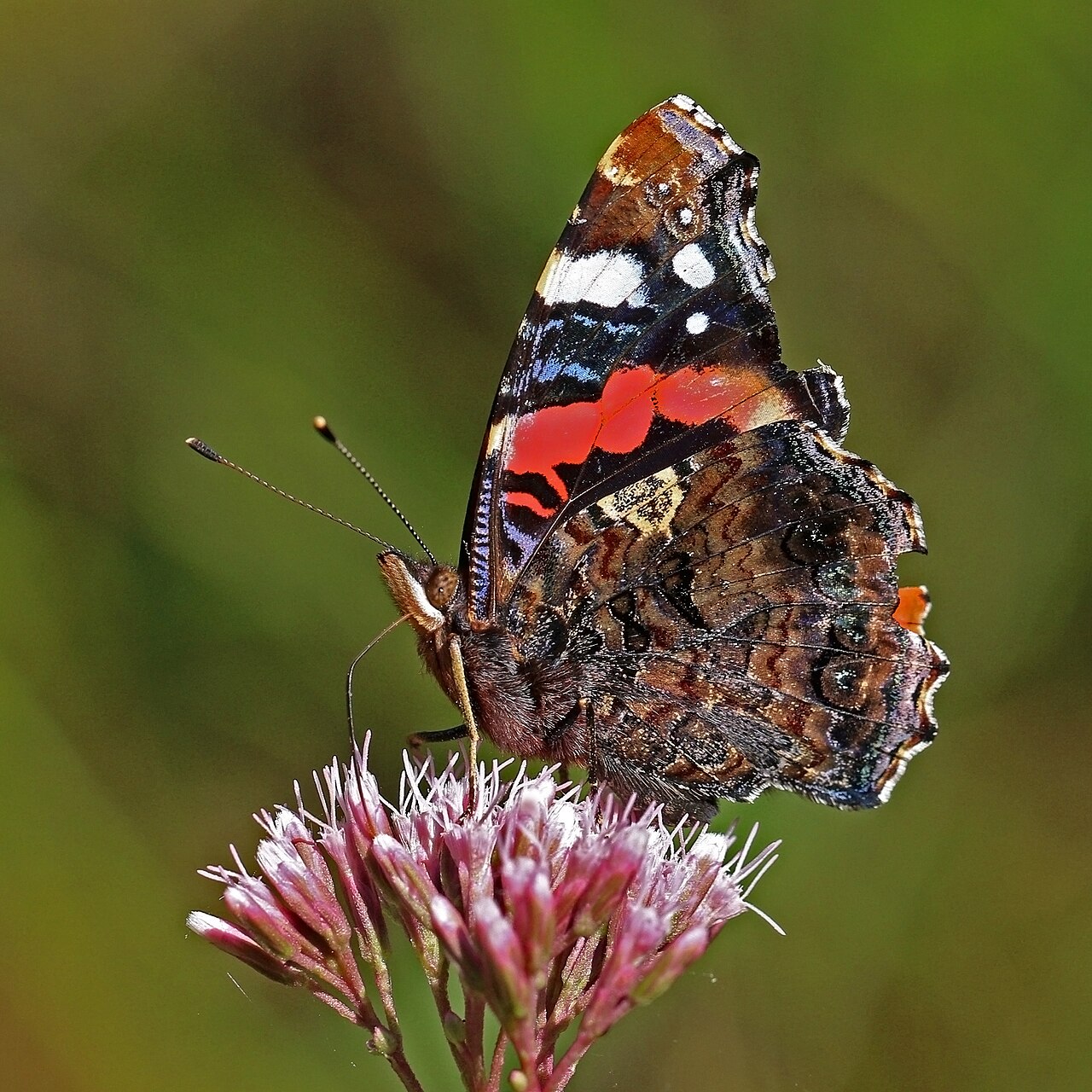
The underside is completely different. The hindwing underside is intricately marbled in brown, black, grey, and blue, providing excellent bark and leaf-litter camouflage, while the forewing underside repeats the orange band and white spots. A settled red admiral with closed wings can vanish against a tree trunk.
Size runs from about 1.75 to 3 inches, and females are usually slightly larger. Fresh individuals have brilliant, almost fluorescent bands; late-season and overwintered ones fade to a duller orange and often carry chunks missing from the wing edges. The red butterfly guide covers the other species with similar colouring.
What Is the Host Plant for Red Admirals?
Nettles. Caterpillars feed on stinging nettle above all, along with false nettle, pellitory, wood nettle, and occasionally hops, and females strongly prefer young vigorous plants in sunny sheltered positions rather than large mature stands.
The caterpillar builds a shelter rather than sitting exposed. It draws the edges of a leaf together with silk into a tent, feeds from inside, and moves to a fresh leaf as it outgrows each one, so the sign of a red admiral on a nettle patch is a folded or tied leaf rather than a visible larva. Caterpillars are dark and spiny with pale side markings, and the spines do not sting.
That dependency has a practical consequence for gardens. Nettles are removed on sight almost everywhere, and a garden with no nettles supports no red admiral breeding regardless of how much nectar it offers. A patch of nettles in a sunny corner is the single change that turns a visiting butterfly into a resident one. The black caterpillar guide covers what the larva can be confused with.
Is It Rare to See a Red Admiral?
Not rare, but strikingly variable between years. Red admirals occur across North America, Europe, North Africa, and parts of Asia, and in a good year they are one of the commonest garden butterflies. In a poor year, following a hard winter in the south or a cold late spring, they can be scarce for months.
The reason is that the species is migratory and mostly cannot overwinter in the north. Adults, and in mild areas pupae, survive winter only where freezes are light, and each spring butterflies push north, breed, and their offspring continue, so northern abundance depends entirely on how well the southern population came through winter.
Some years produce genuine irruptions. In certain springs red admirals appear across whole regions in extraordinary numbers, with reports of hundreds in single gardens, and these events follow favourable southern breeding conditions. The years in between can be so quiet that people assume the species has declined.
Why Do Red Admirals Land on People?
Partly for salt, partly because they are territorial and simply not shy. Red admirals take minerals and sodium from sweat, damp ground, and mud in the same way many butterflies do, and a warm arm or shoulder is a reasonable place to investigate.
Territoriality explains the rest. Males hold sunny perches on paths, walls, tree trunks, and fence posts in the afternoon, launching at passing insects and returning to the same spot repeatedly, and a person standing in that patch becomes part of the perch. Red admirals will land on hands, hats, and shoulders and stay for minutes at a time.
They are among the most reliably approachable butterflies as a result, which is why they turn up so often in stories about butterflies visiting people. Nothing about the behaviour requires a supernatural explanation, and nothing about it rules one out either for the person who finds it meaningful. The guide to a butterfly landing on you covers the symbolic reading.
What Does a Red Admiral Butterfly Mean?
Red admirals are read within general butterfly symbolism as transformation and renewal, with the red adding associations of passion, courage, and vitality. A red admiral landing on someone is commonly taken as a message from a departed loved one, in the same way monarchs and other butterflies are.
There is a specific piece of European folklore worth knowing. The species has been called the butterfly of the dead in some traditions, and its habit of appearing at gravesides and around fermenting fruit in autumn, late in the season when other butterflies are gone, fed that association. It is not an ominous reading so much as a seasonal one.
The name itself is probably a corruption. Red admiral appears in older sources as red admirable, which describes the butterfly rather than any naval rank, and the shift to admiral happened gradually in English usage. The butterfly tattoo meaning guide covers how these readings are used deliberately.
How Long Does a Red Admiral Live?
About two weeks as a summer adult, which is typical for a mid-sized butterfly. The full cycle from egg to adult takes roughly four to six weeks in warm weather, with the egg hatching in about a week, the caterpillar feeding for two to four weeks, and the chrysalis taking one to two weeks.
The overwintering generation lives far longer. Adults that emerge in late summer and enter winter in a sheltered spot in mild regions can live several months, and in Europe red admirals are increasingly recorded hibernating successfully in places where they formerly could not, which is one of the clearer butterfly responses to milder winters.
Pupation happens in a hanging chrysalis attached inside a leaf shelter the caterpillar builds on the host plant, greyish brown with metallic gold points along the back, and it is easy to overlook because it is inside a folded nettle leaf rather than exposed. That habit of building shelters at every stage is unusual among the brush-footed butterflies and is one of the more reliable ways to find the species on a nettle patch.
Multiple broods run through the season, typically two in the north and more in the south, and this is why red admirals appear continuously from spring through late autumn rather than in a distinct flight period. They are often the last butterfly on the wing in November.
How Do You Attract Red Admirals?
Grow nettles for the caterpillars and provide fruit for the adults. A nettle patch in a sunny sheltered spot, cut back in stages through the season to keep producing young growth, is the breeding habitat, and it needs to be in sun rather than in a shaded corner where the plants are usually banished.
For nectar, red admirals favour buddleia, ice plant, aster, verbena, marjoram, ivy flowers, and thistles, with the late-season sources mattering most since the butterflies are active into November when little else is flowering. Ivy in flower in October is one of the best autumn nectar sources for them.
Overripe fruit outperforms all of it in late summer. A shallow dish of mashed banana, sliced overripe pear, or fallen apples placed in a sunny sheltered spot draws red admirals reliably, and they will feed for long periods once settled. Leaving windfalls on the ground under fruit trees achieves the same thing with no effort. The painted lady guide covers a close relative with a very different host plant.
What Is Confused With a Red Admiral?
The painted lady is the most frequent mix-up, and the two are close relatives in the same genus. Painted ladies are orange overall with black wingtips and white spots rather than black with red bands, so the ground colour separates them: a mostly orange butterfly is a painted lady, a mostly black one with a red stripe is a red admiral.
The white admiral and red-spotted purple are darker butterflies with white banding or blue iridescence and no red band across the forewing. Milbert’s tortoiseshell has an orange and yellow band on a dark ground and is smaller, with a more scalloped wing edge.
In Europe the vagrant Indian red admiral and the closely related species in the genus can cause confusion, but in North America a black butterfly with a clean orange-red diagonal band and white forewing spots is a red admiral and effectively nothing else. Butterfly monitoring data, including the records collated through the U.S. Geological Survey (usgs.gov) and state butterfly atlases, track its year-to-year swings in detail. The black and white butterfly guide covers the dark species it gets grouped with.
Frequently Asked Questions
What does a red admiral butterfly look like?
Black with a broad diagonal orange-red band on each forewing, an orange-red band along the hindwing edge, and white spots near the black wingtips. The underside is marbled brown and grey for camouflage.
Is it rare to see a red admiral?
Not rare, but highly variable between years because the species migrates north each spring and cannot survive hard freezes. Some springs produce irruptions of hundreds; other years are very quiet.
What is the host plant for red admirals?
Nettles, principally stinging nettle, plus false nettle, pellitory, wood nettle, and occasionally hops. Caterpillars tie leaves into a silk tent and feed from inside, so folded leaves are the sign to look for.
Why do red admirals land on people?
For salt in sweat and because males hold sunny perches and treat a standing person as part of one. They are among the most approachable butterflies and will stay on a hand or shoulder for minutes.
What is the lifespan of a red admiral?
About two weeks as a summer adult, with the full cycle from egg to adult taking four to six weeks. Adults that overwinter in mild regions live several months.
What does a red admiral butterfly mean?
Transformation and renewal generally, with red adding passion and courage. Some European traditions called it the butterfly of the dead, reflecting its late-season appearance rather than any ominous meaning.
How do you attract red admirals?
Nettles in sun for breeding and overripe fruit for the adults, which prefer sap and fermenting fruit to nectar for much of the year. Ivy in flower is a key autumn nectar source.

Similar Posts
Ladybug: Species, Life Cycle, and What the Spots Really Mean
Ladybugs are beetles, not bugs, and the spots mark the species rather than the age. Life cycle, colours, biting, the Asian lady beetle problem and garden value.
Black Fuzzy Caterpillar: ID by Color and Which Ones Sting
Black fuzzy caterpillars are identified by the second color: brown means woolly bear, red means leopard moth, white tufts mean tussock and irritation.
Baby Rabbit: Nests, Care, and What to Do
A baby rabbit is called a kit. Learn what wild baby rabbits eat, how fast they grow, where they nest, how to tell if one is orphaned, and what to do.
Roach Poop vs Mouse Poop: Shape, Texture, and Control
Roach poop vs mouse poop comes down to texture: ridged cylinders vs smooth pointed rods. Identification, additional evidence, and the different control each needs.
Frog Poop: What It Looks Like and How to Identify It
Frog poop is a dark cylindrical pellet with blunt ends, packed with insect parts. How to tell it from rat and mouse droppings, whether it is dangerous, and how to clean it up.
Baby Arctic Fox: Why Litters Are So Unusually Large
A baby arctic fox is called a kit, born in litters of 5 to 8 that can reach 14 in good lemming years. Growth, dens, coat color, and the lemming connection explained.