Grackle Symbolism: What a Yard Full of Grackles Means
Seeing a grackle is traditionally read as a sign that a community, a voice or a boundary in your life needs attention, and the grackle spiritual meaning turns on exactly that: this is a loud, social, unapologetic bird that arrives in numbers. Where a single crow is read as a private message, a grackle flock is read as a message about the people around you.
Grackles also sit awkwardly in older symbolism, because most of the folklore people apply to them was written about blackbirds, crows and ravens. That matters for the reading, so the sections below keep the traditions apart, say plainly where a meaning was borrowed from another black bird, and work through the situations that actually prompt the question, starting with a yard suddenly full of them.
Spiritually, the grackle symbolizes voice, community and adaptability, and a grackle sighting is usually read as a prompt to speak up or to look at the group you belong to. Flocks are taken as a sign of change arriving through other people. Most traditional black bird omens, including biblical ones, describe blackbirds rather than grackles.
What Does It Mean Spiritually to See a Grackle?
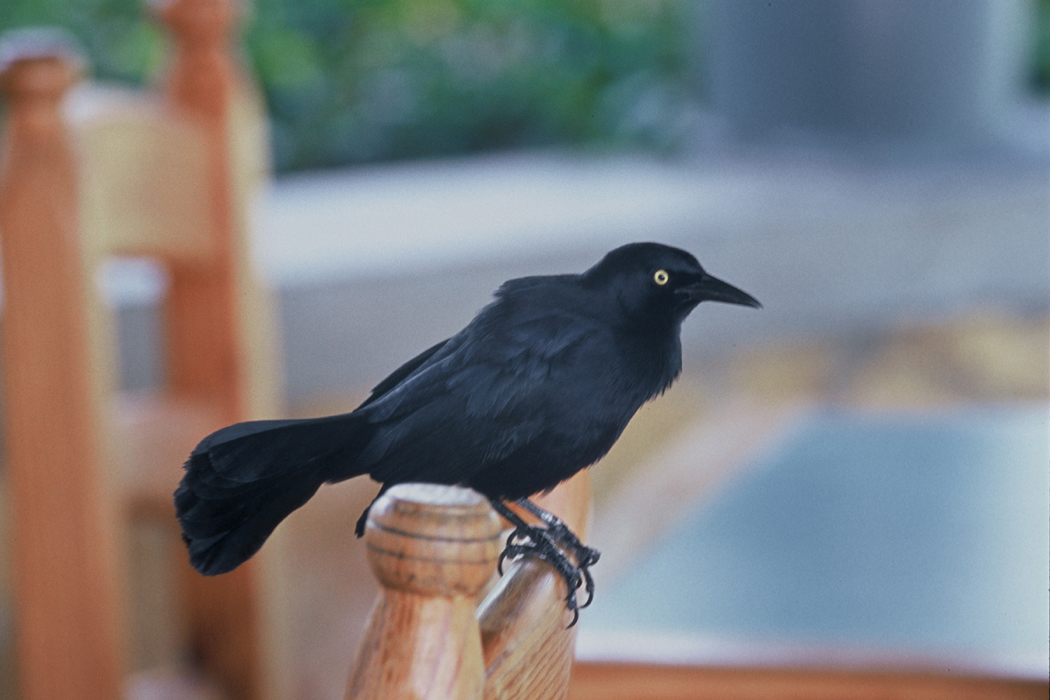
A grackle sighting is read as a call to use your voice even when the sound is not pretty. The bird’s song is a mechanical creak that birders describe as a rusty gate, and it makes no attempt to be pleasant, which is the trait most modern interpretations fasten onto: expression over approval. Alongside that, the grackle carries community, because it roosts and forages in groups, and adaptability, because it thrives in parking lots and feedlots that most birds avoid.
The less flattering readings come from the same behavior. Grackles push smaller birds off feeders, raid nests and take over suburban trees by the thousand, so the shadow side given to them is dominance, noise that drowns others out, and taking what is easiest. Both sides belong to one bird. If you want the animal itself before the symbolism, our profile of the common grackle covers range, diet and behavior.
What Does It Mean When Grackles Are in Your Yard?

When grackles are in your yard, folk reading treats it as news arriving through a group rather than a single messenger: a family matter, a work team, a neighborhood decision. The size of the flock is taken as the weight of the message, and because grackles arrive suddenly and leave just as fast, the traditional advice is to act while the opportunity is loud rather than wait for it to settle.
The plain explanation runs alongside it. Grackles move in large post-breeding flocks from midsummer through winter, following food, and a yard full of them usually means an open feeder, a lawn full of grubs or a nearby roost tree. Both things can be true at once, and the honest version of the omen is that a crowded yard says more about your lawn than your fate.
When Black Birds Gather Around Your House
Black birds gathering around a house is one of the oldest omen patterns in European folklore, and the traditional reading is transition: something in the household is ending or changing form. Because grackles, starlings, crows and red-winged blackbirds all mix in winter flocks, the older sources rarely separate them, and the meaning attached to the gathering is about the number and the noise rather than the species.
Modern interpretations soften that into a message about attention. A flock on the roof is read as a matter you have been ignoring arriving with volume, and a flock that stays for days as a pattern rather than an event. Blackbird symbolism carries most of the older material, and it is worth reading the two side by side before deciding which bird you actually saw.
Grackle Symbolism in Native American Traditions
Named grackle symbolism is thin in Native American sources, and the honest statement is that most black bird material refers to crows, ravens and blackbirds. Where grackles do appear, it is in the Southeast and in Mesoamerica. In Mexican tradition the great-tailed grackle, or zanate, carries a Totonac story in which the bird stole fire, music, love and arrogance from a sleeping possum, a tale told to explain both its voice and its swagger.
Southeastern accounts group the bird with other blackbirds as a sign of coming rain and of the corn harvest, since grackle flocks follow planting and standing crops. Those are regional and specific traditions, not a single pan-tribal meaning, and the grackle’s loud presence in ceremony and story is far smaller than the crow’s. Crow symbolism covers the material that is often misattributed to grackles.
What the Bible Says About Grackles and Blackbirds

The Bible never mentions grackles. The birds are native to the Americas and were unknown to the writers of the Hebrew and Greek texts, so anyone asking what blackbirds mean biblically is really asking about ravens, crows and unspecified birds of prey. Leviticus 11 lists ravens and every kind of raven among the unclean birds, which is the origin of the general suspicion attached to black-feathered birds in Christian folk belief.
The other biblical thread is kinder. In 1 Kings 17 ravens bring bread and meat to the prophet Elijah, and in Luke 12 the ravens are given as an example of birds God feeds without their storing anything. That leaves a genuinely divided tradition: unclean by law, cared for by providence. Reading a grackle through either verse is interpretation applied to a bird the text does not know.
Grackle and Blackbird Symbolism in Celtic Folklore
Celtic folklore treats the blackbird as a gatekeeper between worlds. In Irish tradition the blackbird of Derrycairn sings the call to the otherworld, and the birds of the goddess Rhiannon in Welsh myth sing listeners into a sleep that lasts years, which is the source of the idea that a black bird’s song marks a threshold rather than a warning. Hearing one at dusk was read as the border between day and otherworld thinning.
Because the Celtic bird is the Eurasian blackbird, applying this to a North American grackle is a transfer, not a tradition. Stated as belief, the usable part is the threshold idea: a loud black bird heard at a boundary time, dawn or dusk, was taken as a sign to pay attention to what is just out of sight. Raven symbolism carries the darker Celtic material, tied to Badb and the Morrígan.
Blackbird Symbolism in East Asian Traditions
East Asian traditions give black birds a solar role rather than a funereal one. In Chinese and Korean mythology the three-legged crow or sun crow lives in the sun and is a symbol of imperial authority and of the heavens, and in Japan the large crow Yatagarasu guides a legendary emperor as a messenger of divine will. A loud black bird in these traditions is closer to a herald than a bad sign.
No grackle appears in any of it, for the same reason the Bible omits them: the genus Quiscalus is American. What the comparison does show is how much the reading depends on culture rather than on the bird. The same black plumage and harsh call that produced an omen of death in parts of Europe produced a sun symbol in East Asia, and neither was describing the bird in your yard.
Grackle Spiritual Meaning in Love and Relationships
In relationship readings, the grackle is given to people who have gone quiet. Because the bird is unmistakably audible and displays openly, with males puffing, spreading the tail and singing in full view, the reading attached to it is honest expression: say the thing, including the unglamorous part, instead of waiting to be understood. A pair of grackles is read as a partnership that works in public rather than in private.
The shadow reading is noise without listening, a relationship where both voices compete. Grackle flocks are famously loud and crowded, and interpreters use that image for a bond with too many outside opinions in it. The biology is less romantic: grackles are socially monogamous for a season, and males often leave the female to raise the brood. Female grackles look so different that people frequently report two species.
Is a Grackle a Raven or a Crow?
Neither. Grackles are icterids, the New World blackbird family that also includes meadowlarks, orioles and cowbirds, while crows and ravens are corvids. A common grackle (Quiscalus quiscula) is roughly 11 to 13 in long (28 to 34 cm) with a long keel-shaped tail, a slim pointed bill and pale yellow eyes, while an American crow is nearly twice that size with a heavy bill and dark eyes.
The distinction changes the omen, because almost every traditional black bird reading, from unclean birds in Leviticus to battlefield ravens in Irish myth, describes corvids. Identify the bird first and the symbolism becomes consistent rather than contradictory; the National Audubon Society keeps identification guides for all three. The iridescent purple and bronze sheen in good light is the quickest grackle confirmation, and so is the voice, covered in grackle sounds.
Grackle Omens by Situation
Most people searching for grackle symbolism have one specific situation in mind, so the readings below are the ones that recur in folk sources, each with the ordinary explanation beside it. None of them predicts anything, and the ordinary explanation is right far more often.
| Situation | Traditional reading | Plain explanation |
|---|---|---|
| Flock in the yard | News or change arriving through a group | Open feeder, lawn grubs or a roost tree nearby |
| One grackle calling at you | Speak the thing you have been holding back | Territorial or alarm call, often near a nest |
| Grackle at the window | A matter outside the household wants in | Reflection in glass, or a bird hunting insects on the pane |
| Grackles on the roof | Attention demanded on something ignored | Warm shingles and a clear view of the feeding area |
| Dead grackle found | An ending already complete; a voice has gone silent | Window strike, cat, or disease in a dense flock |
| Grackle in a dream | Something unsaid in your group of people | Common imagery after noisy or crowded days |
Seeing a Dead Grackle
A dead grackle is read as closure rather than warning. Across black bird folklore the dead bird is treated as an ending that has already happened, often a voice or role that has gone quiet, and the traditional advice is to stop maintaining whatever has already finished. Where a living flock is about other people, the dead bird is read as something inside your own situation.
Practically, dead grackles turn up for a few repeatable reasons. Window strikes are the most common in suburbs, outdoor cats take a share, and dense winter roosts spread disease quickly. A single dead bird in the yard is a hazard of urban life for a species that lives this close to people. Several at once is worth reporting to a state wildlife agency rather than interpreting.
Grackle as Spirit Animal, Totem and Power Animal
As a spirit animal, the grackle is described as a guide for people who need to be heard in a crowd and who have been told they are too much. The traits attached to it are voice, nerve, resourcefulness and comfort in groups, and the people who claim it as a totem usually describe themselves as direct, social and unbothered by not being liked. Its lesson is given as presence without permission.
The shadow side is dominance and noise: taking the feeder, filling every silence, mistaking volume for truth. In contemporary practice the grackle is called on for speaking in public, for standing ground in a group, and for adapting fast to a place that was not built for you. All of it is modern interpretation built on observed behavior, which is the honest category for it, and the behavior at least is real.
Frequently Asked Questions
Is blackbird a good omen?
It depends entirely on the tradition. Celtic folklore treats the blackbird as a sacred gatekeeper and its song as a blessing, while parts of European folk belief read one tapping at a window as a death in the house. East Asian traditions are positive, tying black birds to the sun. There is no single answer.
What is the warning of the black bird?
The warning attached to black birds in European folklore is that a transition is close and you are not ready for it, usually a death, a departure or a reversal in the household. Modern readings keep the structure and drop the fatalism, treating the bird as a prompt to deal with what you already know is coming.
What does a grackle do?
Grackles forage on the ground for insects, grain, seeds and scraps, wade for small fish, raid other birds’ nests, and roost communally in flocks that can reach into the tens of thousands in winter. They follow agriculture and parking lots, and males display by puffing up, spreading the tail and singing.
Are grackles smart?
Yes, measurably so for a non-corvid. Grackles solve feeder problems, drop hard food in water to soften it, follow lawnmowers and plows for exposed insects, and learn human routines around restaurants and parking lots fast. They are not at raven level, but their behavioral flexibility is a large part of why the symbolism emphasizes adaptability.
What is the myth associated with blackbirds?
The best known is the Welsh myth of the Birds of Rhiannon, whose song could wake the dead and lull the living into a sleep lasting years. Irish tradition adds the blackbird of Derrycairn calling to the otherworld. Both treat the bird as a voice at the border between worlds rather than as an omen of harm.
What does a black grackle or a red grackle mean?
Both terms describe the same birds in different light. Grackles look flat black in shade and show iridescent purple, bronze or blue-green sheen in sun, and red-winged blackbirds are frequently called red grackles by mistake. Color readings follow the light and the sighting, so identify the species before reading meaning into the shade.