Meadowlark Sounds: 6 Calls, Plus How to Tell Eastern from Western
A meadowlark song is a clear, slurred whistle delivered from a fence post over open grass, and it is one of the few bird sounds in North America that most people recognize before they can name the bird. The meadowlark call that follows it is nothing like the song: a dry rattle or a buzzy dzert, thrown out in flight or when something walks too close to a hidden ground nest.
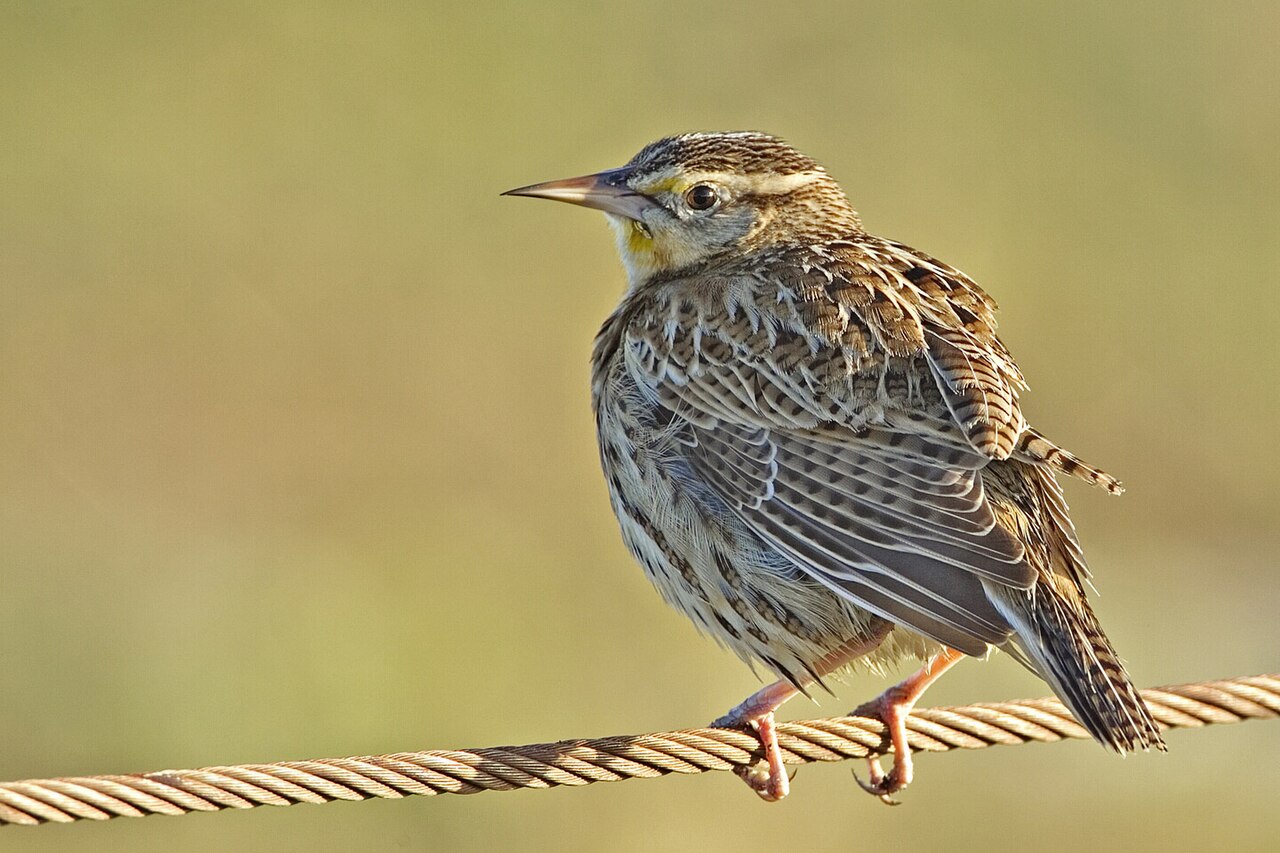
Two species make these sounds in the United States, and they sound different enough that ear alone separates them where plumage does not. The Eastern Meadowlark (Sturnella magna) whistles a short, plaintive phrase. The Western Meadowlark (Sturnella neglecta) runs its notes into a bubbling, flutelike gurgle. Everything else in the repertoire, from the chatter to the begging calls of young, is shared.
Meadowlarks make a clear, flutelike whistled song plus a dry rattle and a buzzy dzert call. The Eastern Meadowlark sings three to eight pure descending whistles often written as spring-of-the-year; the Western Meadowlark sings seven to ten notes that end in a bubbling gurgle. Both sing most from March through July, heaviest at dawn.
| Sound | How it sounds | What it means | When you hear it |
|---|---|---|---|
| Eastern song | 3 to 8 pure whistles, sliding downward, spring-of-the-YEAR | Male holding a grassland territory | March to August, peak at dawn |
| Western song | 7 to 10 notes, whistles into a bubbling gurgle | Male holding a grassland territory | February to August, peak at dawn |
| Chatter | Dry, rolling rattle of 6 to 12 notes | Alarm near the nest or a chased rival | Nesting season, any disturbance |
| Buzzy call | Short, flat dzert or chupp | Contact between mates, mild unease | All year |
| Flight whistle | Thin, rising weet as the bird flushes | Position note while crossing open ground | All year |
| Begging call | Soft, repeated peeps from the grass | Nestlings and fledglings asking for food | May to August |
What a meadowlark song sounds like
The tone is the part people remember: pure, slightly mournful and flutelike, with no buzz, trill or harshness anywhere in it. A meadowlark sings loudly for a bird of its size, and the phrase carries a quarter mile (400 m) across open country because there is nothing in a pasture to absorb it. Each song lasts one to two seconds and is repeated every 10 to 30 seconds from the same perch.
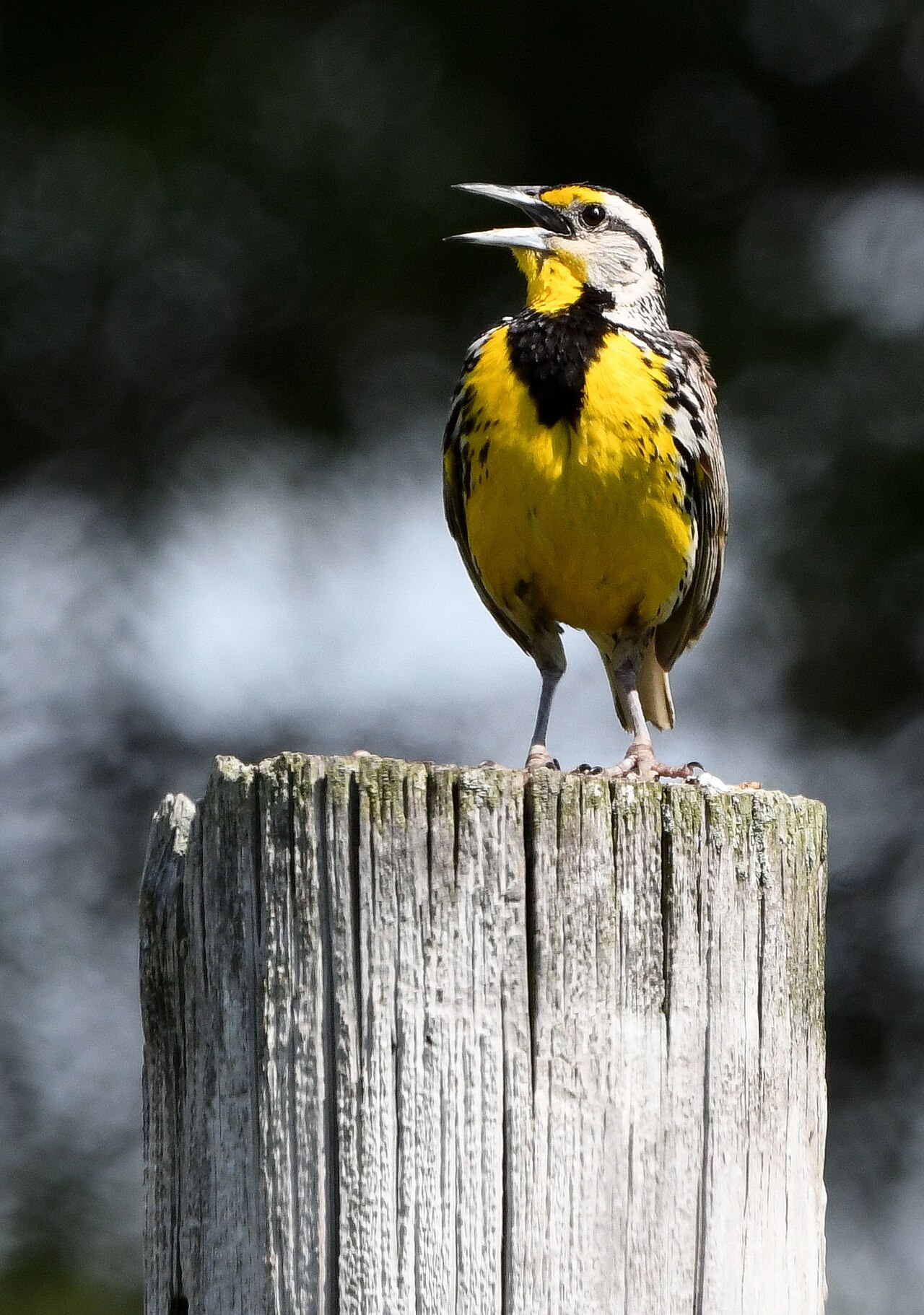
Both species sing from exposed spots on purpose. A fence post, a utility wire, a boulder or the top of a tall mullein stalk puts the sound over the grass, and the singer sits with his yellow breast and black V facing outward. That habit makes meadowlarks one of the easiest grassland birds to confirm by sound and sight at the same moment.
Eastern Meadowlark song: the spring-of-the-year whistle

The Eastern Meadowlark sings three to eight clear whistles that slide downward in pitch, with a short pause between the first notes and the last. The two standard English mnemonics are spring-of-the-YEAR and see-you at-school, and both fit the rhythm well enough to use in the field. Nothing bubbles and nothing accelerates; the notes stay separate.
Simplicity is the field mark. If you can count the notes and hum the phrase back after one hearing, you are almost certainly listening to an Eastern. The song is also slower than it feels, which is why recordings often sound shorter than the bird did in person.
Western Meadowlark song: the flutelike gurgle
The Western Meadowlark starts with one or two whistles, then collapses into a rapid, descending jumble of gurgled notes that accelerates toward the end. Birders describe it as liquid, bubbling or flutey, and it runs longer than the Eastern song, usually seven to ten notes in about one and a half seconds. You cannot hum it back.
That complexity is why six states, among them Kansas, Montana, Nebraska, North Dakota, Oregon and Wyoming, chose this bird as a state symbol. Across the western half of the country it is the default sound of open rangeland from late winter onward.
Eastern versus Western: telling them apart by ear
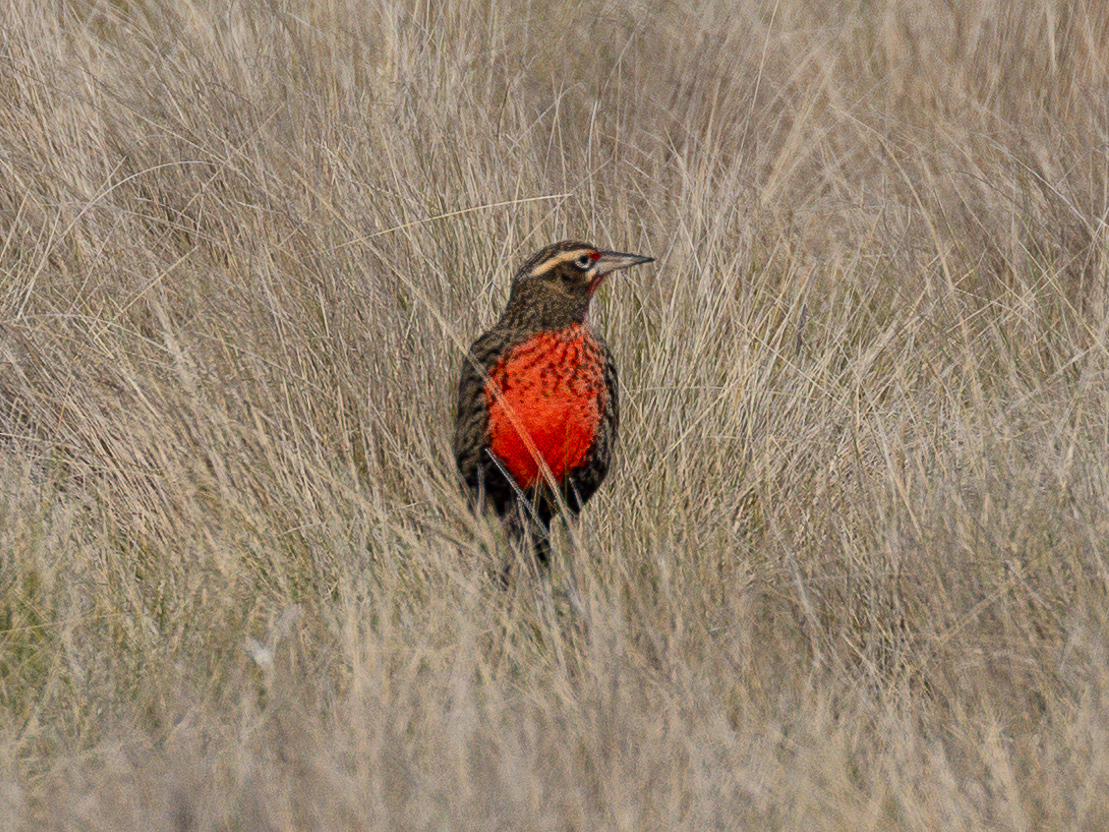
The two species overlap in a broad band through the Great Plains, from Texas north to the Dakotas, and there the plumage differences are too subtle for most sightings. Song does the work. The birds themselves rely on it as well: they recognize each other’s songs, and hybrids are rare and largely infertile.
| Feature | Eastern Meadowlark | Western Meadowlark |
|---|---|---|
| Song shape | Separate whistles, descending | Whistles into a bubbling gurgle |
| Note count | 3 to 8 | 7 to 10 |
| Can you hum it back? | Yes | No |
| Main call | Buzzy dzert | Low, blunt chupp |
The chatter and alarm calls
When you walk into an occupied grassland, the song stops and the chatter starts: a dry, rolling rattle of six to twelve notes, flat in pitch and clearly agitated. An adult usually delivers it from a perch 50 to 100 ft (15 to 30 m) off while circling the area where the nest sits. Both sexes use it, and so do males chasing each other along a territory boundary.
Take the chatter as an instruction to leave. Meadowlarks nest on the ground under a domed grass canopy, the nest is invisible from two steps away, and a lingering observer is a far bigger risk to it than to a bird in a box or a tree.
The buzzy dzert and the flight whistle
Away from the nest, the everyday sound is a short, flat note: a buzzy dzert from an Eastern, a blunter chupp from a Western. It works as a contact call between a pair and as low-level alarm, and it is the sound you get in October when no bird is singing. A thin, rising weet often comes as the bird flushes and flies off low over the grass with its distinctive stuttering wingbeats.
Female meadowlark sounds
Females do not perform the full territorial song. They give the chatter, the buzzy contact note and a quieter series of whistles near the nest, mostly while exchanging food or responding to the male. Reports of a female meadowlark song usually trace back either to a young male practicing or to a female’s abbreviated whistles heard at close range.
Since the sexes look alike at a distance, the safest assumption in the field is that a bird singing a full phrase from an exposed perch is a male.
Song repertoires: why the same bird sounds different
A meadowlark does not sing one song. Studies of Eastern Meadowlarks have documented repertoires of dozens of distinct song types per male, with some birds using more than 50, and a male will cycle through several variants before repeating one. Western Meadowlarks carry fewer song types but each one is more elaborate.
This is the usual reason a listener decides there are three species in one field. Variation within a male’s repertoire is wide, but the structural signature holds: separate whistles stay separate in an Eastern, and the gurgle shows up in every Western variant.
When meadowlarks sing: time of day and season
Song begins in late February in the south and west and by late March almost everywhere, peaks from April into June, and tapers through August. Unlike woodland songbirds, meadowlarks keep singing through the middle of the day, so a noon stop in a pasture is still productive. The strongest hour is still the one after sunrise, and there is a weaker evening burst.
Winter is quiet but not silent. Flocks in southern states and on open ground use the buzzy call and the flight whistle while they forage, and a warm January morning occasionally pulls a half song out of a male.
Birds confused with a meadowlark
Four grassland neighbors account for most mistakes. The Dickcissel pushes out a buzzy, mechanical dick-dick-ciss-ciss with none of the meadowlark’s pure tone. The Bobolink delivers a long, tumbling, metallic jumble. The Horned Lark tinkles thinly and high. The Baltimore Oriole comes closest on tone, with rich whistled notes, but its phrases are more clipped and it sings from trees, not posts.
Habitat settles most cases: a flutelike whistle over open grass in daylight is a meadowlark, while the same tone from woodland edge is usually an oriole or a thrush. Nothing a meadowlark does resembles the staccato bursts covered in our piece on the bird that sounds like a machine gun, and nothing in its repertoire is nocturnal: night whistles over fields belong to owls, including the Barred Owl and the Barn Owl.
Why meadowlark song is getting harder to find
The Eastern Meadowlark has lost roughly three quarters of its population since 1970, one of the steepest declines of any common North American songbird, and the Western has slipped as well. The cause is habitat: hayfields cut earlier and more often, pasture converted to row crops, and grassland lost to development. Early mowing destroys nests outright, which is the one conflict people actually create with this bird, since meadowlarks never nest in buildings.
Landowners with 10 acres (4 ha) or more can keep a pair by delaying the first cut until after mid-July. Reference recordings of both species are at All About Birds, which is worth a listen before a spring walk; our guides to Eastern Bluebird sounds, Bald Eagle sounds and bird deterrent sounds cover other open-country species people ask about most.
Frequently Asked Questions
Is an Eastern Meadowlark rare?
It is not rare in the technical sense, with millions of birds still in the United States, but it is disappearing fast and is now listed as near-threatened. Populations have fallen by about three quarters since 1970. In much of the Northeast and upper Midwest it has vanished from farmland where it was common 40 years ago, so locally it can be genuinely hard to find.
What bird call sounds like Jimmy Jimmy Jimmy?
Not a meadowlark. Repeated-name mnemonics like that usually belong to birds that double or triple a phrase, most often the Carolina Wren, the Northern Cardinal with its birdie-birdie-birdie, or the Eastern Towhee. Meadowlark mnemonics run as sentences instead, which is why they came out as spring-of-the-year and see-you at-school.
What is a bird song versus a bird call?
A song is longer, structured and largely learned, and males use it to claim territory and attract mates, so it is seasonal. Calls are short, innate and year round, each tied to one job: contact, alarm, flight or begging. For a meadowlark the whistled phrase is the song and the rattle and dzert are calls.
What bird has the prettiest call?
Taste decides it, and the usual nominees are the Hermit Thrush and Wood Thrush for their overlapping flutelike tones. Meadowlarks place high on most lists for a different reason: the pure whistle carries an unmistakable note of open country, which is why six states adopted the Western Meadowlark as a symbol.
Do birds understand each other when they chirp?
Within a species, yes. Meadowlarks respond specifically to songs of their own kind and ignore those of the other species, which is how the two stay separate in the overlap zone. Alarm calls cross species lines too: sparrows, blackbirds and meadowlarks in one field all react to each other’s warnings, because a predator is a shared problem.
What does it mean if birds are chirping at 3am?
It is almost never a meadowlark, which sings in daylight. Night singing usually comes from an unpaired Northern Mockingbird, from birds kept awake by street lighting, or from the thin flight notes of migrants passing overhead in spring and fall. None of it signals anything wrong; a mockingbird on a 3 am schedule typically stops once it finds a mate.