7 Bugs That Look Like Kissing Bugs (and Ticks)
Most bugs that look like kissing bugs are assassin bugs, leaf-footed bugs, or boxelder bugs, and the fastest way to tell them apart is the head: a kissing bug has a narrow, cone-shaped head and a flat body with striped edges, while lookalikes have a broad head or a shield-shaped body. The stink bug lookalikes are covered separately.
Only kissing bugs can carry the parasite behind Chagas disease. Wheel bugs, masked hunters, and western corsairs bite painfully but spread no disease.
Seven common bugs get mistaken for kissing bugs, mostly assassin bugs and plant-feeding shield bugs. Only a kissing bug combines a narrow, cone-shaped head with a flat, dark body and red, orange, or yellow stripes along the abdomen edge. Lookalikes show a broad head, a curved beak, or a wide shield shape.
| Lookalike | Scientific name | How it differs | Bites? |
|---|---|---|---|
| Wheel bug | Arilus cristatus | Gray body, cog-shaped crest, curved beak | Yes, painful, no disease |
| Masked hunter | Reduvius personatus | Dark brown, no edge stripes, dusty nymphs | Yes, painful, no disease |
| Western corsair | Rasahus thoracicus | Orange and black, orange spot on each wing | Yes, painful, no disease |
| Boxelder bug | Boisea trivittata | Broad head, red thorax lines, red wing veins | No |
| Brown marmorated stink bug | Halyomorpha halys | Wide shield, mottled brown, white antenna bands | No |
| Leaf-footed bug | Leptoglossus phyllopus | Leaf-like flares on hind legs, white wing band | No |
| Large milkweed bug | Oncopeltus fasciatus | Bright orange, black band across the back | No |
What Do Those Kissing Bugs Look Like?
A kissing bug (genus Triatoma) is a flat, oval, dark brown or black insect, about 0.5 to 1 inch (1.3 to 2.5 cm) long, with red, orange, or yellow markings along the outer edge of the abdomen. The head is long, narrow, and cone shaped. The western conenose (Triatoma protracta) and eastern bloodsucking conenose (Triatoma sanguisuga) are true kissing bugs, so their stripes can be faint and their color varies from brown to nearly black.
The beak separates kissing bugs from the other assassin bugs. A kissing bug holds a straight, slender beak flat under the head. Wheel bugs and masked hunters carry a short, thick beak that curves away from the head like a hook. Plant feeders have a short, triangular head with no cone-shaped neck.
Adults come indoors in summer, drawn to porch lights, and hide by day in cracks, under mattresses, or in dog bedding. A dark, flat insect in those spots is more often one of the bugs that look like cockroaches.
Which Bugs Are Mistaken for Kissing Bugs?
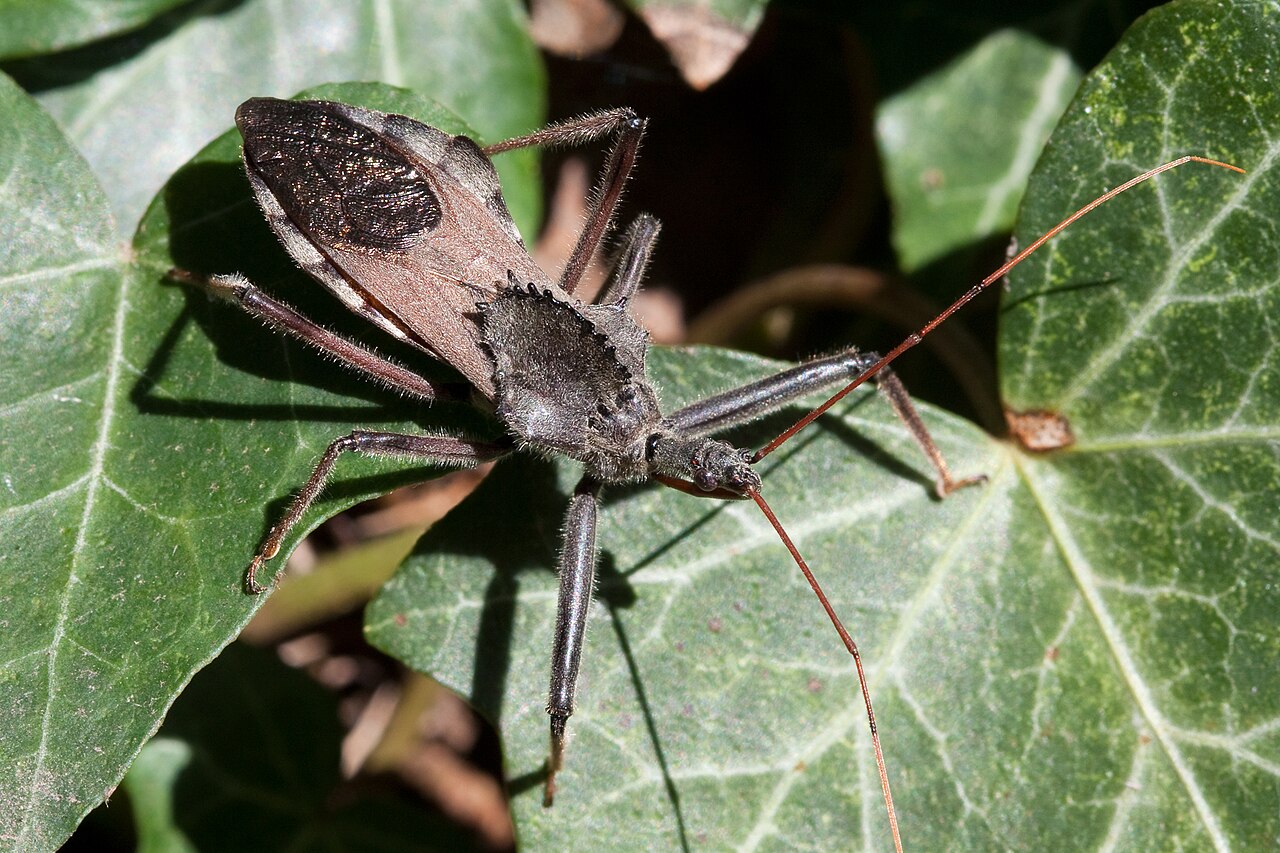
Assassin bugs cause the most false alarms, since kissing bugs belong to the same family (Reduviidae). The masked hunter is the one found indoors, and its nymphs cover themselves in dust and lint. Plant-feeding lookalikes have broad heads and shield-shaped bodies, and the slim red-lined boxelder bug lookalikes gather on sunny walls in fall.
What Bugs Can Be Mistaken for Ticks?
A fed kissing bug nymph can be confused with a tick, since both swell as they feed. Count the legs: a kissing bug has six, a tick has eight, and a tick has no wings, antennae, or distinct head. A tick is an arachnid, closer to the bugs that look like spiders than to any true bug.
Bed bugs and spider beetles get reported as ticks too. Spider beetles are round and brown like a fed tick but have six legs and long antennae.
What Should You Do With a Suspected Kissing Bug?
Do not touch it with bare hands. According to the CDC, Chagas disease is caused by a parasite and spreads through the droppings of the triatomine bug: the droppings carry the parasite, which enters the body when they are rubbed into the bite, eyes, or mouth. Scoop the insect into a sealed container with a spoon or card, not bare fingers.
Save the bug for identification: freeze it or drop it in rubbing alcohol, never crush it, and send photos or the specimen to your state health department or county extension office. If you were bitten and develop fever or swelling near the bite, see a doctor. Kissing bugs feed on blood at night, like bugs that look like mosquitoes, so check bedding for more.
Frequently Asked Questions
Can kissing bugs fly?
Yes, adult kissing bugs have full wings and fly at night, while nymphs are wingless and crawl. Wheel bugs and masked hunters fly too. Flying adults land on lit porch screens in summer, which is how people meet them, and a jar is safer than a hand.
Can a wheel bug bite you?
Yes, a wheel bug bite is painful and can throb for days, but the bug carries no disease. It bites only when grabbed or pressed against skin. Leave it on the plant, where it hunts caterpillars and other pests, and it will not come looking for you.
How big is a kissing bug compared with a wheel bug?
A kissing bug is 0.5 to 1 inch (1.3 to 2.5 cm) long, while a wheel bug reaches about 1.25 inches (3.2 cm) and carries a toothed crest on its back. Size overlaps at the lower end, so the crest and the gray color are the safer clues.
Are kissing bugs found across the whole United States?
No, kissing bugs live mainly in the southern half of the United States, and a bug found in the northern states is far more likely to be a lookalike. Infected kissing bugs have been found in 32 states, with records reaching as far north as Missouri and Illinois.