Eastern Rat Snake: How to Identify It and Why You Want One Around
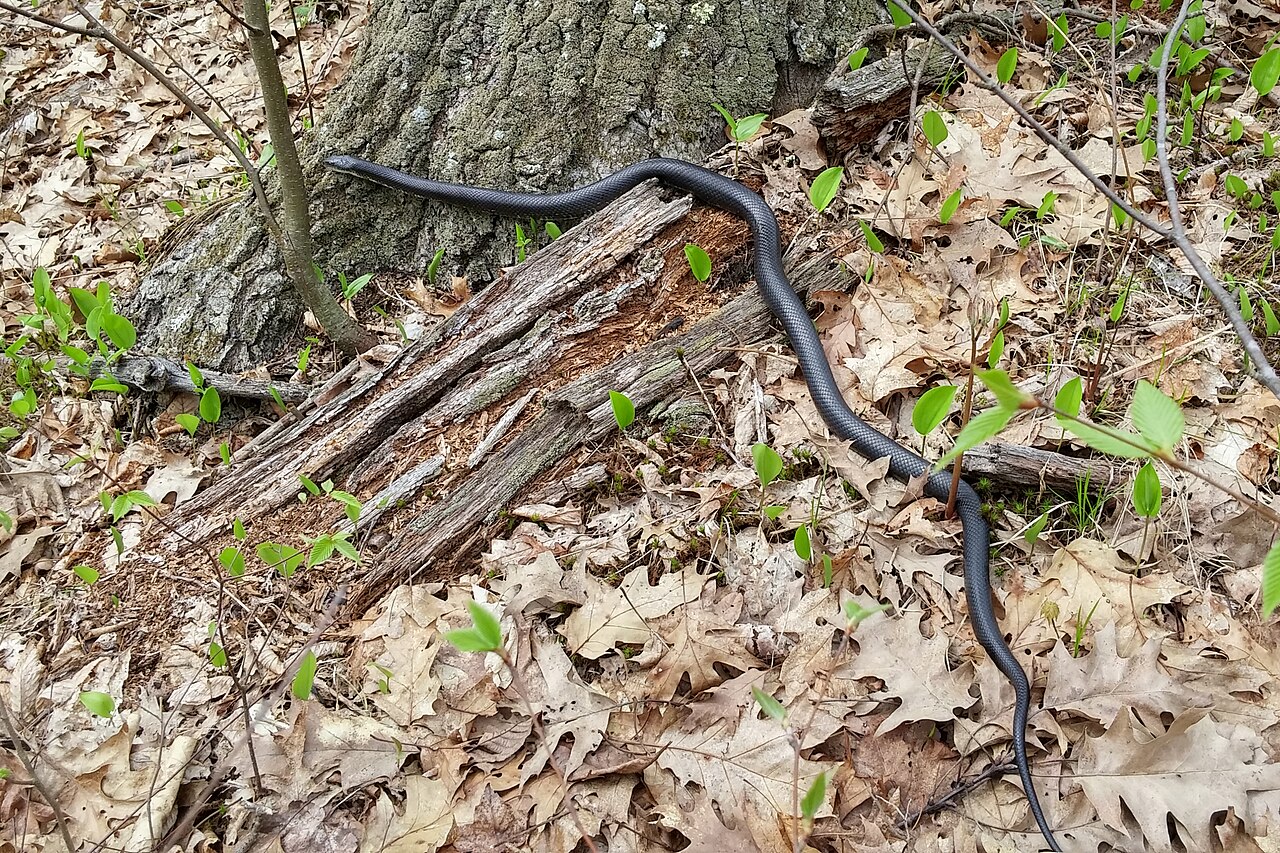
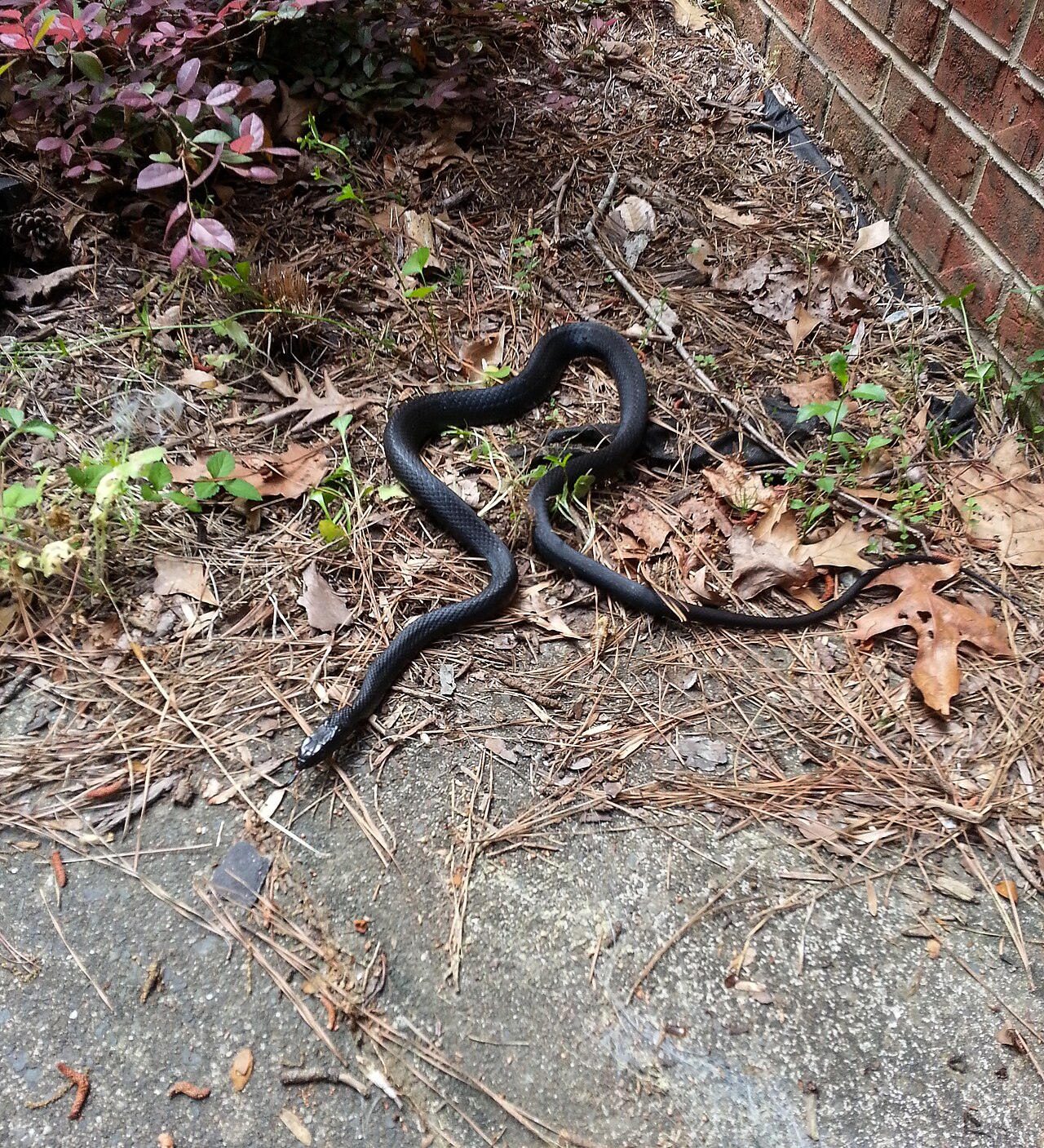
The eastern rat snake is a large, nonvenomous black snake that climbs like a squirrel and eats the rodents around your house. Adults reach 3 to 7 ft (1 to 2.1 m), wear glossy black scales over a gray and white checkered belly, and show a pale chin. Nothing about the species is dangerous to people or pets.
Most sightings happen in exactly two places: draped along a gutter or fence line, and stretched across a driveway on a warm morning. Both are normal. What confuses people is the juvenile, which looks like a completely different animal with gray skin and dark saddle blotches, and gets mistaken for a copperhead every spring.
The eastern rat snake (Pantherophis alleghaniensis) is a nonvenomous constrictor of the eastern United States, 3 to 7 ft long, shiny black as an adult with a white chin and a checkered belly. It is harmless to humans, kills rats and mice, and climbs trees and walls easily. Juveniles are gray with dark blotches.
| Feature | Eastern rat snake |
|---|---|
| Scientific name | Pantherophis alleghaniensis (formerly Elaphe obsoleta) |
| Adult length | 3 to 7 ft (1 to 2.1 m), rarely over 8 ft |
| Venom | None, kills prey by constriction |
| Adult color | Glossy black above, white or cream chin, gray and white checkered belly |
| Juvenile color | Gray with dark brown saddle blotches, fades by about 3 ft |
| Range | Southern New England south to Florida, west to the Appalachians and the Gulf states |
| Main prey | Rats, mice, chipmunks, birds and bird eggs |
How to identify an eastern rat snake?
Look at the chin and the belly first, because the back of a black snake tells you very little. An adult eastern rat snake has a white to cream chin and throat and a belly patterned like a checkerboard in gray and white, while the black racer is uniformly slate gray underneath with a dark chin. Rat snake scales are weakly keeled, so the back looks matte rather than mirror bright, and the body in cross section is squarish, often described as loaf shaped.
Size helps too. Anything black and thicker than a garden hose at over 4 ft in the eastern states is almost certainly this species.
Juveniles cause most of the confusion. A 12 to 20 in gray snake with squared dark blotches is a baby rat snake, not a pit viper: the pupils are round, the head is barely wider than the neck, and there is no facial pit between eye and nostril. For the whole genus and its regional forms, see our overview of the rat snake group and the heavier bodied Texas rat snake of the south central states.
Are eastern rat snakes harmful?
No. The species has no venom, no fangs beyond rows of small recurved teeth, and no interest in people. A cornered individual will kink its body into stiff angles, vibrate its tail in dry leaves so it buzzes like a rattle, release a foul musk, and strike with a closed or barely open mouth. The bluff is convincing and entirely empty.
A bite that connects leaves a shallow arc of scratches. Wash it with soap and water, cover it, and watch for the ordinary signs of a skin infection. No antivenom, no emergency room, no treatment beyond basic first aid, which is also true of the nonvenomous eastern hognose snake and its theatrical death act.
Do eastern rat snakes keep copperheads away?
This is the most repeated piece of folklore about the species, and it does not hold up. Eastern rat snakes are rodent and bird specialists. They are not snake eaters, they do not defend territories, and state wildlife agencies have never documented a yard that stayed copperhead free because a rat snake lived in it. The snake that genuinely hunts and eats venomous species is the kingsnake, which is immune to pit viper venom.
Treat a rat snake as free pest control, not as a fence.
Is it good to have a rat snake in your yard?
Yes. One adult eating a rat every week or two takes a meaningful bite out of a rodent population that would otherwise chew wiring, contaminate feed, and carry ticks toward the house. Barns, chicken runs, and compost piles are where the species earns its keep.
The two real complaints are attic visits and nest raids. This snake climbs brick, siding, and downspouts, so a gap under a soffit becomes a doorway. It will also take eggs and nestlings from bluebird boxes and low coops. Both problems are fixed with hardware rather than with the snake: seal gaps larger than half an inch, and fit boxes with a smooth metal baffle.
What time of day are rat snakes most active?
It shifts with the season. In spring and fall they are active by day, basking on rock walls, road edges, and wood piles through the morning. Once midsummer heat arrives, they move at dusk and after dark, traveling fence lines and climbing toward nests and rodent runs.
Cold months are spent underground in rock crevices, stump holes, and old burrows, sometimes sharing a site with other snakes, so a black snake in January is a surprise worth a photograph. The same seasonal clock drives the corn snake, a close relative of the same genus. Details on state distributions and life history are compiled by the University of Georgia herpetology program at srelherp.uga.edu.
Frequently Asked Questions
Will a rat snake hurt a human?
No. A rat snake has no venom and its teeth produce only shallow scratches, comparable to a scrape from a thorn. Wash the bite with soap and water and keep it covered. The snake would rather flee, freeze, or musk you than bite, and nearly every bite on record follows an attempt to grab the animal.
Will rat snakes eat small dogs?
No. Even a 7 ft eastern rat snake can swallow prey only a few inches across, so a rat or a chipmunk is the ceiling. Dogs, cats, and puppies are far too large and too heavy to be handled by a constrictor of this size. Poultry chicks and caged birds are the only pets genuinely at risk.
What are rat snakes afraid of?
Open ground and anything larger than themselves. Rat snakes avoid mowed lawns with no cover, and they retreat from dogs, hawks, and people on approach. No chemical repellent has passed testing, so the reliable deterrents are removing brush piles, tall grass, and stacked debris, then cutting off the rodents that drew the snake in.
What is the difference between an eastern rat snake and a black rat snake?
They are the same animal under two names. Black rat snake is the old common name for Elaphe obsoleta obsoleta, which genetic work split into separate species: populations east of the Appalachians are now the eastern rat snake, Pantherophis alleghaniensis, while the inland form carries the gray rat snake name.