Spiny Softshell Turtle: ID, Range, Diet and Bite Risk
The spiny softshell turtle (Apalone spinifera) is a flat, leathery freshwater turtle identified by the cone-shaped spines along the front edge of its shell and its long, snorkel-like snout. It is one of the most widespread turtles in North America, living in rivers and lakes from Montana and Quebec south to Florida and Texas.
Most people meet one by accident: a pancake shape buried in river sand, or a single nostril breaking the surface in the shallows. Telling this species apart from the Florida softshell matters, because the two overlap in the Southeast and differ in size, shell texture, and temper.
Spiny softshell turtles are flat freshwater turtles with a leathery shell, a tubular snout, and spines along the front of the carapace. Females reach 7 to 19 in (18 to 48 cm), males 5 to 9.5 in (13 to 24 cm). They are not venomous, but they bite hard and should not be picked up.
| Quick Facts | Spiny Softshell Turtle |
|---|---|
| Scientific name | Apalone spinifera |
| Shell length | Females 7 to 19 in (18 to 48 cm), males 5 to 9.5 in (13 to 24 cm) |
| Range | Central and eastern US, Great Lakes, Gulf states, southern Canada |
| Habitat | Rivers, large creeks, lakes and reservoirs with sandy or muddy bottoms |
| Diet | Crayfish, aquatic insects, small fish, occasional plant matter |
| Lifespan | Around 50 years for females, 25 to 30 years for males |
| Status | Common rangewide, protected in several northern states and provinces |
How to Identify a Spiny Softshell Turtle
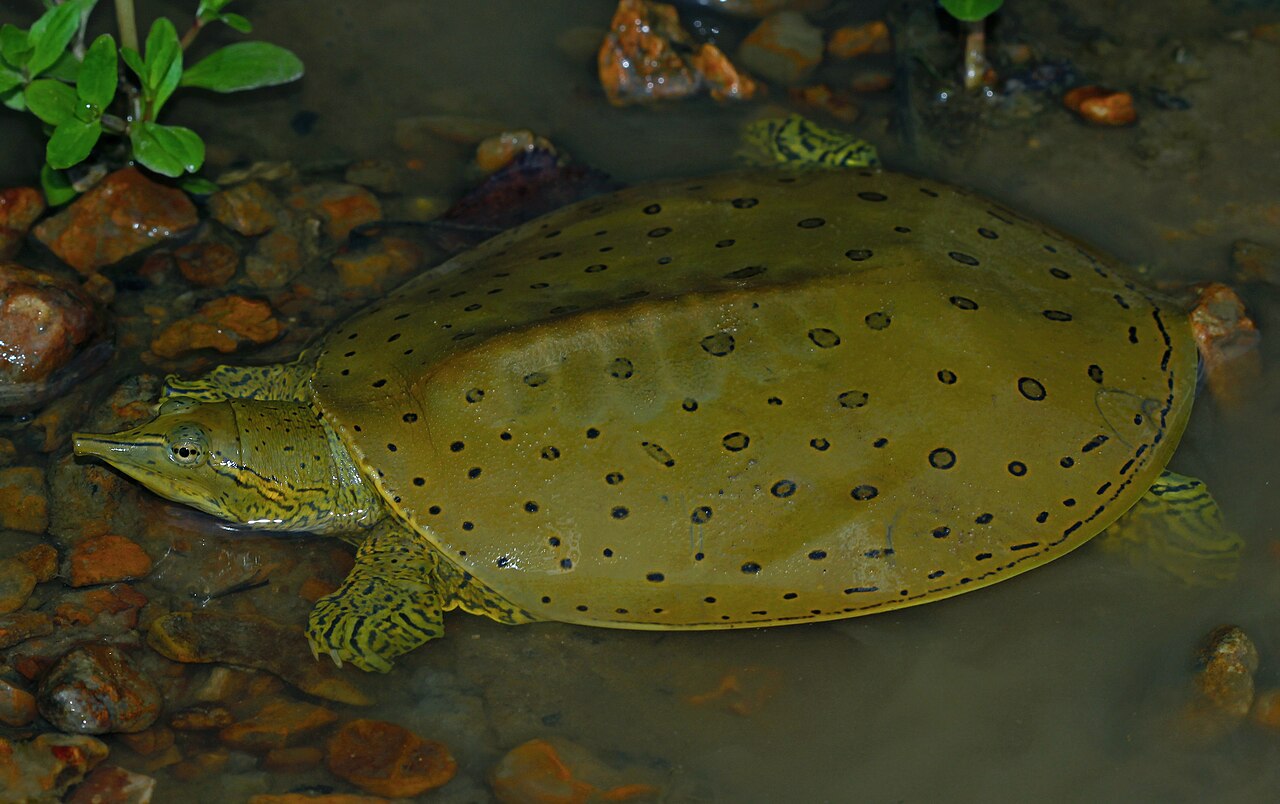
The shell gives it away first. Instead of hard scutes, the spiny softshell wears a flexible, leathery carapace that feels like wet rubber and flexes at the edges. Along the front rim, above the neck, sit the small conical tubercles that give the species its name; they are easiest to feel on large females. The snout ends in a flexible tube with a septum ridge inside each nostril, and the feet are broad, webbed, and clawed.
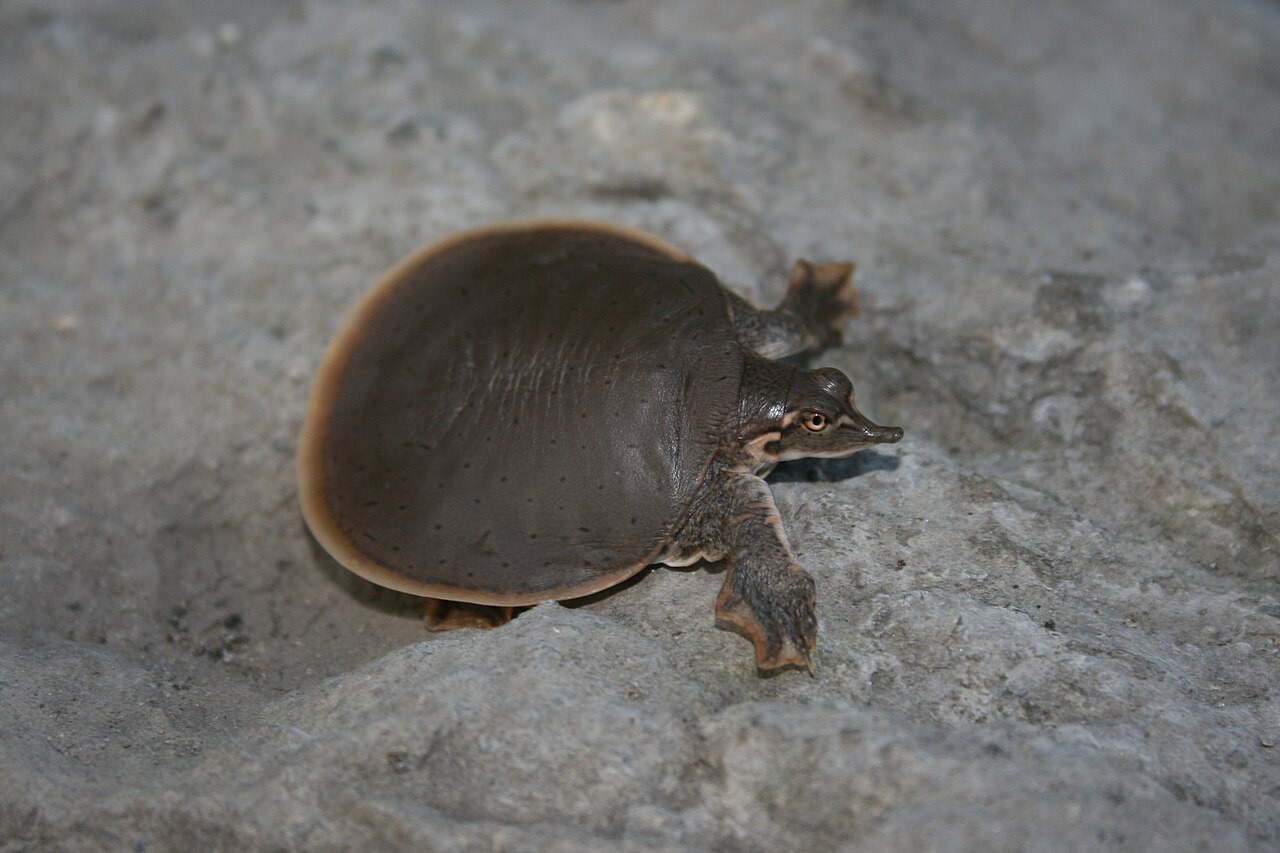
Color runs olive to tan with dark spots or ocelli that fade with age, and a pale line bordered in black runs back from the eye. A hatchling looks like a patterned coin. Compared to a painted turtle or a high-domed box turtle, nothing about the outline is rigid.
Where Spiny Softshell Turtles Live
This is a river turtle above all. It favors the Mississippi and Missouri drainages, the Great Lakes, and coastal rivers of the Gulf, and it has been introduced well outside that range in the Southwest. Sandbars, slow current, and a sandy or silty bottom matter more than water clarity, because the turtle spends much of the day buried with only its head exposed.
Basking happens on open banks and logs, but the animal slides off at the first vibration. In the northern part of the range it overwinters buried in bottom sediment, the same strategy discussed in whether turtles hibernate.
What Do Spiny Softshell Turtles Eat?
Spiny softshell turtles eat mostly crayfish and aquatic insects, with small fish, tadpoles, and mollusks making up the rest. They hunt two ways: ambush from a shallow burial, with the neck shooting out at anything that drifts close, and active foraging along undercut banks. Plant material shows up in stomach contents but appears to be incidental.
Long jaws and sharp cutting edges hidden under fleshy lips handle hard prey easily. That same equipment is the reason handling ends badly, and it separates them from the plant-heavy diet of many eastern mud turtles.
Are Soft Shell Turtles Aggressive, and Is It Safe to Pick Up a Softshell Turtle?
Softshell turtles are not aggressive in the water, where the reflex is always to flee and bury. Out of the water they are a different animal. The neck reaches roughly two thirds of the way back along the shell, so a grip anywhere near the sides is within range of the jaws, and the claws rake hard.
It is not safe to pick up a softshell turtle casually. If one must be moved off a road, hold the rear edge of the carapace with both hands, keep it low, and set it down facing the direction it was already heading. The bite is not venomous, but it cuts and it carries a real infection risk. A larger softshell turtle is better left alone entirely.
How Rare Is a Spiny Softshell Turtle, and How Long Do They Live?
Rangewide the species is common and listed as Least Concern, yet it is genuinely rare at the edges. Vermont, Massachusetts, and several Canadian provinces treat their populations as threatened or of special concern, because the turtle depends on undisturbed sand nesting banks that dams and riprap remove. A sighting feels rare mostly because the animal is almost invisible when buried.
Females can live around 50 years and mature slowly, at 8 to 10 years; males mature earlier and live 25 to 30 years. That slow schedule is why losing adult females to boat strikes or fishing bycatch hurts a population for decades. State summaries from wildlife agencies and university herpetology programs such as the Savannah River Ecology Laboratory track those local trends.
Frequently Asked Questions
Are spiny softshell turtles friendly?
No. They are shy rather than hostile, but they do not tolerate handling and will bite, scratch, and thrash when restrained. In captivity some individuals learn to associate a keeper with food, which looks like friendliness. Treat every wild spiny softshell as an animal that wants distance, not contact.
Can softshell turtles survive out of water?
Only briefly. Softshells absorb some oxygen through the skin and the lining of the throat, which lets them stay submerged for long periods, but the reverse is not true. The leathery shell dries and cracks in sun and wind, so a stranded turtle in hot weather is in serious trouble within hours.
Is it illegal to harvest softshell turtles in Florida?
Florida prohibits the commercial harvest of freshwater turtles and bans taking softshell turtles from the wild during the nesting season, with tight limits the rest of the year. Rules change, so check the current Florida Fish and Wildlife Conservation Commission regulations before keeping any turtle you find.
Can turtles hear you when you talk to them?
Yes, within limits. Turtles have no external ears but detect low-frequency sound and vibration through a bone-and-membrane system under the skin. A spiny softshell notices footsteps on a bank long before it notices a voice, which is why basking animals vanish before you see them.