Leatherback Sea Turtle: The 2,019 Pound Turtle That Eats Only Jellyfish
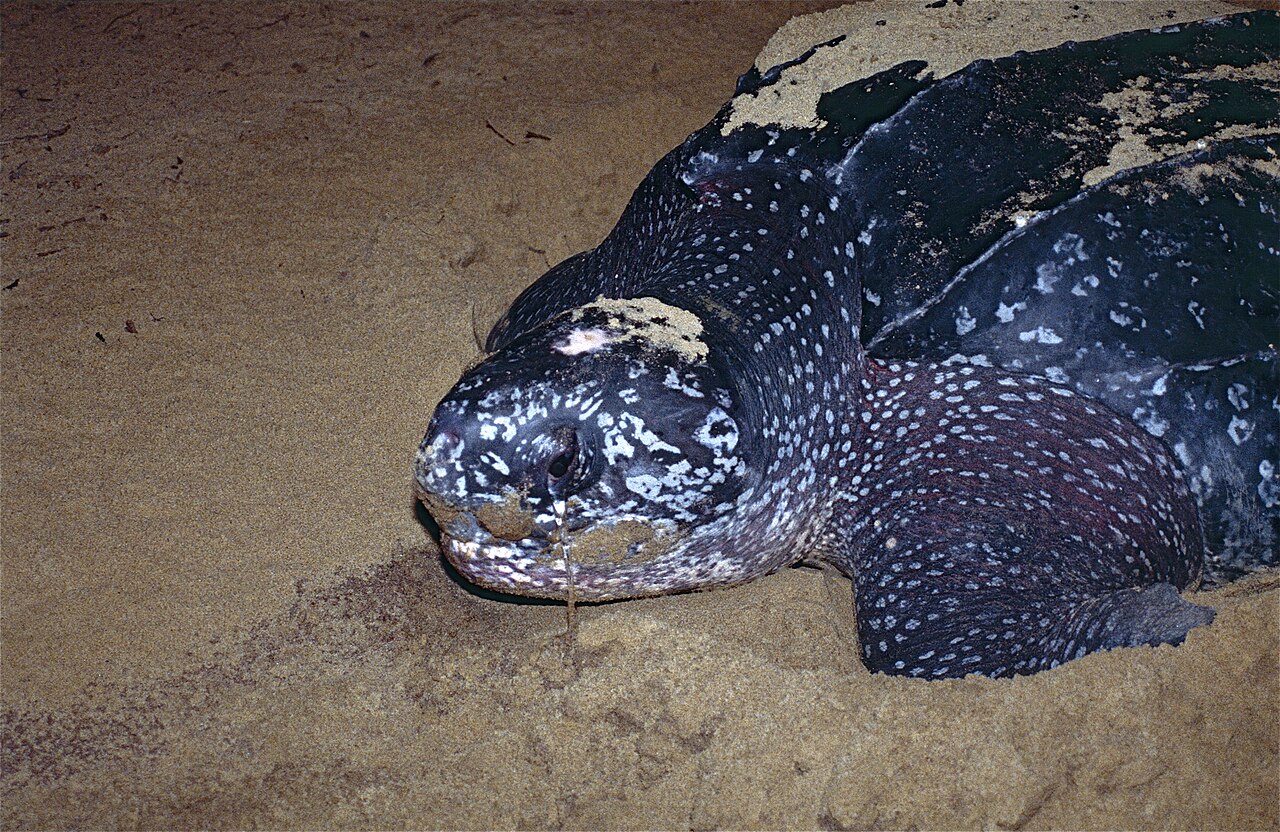
The leatherback sea turtle (Dermochelys coriacea) is the largest turtle on earth and the only one with no hard shell. The record animal, washed up on a beach in Harlech, Wales in 1988, measured 8.5 ft (2.6 m) from nose to tail and weighed 2,019 lbs (916 kg), which is heavier than most bulls. It survives on a diet of jellyfish, dives deeper than a sperm whale routinely goes, and swims from tropical nesting beaches to waters off Newfoundland and Norway.
That combination makes it the strangest reptile in the ocean and one of the most endangered. Two Pacific populations have collapsed by more than 90 percent since the 1980s. Here is what a leatherback is, how big it gets, what it eats, how long it lives, and what is killing it.
The leatherback sea turtle is the world’s largest turtle, reaching 6 to 7 ft (1.8 to 2.1 m) in shell length and 550 to 1,500 lbs (250 to 680 kg). Instead of a bony shell it has a leathery, ridged carapace. It eats almost nothing but jellyfish and dives over 3,000 ft (900 m).
| Quick facts | Leatherback sea turtle |
|---|---|
| Scientific name | Dermochelys coriacea |
| Shell length | 4 to 7 ft (1.2 to 2.1 m) |
| Weight | 550 to 1,500 lbs (250 to 680 kg) |
| Record size | 8.5 ft, 2,019 lbs (Wales, 1988) |
| Diet | Jellyfish, salps, siphonophores |
| Max dive | About 4,200 ft (1,280 m) |
| Status | Vulnerable globally, two subpopulations critically endangered |
What Is a Leatherback Sea Turtle?
A leatherback is the last surviving member of the family Dermochelyidae, a line that split from all other sea turtles roughly 100 million years ago. Every other living sea turtle sits in one family, Cheloniidae, with a shell of fused bony plates covered in horny scutes. The leatherback abandoned that design.
Its carapace is a mosaic of thousands of small bones embedded in oily, rubbery skin, crossed by seven long ridges that run from neck to tail and end in a point. The effect is a teardrop hull rather than a dome, dark slate-blue to black and speckled with white. A hatchling is covered in tiny bead-like scales that it loses within weeks.
The head carries no crushing beak. The upper jaw ends in two sharp cusps shaped to bite through soft tissue, and the throat is lined with hundreds of backward-pointing spines that stop slippery prey from escaping. Nothing about the animal makes sense until you know what it eats. Compare the classic armored build of the green sea turtle to see how far the leatherback diverged.
How Big Do Leatherback Sea Turtles Get?

An adult leatherback usually measures 4 to 6 ft (1.2 to 1.8 m) in curved carapace length and weighs 550 to 1,500 lbs (250 to 680 kg). Front flippers span up to 9 ft (2.7 m) tip to tip, the widest of any turtle and proportionally longer than in any other sea turtle.
Pacific leatherbacks run smaller than Atlantic ones, averaging closer to 700 lbs (320 kg) against roughly 900 lbs (410 kg) for nesting females in the Caribbean. Males are a shade longer in the tail and never come ashore, so almost every measurement in the literature comes from a female on a nesting beach or a stranded carcass.
What Is the Largest Leatherback Sea Turtle Ever Recorded?

The largest leatherback sea turtle on record is the male found dead on the beach at Harlech, Wales on 23 September 1988, after drowning in fishing lines. It was 9.5 ft (2.9 m) long overall including flippers, with a carapace of about 6.5 ft (2 m), and it weighed 2,019 lbs (916 kg). The specimen is still on display at the National Museum Cardiff.
Claims above that figure circulate online and none of them hold up. A 2,000 lb animal is exceptional; fewer than a handful have ever been weighed above 1,500 lbs. Treat any “3,000 pound leatherback” as a story rather than a measurement.
Why Leatherbacks Have No Shell

The soft carapace is what lets the animal dive. A rigid bony shell cannot compress, and at 3,000 ft the pressure is roughly 90 atmospheres. A flexible shell folds slightly, the lungs collapse without damage, and the turtle keeps going down. Leatherbacks have been recorded to about 4,200 ft (1,280 m), deeper than any other reptile.
The trade-off is protection. A leatherback cannot pull its head or flippers in and has no armor against a bite, which is why adults carry shark scars and missing flipper edges as a matter of course. It relies on size instead.
Softness alone is not unique. Freshwater softshells made the same bargain on a smaller scale, trading bony plates for a pliable skin-covered carapace, as the Florida softshell turtle shows. The difference is scale and purpose: a softshell gains speed in shallow water, a leatherback gains depth in the open ocean. The ridges on its back are not decoration either. Flow tank work indicates they channel water along the hull and cut drag, part of why a leatherback has been clocked at 21.9 mph (35.3 km/h), the fastest recorded speed for any reptile.
Where Do Leatherback Sea Turtles Live?
Leatherbacks have the widest range of any reptile on earth. They nest on tropical and subtropical beaches, then feed in cold temperate water: off Nova Scotia and Newfoundland in the west Atlantic, off Norway and the British Isles in the east, and north to Alaska in the Pacific. No other turtle regularly enters water below 50 F (10 C).
They manage it through gigantothermy. Sheer bulk, a thick oily insulating layer, countercurrent heat exchangers in the flippers and a high metabolic rate let an adult hold its core temperature up to 18 F (10 C) above the surrounding water. Unlike freshwater species that shut down for winter, a leatherback simply swims out of the cold; if you want the contrast, read how turtles hibernate.
Migrations are enormous. Satellite-tagged animals have crossed the Pacific from Indonesia to the US West Coast, a journey of more than 10,000 miles (16,000 km), and Atlantic turtles routinely cover 4,000 miles between nesting and feeding grounds.
What Do Leatherback Sea Turtles Eat?
Almost entirely jellyfish and other gelatinous drifters: moon jellies (Aurelia aurita), sea nettles (Chrysaora), the purple-striped mauve stinger (Pelagia noctiluca), plus salps and siphonophores including the Portuguese man o’ war. Lion’s mane jellyfish, the largest species in the Atlantic, are a favorite off Canada.
Jellyfish are around 95 percent water, so the volume required is extreme. Estimates put daily intake at 73 percent of the turtle’s own body mass, which for a 1,000 lb adult means several hundred pounds of jellyfish every day and roughly three times its energy needs. The backward-pointing throat spines exist for exactly this task.
What Is Inside a Leatherback Sea Turtle’s Mouth?
A forest of spines. The mouth, throat and esophagus of a leatherback are lined with hundreds of stiff, backward-pointing keratin papillae, the longest of them several inches, all angled down the gullet. Photographs of an open leatherback mouth circulate online every few years labeled as fake or as a deep sea monster. They are neither; that is what the inside of the animal looks like.
The structure solves a specific problem. Jellyfish are slick and nearly weightless, so the turtle gulps a mouthful of prey and seawater, then pushes the water back out while the papillae hold the solids in place. There are no teeth anywhere in the jaw, only the two sharp cusps on the upper beak that shear the bell.
The same anatomy is a death trap in a polluted ocean. Once a plastic bag or a balloon fragment passes the papillae it cannot be regurgitated, and autopsies regularly find gut blockages from a single bag. One review of necropsied leatherbacks found plastic in about one in three animals examined.
How Strong Is a Leatherback Sea Turtle Bite?
Weak, and deliberately so. No published study has measured leatherback bite force, because there is nothing in its diet worth measuring against. The jaw is built as a pair of shears for slicing through a jellyfish bell, not as a crusher; the cusps are sharp but the muscle mass behind them is modest compared with a loggerhead, which can shatter conch shells.
That said, the jaws are edged like a blade and an adult weighs as much as a small car. Handlers on nesting beaches are far more wary of a flipper stroke, which can break a human arm, than of the mouth.
Are Leatherback Turtles Friendly?
Leatherbacks are indifferent rather than friendly. Divers who encounter one report an animal that registers their presence and keeps swimming, with no interest in contact and no defensive display. There is no record of an unprovoked leatherback attacking a person in the water.
They are still wild animals protected under the US Endangered Species Act, so touching, riding or chasing one is a federal offense. A nesting female in the middle of laying will tolerate almost anything, which is precisely why crowding her is illegal.
How Long Do Leatherback Turtles Live?
Nobody knows exactly. Leatherbacks lack the bone growth rings that let researchers age other sea turtles, so estimates come from growth rates and skeletal analysis: most put lifespan at 45 to 50 years, with some work suggesting individuals reach far higher. Sexual maturity arrives somewhere between 9 and 16 years, earlier than in other sea turtles.
Turtles famous for passing 100 years are land species, above all the Galapagos and Aldabra giant tortoises, and some freshwater turtles get remarkably close. Leatherbacks live fast by comparison, growing quicker and maturing sooner than any other sea turtle.
Nesting and Hatchlings
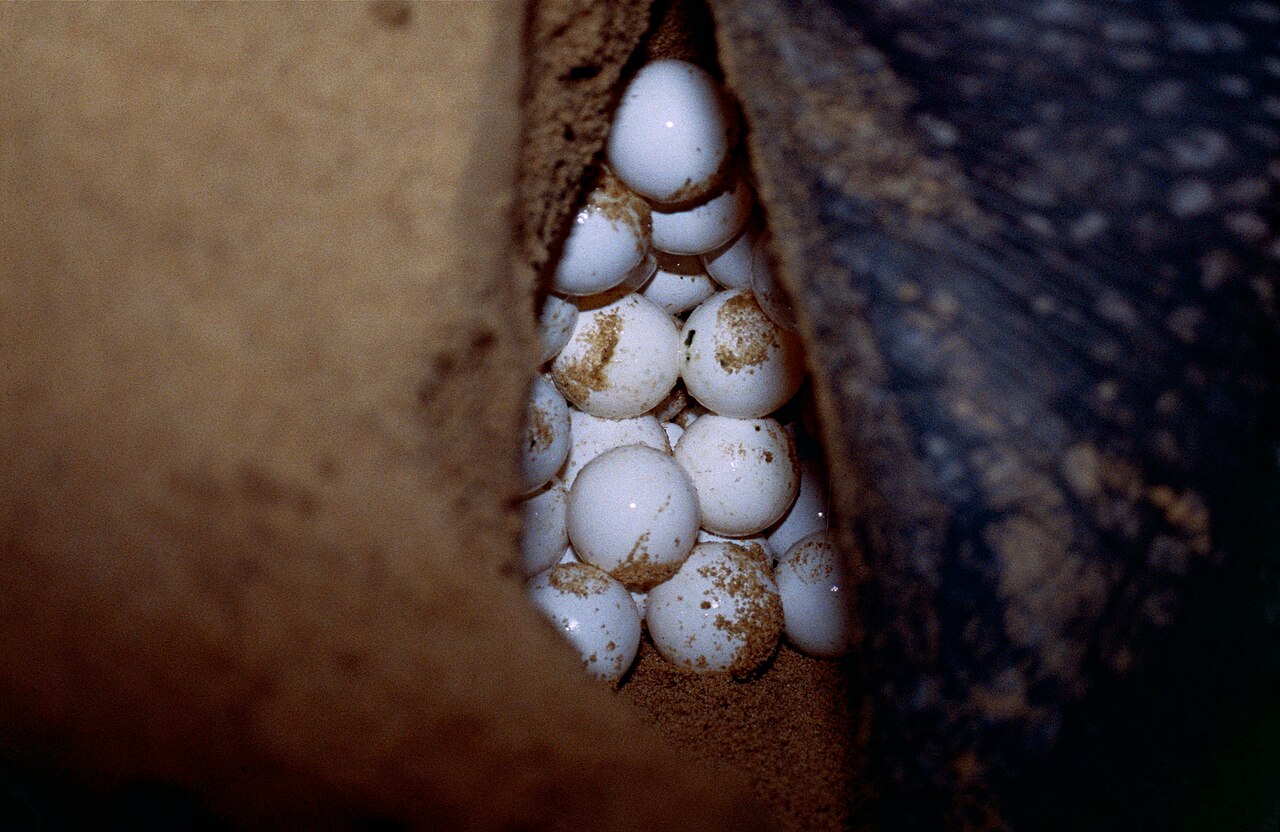
Females return to the region where they hatched every 2 to 3 years, then nest 5 to 7 times in a single season at roughly 10 day intervals. Each clutch holds about 80 fertile eggs the size of billiard balls, topped with a layer of smaller yolkless eggs whose purpose is still argued over.
Incubation runs 60 to 70 days, and sand temperature sets the sex of the hatchlings: cooler nests produce males, warmer nests females, with the pivot near 85 F (29.5 C). Hatchlings emerge at about 2.4 in (6 cm), and the standard estimate is that only one in a thousand reaches adulthood. Our guide to the baby sea turtle covers those first hours in detail.
What Eats Leatherback Sea Turtles?
An adult has few predators. Killer whales, great white sharks and tiger sharks account for most confirmed attacks, and even those usually end with the turtle escaping minus part of a flipper. Size is the defense.
Eggs and hatchlings are another matter. Ghost crabs, raccoons, coatis, feral dogs and pigs dig out nests, frigatebirds and gulls take hatchlings on the sand, and once in the water the survivors run a gauntlet of jacks, groupers and sharks. Many of the same nest raiders hit freshwater species too, from the western painted turtle to the map turtle.
How Many Leatherback Turtles Are Left?
Roughly 34,000 to 36,000 nesting females worldwide, a number that hides two very different stories. The Northwest Atlantic population is comparatively stable, with Trinidad, Gabon and Suriname still hosting large nesting beaches. The Pacific has crashed.
The Western Pacific subpopulation is down to around 1,400 nesting females and the East Pacific to a few hundred, both listed as critically endangered by the IUCN, with declines above 90 percent since 1980. Fisheries bycatch in gillnets and longlines is the leading cause, followed by egg harvest, coastal development, vessel strikes and plastic bags mistaken for jellyfish. The species account at NOAA Fisheries tracks the current recovery plan.
Is It Rare to See a Leatherback Sea Turtle?
Yes, and not only because the numbers are low. Leatherbacks spend their lives in the open ocean, surfacing briefly, and only females come ashore. Most people who see one see a nesting female at night on a beach in Trinidad, Costa Rica or Florida, or a dark ridged back from a boat off Cape Cod or Monterey Bay in late summer when jellyfish swarm.
In the continental US, nesting is concentrated on Florida’s southeast coast, where a few hundred nests are laid each year, with scattered records north to North Carolina. Permitted turtle walks run by state and nonprofit programs are the only legal way to watch one lay.
Frequently Asked Questions
What are 10 interesting facts about leatherback sea turtles?
They are the largest turtles alive, the deepest-diving reptiles, the fastest swimmers among turtles at 22 mph, the only sea turtle without a hard shell, the widest-ranging reptile on earth, warm-bodied through gigantothermy, jellyfish specialists eating 73 percent of their weight daily, throat-spined, 100 million years old as a lineage, and down to about 34,000 nesting females.
How many years does a leatherback turtle live?
Most estimates land at 45 to 50 years, though the figure is genuinely uncertain because leatherback bone does not preserve countable growth layers. They mature faster than other sea turtles, at roughly 9 to 16 years, and grow more quickly, which suggests a shorter life than the 60 to 70 years often quoted for green turtles.
What turtle can live 100 years?
Land tortoises, not sea turtles. Galapagos and Aldabra giant tortoises regularly pass 100 years, and Jonathan, an Aldabra tortoise on Saint Helena, is over 190. Among freshwater species, Blanding’s turtles and some snapping turtles reach 75 or more. No leatherback has ever been documented at a century.
Are leatherback sea turtles dangerous to people?
No. There is no record of a leatherback biting a swimmer or diver unprovoked, and the jaws are built for jellyfish, not defense. The real hazard is mechanical: an alarmed adult throws its front flippers hard enough to break bones, so beach volunteers work from behind the animal and never straddle it.
Do leatherback turtles have a shell at all?
They do, but it is nothing like the shell of other turtles. Thousands of small interlocking bones called osteoderms sit inside a thick layer of oily, leathery skin, forming a flexible carapace with seven raised ridges. It compresses under pressure at depth, which is exactly why the animal can dive below 3,000 ft.
Why are leatherback sea turtles endangered?
Bycatch in commercial gillnet and longline fisheries kills more adults than anything else. Add egg poaching on unprotected beaches, coastal lighting that sends hatchlings away from the sea, beach armoring that removes nesting habitat, vessel strikes, and ingestion of plastic bags and balloons that look like jellyfish. Adults die faster than the slow reproductive cycle can replace them.